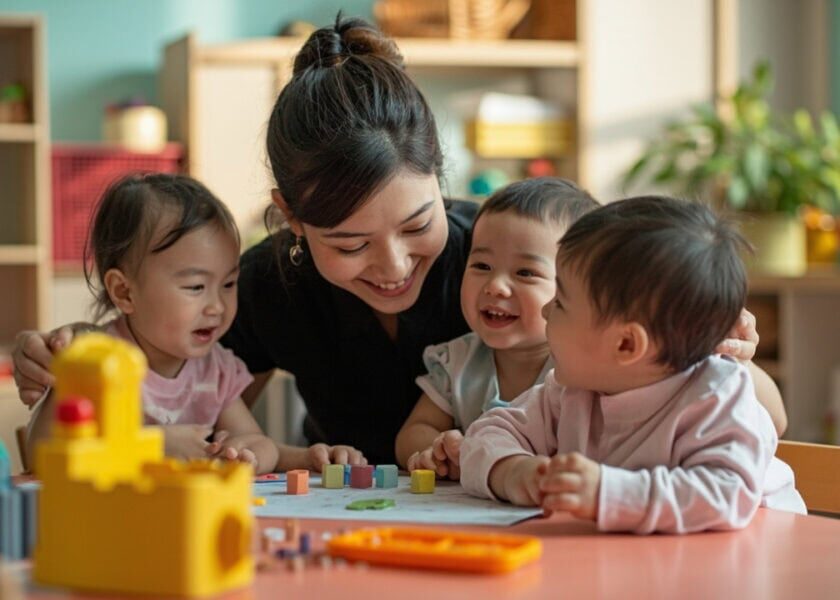
The Choice Singaporean Parents Make When Family Is Not the Answer
The Question Singaporean Parents Don’t Ask Out Loud
There is a question that hangs in the air at many Singaporean dinner tables, in the pauses between conversations, in the text messages that parents do not send and the ones they agonise over for hours before finally hitting delete. It is a question that is rarely asked out loud, and even more rarely answered honestly. But it is always there, sitting beneath the surface of one of the most consequential decisions a Singapore parent will ever make.
The question is this: Are you giving up?
Not on your career. Not on your ambitions. Not on your marriage or your social life or the version of yourself that existed before your child arrived. You know, in the daylight hours, that those trade-offs are real but manageable. What keeps you awake at night is something far more specific, and far more Singaporean than that.
Are you giving up on your family? On the grandparents who raised you, who flew across the Causeway or drove in from Jurong, who said without hesitation, “We will help”? On the ones whose arms are open, whose schedules are flexible, whose love for your child is fierce and uncomplicated and free?
If this question has ever lived in your chest, you are not alone. You are not weak. You are not a bad parent. You are simply a Singapore parent, standing at one of the most complex crossroads modern parenting has to offer. And what you are feeling is not a sign that you are making the wrong choice. It is a sign that you are feeling something deeply true about what it means to raise a child in a country where family is not just a value, but a structure, a culture, a compass.
Why This Decision Weighs So Heavily in Singapore
Singapore has one of the highest rates of grandparent involvement in early childhood care anywhere in the world. This is not an accident. It is the result of something genuinely beautiful: a society where grandparents and grandchildren have historically lived in close proximity, where elder wisdom has been genuinely valued, where the extended family has functioned as a safety net so tightly woven that it has become invisible.
It is the fabric of how we have always done things.
And because this is how we have always done things, choosing differently carries a weight that parents in other countries simply do not feel. When a Singaporean parent considers professional childcare, they are not simply weighing logistics. They are navigating an entire emotional ecosystem.
They are thinking about what their own mother will say. What their mother-in-law will imply at Chinese New Year. What the aunties at the playground will whisper when they see grandma not on duty. They are asking themselves whether saying yes to a childcare programme feels like saying no to everything their parents sacrificed to raise them.
The Guilt Is Not About the Childcare
Here is the truth that needs to be said plainly: the guilt is not about the childcare itself. The guilt is about the comparison. The unspoken hierarchy that suggests family care is noble and professional care is a concession.
That grandparents are the default and everyone else is the backup plan. That if you choose the backup plan, you are somehow less grateful, less committed, less loyal to the family that made you.
I want to say something clearly: this hierarchy is a lie. Not a malicious one. Not an intentional one. But a lie nonetheless, and one that does tremendous damage to parents who are simply trying to make the best decisions they can for their children and their families.
Reframing the Choice: What Professional Care Actually Looks Like
Some of the most thoughtful, intentional, researched parenting decisions I have ever witnessed have come from Singapore parents who chose professional care. These are parents who spent months visiting centres, interviewing caregivers, reading about developmental psychology, weighing every variable, and feeling the full weight of family expectations before they made their choice.
They chose professional care not because they had to, but because after careful, loving consideration, they believed it was the right fit for their child and their family.
That is not failure. That is not giving up. That is the exact opposite of giving up. That is showing up, fully and consciously, for one of the most important responsibilities you will ever hold.
We are living through a moment in Singapore that has never existed before. A growing number of parents—educated, reflective, deeply invested in their children’s futures—are making choices that their own parents did not make, or could not make, or were never offered.
This is not a rejection of tradition. This is an evolution of it.
The new generation of Singapore parents understands something that the previous generation did not always have the language or the resources to articulate: that children are not just loved into thriving. They are developed into it. And development requires more than warmth and proximity. It requires intentionality. It requires environments designed for growth.
What Quality Childminding Actually Looks Like
Most grandparents are extraordinary caregivers in the ways that matter most: they love fiercely, they are present, they give of themselves without reservation. But love alone, even love that spans generations, is not a pedagogical framework.
As we learn more about the critical importance of the early years—how the brain builds its architecture in the first thousand days, how attachment patterns form before children can speak, how the foundations of emotional regulation and cognitive flexibility are laid in infancy and toddlerhood—we owe it to our children to ask harder questions than simply who is available.
When evaluating any childcare arrangement, these are the questions that matter most:
- Is my child receiving responsive, attentive care from consistent caregivers?
- Is this environment designed to support my child’s developmental needs?
- Do the caregivers have training and understanding of infant development?
- Is my child’s individual schedule, needs, and cues being respected?
- Will my child thrive here—not just be supervised, but genuinely develop?
These are not questions that can be answered by proximity alone, or by love alone, however genuine those things are. They are questions about fit, about intentionality, and about what your child actually needs to become who they are meant to be.
Navigating Family Expectations With Honesty
Making a decision that differs from family expectation is not simple. It requires clarity about your own values, confidence in your own judgment, and the emotional strength to hold a different course than the one your parents may have envisioned for you.
The expectations that surround childcare in Singapore are not just about logistics. They are about identity. Grandparents in Singapore often derive deep meaning and purpose from their role in their grandchildren’s lives. Being asked to step back, or being gently declined when offering to help, can feel like a diminishment. Like a rejection of their value. Like a suggestion that they are no longer needed.
But I also want to offer a different perspective: the most generous thing you can do for a grandparent is to let them be a grandparent. To give them the role without the responsibility. To allow them to show up with toys and sing songs and spoil your child on weekends, without the weight of daily caregiving, without the stress of nap schedules and feeding battles and the relentless demands of infant care.
To let their relationship be about presence and joy and legacy, not about performance and obligation.
The families who navigate this tension most gracefully are the ones who reframe the conversation early: who say, not as a rejection but as a gift, we want you in our grandchildren’s lives in this way, not that way. Who understand that protecting the grandparent-grandchild bond sometimes means protecting it from the strain of full-time caregiving.
Choosing quality professional care is not to replace your parents. It is to preserve what is most precious about your parents’ role in your children’s lives.
EduNanny: A Thoughtful Singaporean Approach to This Singaporean Question
There is a place for parents who have made this considered choice. Who have weighed the options, felt the weight of family expectations, and concluded that professional care is the right fit for their child and their family. Who deserve a programme that understands what they have been through, and holds their decision with the respect it deserves.
EduNanny by BUTLER exists in a space that was designed precisely for parents like you.
It is part of an ECDA Childminding Pilot, which means it operates within a framework that is structured, accountable, and built for Singapore’s specific context. It is not a foreign model imported wholesale from somewhere else. It is a Singaporean solution, built by people who understand Singapore’s family structures, Singapore’s cultural expectations, and the particular pressures that Singapore parents navigate.
Two Pathways, One Standard of Quality
EduNanny offers both home-based and community or centre-based pathways, because families are not all the same, and neither are their needs. For some families, a trusted caregiver in the home provides the continuity and comfort that children thrive on. For others, a community setting offers rich social environments and the structure that young children benefit from. Both pathways are held to the same standard of quality. Both are designed with infant wellbeing at the centre.
What EduNanny Provides
- Staff-to-infant ratios that ensure every child receives responsive, attentive care
- Monday to Friday care blocks designed around the rhythms of working families
- CDA and Baby Bonus usability, so financial logistics do not become an additional source of stress
- Affordable fee structures within the pilot programme, because quality should not be the exclusive domain of families with unlimited resources
Trust Through Transparency
Communication matters to parents in a way that childcare providers often overlook. EduNanny operates with transparency as a core principle. Where deployed, communication measures and CCTV provisions are in place—not because there is any expectation of wrongdoing, but because trust is built through openness.
Because parents who feel informed feel calm. Because a parent who knows what is happening with their child during the day is a parent who can focus at work, sleep at night, and show up fully when they pick their child up at the end of the day.
The gap between parent and caregiver shrinks when communication flows freely. And that gap is where anxiety lives.
You Are Ready to Make This Decision
Here is a question I want you to carry with you as you think about this decision: What do you want your child’s first thousand days to look like?
Not in terms of logistics. Not in terms of who is holding them for the eight hours while you are at work. But in terms of what they are experiencing. The quality of their environment. The richness of their interactions. The way their brain is being shaped, day by day, by everything they encounter.
Because that is what is actually at stake here. Not your guilt. Not your in-laws’ expectations. Not the comparison between family care and professional care.
What is at stake is the environment in which your child’s brain builds its capacity for connection, for learning, for resilience, for joy. That environment matters more than any other variable in the equation.
Creating that environment—intentionally, thoughtfully, with full awareness of what you are choosing and why—is not a compromise. It is one of the most loving acts of parenting you will ever perform.
If guilt has been your constant companion through this decision, I want to offer you permission to set it down. Not because your parents’ sacrifices do not matter. Not because your family’s love is not real. But because choosing what is right for your child—after careful thought, after deep consideration, after weighing everything you know about development and everything you know about your family—is not a failure.
It is wisdom. It is courage. It is the kind of parenting that the next generation deserves.
There is a place for you. For your child. For your family, in whatever form it takes. A place where quality and care and cultural understanding sit together. Where your child is held by people who believe that the early years are not just a phase to be survived, but a foundation to be built.
Where you are not judged, not compared, not made to feel small for making a decision that took courage.
The choice you are making—the one that keeps you up at night, the one you have not quite told your mother about, the one that feels both right and terrifying—is not a compromise. It is a declaration. A statement about who you are as a parent and what you believe your child deserves.
It is one of the bravest things you will do.
And the first thousand days are calling. Your child is ready. And so, I believe, are you.
Whether you are just beginning to explore your options or are ready to take the next step, EduNanny by BUTLER is here to listen, answer your questions, and walk this path alongside you. Because every family deserves childcare that feels like the right fit—not just logistically, but in their bones.
Get in touch to learn more about how EduNanny supports Singapore families with care, thoughtfulness, and genuine understanding.