The Evolution of Love: Singapore’s New Approach to Childcare
The Sea of Inherited Wisdom
The generational inheritance of childcare beliefs is one of the most powerful and least examined forces in Singapore parenting. From the moment a child is born, parents are swimming in a sea of inherited wisdom:
- Breast is best.
- Cry it out is cruel.
- Co-sleeping creates dependency.
- Grandparents know best.
- Modern parents overthink everything.
- You must sacrifice everything for your child.
- Trust your instincts.
- But also read the research.
- Be present. Be productive. Be calm. Be everything.
And underneath all of this noise, there is the quiet, insistent voice of your own upbringing. The way your mother held you. The way your grandmother spoke about children. The unspoken beliefs about who should care for infants, about whether love can be delegated, about what it means to truly be devoted to your child.
These beliefs are not wrong. Many of them contain profound wisdom. But wisdom, like love, evolves. And what served one generation does not always serve the next, not because the love was insufficient, but because the world has changed, and the children we are raising are living in a different context than the one we grew up in.
The World Your Child Is Growing Into
Consider what that context looks like today. Singapore is one of the most dynamic, demanding, and expensive cities in the world. The cost of raising a child here is not theoretical; it is a concrete reality that families navigate every single month.
Many parents are working not out of ambition alone, but out of necessity. The mortgage does not pause for parenthood. The HDB loan does not forgive missed payments. The CCAs and enrichment classes and medical appointments and the sheer infrastructure of raising a child in Singapore require resources that two incomes, more often than not, barely cover.
And even beyond the financial, there is the psychological reality of modern parenting. We know more than any generation before us about early childhood development. We know about attachment and brain development and the critical importance of the first thousand days. We know that what happens in the earliest years shapes not just a child’s immediate wellbeing but their capacity for relationships, for learning, for resilience, for the rest of their lives. We know this, and the knowledge sits in us like a sacred responsibility.
The village that once surrounded Singapore families has dispersed. Extended family networks are smaller, more stretched, more geographically scattered. The auntie next door who once helped with childcare has moved to a condo in the east. The grandmother who could have watched the baby is still working, or has health considerations, or lives across the Causeway.
The traditional village of Singapore parenting has had to evolve, and with it, so has our understanding of what it means to raise a child well.
Where the Tension Lives
This is where the tension lives. In the space between what we were taught about parenting and what we now understand about it. In the gap between the inherited belief that family alone should raise children and the modern reality that many families cannot raise children that way, not because they do not want to, but because the architecture of their lives has changed.
It is the tension between the belief that love means doing it all yourself and the knowledge that love sometimes means finding the right support so that you can be the parent you want to be.
It is not about dismissing the wisdom of elders. It is not about saying that grandparents are wrong, or that traditional Singapore childcare is somehow inferior. It is about recognizing that wisdom can be inherited without being imprisoned by it. That honoring your parents does not mean replicating their exact choices.
Your mother raised you with love. But she also raised you in a world that was different. She raised you when a single income could support a family, when HDB flats were more affordable, when the expectations for children’s enrichment were not what they are today. She raised you with the resources and constraints of her time, just as you are raising your child with the resources and constraints of yours.
This is not judgment. It is simply truth. And truth, spoken with kindness, can be a kind of freedom.
The Conversation That Does Not Happen
Let me tell you a story. It is not one particular story, but a composite of countless conversations I have had with parents across Singapore, in playgrounds and coffee shops, in living rooms and during late-night calls, in the quiet aftermath of decisions that felt much larger than they appeared on the surface.
A young mother sits across from her own mother at the dining table. Her mother is visiting, as she does every weekend, and she has noticed things. She has noticed that her daughter has returned to work. She has noticed the arrangement that has been made, the professional caregiver who comes to the home each morning, the woman her daughter speaks about with warmth and genuine trust. And now, over tea, she is asking questions. Not unkindly. Not with malice. But with the weight of a lifetime of belief behind her words.
Why do you need someone else to look after your child? Did we not do this ourselves? Did your father and I not raise four children, all healthy, all successful, without any of this?
The young mother opens her mouth to answer, and the words that come out are not the words she practiced in the shower that morning. They are softer, more uncertain. She says something about needing to work, about the cost of living, about wanting her daughter to have the best start. And her mother nods, accepts the answer, but something remains unspoken between them. A question that hovers in the air like steam over a kettle. A question that sounds something like: Are you sure this is about giving her the best start? Or is it about your own ambitions? Your own convenience?
This is the conversation that does not happen fully in many Singapore families, because the stakes feel too high. Because to answer that question truthfully would mean explaining something that is difficult to articulate: that this decision, this terrifying, beautiful, expensive, necessary decision to welcome someone else into the intimate world of raising your child, is not a departure from love. It is an evolution of it.
What Professional Childcare Is Not
There is another truth I want to speak, because I think it is one of the most important and least acknowledged realities of modern parenting.
The decision to welcome a professional caregiver into your child’s life is not a decision made lightly. It is not a decision made by parents who do not love their children enough. It is made by parents who love their children so much that they are willing to examine their own beliefs, to challenge inherited assumptions, to look at the evidence, to do the research, to ask the hard questions, and to make a choice that serves their child’s future even when that choice feels uncomfortable in the present.
This is not convenience. I want to say that clearly, because it is one of the most common misreadings of parents who choose professional childcare. It is not about wanting to go back to work as quickly as possible. It is not about prioritizing career over children.
It is about a more complex, more honest understanding of what children actually need: they need parents who are present, yes, but also parents who are stable, parents who are not crushed by financial stress, parents who have room to breathe, parents who can show up emotionally even when they are not showing up physically every single hour of every single day.
Children do not need a parent who is with them constantly. They need a parent who is attuned to them, who is responsive, who is warm, who is consistent. It is not the quantity of time that matters most; it is the quality. And quality time is not possible when a parent is exhausted, overwhelmed, or financially desperate. Quality time is not possible when the stress of trying to do everything alone is eroding the very reserves of patience and presence that parenting requires.
What Quality Childminding Actually Looks Like
The thought of leaving your infant with someone else, of not being there for every moment, of not knowing what is happening when you are not in the room: these fears are not irrational. They are the natural fears of a parent who loves deeply and wants to protect fiercely.
But fear is not a reliable guide. Fear will tell you to do everything yourself, to sacrifice everything, to never let anyone else touch your child. But fear will also exhaust you, isolate you, and ultimately diminish your capacity to be the parent your child needs.
So what does quality care actually look like? It looks like:
- A caregiver who is warm, not just competent. Someone who genuinely delights in the work of nurturing infants.
- A setting where your child is seen, not just supervised. Where they are engaged, not just kept safe.
- Focused attention. In infant care, ratios matter enormously. When your baby is learning to roll, to reach, to babble, they need someone whose attention is not divided between too many children.
- Honest communication. Regular updates, photos, transparency about the day. Not because parents need to be monitored, but because trust is built through openness.
- Developmental intentionality. A caregiver who understands early childhood development, not just supervision.
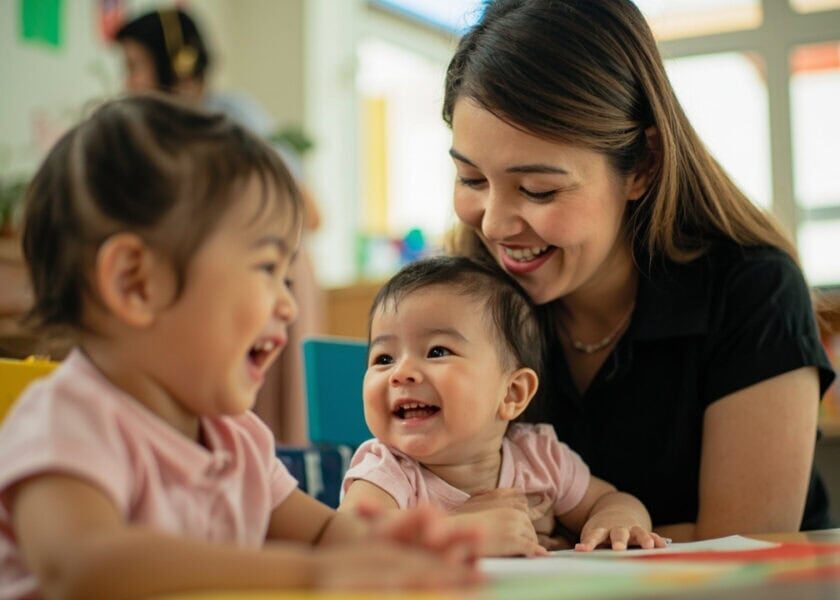
When you find it, something remarkable happens. The guilt begins to dissolve. Not because you have stopped caring about doing the right thing, but because you can see that you are doing the right thing. You are providing your child with a warm, trained, consistent caregiver who loves the work of caring for infants. You are giving your child the gift of early socialization, of developmental support, of a safe environment where they can explore and learn and grow.
An Answer to the Question Singapore Parents Have Been Asking
What EduNanny by BUTLER has been building is a response to the exact tension I have been describing. It is an answer to the question that Singapore parents have been asking, sometimes silently, sometimes desperately: Is there a way to honor both where I came from and where I am going? Is there a way to acknowledge the wisdom of my parents while also trusting my own judgment?
What EduNanny Offers
EduNanny is part of the ECDA Childminding Pilot, a government-supported initiative that recognizes what many parents have known for years: that home-based, professional childcare is not just a valid option but an essential one. The pilot is designed to provide families with access to quality childcare that is flexible, affordable, and rooted in the same ECDA standards that govern the best preschools and kindergartens in Singapore.
One of the most significant features of the EduNanny model is the ratio. In infant care, the ratio of caregivers to children is not a bureaucratic technicality. It is the difference between your child being cared for and being truly attended to. EduNanny maintains ratios of up to one to three infants in their home-based settings.
This means that when your baby is learning to roll, to reach, to babble, there is someone whose attention is not divided between seven other children but focused on the small, crucial moments of your baby’s development. In the first year of life, when the brain is developing faster than it ever will again, this kind of focused attention is developmental fuel.
The affordability of the pilot is also worth noting. Singapore parents should not have to choose between quality and cost. The EduNanny model within the pilot fee structures is designed to be accessible, and families can utilize CDA and Baby Bonus funds to help manage the expense. This matters. The stress of childcare costs is real and it is corrosive. When parents can access quality care without it being a source of constant financial anxiety, they are better parents. Their children benefit. The whole family benefits.
Building Trust Through Transparency
Trust is not built on promises alone. It is built on transparency, on consistency, on the willingness to be seen and evaluated.
EduNanny understands this, which is why communication is woven into the fabric of their model. Parents receive regular updates about their child’s day. In settings where CCTV measures are deployed, parents have the option to stay connected to the caregiving environment in a way that provides genuine peace of mind.
Parents who trust what they can see are parents who can relax, and parents who relax are parents who can be fully present when they are with their children.
The caregivers themselves are trained and supported, working within the framework of the Childminding Pilot, which means they are not just caring for children; they are part of a system designed for quality and accountability. When caregivers are treated as professionals, when they are trained and respected and supported, they bring that professionalism into every interaction with your child. The warmth is not performative. It is the natural byproduct of a person who has been given the tools and the environment to do meaningful work well.
A Word to the Grandparent Generation
If you are a grandmother or grandfather who has been troubled by your own child’s choices, I want to offer you something. Not a dismissal of your concerns, because they come from love, and love should never be dismissed. But an invitation to look at this moment with fresh eyes.
Your children are not rejecting the way you raised them. They are building on it. They are taking the love you gave them and asking how that love can grow to meet the world their children are entering.
The children you raised are now parents themselves. And part of what you gave them, whether you intended to or not, was the capacity to think, to question, to adapt. You raised them to be capable of making decisions. Now they are making them.
The caregivers who work with EduNanny are not replacing grandparents. They are providing a professional service, a bridge between what families need and what the modern world demands. And they do so with the deepest respect for the role that parents and grandparents play in a child’s life.
The best childcare does not compete with family. It supports it. It strengthens it. It gives parents the resources to be more present with their own parents, more capable of honoring the generations that came before, because they are not drowning in the attempt to do everything alone.
Addressing the Real Concerns
Let me speak directly to some of the concerns that often arise when parents are considering professional childcare. These are not objections to be dismissed. They are fears to be understood.
“Am I abandoning my child?”
You are not abandoning your child. You are providing your child with additional support, additional attention, additional love. The caregiver becomes part of your child’s village, not a replacement for you. The research on attachment is clear: children form multiple healthy attachments. What matters is consistency, warmth, and responsiveness. A quality caregiver provides all three.
“Will my child love me less?”
Your child will not love you less. They will love you for being honest about your needs and for building a support system that allows you to be your best self when you are together. Children are remarkably perceptive. They know when their parents are stressed, depleted, or absent in spirit even when physically present. They also know when their parents are engaged, present, and joyful. Which would you rather come home to?
“What if the caregiver doesn’t care as much as I do?”
This fear is understandable, but it assumes that love for a child can only come from biological family. The reality is that many professional caregivers enter this work because they genuinely love children. They have chosen this profession, trained for it, and find meaning in it. The best caregivers bring genuine devotion to their work. Your job is to find someone whose values align with yours, whose warmth you can observe, whose commitment you can trust.
“What will people think?”
This concern, though rarely spoken aloud, is real. Singapore families can be judgmental. Here is what I want to say to that: Other people’s judgments about your parenting are not your responsibility. Your child’s wellbeing is. The people who truly matter in your life will understand your choices. Those who don’t may reveal something about themselves rather than about you.
How to Choose: A Practical Framework
If you are in the process of evaluating childcare options, here is a framework that may help:
1. Start With Your Values
Before you visit any centre or meet any caregiver, get clear on what matters most to you. Is it developmental support? Warmth and personal connection? Flexibility? Proximity to home or work? Transparency? Write these down. They will help you evaluate options rather than simply being overwhelmed by them.
2. Observe, Don’t Just Interview
When you meet a potential caregiver, ask yourself: Do they enjoy this work? Do they light up when they talk about the children in their care? Do they ask thoughtful questions about my child? Are they defensive or open? The best caregivers are not those who claim to be perfect, but those who are reflective, honest, and genuinely warm.
3. Trust Your Gut, But Verify
Parental intuition is real. If something feels off, pay attention. But also verify your instincts against evidence. Check references. Visit unannounced if possible. Ask detailed questions about daily routines, safety protocols, communication practices.
4. Think in Terms of Partnership, Not Delegation
The best childcare relationships are partnerships. You are not handing off responsibility entirely. You are building a team that has your child’s best interests at its centre. Look for caregivers and services that welcome this collaboration, that communicate openly, that see you as a partner rather than just a client.
5. Give It Time
The transition to professional childcare takes time. For both parent and child. Do not expect immediate seamless adjustment. There may be an adjustment period, some tears (from parents too), some uncertainty. This is normal. Give yourself and your child grace during this transition.
You Are Not Failing
Now I want to speak directly to you, the parent who is sitting with this decision right now. Perhaps you are still in the middle of it, weighing options, visiting centres, interviewing caregivers, feeling the weight of the choice and the judgment, both external and internal. Perhaps you have already made the choice and are living with the mix of relief and guilt that often follows. Perhaps you are nowhere near the decision yet but know it is coming and want to prepare yourself emotionally.
Wherever you are in this journey, I want you to hear this:
You are not failing. You are not abandoning anyone. You are not choosing your career over your child. You are doing the hard, mature, loving work of figuring out how to raise your child well in the world as it actually exists, not as you wish it were or as it was in some idealized past.
The wisdom you have gained in your own lifetime is real wisdom. It is not arrogance. It is not rebellion. It is the natural consequence of loving someone enough to learn everything you can about how to help them thrive.
Your instincts are not wrong. Your research is not overthinking. Your desire to find the right support is not an admission of weakness. It is the clearest sign that you take this responsibility seriously, that you understand the stakes, that you are willing to do what it takes to give your child the best possible foundation.
There is a quiet courage in the decisions you are making. The courage to question inherited beliefs. The courage to seek out professional help. The courage to admit that you cannot do everything alone and that asking for help is not a sign of failure but a sign of wisdom. The courage to parent according to your own values even when that means navigating tension with those you love most.
This courage is love. Let me say that again, because I think it is the most important thing in this article: this courage is love. The willingness to grow, to adapt, to question, to seek, to build something new for your child: this is love in its most generative form. This is the love that does not merely repeat the past but creates the future.
You are not abandoning your traditions. You are continuing them. You are taking the thread of what was passed down to you and weaving it into something new, something that reflects the world your child will actually live in, something that honors the love you received by passing it forward in a form that can serve the children of this generation.
An Invitation
You do not have to do this alone. There are partners who understand what you are navigating, who have built their services around the recognition that modern parenting is complex and that families need thoughtful, professional, compassionate support.
EduNanny is one such partner. Not the only one, but one that has been built with genuine understanding of what Singapore families are facing. They are part of a pilot that is redefining what childcare can look like in this country. They are providing home-based care that is professional, affordable, and rooted in the belief that every child deserves attentive, loving, developmental support.
The best thing you can do for your child is to show up as your best self. And sometimes, that means building a team.
The Love That Does Not Change
This is not the end of tradition. This is its evolution.
This is not the abandonment of parental devotion. This is its maturation.
This is not a compromise. This is a choice, made with intention, made with research, made with love, made with the quiet confidence that you are doing what is right for your child even when it does not look exactly like what came before.
So if you have been carrying guilt, set it down. Not because the weight was never real, but because you have earned the right to move beyond it. You have done the work. You have asked the questions. You have found the support. You have made the choice.
And now, I invite you to trust that choice. Trust the wisdom you have gained. Trust the love you are giving. Trust that your child is in good hands, hands that you have carefully chosen, hands that are warm and trained and devoted to the work of nurturing infants.
You are doing something beautiful. Something difficult. Something that has always been done in every generation, in every culture, in every home where a parent has ever looked at their child and asked: How do I love you best?
The answers change. The world changes. But the love does not. It never does.
Let that be enough. Let that carry you forward. And let the partners you have chosen walk beside you on this journey, not as replacements for what you do, but as supports for it.
You are not alone. You were never meant to be.
And your child, growing in a world that is complex and demanding and full of possibility, is going to be just fine. Because they have you. Because you care enough to ask the hard questions. Because you love enough to grow.
That is everything. That has always been everything. And now, with the support you deserve, you can let that love do what it was always meant to do: build the future.
If you are ready to explore what thoughtful, professional childcare support looks like for your family, connect with EduNanny to learn more about their approach to home-based childminding in Singapore.
You can also read more about EduNanny’s story and their commitment to quality, developmental childcare.
#SingaporeParenting #InfantCareSG #ChildmindingSingapore #ModernParenting #EduNannySG