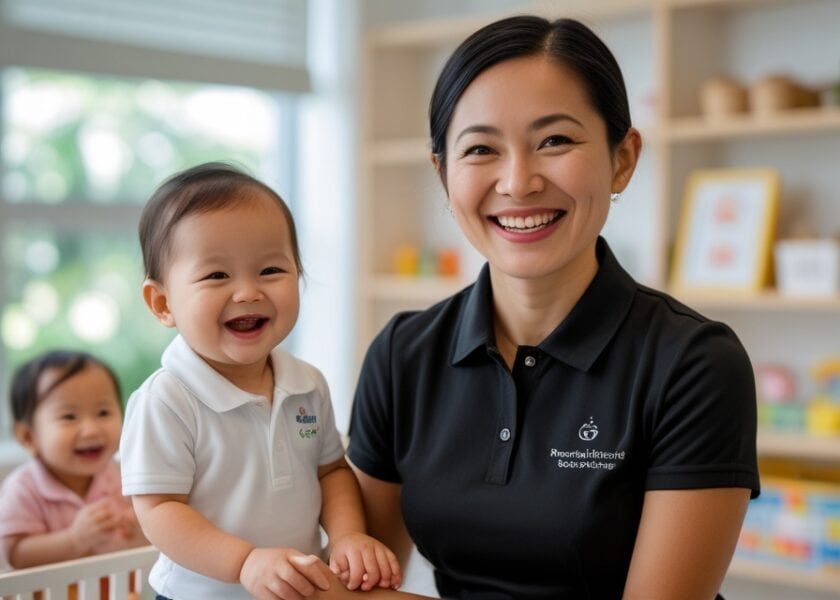
The Five Questions Every Singapore Parent Should Ask About Childcare
The Question Every Singapore Parent Is Asking—But Has No Framework to Answer
There is a question that quietly haunts almost every Singapore parent in the months before they return to work. It does not arrive all at once. It comes in the quiet moments—a feeding at three in the morning, a conversation with a fellow parent at the playground, a late-night scroll through review after review.
The question is simple, and it is not rhetorical: how do I actually know if this childcare is good?
Not good enough to check a box. Not good enough to ease your guilt. Good. Excellent. The kind of care that will shape your child in ways you may never fully see but will feel for the rest of his life.
Here is what is quietly unjust about the way we talk about childcare in Singapore: we tell parents to trust their instincts. We tell them to follow their gut. And all of that matters—intuition is not nothing. But we rarely give parents the vocabulary to understand what they are looking at. We rarely hand them the framework they need to interpret what their instincts are actually responding to.
We leave them standing in the middle of a marketplace full of beautiful classrooms, warm smiles, and polished websites, and we say, “You will know when you see it.”
But what if you do not see it? What if what looks warm and safe and welcoming is actually mediocre care wearing a premium price tag? What if what feels professional and impressive is just sophisticated marketing? What if, without a standard to measure against, the very parents who want to choose excellently end up defaulting to the most convenient option, the cheapest option, or the one with the most eye-catching advertisement—precisely because they have no clear language for what genuine quality should look like?
This is the gap we need to address. Not because the question of childcare quality is mysterious. It is not. But because Singapore parents have been asked to make one of the most consequential decisions of their early parenting years with less support, less information, and fewer concrete tools than the decision deserves.
Why “Trust Your Gut” Is Not Enough
The advice to trust your instincts is well-intentioned. Parenting does require intuition. But when it comes to evaluating childcare quality, trusting your gut alone is like being asked to diagnose a medical condition without ever being taught the symptoms to look for.
You might feel reassured by a beautiful facility. But beauty is a design choice, not a developmental one. You might feel comfortable with a warm receptionist and a welcoming atmosphere. But warmth is a marketing asset, not a quality standard. You might feel impressed by a glossy website and impressive-sounding credentials. But marketing is sophisticated, and impressive language does not automatically translate to excellent care.
The problem is not that Singapore parents lack good judgment. The problem is that they have been given no concrete tools to exercise that judgment. They have been offered reassurance when they needed frameworks. They have been offered warmth when they needed standards. They have been told to trust themselves when what they actually needed was to be taught how to see.
This matters because the stakes are real. In the early years, your child’s brain is developing at a speed it will never match again. The quality of care he receives—not just the supervision, but the responsiveness, the consistency, the intentional support of his development—leaves lasting imprints on his emotional security, his ability to regulate himself, and his capacity for curiosity and learning.
Choosing childcare is not like choosing a restaurant. You cannot simply try somewhere new if the first choice disappoints. The transition itself carries costs, especially for infants who are building their first sense of security outside the home. You deserve to choose well the first time—not because perfection exists, but because the act of choosing from a place of knowledge, rather than confusion, dramatically increases the odds that your child lands in an environment that genuinely serves him.
The Five Dimensions of Quality: What You Are Actually Looking For
When we evaluate the quality of infant care, we look at five observable, verifiable dimensions. These are not subjective impressions. These are not gut instincts. These are the benchmarks that separate adequate from excellent, and any parent can learn to see them within the first visit to any childcare setting.
1. Ratio: The Numbers That Determine Responsiveness
Not just the legal minimum, but the actual ratio your child will experience in daily life. In Singapore, the regulatory minimum for infant care is one caregiver to eight infants. That is the floor. That is what the law permits.
But any developmental specialist will tell you that meaningful attachment, responsive care, and the kind of attentiveness that supports early brain development requires something closer to one caregiver for every three infants. That is not a luxury. That is the ratio at which a caregiver can genuinely know each child—his rhythms, his cues, his particular ways of expressing hunger or fatigue or the need for comfort.
At a 1-to-8 ratio, it is simply math: a single caregiver cannot give each infant the responsiveness he needs. Crying may go unanswered longer. Subtle cues may be missed. The serve-and-return interactions that literally build neural pathways may become impossible to sustain consistently.
What to ask: “What is the actual caregiver-to-infant ratio in the infant room, not just the regulatory minimum?”
2. Caregiver Continuity: The People Behind the Promise
Your child is not forming a relationship with a concept called “the infant care team.” He is forming a relationship with specific human beings.
The research on this is unambiguous: infants need consistent caregivers to build the secure attachment that becomes the foundation for emotional regulation, social confidence, and cognitive exploration throughout their lives. When caregivers change frequently—through high turnover, rotating shifts, or staff instability—children do not just feel mildly unsettled. They are actually, measurably, developing in an environment that withholds the consistency their brains require for healthy growth.
This is not sentiment. It is developmental science. The infant brain is wired to form attachments as a survival mechanism. When those attachments are disrupted repeatedly, the stress response system is activated in ways that, over time, carry real costs.
What to ask: “How long has my child’s primary caregiver been in this role? How long do they intend to stay? What is your staff retention rate?” These are not impertinent questions. They are the questions that reveal whether the promises about care and connection are real.
3. Interaction Quality: What You Can See If You Know Where to Look
This is where many parents stop looking because they do not know what to look for. When you visit an infant care setting, do not just look at the toys or the paint on the walls.
Watch what happens when a child cries. Does a caregiver respond promptly, warmly, with words that acknowledge what the child might be feeling? Or does the child wait? Is he soothed, or is he left to self-soothe in an environment that is too loud or too busy for that to be healthy?
Watch how caregivers speak to the infants. Not at them. To them. With the same courtesy and attention you would give to a person you respect. Listen for the texture of the language—not baby talk, but real conversation adapted to the infant’s comprehension level.
Watch whether children are propped in front of screens or whether they are engaged in back-and-forth interaction—the kind of serve-and-return conversation that literally builds neural pathways in the developing brain.
These are not subtle differences. They are visible. Once you know what to look for, you cannot unsee them.
4. Developmental Intentionality: The Architecture of Care
Premium infant care is not just supervision. It is architecture. It is the deliberate design of an environment and a daily rhythm that supports motor development, language acquisition, sensory exploration, and social-emotional growth.
In a high-quality infant care setting, every element has been chosen with purpose. The texture of the materials. The structure of nap times. The ratio of outdoor to indoor experience. The way non-verbal communication is tracked and shared with parents. The way caregivers are equipped to support developmental leaps.
It is not accidental. It is not inherited from a generic template. It is intentional, and the staff can explain why.
What to ask: “Can I see the daily schedule?” “What is your approach when a child is approaching a developmental milestone?” “How do you track and communicate my child’s progress?”
If the answers feel vague or rehearsed, that is information. If the staff can speak clearly and specifically about the why behind their practices, that is a sign of genuine intentionality.
5. Transparency and Trust: The Partnership You Deserve
This is where the relationship between the provider and the parent either deepens or collapses.
Premium care means parents are not left guessing. It means regular, meaningful updates—not just photographs, but developmental narratives. It means communication channels that allow for real conversation, not just announcements.
Where documentation is maintained, it should be maintained not as bureaucratic compliance but as a living record of your child’s growth that you can access and engage with. Where CCTV is deployed, it should serve mutual accountability and peace of mind, not just surveillance.
When parents understand what they are seeing and why, they become partners in their child’s care rather than passive observers. And that partnership matters—not just for parental peace of mind, but for the consistency between home and care that children depend on.
Why Price Alone Tells You Almost Nothing
Here is something that surprises many parents: premium quality is not about price alone.
You can pay a great deal and receive care that meets only the legal minimums in every way that matters. You can pay modestly and receive genuinely excellent care, if the provider has made deliberate choices to prioritize development over margin.
The price tells you what the market will bear. The quality standards tell you what your child will actually experience. These are not the same thing, and conflating them is one of the most reliable ways to make a poor decision in a moment of exhaustion and overwhelm.
This is why the framework matters. When you know what to look for, you stop relying on price as a proxy for quality. You start evaluating based on what your child will actually experience: the ratio, the continuity, the interactions, the intentionality, the transparency.
“What if I cannot afford premium care?”
We believe financial constraints should not force families into inadequate care. Quality standards are not reserved for families with unlimited budgets—they are what every child deserves, and they should be accessible.
“Is it normal to ask these questions? Will they think I am being difficult?”
Asking about ratio, caregiver continuity, staff retention, and developmental approach is not being difficult. It is being a parent. If a provider becomes defensive or dismissive when you ask these questions, that is itself valuable information about how they view the parent-provider relationship. Premium care welcomes scrutiny because it has nothing to hide.
“What if I make the wrong choice?”
The goal is not perfection. The goal is informed choice. When you choose from a place of knowledge rather than confusion, you dramatically increase the odds of landing in the right environment. And if the fit is not right, the framework you build now will help you recognize it sooner and make a change with greater clarity.
What EduNanny Has Built—and Why
EduNanny is part of the ECDA Childminding Pilot, and this matters for reasons that go beyond regulatory compliance. The Childminding Pilot represents a considered response by Singapore’s authorities to a real problem: the lack of flexible, high-quality, home-based and centre-based care options that meet the diverse needs of Singapore families.
By participating in this pilot, EduNanny is not just offering a service. We are helping to define what excellent childminding can look like in the Singapore context—and that definition is grounded in standards that exceed minimum requirements, because the children in our care deserve nothing less.
Our Care Model
Our care model offers up to one-to-three infant ratios, because we know what developmental research confirms: that ratio is not a luxury, it is the threshold at which genuine responsiveness becomes possible.
Our care blocks are structured around Monday to Friday, designed to serve the realities of working families without the fragmentation that leaves parents cobbling together half-solutions.
Our fees are structured within the pilot framework to be affordable and accessible, and we actively support the use of CDA and Baby Bonus funds, because financial barriers should not prevent families from accessing the quality their children deserve.
Supporting Parents, Not Just Children
We understand that modern parenting is complex and often isolating. That is why we built something we are particularly proud of: the Thomas AI Chatbot.
Thomas is not a gimmick. It is a practical resource for parents navigating the real, daily questions of infant care and childminding—from developmental milestones to feeding concerns to the emotional logistics of returning to work. It is available when you need it, without judgment, without waiting for office hours, without the anxiety of wondering if you are asking the right person.
We designed Thomas because we believe that supporting parents is not separate from supporting children. It is the same work.
Your Next Step
Singapore parents are not lacking in care or options. They are lacking in confidence—not because they are uncertain people, but because they have been given insufficient tools.
Here is what changes when a parent is given a quality framework: they stop guessing and start demanding. They stop accepting what is offered and start evaluating what is sufficient. They stop feeling guilty about wanting excellence and start recognizing that demanding excellence for their child is not optional—it is the job.
Before your next visit, write these down:
- Ratio: What is the actual caregiver-to-infant ratio? Is it consistent throughout the day?
- Continuity: How long has the primary caregiver been in this role? What is the staff retention rate?
- Interactions: Watch a caregiver respond to a crying infant. Notice the language and tone used with infants throughout your visit.
- Intentionality: Ask to see the daily schedule. Ask how developmental progress is tracked and communicated.
- Transparency: Ask what updates you will receive and how often. Ask how concerns are communicated.
- Environment: Notice whether the space feels stimulating but not overwhelming. Are materials accessible? Is there outdoor time?
Trust your instincts—but let them respond to the observable quality, not just the aesthetics.
If the answers you receive are not satisfactory, keep looking. Because your child deserves caregivers who can tell you why they do what they do, not just that they do it. He deserves an environment designed with his development in mind, not just his safety. He deserves the kind of care that sees him as a whole person—a person who is learning, growing, feeling, and becoming, in every single hour of every single day.
Explore what EduNanny’s approach to quality infant care looks like in practice. Request a consultation to see how we meet the standard your child deserves.
EduNanny is a Singapore-based childminding service participating in the ECDA Childminding Pilot. We provide development-focused infant and child care designed around the needs of working families. Learn more about who we are or explore our approach to quality childcare.