What Quality Childcare Looks Like From the Inside
The Invisible Question Every Parent Carries
We talk so much about what children need to be ready for school, for learning, for achievement. But underneath all of that readiness is something more foundational: the child’s sense of self. The quiet knowledge, growing inside a child over months and years of daily experience, that I am competent. I am lovable. I am capable of affecting the world around me.
Quality childcare builds that knowledge not through lessons but through the accumulated weight of hundreds of small moments — each one a tiny proof to the child that they are real, that they matter, that their actions have consequences and their presence makes a difference.
And here is what most parents do not see: what the caregiver is doing in those moments is not simple. Reading a child’s inner state — their level of anxiety, their threshold for separation, their particular way of needing comfort — requires a skill that is closer to an art than a technique.
When we choose childcare, we are not just choosing a schedule. We are choosing the world that will hold our child for the most awake, most receptive, most extraordinary years of their life. We are choosing the people who will witness and shape their inner experience when we cannot be there to do it ourselves.
The Morning: When Your Child Is First Known
Picture the morning. Your child arrives carrying the particular weight of separation — that tight grip on your hand, that backward glance. And then something interesting happens.
The caregiver kneels down. Not in a performative way, not in a way that feels staged for your reassurance, but in a way that is genuinely focused on your child. The caregiver says something simple — a greeting that is specific to this child, a reference to something your child cares about, a small piece of continuity from the day before.
And in that moment, your child feels something remarkable: I am known here.
The room is not unfamiliar anymore. The person is not a stranger. This is a place where I have already existed, where I already have a history, however brief.
The Art of Reading a Child
A skilled caregiver does not apply a single strategy to all children. They read the micro-signals:
- The way a child holds their body when they are uncertain
- The difference between a child who needs to be held and a child who needs to be given something interesting to do with their hands
- The particular silence of a child who is not distressed but is simply not yet ready to engage
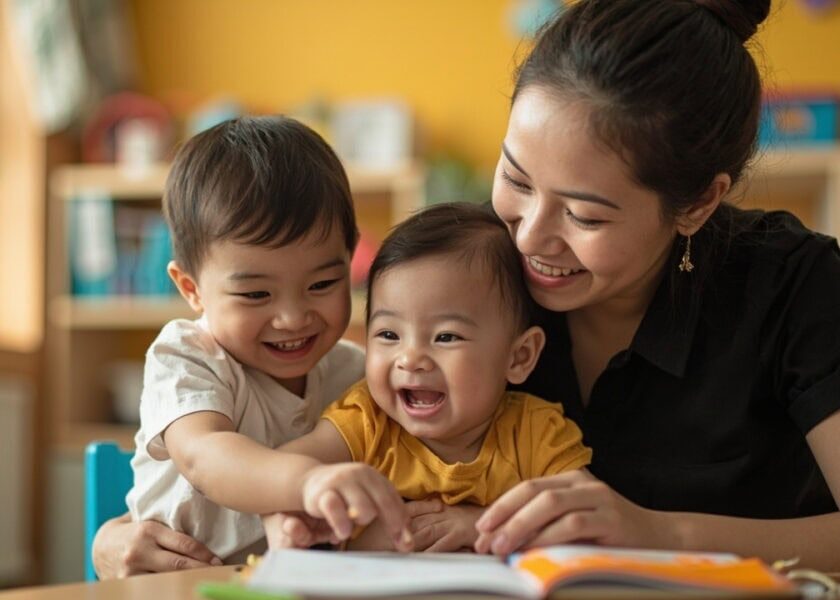
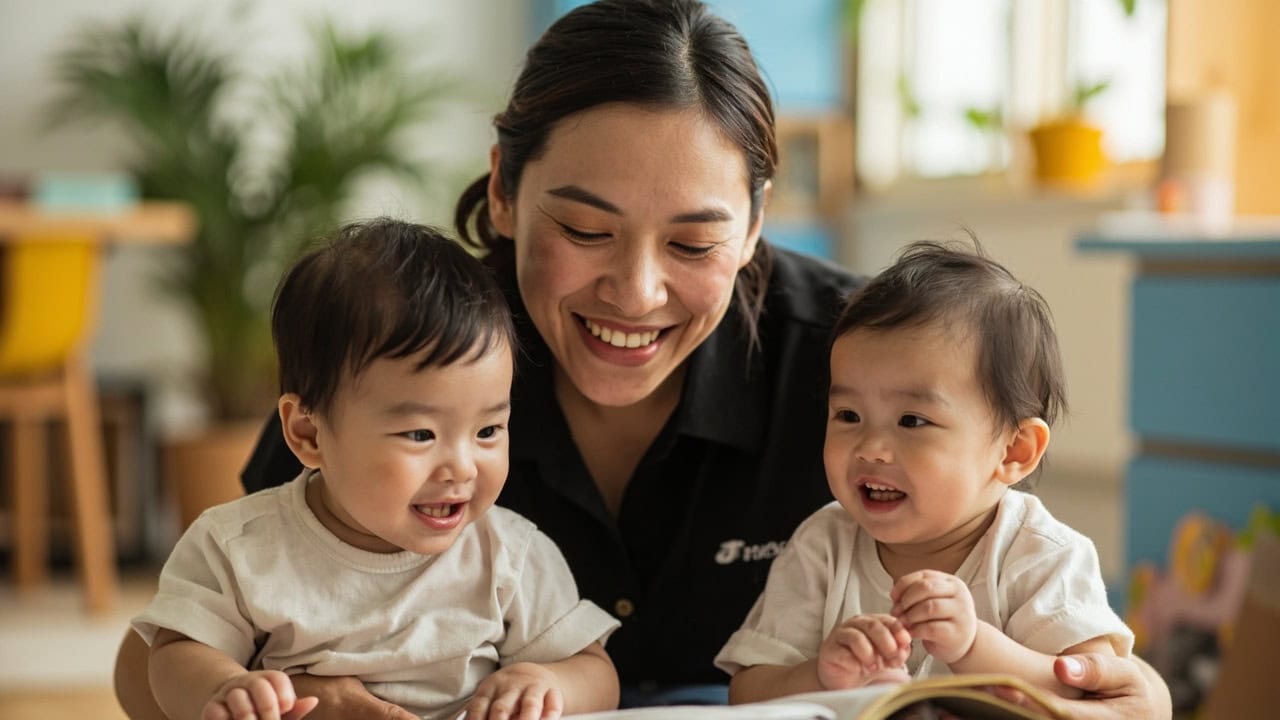
This is what good infant care looks like from the inside — not a routine applied uniformly, but a living, responsive attunement to the inner life of each small person in the room.
That feeling — being known — is the single most important thing that can happen in a child’s morning. It is the foundation upon which everything else is built. Without it, a child spends the first hours of the day consolidating anxiety, watching the door, waiting for you to return.
With it, a child turns away from you with surprising ease and walks — or runs — toward the activity that is already calling their name.
Where Discovery Becomes Learning
Follow the child into the mid-morning. The room is alive with textures that you might not think to provide at home.
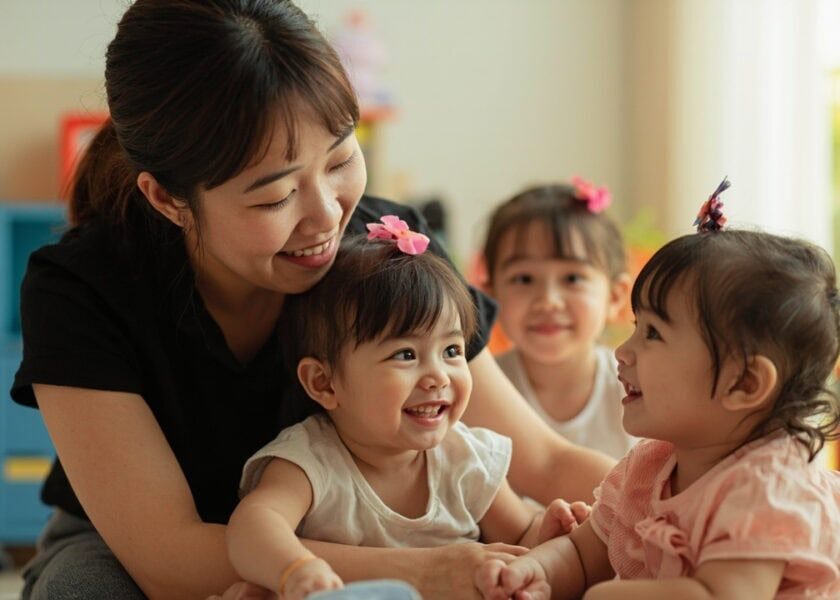
There is sand in a sensory tray. There are blocks stacked into a structure that three children are negotiating over — not always gracefully, not always quietly, but in the way that real human negotiation begins, with gestures and sounds and the slow, astonishing discovery that other people have intentions too.
There is a caregiver on the floor, narrating what is happening not to control it but to help these children understand what they are experiencing. “You want the blue block. He is using the blue block right now. That is hard.”
Simple language, carrying enormous developmental weight. Because a child does not yet have words for frustration, for sharing, for the complicated feeling of wanting something someone else has. And the caregiver gives them the language — and in giving them the language, gives them the beginning of mastery over the feeling.
This is what is happening while your child is away from you. Not supervised care. Not mere watching. A daily curriculum of emotional and cognitive development that is woven so naturally into play that your child does not know they are learning.
They only know:
- They are engaged, interested, absorbed
- When they drop a wooden spoon into a metal bowl and listen to the sound, something in them responds with delight
- When another child takes their place in line and they feel that flash of frustration, someone nearby names it and helps them find another way
The Architecture of Safety
There is another dimension of this interior world that deserves our attention, because it is the dimension that parents most often worry about, and it is the dimension that is most invisible from the outside. That is the child’s experience of safety.
I do not mean physical safety, though that is, of course, non-negotiable. I mean the deeper safety — the felt sense, living in a child’s body, that the world is generally reliable, that the people around them will respond when they need something, that they will not be left alone with a feeling too big for them to carry.
This is what developmental psychologists call emotional security, and it is built not in dramatic moments but in the ordinary, everyday evidence that the world is a consistent and caring place.
The Smallest Moments That Build Everything
In quality care, this security is built in the smallest possible moments:
- The caregiver who notices that a child is beginning to overwhelm and quietly intervenes before the child tips into full dysregulation
- The caregiver who remembers that this particular child does not like loud noises and lowers their voice without being asked
- The caregiver who, when a child falls and looks startled, is the first to arrive — not with panic, but with a calm, steady presence that says, I am here, and you are okay, and I am not alarmed
These moments seem small. In isolation, they are small. But a child’s inner world is built from accumulation. Every one of these micro-responses is a brick in a structure that will become the child’s inner architecture of trust — the template they carry into every future relationship, every future challenge, every future moment when the world does not go as they expected.
Reading Your Child’s Day
Now let me bring you back to that evening scene, because this is where everything described above meets the parent who is waiting.
You are on the floor with your child, and you are watching. And the question is no longer just what happened today — it is what is this child showing me right now?
Because children who are thriving in quality care carry their experience in their bodies and their behaviour in ways that are visible to a watchful parent. Not always dramatically. Not always in ways that announce themselves. But present, observable, real.
A child who has spent the day in an emotionally secure environment comes home with a particular quality of ease. They are not clingy in the way of constant anxiety. They are not depleted in the way of overstimulation without attunement. They are present — available, curious, open. They engage with you fully, not because they are desperate for your attention but because they have enough security to share it.
They may be tired, yes. But it is the good kind of tired — the tiredness of a body and a mind that have been used, stretched, engaged. A child who has been truly cared for in the full sense of the word comes home ready to be themselves.
Watch, too, for the new:
- The new word, the new gesture, the new way of relating to a peer or a toy
- The child who brings you a picture that means nothing to you and everything to them
- The child who sings a song you have never heard
- The child who demonstrates, with absolute confidence, that they know how to share — a knowledge that came not from your instruction but from the daily negotiation of the childcare world
These are the evening signals. They are quiet. They will not shout at you. But if you know how to look for them, they will tell you everything you need to know about what your child is experiencing when you are not there.
What to Look For and Why It Matters
Understanding your child’s interior life is the deepest reason to choose quality care. When you evaluate childcare options, look beneath the surface of programs and ratios to ask: What is my child actually experiencing here?
| What to Observe | What It Tells You |
|---|---|
| Caregivers kneel to your child’s level when greeting | Your child is seen as a person, not a task |
| Greetings reference your child’s specific interests or history | Your child is known as an individual |
| Caregivers narrate children’s actions and emotions | Your child is being given language for their experience |
| Small moments of overwhelm are noticed and addressed | Emotional security is actively protected |
| Children move freely between activities | Autonomy and curiosity are supported |
| Your child comes home easeful, not depleted | The environment is attuned, not merely supervised |
Questions Worth Asking
When you visit a potential childcare setting, ask yourself:
- Do the caregivers seem genuinely interested in each child as an individual?
- Is there enough space and attention for every child, or are ratios stretched thin?
- Do the children seem absorbed in their play, or are they simply waiting?
- When a child is upset, how do the caregivers respond — with control, or with attunement?
- Would I feel comfortable if I could see everything happening here?
How EduNanny Approaches This
At EduNanny Singapore, we hold a simple conviction: the child is not a project to be managed. The child is a person — a full, complete, astonishing person who is living an interior experience as rich and complex as any adult’s, even if they lack the words to articulate it.
We operate within the ECDA Childminding Pilot framework — not as a bureaucratic structure, but as a genuine commitment to standards that protect the child’s experience. With carefully maintained ratios of up to one to three for infants, we ensure that each child’s inner state can be read, responded to, and held with the attention it deserves.
For Singapore parents, trust is not built on promises alone. It is built on transparency — on the visible evidence that the world your child inhabits during the day is one you can see, understand, and ultimately rely upon.
Our pathways — home-based, community, and centre-based — are designed not around a single idea of what childcare should look like, but around the reality that every family in Singapore has a different life, a different rhythm, a different need:
- Care blocks that integrate with the actual structure of a working parent’s life
- Navigation support for CDA and Baby Bonus structures, so quality care is not only available to those with significant financial flexibility
- Coverage across Singapore because the need for excellent childminding does not respect the geography of any particular district
A child’s right to a rich interior experience should not be determined by their parents’ income. That is why we work to make our pathways accessible, practical, and grounded in the real needs of Singapore families.
Questions You May Not Say Aloud
You may have questions that feel too vulnerable to voice. Let us name some of them here.
“Will my child feel abandoned when I leave?”
A child who feels known — whose caregiver remembers their name, their interests, their particular ways of needing comfort — does not experience your leaving as abandonment. They experience it as a temporary separation in a world that remains reliable.
The morning greeting, the ongoing continuity of care, the caregiver who reads their signals and responds — these are what transform separation anxiety into the ordinary, manageable experience of growing up.
“How do I know what my child is really experiencing?”
You cannot witness every moment. But you can read the evening signals: the quality of ease, the new discoveries, the way your child moves between wanting you and confidently exploring.
You can ask questions that invite detail — not “did you have fun?” but “what was your favourite part of the morning?” You can notice whether your child seems to trust the world, not just tolerate it.
“Am I letting someone else raise my child?”
You are not outsourcing parenthood. You are inviting trusted people to share in your child’s daily experience — to hold, witness, and nurture the person your child is becoming during the hours you cannot be there.
Quality care supplements and supports what you are already building. It does not replace it. And when you choose well, the people caring for your child become allies in the same project you care about most: your child’s wellbeing and development.
“What if I choose wrong?”
You will have evidence. The evening signals, the weekly patterns, the gradual unfolding of your child’s personality and confidence — these will tell you whether the care you have chosen is serving your child well.
And if you ever feel uncertain, that feeling deserves attention. You know your child better than anyone. Trust that knowledge, and trust the process of watching, asking, and adjusting as you learn.
The Most Important Act of Trust
Let us return to that evening floor, because that is where the story truly belongs — with you and your child, in the quiet that follows a day lived apart.
You are kneeling there, and your child is telling you something about their day — a fragment, a feeling, a small revelation. And what we want you to know, what we want every parent in Singapore to understand, is that the quality of that moment — the openness, the ease, the aliveness in your child — is not accidental.
It is the accumulated result of hundreds of days of care, attention, response, and love, some of it yours and some of it given by the extraordinary people you have trusted to stand in your place.
The child’s interior experience is not a soft concept. It is the actual substance of a childhood. It is:
- The feeling of safety that allows a child to climb
- The language for frustration that keeps a child from being swallowed by big emotions
- The quiet confidence that says, I have been away from my parent and the world did not end, and I am still me, and I am still loved
When we make that decision that feels so heavy, so consequential, so impossible to get perfectly right — we are not just choosing a schedule. We are choosing the world that will hold our child for the most awake, most receptive, most extraordinary years of their life. We are choosing the people who will witness and shape their inner experience when we cannot be there to do it ourselves.
And that is not a small thing. It is the most important act of trust most parents will ever perform.
So this evening, when your child comes home a little flushed, a little rumpled, carrying something new in their eyes — kneel down to their level. Watch them. Listen to what they are telling you, not just in words but in the way they move, the way they breathe, the way they reach for you and then let go again.
And read there the evidence of a life that is rich and safe and full of discovery — a life that you chose for them, with the best of intentions and the deepest of love, and that people like us are honoured to help you build, one extraordinary day at a time.
If you are researching infant care or childminding options in Singapore and want to understand how EduNanny can support your child’s daily experience, we welcome the conversation. Every family’s journey begins with a question — and we are here to listen, not to sell.
Begin a conversation with EduNanny Singapore today