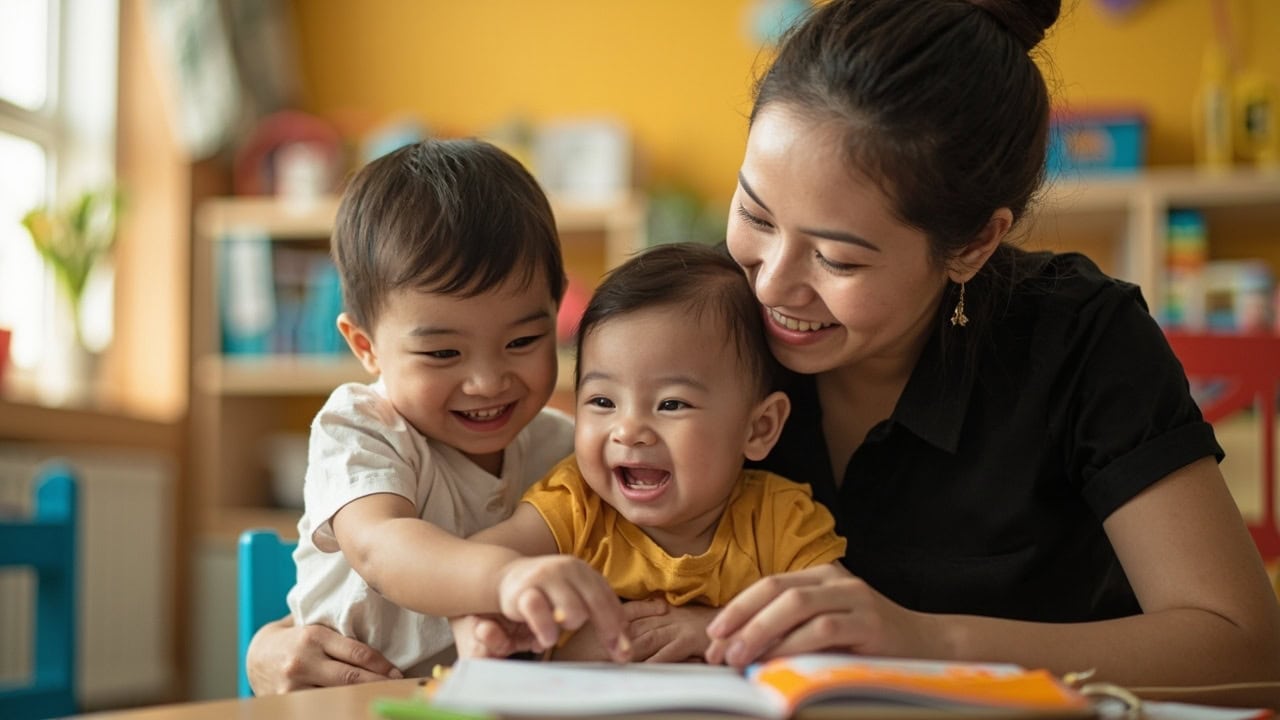
The Real Question Every Singapore Parent Should Ask Before Primary One
The Question We Keep Getting Wrong
When we ask if a child is ready for Primary One, we usually mean something very specific — can they read, can they count, do they know their colours and shapes, have they started on phonics or the enrichment circuit that every other parent seems to be running.
We reach for the measurable things because they feel safe. They feel like proof.
But readiness is not a worksheet. And the skills that will carry your child through Primary One and beyond are largely invisible on a report card.
The Capabilities That Actually Matter
When educators talk about school readiness, they point toward a cluster of capabilities that have very little to do with academic content and everything to do with how a child meets the world.
1. Self-Regulation
This is the ability to manage impulses, to wait, to adapt, to redirect emotion into something productive rather than being ruled by it. A child who can sit through a story without interrupting. Who can manage the disappointment of not being chosen first. Who can enter a classroom and settle into the routine rather than melting down at the door.
This child is ready in the way that matters most. Self-regulation is not a personality trait — it is a skill, and it is built, day by day, in the small moments of early childhood.
2. Social Confidence
Not the absence of shyness, but the ability to be in the company of peers and adults without fear. A child who can ask for help. Who can share. Who can navigate a conflict with words instead of hands. Who can walk into a group of children at recess and find a way to belong.
Social confidence is developed through repeated, supervised, meaningful interaction with other children. This is precisely what quality childcare provides — not a substitute for the family, but a complement that extends the child’s world into the relational spaces where these skills are practiced and grown.
3. Curiosity
The genuine love of learning that precedes any specific knowledge. Some children arrive at school already armored against it, already resigned. Do I have to? is a sentence that no parent wants to hear on the first day.
Other children arrive with their hands already raised, already leaning forward, already hungry to know what comes next. The difference often traces back to the early experiences of learning — whether discovery was framed as joy or as obligation.
4. Emotional Resilience
The ability to tolerate frustration, to persist, to try again after failing, to not catastrophize a setback. School will bring challenges that are not academic in nature: a friendship that sours, a teacher who seems unfair, a lesson that does not land.
A child who can weather these moments without unraveling has a significant advantage over one who has never been given the space to practice emotional recovery.
What Singapore’s Top Primary Schools Actually Want
Top primary schools in Singapore know this. They have seen the children who arrive with impressive vocabularies and impressive anxiety, who can perform under pressure but crumble when the structure lifts.
They have also seen the children who may not be the fastest readers in the class but who collaborate, who ask questions, who try new things without being asked, who make mistakes and laugh them off and try again.
The difference is not the academic head start. The difference is the foundation.
This is why Singapore’s Ministry of Education has progressively restructured Primary One registration to prioritize character and readiness over academic criteria. School interviews — where they exist — increasingly focus on how a child interacts, how they approach a task, whether they demonstrate curiosity and social ease.
Schools are not looking for children who have been taught to perform. They are looking for children who have been given the space to grow into themselves.
The Enrichment Trap
Despite this well-documented shift in what schools actually value, the dominant anxiety among Singapore parents continues to centre on academic preparation. The enrichment industry has thrived on this anxiety — phonics programmes, mathematics acceleration, creative writing workshops, Mandarin immersion boot camps.
None of this is inherently harmful. The concern is not that parents care about education. The concern is that the focus on academic enrichment often comes at the expense of the very foundations that make academic learning possible.
A child who spends every afternoon in a structured enrichment class may have impressive flashcards but may never have had the unstructured, peer-rich, emotionally demanding hours that build self-regulation, social confidence, and resilience.
This is where the role of quality childcare becomes not just logistically convenient but developmentally essential.
How Quality Childcare Builds School Readiness
A well-designed childcare environment is not a waiting room. It is a carefully constructed setting where the invisible skills of school readiness are cultivated every single day.
The Daily Routine
The daily routine — predictable, warm, gently structured — is not a bureaucratic necessity. It is a mechanism for building the internal rhythm that helps a child transition smoothly between activities, manage change without distress, and develop the self-regulation that will serve them in a classroom.
The Peer Environment
The peer environment — supervised, purposeful, relational — is not just childcare. It is a social curriculum that cannot be replicated at home, no matter how much love and attention a parent provides.
The Caregiver Relationship
The caregiver — the qualified, trained, emotionally attuned adult who responds to distress, celebrates effort, models regulation, and holds a safe, warm relationship — is not a placeholder parent. This person is, in many ways, the architect of your child’s early sense of the world as a trustworthy, explorable, exciting place.
Think about how this unfolds:
- When a child feels safe, they explore.
- When they explore, they learn.
- When they learn in the company of peers, they develop social skills.
- When they experience the gentle structure of routines, they develop self-regulation.
- When a caring adult responds to their frustration with patience and empathy, they learn emotional resilience.
None of these outcomes require a worksheet. They require a relationship. They require time. They require a thoughtful environment designed with your child’s whole development in mind.
What School Readiness Looks Like in Practice
These are the observable indicators of school readiness — the things that no enrichment programme can guarantee and that no academic checklist can capture:
- Transitions: A child who can enter a new environment — school, a new class, a birthday party — without clinging for an hour.
- Emotional management: A child who can manage a minor disappointment — a toy being taken, a turn not coming — without escalating.
- Genuine curiosity: A child who asks questions, who wants to know why, who is not afraid to not know something.
- Perseverance: A child who tries a new activity and, when it does not work the first time, tries again.
- Emotional expression: A child who can express what they feel in words, even big feelings, even when they are upset.
Choosing Quality Childcare with Confidence
If you are a parent in Singapore considering your options — whether your child is an infant or approaching school age — here is what to look for.
Questions to Ask Any Childcare Provider
- How do you handle transitions and separations?
- What does a typical daily routine look like?
- How are peer conflicts managed?
- How do you communicate with parents about their child’s day?
- What are the caregiver-to-child ratios?
- How are caregivers trained and supported?
Signs of Quality Care
A quality childcare environment should feel warm and predictable. Children should seem comfortable with their caregivers and with each other. Routines should provide gentle structure without rigidity. Communication should be transparent and regular.
The right environment will not just keep your child safe — it will actively build the foundations your child needs for school and for life.
How EduNanny Supports Your Child’s School Readiness
EduNanny by BUTLER operates as part of the ECDA Childminding Pilot, offering both home-based and community-based pathways depending on what suits your family.
The pilot structure is significant because it is designed to make quality childcare more accessible — with fee structures mindful of affordability, and CDA and Baby Bonus funds applicable. This means the financial conversation does not have to be a barrier to quality care.
Infant ratios are maintained at a level that allows for attentive, individualized support. Because when ratios are appropriate, care is not just supervision. It is responsiveness. It is the kind of attention that builds trust.
Communication and Transparency
Beyond the structural details, what matters is how care is delivered. Parents want to know what their child’s day looks like, how they are settling, what they are enjoying, where they might be struggling.
EduNanny’s approach integrates communication as a core part of the model, with measures such as CCTV where deployed, so that parents have visibility into their child’s day without having to rely on guesswork or anxiety.
Consistency and Continuity
Monday to Friday care blocks provide the consistency that young children need to build trust, develop attachments, and settle into the rhythms that support their development.
The caregivers — trained, vetted, supported — are not just filling a gap. They are doing the meaningful work of nurturing the whole child.
Your Child Is Ready. Perhaps You Are Too.
There are questions that every parent eventually asks, usually late at night, when the house is quiet and the day feels long: Am I doing the right thing? Am I giving my child enough? Is this the right choice for my family?
The honest answer is that no single decision will determine your child’s trajectory. There is no magic school, no perfect childcare arrangement, no enrichment programme that will guarantee a particular outcome.
What there is, is a foundation — built over years, in moments, through consistent, warm, responsive care. And you have more influence over that foundation than you may feel right now.
Your child is capable of more than you know.
The skills they are building now, in the quiet ordinary hours of early childhood, are the ones that will carry them through every first day of school, every new classroom, every new challenge that comes:
- The confidence to try.
- The resilience to recover.
- The curiosity to ask why.
- The social ease to belong.
That is readiness. And it is closer than you think.
You are not navigating this alone. You are not expected to have all the answers. You are expected to love your child, to make thoughtful choices, and to trust that decisions made with care will compound over time into something powerful.
When you are ready to explore how EduNanny can support your child’s development — from infancy through school readiness — we are here to have that conversation with you.
Learn more about who we are or visit edunanny.com to begin.