The Invisible Excellence in Singapore’s Best Childcare
What Quality Childcare Actually Looks Like When You’re Not There
Singapore is expensive. Careers demand attention. The village that once surrounded your family has scattered across neighborhoods, across countries, across generations that cannot always bridge the distance. You made a decision—probably a difficult one—to entrust your child’s earliest hours to someone outside your family.
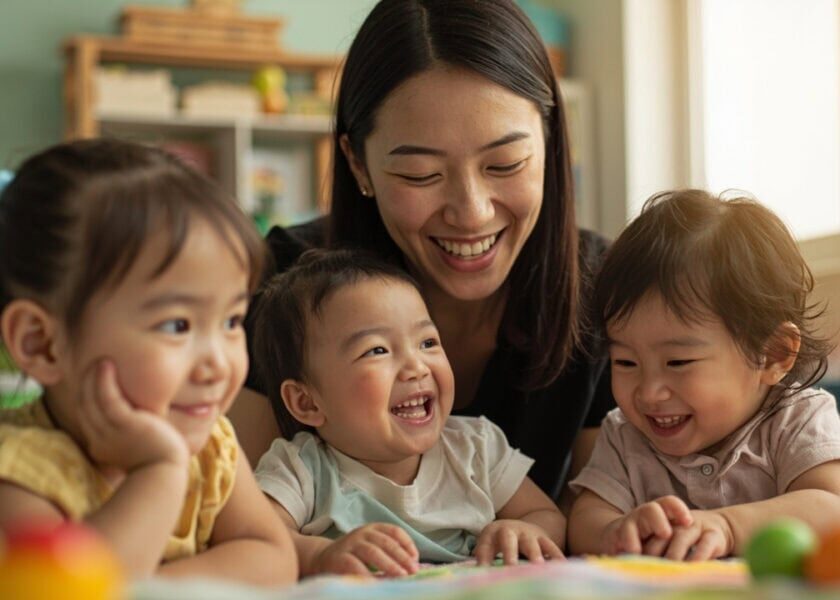
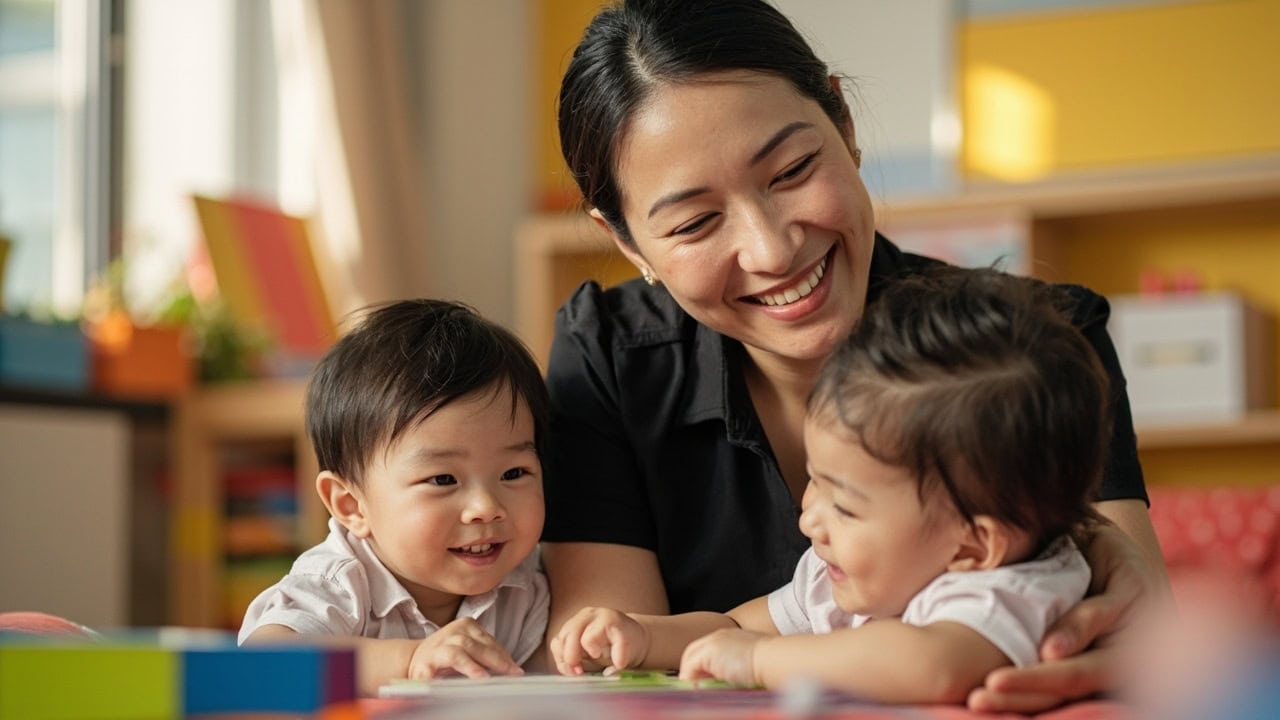
You chose a place with good ratios, thoughtful materials, perhaps even warm-looking staff in the photographs. You did your research. You asked the right questions during the tour.
But here is the tension that keeps you up at night: you have chosen quality, and yet you cannot see inside it. You cannot observe the micro-decisions, the moments of attunement, the developmental intelligence happening throughout an ordinary Tuesday.
This article is a window into what genuine quality looks like in the hours you are not there. Because the difference between adequate care and excellent care lives in precisely the moments you cannot witness.
- Before arrival: Prepares the environment with attunement—adjusting light, temperature, and arrangement based on the specific children coming that day
- Reading each child: Observes body language, movement pace, and threshold behavior to understand emotional state before any words are exchanged
- Responding without demanding: Offers proximity and calm presence instead of direct questions that pressure children to perform
- Building routine as architecture: Creates reliable structure so children can be curious and regulated within predictable rhythms
- Managing conflict with restraint: Allows children space to solve small problems independently while remaining nearby
- Scaffolding development: Offers just enough support to help children reach beyond their current capacity without taking over
- Witnessing rest: Understands that rest is not simply sleep—it is different for every child, and meeting each child’s needs matters
- Reading the day: Tracks what children reveal through eating, play, sleep depth, and social engagement to understand how the day landed
- Preparing for homecoming: Knows how each child will come home and has gently prepared them for the transition all day
A Day of Quiet Attention: From Morning to Evening
There is a particular quality of quiet in the morning at a place like this—not silence, but readiness. The caregiver has been here for some time already.
The mat near the window is not in a random spot. It is where the morning light will fall warmest, and the caregiver knows that one child in today’s group tends to wake slowly and needs a gentler landing than the others. The materials on the shelf have been arranged to offer choices without overwhelming—to signal that today is a place where the child’s preferences will matter.
The temperature has been considered. The water temperature for handwashing has been checked. These small acts are the first iteration of attention—the caregiver’s way of saying, before the day even begins, I am thinking about who is coming.
Reading the Arriving Child
The door opens. A child enters. You have seen this child in the morning rush at home—the pajamas that were not cooperated with, the breakfast that was not finished, the small resistance to shoes. You have seen the way they press against your leg at the gate. You drove away wondering.
Here is what you do not see.
The caregiver reads the child’s body before anything else. Not the face—children learn early to perform for adults, to offer the smile that says everything is fine. But the body does not lie. The body tells the truth in angles and paces and directions.
The caregiver notices whether the child moves toward the room or toward the caregiver. Whether they pause at the threshold or cross it quickly. Whether their shoulders are set in their usual position or held slightly higher, slightly tighter.
These are not signs to interpret like a checklist. They are information—raw, immediate, and real. And the caregiver receives them the way a musician receives a new piece of music: with full attention, ready to adjust.
When a Child Arrives Carrying Something
Some mornings, the child is carrying something invisible. The caregiver sees it in the way the small body moves—slightly guarded, slightly slower than usual. There was no visible incident the night before. There is no obvious reason for the guardedness.
But the caregiver does not need a reason. The body has already told the story.
What does the caregiver do? She does not ask what is wrong. She does not narrate the child’s anxiety back to them. Instead, she offers proximity without demand. She is near the shelf where the blocks live, and she picks up a block, turns it in her hands, makes a small sound of interest as though the block itself is remarkable.
She is not pretending. The block is interesting to her because the child before her is interesting to her. Everything else follows from that.
The child notices. The child comes closer. Not yet ready to engage, but closer. The caregiver continues her quiet conversation with the block. She simply holds space—an open, unhurried space that says, in a language younger than words, you do not have to perform here.
Why Routine Serves Freedom
The morning unfolds. There is routine, but routine here is not the enemy of responsiveness. It is the architecture that makes responsiveness possible.
The caregiver has learned that children do not thrive in chaos no matter how warm the chaos feels. They thrive when the world is reliably organized—when they know that snack comes after play, that outdoor time follows circle, that the sequence of the day is a promise the environment keeps.
Within that reliability, children are free. Within that structure, they can afford to be curious.
If your child had to figure out, every single morning, what was going to happen next, they would spend their cognitive energy on prediction and control rather than on exploration and connection. The routine is not a cage. It is a frame that lets the picture be seen.
When Conflict Arises
Mila arrived slightly tired this morning, slightly behind her usual rhythm. She is not fighting to understand the shape of the day—the shape is already known. What she fights, briefly, is a conflict with Jin over a yellow crayon.
The caregiver does not intervene immediately. She watches. She wants to know whether they can solve it themselves, because the capacity to solve small social problems is not a skill that can be taught in a lesson. It is a skill that is built, brick by brick, in the moments when adults resist the urge to fix and instead offer what children actually need: the confidence that someone is nearby, that the situation will not escalate, that resolution is possible.
The crayon dispute lasts forty-three seconds. Mila uses her words. Jin shares. The caregiver, who has been monitoring from two feet away, gives no indication that she noticed anything significant.
But she noticed. And she will remember.
The Difference Between Watching and Witnessing
There is a moment in the late morning that you would not think to ask about, but that matters more than the activities you see on the tour.
The children are washing their hands before lunch. Aiden is three. His hands are small, and soap makes them slippery, and he is trying to rotate his wrists the way the caregiver showed them, but his motor control is still incomplete. The water is too hot or too cold—he cannot quite judge.
She does not wait for frustration to arrive. She steps in, gently, naturally—not to take over but to adjust. She turns the tap slightly. She adjusts the water temperature by feel, because her hands have learned the temperature a three-year-old needs. She adds a small amount of water to Aiden’s hands, diluting the soap slightly, making the next step possible.
This takes four seconds. Aiden completes washing his hands without ever knowing he was assisted. He believes he did it himself. The caregiver believes she did not need to be acknowledged.
Watching is external. It notes that a task was completed.
Witnessing is internal. It notes what was needed, what was possible, what could be offered without diminishing.
Watching says, the children are being cared for.
Witnessing says, each child is being known.
Scaffolding: How Children Grow Beyond What They Can Do Alone
In the late afternoon, the caregiver is on the floor with three children. They are building something with blocks, though building is not quite the right word. They are negotiating something—a structure, a story, a territory.
The caregiver’s role is not to direct. It is to be the steady presence in the room that makes negotiation possible. She offers a block when a block is needed. She asks a question—”I wonder what would happen if the tower were shorter?”—when the children are stuck. She does not solve the problem. She expands the possibility space so that solving becomes more likely.
Educational research calls this scaffolding: the temporary support that enables a child to do something they could not yet do alone. But the lived experience of scaffolding is warmer than that. It is a hand extended at the right moment—not taking over, not abandoning, but meeting the child exactly where they are.
The children will not remember this afternoon. They will remember, perhaps, the feeling of building something with a friend. They will carry the feeling forward into other afternoons, other negotiations, other moments when they will trust that resolution is possible.
This is how character is built—not through lessons about persistence or cooperation, but through lived experiences of persistence and cooperation, repeated until they become the architecture of a self.
The Evening Transition
Now the light is changing. The afternoon is tilting toward evening, and the caregiver is beginning the transition she has been preparing for all day.
She has known for hours how this child would come home tonight. She has read it in the way the child ate lunch—whether they finished their food or pushed it around, whether they were hungry or distracted. She has read it in the afternoon’s play—whether the child sought out connection or retreated into solo activity. She has read it in the rest period—the depth of the sleep, the quality of the waking.
What she knows is not a diagnosis or an assessment. It is simply: this is who this child is today, and here is what they need from the evening to land well.
When you arrive, you will see your child come toward you. You will read their face, their body, their voice. You will notice whether they are flushed from play or quiet in a way that seems settled rather than subdued.
You will notice whether they mention the caregiver by name, whether they talk about what happened, whether they are hungry in the way that says the lunch was eaten well or in the way that says it was not.
These are not clues to decode. They are evidence. They are the visible residue of a day that was, or was not, what your child needed.
Rest: What It Actually Means and Why It Matters Differently for Each Child
The afternoon brings its own rhythms. After lunch there is rest—a concept the caregiver understands differently than you might expect.
Rest is not simply sleep. For some children, rest is the permission to be quiet. It is the dimming of lights and the softening of voices and the body of the caregiver moving through the room with the particular quietness that says, this is a space where slowing down is allowed.
For other children, rest is harder. Their bodies do not know how to stop easily. Their minds are still spinning with the morning’s inputs. The caregiver does not fight this. She offers what these children actually need—not sleep, but the experience of being held in a calm space, of having someone nearby who is not asking them to be anything other than what they are.
For these children, rest looks like lying on a mat, eyes open, watching the mobile turn slowly overhead. It looks like a hand reaching out, briefly, to touch the caregiver’s sleeve as she passes—a touch that says, I know you’re there. It looks like the slow unwinding of a body that has been braced for something all morning and is only now learning that it can soften.
The Accumulated Knowledge of Rest
The caregiver moves between the children who are sleeping and the children who are resting and the children who are in that tender middle space where sleep is approaching but not yet arrived. She knows each child’s sleep pattern the way you know your own child’s sleep pattern—intimately, specifically, with the accumulated knowledge of hundreds of days.
She knows that Mei-Ann always falls asleep on her left side but wakes if the blanket shifts to her right. She knows that Raj prefers white noise but becomes overstimulated if the volume rises above a certain point. She knows that the twins, who arrived this year, have started sleeping through the entire rest period together, curled toward each other like parentheses, and she has quietly arranged the mats so that they are near enough to find each other but far enough that an elbow to the face will not wake either one.
This knowledge did not come from a training module. It came from time—from the slow, patient accumulation of days spent in close proximity to small people whose needs are not standardized and whose rhythms are not predictable. It came from the willingness to pay attention when attention is the hardest work there is.
The EduNanny Approach: Built Around Knowing Your Child
Quality is not the toys, though the toys matter. It is not the curriculum, though the curriculum matters. Quality is not the certificates on the wall or the ratios in the ratio.
Quality is the quality of the attention. It is the quality of the decisions made in the spaces you cannot observe—the decisions about water temperature, about crayon conflicts, about the child who is carrying something in their body before their mind has words for it.
Quality is the willingness to be present to what is small, to what is ordinary, to what will never be photographed or shared or remembered by anyone except the child who lived it.
This is what you chose when you chose quality. You chose a place that would witness your child. That would pay attention to what is small. That would build, day by day, the internal architecture of a person who knows they are known.
Deliberate Design for Singapore Families
EduNanny Singapore was built around this understanding. Not as an abstract principle, but as a daily practice.
The caregivers here are not assigned to children like workers on a shift. They are known to children. They return. They build the relationship that makes attunement possible—the relationship that allows a caregiver to read a child’s body before the child has shown anything, to offer what is needed before the need has been spoken, to hold the child’s inner life with the care it deserves.
This model is the result of deliberate design, shaped by the ECDA Childminding Pilot and the recognition that Singapore’s families need more than institutional solutions. The pilot creates pathways—home-based care, community options, centre-based support—that honor the reality of Singapore’s diverse family structures.
The ratios are intentional: small enough that a caregiver can actually know the children in her care, not just manage them. The fees are structured to make quality accessible, not a luxury reserved for those who can pay premium rates. Monday through Friday, the care is there—consistent, continuous, reliable.
Where families have CDA or Baby Bonus resources, they can be used here, because the financial architecture of childcare should not be a barrier to the kind of care that matters most.
Transparency as Trust
There is technology too—because Singapore is a place that runs on information, and parents need windows, not just trust. The communication tools, the transparency measures, the CCTV where deployed—these are not surveillance. They are bridges. They are the infrastructure of trust made visible, so that you do not have to believe blindly. You can see. You can ask. You can know.
But the heart of it remains what it has always been: a person in a room with a child, paying attention. Nothing replaces that. No app, no platform, no amount of data can replicate the knowledge that comes from being present—really present—to another human being during the years when everything is being formed.
What to Look For When Choosing Infant Care in Singapore
You are raising a child in Singapore, and it is not easy. You are doing this in a city that is fast and ambitious and demanding, where the pressure starts early and never quite lets up. These are not small decisions. They are enormous decisions, dressed in the ordinary clothing of daily life.
Questions Worth Asking
Will my child be safe? Safety is the floor, not the ceiling. But the question beneath the question is: will my child be seen? Will someone notice if they are tired, or sad, or carrying something they cannot name? Will someone adjust—not just keep them from harm, but actually meet their needs?
How do I know what’s happening during the day? You should be able to ask. A quality childcare arrangement should welcome your questions, offer regular updates, and provide windows—literal and figurative—into your child’s day.
Is my child being managed or actually known? Ask about continuity. Will the same caregiver see your child most days? Ask whether they can tell you something specific about your child’s preferences, rhythms, or patterns. A caregiver who knows your child will have specific answers.
Can we afford quality? Quality should not require wealth. The EduNanny model is structured to make this kind of care accessible—CDA and Baby Bonus funds can be used, and the fees are designed to remove childcare as a barrier rather than add to it.
A Checklist for Visiting
- Ask about continuity. Will the same caregiver see your child most days? Relationship is the foundation of attunement.
- Notice the environment before the children arrive. Is it clean? Is it warm? Is it arranged with intention or just functional? The preparation tells you something about the attention that will be paid.
- Ask what a typical day looks like. Routine should be visible and explainable. The caregiver should be able to tell you why the day is structured the way it is.
- Ask how they handle conflict. Listen for restraint. You want a caregiver who will not swoop in immediately, but who is present and watching.
- Ask about communication. How will you know what happened during the day? What windows are available? What happens when you have questions?
- Watch your child’s body over time. Not just the first week, but over a month. How does your child arrive in the morning? How do they come home? These patterns will tell you the truth.
- Trust your read of the caregiver. You are entrusting your child to a person. Do you sense that this person is attentive? Curious about children? Comfortable with silence? These qualities matter more than credentials alone.
The Most Honest Measure
Will my child actually be happy there?
Happiness is not the only measure, and it is not always the first sign. Watch your child’s body when they come home. Watch whether they are settled, regulated, easeful in their own skin.
Watch whether they mention the caregiver with familiarity or not at all. Watch whether they want to go back the next day, or resist, and what kind of resistance it is.
These observations, accumulated over weeks, will tell you more than any tour or testimonial.
What Quality Looks Like When No One Is Watching
We know the weight of the wondering—whether your child is okay, whether the day was good, whether the person caring for them truly sees them. We cannot remove that weight entirely. It is part of loving someone.
But we can meet that weight with something real. We can open the room. We can show you the morning preparation and the afternoon rhythms and the evening transition. We can introduce you to the caregiver who knows your child’s left-side sleep preference and their tendency to advocate for themselves over crayons.
What we are doing here, in this place, is not complicated. It is not revolutionary. It is the simple, difficult, essential work of paying attention to a child. Of treating each day as an opportunity to witness who they are becoming. Of holding the ordinary hours with the same care that others reserve for the extraordinary ones.
Your child is being known here. Not managed. Not monitored. Known.
That is what happens in the hours you are not there. That is what quality looks like when no one is watching.
As the light softens and the evening approaches, the caregiver is preparing for tomorrow. She will return early, as she does every morning. She will adjust the mat toward the window. She will notice the angle of the light. She will prepare, once again, to receive your child with everything she has.
You can trust that. But more than that—you can know it.
Come and see for yourself. Schedule a visit to EduNanny Singapore. Meet the caregivers, observe the environment, ask your questions. Let us show you what quality looks like when the door is open.
If you would like to learn more about who we are and what guides our approach, we invite you to read about EduNanny.