The Quiet Signs of Quality Childcare Singapore Parents Learn to Notice
You Already Know More Than You Think
We live in a city where information is never the problem. There are forums with detailed reviews, parenting groups with heated debates, well-meaning relatives with strong opinions about what children need. There are expert articles, developmental milestones, and infographics about brain architecture in the first thousand days.
And beneath all of this noise, there is a parent—a perceptive, loving, exhausted parent—trying to figure out what is actually best for their child. Trying to trust themselves in a decision that feels enormous, even though logically, they know other parents have made this same choice and the world has not ended.
The irony is that the Singapore parent in the middle of this search is often more qualified to evaluate quality than they realize. They have spent every day since their child’s birth noticing things. They notice when their baby is soothed by a particular tone of voice. They notice the difference between crying that means hunger and crying that means discomfort. They notice when their toddler’s face lights up at the sound of a familiar footstep.
Without any formal training, they are already expert in the most important subject: their own child. And yet somewhere along the way, in the flood of advice and opinions, this expertise gets buried. Parents start searching outside themselves for answers they already possess. They look for checklists that promise certainty. They seek external validation for choices that ultimately rest on their own observation and judgment.
The search becomes a way of avoiding the uncomfortable truth that there is no perfect guarantee—only the ongoing, attentive work of noticing what is actually happening.
The Difference Between Searching and Observing
Consider what you notice when you walk into a room and your child is present. Not what the certificates on the wall say. Not what the brochure promises. What you actually notice.
- The way your child moves through the space
- Whether they approach the caregiver with ease or hesitation
- Whether there is laughter or silence
- Whether the caregiver looks up when your child enters or remains absorbed in something else
These observations are not trivial. They are, in fact, the most reliable data you will ever have about the quality of care your child receives.
Searching is reactive—it asks, “What should I be looking for?” Observing is receptive—it asks, “What am I actually seeing?” The first is exhausting because there is always more to search for, another review to read, another centre to visit. The second is clarifying because it returns you to what is directly in front of you, what is already present, what is already true.
What Quality Childminding Actually Looks Like
Parents who choose well in Singapore often describe a similar experience. They stopped looking for the perfect option and started noticing the right fit. They stopped asking the internet what good care looks like and started trusting what they saw with their own eyes.
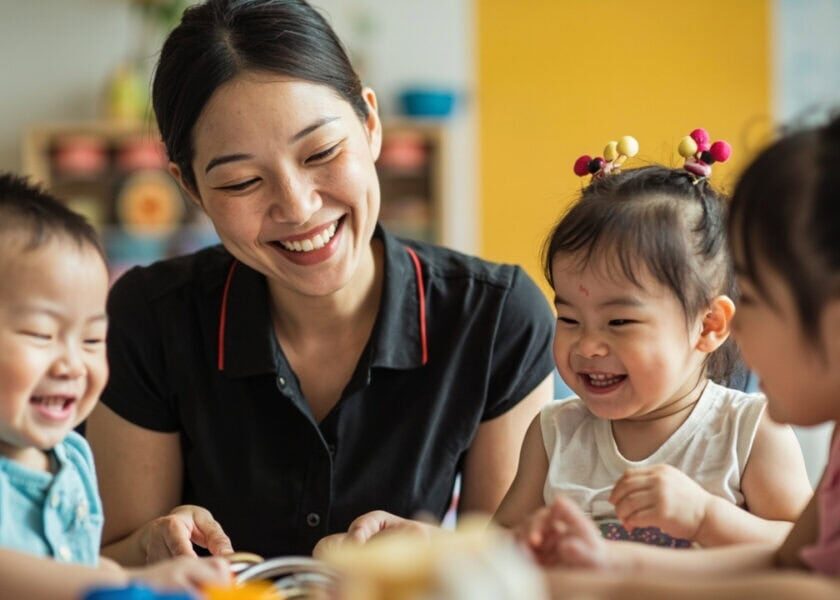
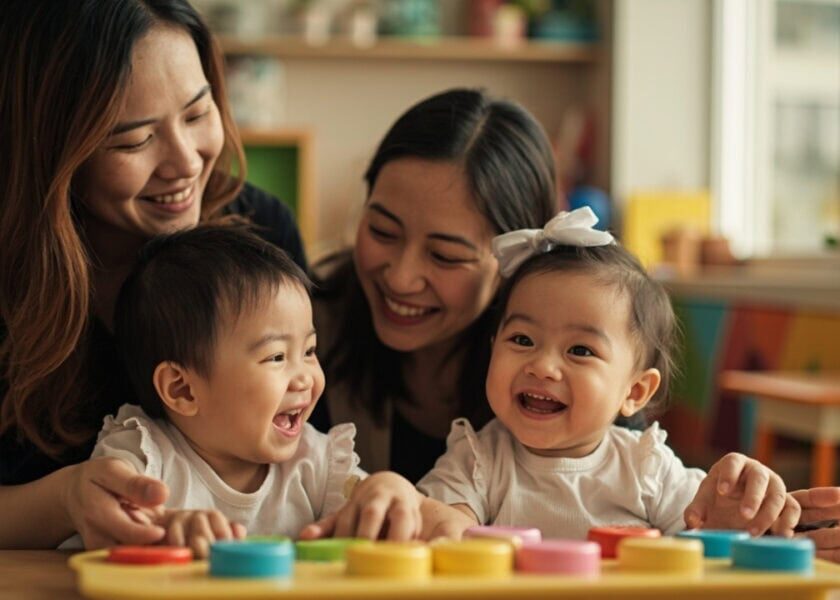
They looked for responsiveness—how quickly a caregiver answered a child’s reach, how attentively they listened to babble, how gently they intervened in small conflicts. They looked for warmth that was genuine rather than performed. They looked for a space where their child was not merely supervised but actually engaged.
And they found that when they stopped searching for certainty and started observing with attention, the evidence accumulated quietly, naturally, and persuasively.
This is not about attachment theory or brain science, though both are real and important. It is about something more immediate and more accessible. It is about the parent who leaves their child in the morning and, on the way to work, notices that the worry is getting lighter. It is about the afternoon pickup when the child runs toward the door with a smile that says, “I want to come back tomorrow.” It is about the text message during the day that shows a photo of your child building something with blocks, and the small caption beneath it—unedited, unscripted, real.
These moments are not accidents. They are evidence. They are the quiet accumulation of data that tells you something is working.
The EduNanny Model: Trust Earned Through Practice
EduNanny Singapore was built with this kind of parent in mind. Not the parent who needs to be told what to look for, but the parent who needs a model of care that will stand up to their own careful observation. Not the parent who wants to hand over the decision to experts, but a parent who wants a partner that respects their intelligence and earns trust through what it actually does, not what it promises.
When EduNanny joined the ECDA Childminding Pilot, it was with the understanding that the pilot represents something significant for Singapore families—the recognition that home-based and community-based care, thoughtfully designed and professionally supported, can offer something valuable for infants and their parents.
Within this framework, EduNanny has built a model that centres the relationship between caregiver and child, maintaining ratios that allow for genuine attention—for one caregiver for every three infants in the earliest years, for consistent faces that become familiar over months and mornings and shared meals. This is not a feature to be checked against a list. It is a condition that makes everything else possible: the noticing, the responsiveness, the warmth, the safety that is not just physical but emotional.
For parents navigating the practical realities of childcare in Singapore, there are real considerations that matter. The pilot fee structures have been designed to make quality care accessible. CDA and Baby Bonus can be used, which means the financial conversation can focus on sustainability rather than crisis. Care is available across Monday to Friday blocks, in home-based settings and community or centre-based pathways, offering flexibility for the different rhythms of Singapore family life.
Communication is built in—not as an afterthought but as a deliberate practice. Where deployed, transparency measures like CCTV exist not because parents are suspected of distrust but because clarity and openness strengthen the relationship between parent and caregiver over time.
Singapore parents are not naive. They know that good intentions require structural support. They want to trust, but they also want accountability. They want warmth, but they also want professionalism. They want a model that treats their child as a whole person, not a task to be managed.
A Practical Framework for Observation
If you are beginning the search—or if you are somewhere in the middle, feeling uncertain—here is a structure for organizing what you already know how to see.
On Your First Visit, Notice:
- Your child’s response. Does your child seem at ease? Curious? Withdrawn? Very young children cannot tell you what they think, but their bodies and faces communicate clearly.
- The caregiver’s attention. Does she look up when your child enters the room? Does she kneel to your child’s level? Does she seem genuinely present, or are her eyes on her phone or her notes?
- The environment. Is it clean and safe, yes—but also warm? Are there signs of real use—children’s drawings on the wall, toys that show wear from being played with? Or does it feel staged?
- The communication. When you ask a question, do you get a thoughtful answer or a scripted response? Does the caregiver seem comfortable being asked questions?
In the Weeks After Care Begins, Watch For:
- Your child’s greeting at drop-off—ease or distress?
- The quality of updates you receive—specific or generic?
- Your own emotional state—are you still catastrophizing, or has the background worry started to ease?
- Your child’s energy at pickup—content, overtired, or wound up in a dysregulated way?
These are not definitive tests. They are invitations to pay attention to what is actually happening, rather than what you were told should be happening.
You Already Know What Your Child Needs
There is a moment that many parents describe, usually weeks or months into a good arrangement, when they realize the anxiety has lifted. It does not happen all at once. It is not a dramatic revelation. It is quiet.
It is the morning when you leave your child and the goodbye is brief and easy, and you do not spend the first hour of work wondering if you made a mistake. It is the afternoon when you arrive and your child is content, and the caregiver tells you something specific—something about your child’s morning, a small triumph or discovery—and you know that person was truly paying attention.
It is the evening when you are home and your child is tired but happy, and you realize that care did not complicate your relationship with your child. It supported it.
What quality childcare does when it is done well is simple: it does not insert itself between parent and child. It does not create distance. It creates the conditions for your child to thrive, which means you can focus on being a parent without the exhaustion of constant worry.
It creates the conditions for you to trust yourself, because you are receiving clear, consistent evidence that your child is in a good place. It creates the conditions for the parent-child bond to deepen rather than weaken, because your child is secure enough to explore and grow, and secure enough to come back to you at the end of the day ready to connect.
The parent who knows quality when they see it is not a mythological figure. They are you, on a Tuesday morning, standing in a playroom, watching your child reach for a caregiver’s hand. They are you, reading a message during lunch and feeling something ease in your chest. They are you, at pickup, noticing that your child does not want to leave, and feeling—perhaps for the first time—certain that you made the right choice.
That certainty is not luck. It is not blind faith. It is the result of observation, over time, accumulating into confidence. It is the result of paying attention to what was actually there, rather than what you were told should be there. It is the result of trusting yourself—not because you have no doubt, but because you have learned to trust your own eyes.
EduNanny Singapore was built for parents who know how to see. And we have found, in the years of serving families across this city, that when you give such parents a model of care that respects their intelligence, that holds up to scrutiny, that delivers what it promises—something remarkable happens.
The search ends. The confidence grows. The relationship between parent and child remains strong. And the child, secure and loved, begins to flourish in ways that make every difficult early decision feel worth it.
The question was never whether you could find quality. The question was whether you would trust yourself to recognize it when you saw it.
You were right all along. You just needed a partner who would trust you to see.
If you are ready to explore what EduNanny’s model looks like through your own eyes, you are welcome to get in touch with your questions, or learn more about our approach. We believe the best decisions are made through observation—not persuasion.