Trained Observation: A Singapore Parent’s Framework for Quality Childcare
The Silence of a Hundred Questions: What Trained Eyes See in a Childcare Centre
There is a particular kind of silence that falls over a parent standing in a childcare corridor. It is not the silence of emptiness. It is the silence of a mind working furiously, a heart beating a little faster than usual, and a feeling that resists language.
You have come to this place armed with a list of questions, perhaps even a checklist downloaded from a parenting forum. You have walked through bright rooms filled with small tables and colourful shelves. You have watched teachers kneel to a child’s level, smile, and respond. You have nodded and smiled back.
And then you have left. You have gotten into your car or onto the train, and sat with a question that has no easy answer: Did I just see what I needed to see?
If this sounds familiar, you are not alone. This is the moment I want to speak to you about — not the moment of choosing, which comes later, but the moment before. The moment of observation. The moment when you are standing inside a place that will, in some meaningful way, shape your child’s days, and you must decide whether this is the right place — with incomplete information, with instincts that may or may not be trained, and with a weight of responsibility that feels, in that moment, almost unbearable.
This article will give you:
- A clear framework for evaluating any childcare centre in Singapore — not just what looks good, but what matters
- Five specific signals that indicate quality care, observable on any visit
- Red flags that deserve attention without generating anxiety
- Practical questions to ask on a second visit
- A path from uncertain observation to confident decision-making
The Problem with Looking: Why Observation Without a Framework Is Just Scanning
Singapore parents are among the most informed, most intentional parents I have ever worked alongside. You read. You compare. You ask questions in forums and weigh responses. You consult grandparents and colleagues and friends who have walked this path before. You want to do this well.
That wanting — that deep, genuine desire to give your child the best possible start — is not a weakness. It is the very thing that makes you capable of doing this well. But here is the truth I have learned from years of working with families in Singapore: wanting is not the same as knowing. And the gap between wanting and knowing is where so many parents find themselves standing — in that corridor silence I described earlier.
Observation without a framework is just looking. You can walk through the same room twice and see completely different things depending on what you are looking for.
A parent without a framework sees:
- A busy room
- Smiling teachers
- Walls decorated with children’s art
- Colourful shelves
A parent with a framework sees something else entirely:
- How quickly a teacher responds when a child calls out
- Whether the response is brief and corrective, or warm and extended
- Whether children are moving toward activities or being directed toward them
- The quality of noise in the room — not volume, but whether it sounds like children absorbed in play, or children waiting
This is not about finding fault. It is about developing what I call trained observation — a way of seeing that transforms uncertainty into understanding. This is a skill you can develop. You do not need a degree in early childhood education. You need a framework. You need to know what signals matter most, and you need to trust that when you see those signals, you will recognise them.
The Five Signals of Quality Care: What Trained Eyes Notice
Signal 1: Caregiver Responsiveness
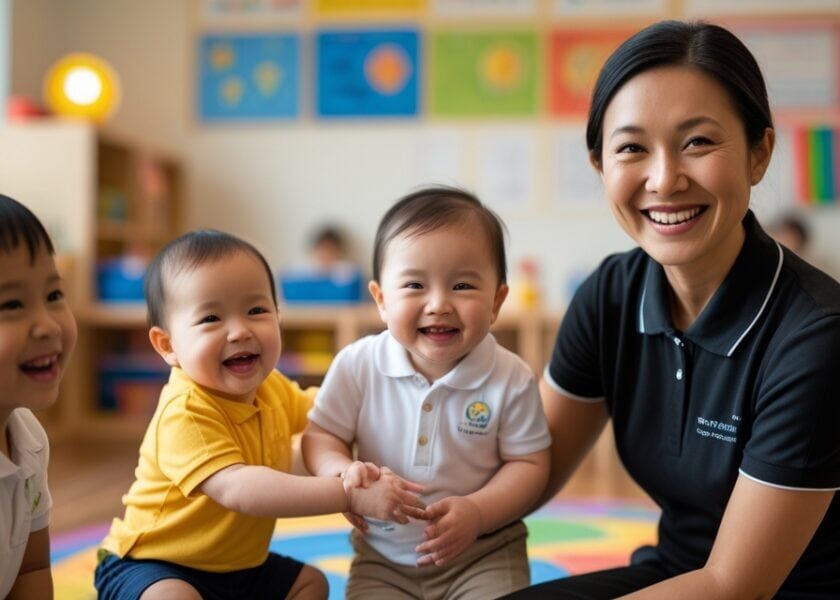
When you are standing in a room, watch not what the adults are doing with the whole group, but what they are doing with individual children. Notice how a caregiver responds when a child approaches with a question or a need.
Ask yourself:
- Is there a pause before the response?
- Is the caregiver already seated at a child’s level, or do they respond from across the room without changing position?
- When a child reaches out, does the response feel immediate, warm, and respectful of the child’s initiative?
Responsive care is not performative. It looks like a natural rhythm of attention and response that a caregiver has developed through genuine engagement with the children in their care.
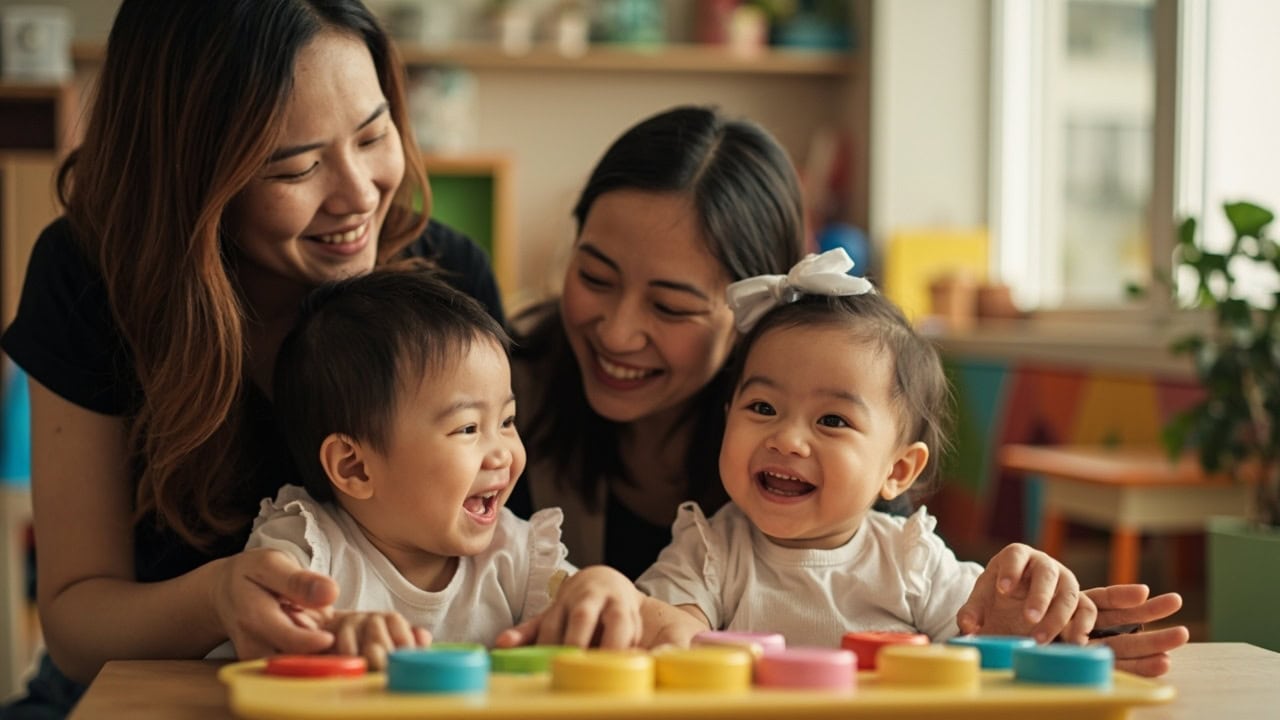
In Singapore, infant care ratios can vary, and this is worth asking about directly. Some programmes maintain ratios of up to one to three for infants, which allows for precisely this kind of responsive, individualised attention. When a caregiver has the space to respond to each child, the whole environment shifts. You will feel it the moment you walk in.
Signal 2: Child-Initiated Activity
Watch where children are directing their own energy. Are they moving toward materials, choosing what to play with, or are they waiting to be directed to an activity?
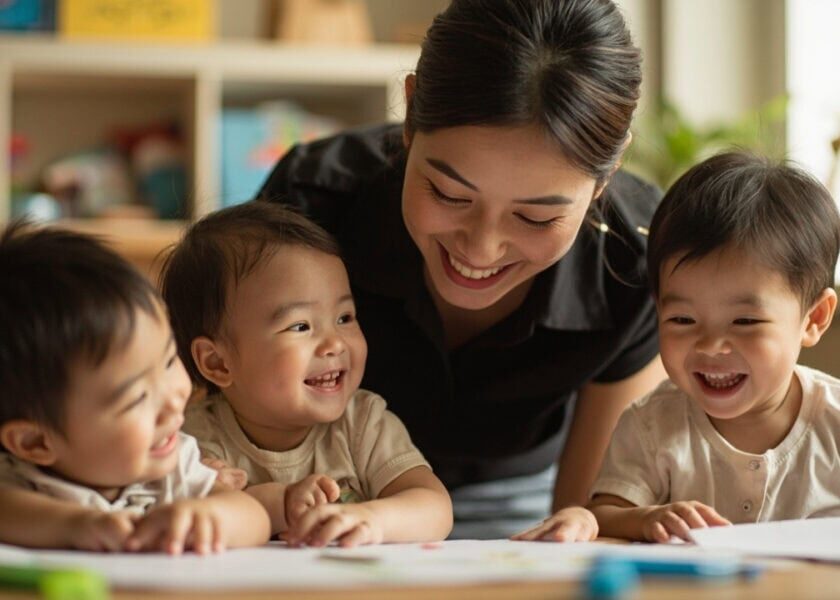
In a high-quality environment, you will see children engaged in self-directed play — building with blocks, exploring sensory materials, drawing, moving. The role of the caregiver in this environment is not to orchestrate but to support.
You should see teachers circulating, observing, occasionally entering a child’s play to extend it — asking a question, offering a new word, joining in for a moment before stepping back. This is the dance of early childhood education, and when you see it happening, you are seeing quality.
What to look for:
- Children choosing their own activities
- Caregivers supporting rather than directing
- Caregivers extending play naturally, not controlling it
- Children moving confidently through the space
Signal 3: Environment Design
Many parents underestimate this signal because it is easy to mistake aesthetics for intention. A beautiful room is not the same as a well-designed room.
Look at the materials available to children. Ask yourself:
- Are they open-ended — blocks, paint, clay, natural objects — or are they closed and prescribed?
Open-ended materials invite thinking, problem-solving, and creativity. Closed materials do a single thing and do not encourage exploration.
Look at the organisation of space:
- Are there clear areas for different types of play?
- Is there a quiet corner, an active space, a place for messy play?
The environment is a teacher in itself, and the best childcare environments are designed with intentionality.
You will also notice safety in the design:
- Are sharp corners minimised?
- Are materials age-appropriate and free from choking hazards?
- Are children able to move freely without constant intervention?
Safety in a high-quality environment is embedded in the design, not enforced through constant supervision and correction. When you see children moving confidently through a space, you are seeing an environment that has been built with their safety and development in mind.
Signal 4: Communication Patterns
Listen to how teachers speak to children, and how children speak to each other.
In a high-quality environment, you will hear respectful, reciprocal communication — not commands, not just directives, but conversation. Teachers narrate what they see. They name emotions. They ask open questions that invite thinking:
- “What are you building?”
- “What do you notice about this?”
- “How does that feel?”
This kind of language exposure is critical for early development, and it happens throughout the day, in small moments, woven into the ordinary rhythm of care.
Also notice communication with you, as a parent:
- How does the centre communicate with families?
- What systems are in place for daily updates, for concerns, for questions?
- In a well-run environment, you should feel welcomed to ask, welcomed to observe, and welcomed to partner in your child’s care.
Transparency is not a courtesy — it is a practice. For the first thousand days of your child’s life, when the brain is developing faster than it ever will again, knowing what happened in your child’s day is not an extra. It is essential.
Signal 5: Teacher-Child Ratio in Practice
This is not simply about the number posted on the wall. It is about what you observe when you are in the room.
Ask yourself:
- How many children is each teacher attending to at any given moment?
- Can you see moments where a child needs something and a caregiver is simply not available?
In an infant room, these moments matter enormously. A child who cries and is not responded to quickly experiences stress that, over time, shapes development. A child who is consistently responded to experiences something different — a world that is reliable, that makes sense, that responds to their needs.
This is the foundation of trust itself.
Red Flags: What Deserves Your Attention
A red flag is not a reason to panic. It is a reason to ask a question. Naming what to avoid is not about generating anxiety — it is about empowering you to trust your instincts when something genuinely is not right.
When you see these, pay attention:
- Inconsistent caregiver tone: A caregiver consistently raising their voice rather than using warmth
- Disengaged children: Children appear listless or passive — not calm, but disengaged
- Environment concerns: Unusual smells, crowding that makes free movement difficult
- Disconnection: A teacher who does not know a child’s name, or cannot tell you anything about how a child is settling
A single red flag is not a verdict. It is a conversation.
A good childcare environment welcomes your questions. If you notice something that concerns you, ask about it directly. Watch how the response is given. Is it defensive? Dismissive? Or open?
The way a centre responds to your concerns tells you something as important as what originally caught your attention.
The Second Visit: Where Observation Becomes Truth
Come back. Come back for a second visit. Not the polished tour visit, but an ordinary morning, when the routine is running, when the teachers are not performing for visitors.
This is what well-run centres invite, because what you see on an unannounced second visit is closer to the truth than what you see on a tour. If a centre resists a second visit, that is itself information.
On that second visit, bring the framework you now carry with you. Ask specific questions.
Not “Is my child safe?” — any centre will say yes.
Ask instead:
- “What does a typical morning look like for my child?”
- “How do you handle separation anxiety?”
- “What does communication with parents look like on a daily basis?”
- “Can I see the room where my child would spend most of their time?”
These are not challenging questions. They are smart questions. And the answers you receive, combined with what you observe, will begin to form a picture that is much clearer than the corridor silence you felt on your first visit.
Watching Your Child: The Signal No Framework Can Teach
And then — and this is the part that no framework can fully teach — watch your child.
Watch what happens in the days and weeks after care begins. Does your child seem to be settling, even if there are morning tears that fade? Or does your child seem to be retreating, losing something of their natural expressiveness?
A child’s response to care is not the only measure, but it is a profound one. Children are extraordinarily honest beings. They cannot hide what a place is doing to them, even when they cannot put it into words.
Trust what you see in your child. It is data. It is real information.
From Observation to Trust: The Honest Truth About Choosing Childcare
Choosing childcare is hard. It is hard not because you are inadequate or unprepared, but because it matters — genuinely matters — and there is no such thing as a decision that matters without some weight to it.
You are being asked to place your child’s days, their early experience of the world, in someone else’s hands. That is not a small thing. It is one of the most significant things a parent does in the early years.
But here is what I have seen, after years of working alongside families in Singapore: parents who are equipped — who know what to look for, who ask the right questions, who trust their trained observation — those parents do not just find good care. They find peace.
Not the peace of having removed all uncertainty, but the peace of knowing they have done their part. They have looked. They have asked. They have seen. And what they have seen is good enough.
And this is precisely where EduNanny meets you. We are part of Singapore’s ECDA Childminding Pilot, and we have built our programme around the conviction that quality early care is not a privilege for some families but a right for all children.
Our home-based and centre-based pathways are designed to be affordable within pilot fee structures, and we welcome the use of CDA and Baby Bonus subsidies — because the financial question should not be what stands between a child and the care they deserve.
Our Monday to Friday care blocks are structured around the realities of working families in Singapore, and our infant-to-caregiver ratios are designed to make the kind of responsive care described here not just possible but consistent.
We invite you to visit us. Not for a performance — for an observation. Bring your framework. Ask your questions. Watch what happens when a child reaches out and a caregiver responds. See for yourself what trained eyes notice.
You are not looking for perfection. No such place exists.
You are looking for a place where your child is safe, where they are known, where they are helped to grow into whoever they are becoming.
And when you know what to look for, you will recognise that place when you are standing inside it.
Come and see. We will be ready.
EduNanny is a Singapore childcare and childminding programme built on warmth, trust, and developmental care. Learn more about our approach.