The Learning Happening Right Now That You Cannot Yet See
The Learning You Cannot See
Here is what we want you to know, plainly and without jargon: your child is learning in there. Not just in the way a child always learns simply by existing — but in ways that are specific, intentional, and profoundly important to the person they are becoming.
The world of early childhood research has spent decades demonstrating something that parents tend to discover on their own, quietly, through observation: children do not learn primarily from what we teach them. They learn from what they experience, absorb, and practice in the ordinary course of a day. And in a quality childcare environment, the ordinary course of a day is extraordinary.
The Language That Arrives Before Words Do
Consider a morning in the life of a child in good care. She wakes from a nap and is greeted not with efficiency but with language — a caregiver who narrates what is happening, who says good morning, I see you slept well, shall we get your shoes now — a steady, warm stream of words that researchers call language-rich interaction.
By the time she is two years old, the child in a language-rich care environment has heard millions more words in meaningful context than a child who has not. Not from a screen. Not from a recording. From a person who is looking at her and speaking to her, in the ordinary business of a morning.
This is not a technique. It is not a curriculum item that gets checked off. It is simply what happens when a caregiver understands that every interaction is an opportunity — a meal, a diaper change, a walk to the garden, a moment of frustration over a toy — to model language, to expand a child’s thinking, to say, I see you are building a tower. It keeps falling down. That is frustrating, isn’t it? Let us try again together.
The Social World That Opens Between Peers
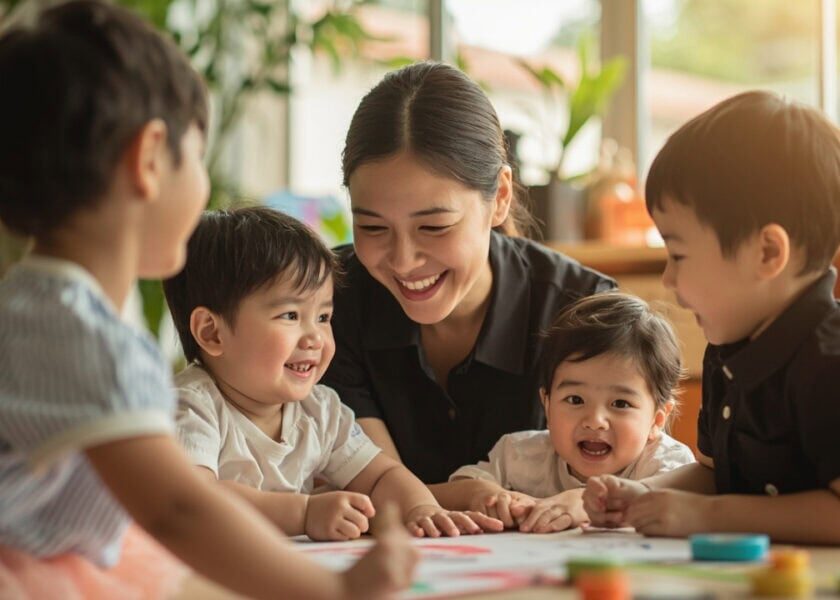
Now place that same child in a room with two or three others, as she might be in a small home-based setting with a carefully maintained ratio. She watches another child push a truck across the floor. She reaches for it. There is a brief negotiation — or a cry, or a laugh — and in the space between that cry and the caregiver’s quiet intervention, something significant is occurring.
She is learning that other people have intentions. That her actions affect someone else. That a caregiver can be trusted to help sort things fairly. These are not small lessons. They are the foundations of social competence — the ability to be a person among people — and they are built brick by brick, in moments that parents rarely witness and that do not appear in any daily report.
This is what researchers mean when they speak of the hidden curriculum of childcare. It is the learning that occurs not because it was planned but because a child was present, in a thoughtfully designed environment, with attentive adults and peers, for enough hours of the day that the ordinary begins to do its work.
Why Singapore Parents Feel This More Deeply
There is another dimension to this that deserves careful attention, because it speaks to something Singapore parents understand viscerally, even if they have not articulated it.
Singaporeans invest heavily in their children’s futures. This is not a cultural abstraction — it is a lived reality shaped by economic circumstances, family expectations, and a deep collective belief that the early years matter in ways that are difficult to overstate.
You know that the window is small. You know that what happens between birth and primary school — between the ages of zero and six — shapes cognitive architecture in ways that later schooling can build upon but cannot fully recreate.
This knowledge is a gift. It is also a weight. It means that every decision about childcare carries more than logistical significance. It carries the feeling of permanence, of consequence, of a door that will not open again if it closes.
You are not wrong to care about this. You are not being anxious or overprotective or insufficiently trusting when you wonder whether the care your child receives is truly developmental. That wondering is a sign of engagement.
And here is what quality care quietly, consistently, and competently does every single day: it builds in your child capacities that will not show up on a report card for years. The ability to wait. The ability to express a feeling in words instead of a scream. The ability to try something difficult, fail, and try again without catastrophizing. The ability to walk into a room of strangers and find a way to belong.
These are not soft outcomes. They are the executive function skills and emotional regulation capacities that predict school readiness, social confidence, and long-term resilience with a consistency that has been documented across decades of developmental research.
What Quality Childminding Actually Looks Like
In the context of an arrangement like EduNanny, this philosophy takes specific form. Understanding what to look for — and what to expect — helps you evaluate whether the care you are considering truly offers these developmental advantages.
The Advantage of Small Scale
EduNanny operates within the ECDA Childminding Pilot, which means it is part of a deliberate, structured effort to expand the kinds of childcare options available to Singapore families — options that go beyond what centre-based care can easily provide for the youngest infants and the most intimate learning environments.
The childminding pathways through EduNanny — whether home-based or community-based — share a defining characteristic that sets them apart from larger group settings: scale. When a caregiver is responsible for one, two, or three infants at most, every interaction is unhurried.
There is no pressure to move through a routine because the next activity begins in fifteen minutes. A child’s fascination with how water pours from one cup to another is allowed to continue for as long as it holds the child’s attention, because in a small, carefully staffed environment, there is space for that.
And that sustained, self-directed exploration — not the activity itself but the experience of choosing something, focusing on it, and returning to it — is one of the earliest and most important exercises in independent thinking a young child can have.
Small Settings Are Not Lesser Settings
Parents sometimes worry that home-based or small-group care means fewer learning opportunities — that their child will miss out on the social dynamism of a larger peer group.
This is understandable, but it mistakes quantity for quality. In a small setting with one to three infants, each peer interaction is significant. There is no anonymity. Your child cannot hide in the crowd because there is no crowd.
Every interaction with another child is a learning moment, and every moment is observed and gently guided by a caregiver who knows both children by name, by temperament, by mood, by what soothes them and what challenges them.
| Small-Group Childminding | Larger Centre Settings |
|---|---|
| One to three infants per caregiver | Multiple children per educator |
| Every interaction is unhurried | Routine schedules keep things moving |
| Caregiver knows each child deeply | Broader relationship across more children |
| Each peer moment is significant | More peer exposure, less individual focus |
| Extended self-directed exploration | Activities structured around group timing |
Everyday Moments as Learning Opportunities
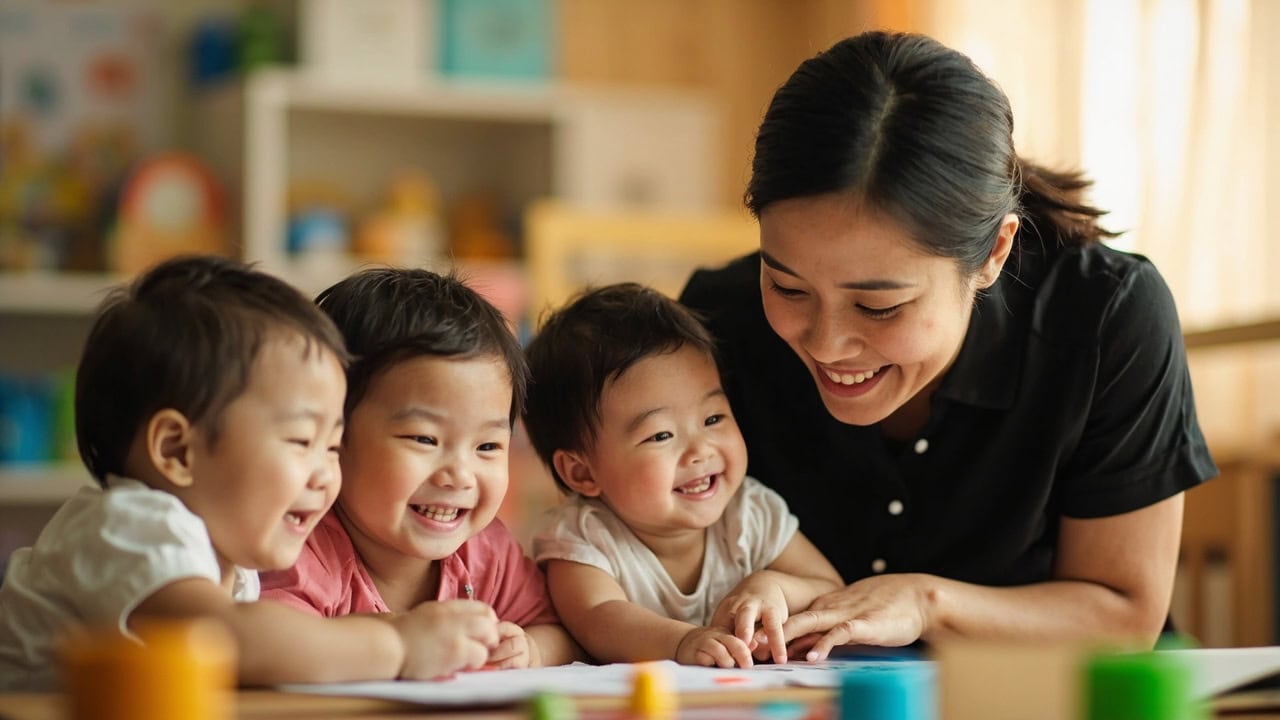
The caregiver is not just watching. She is noting, reflecting, extending. She is the quiet narrator of your child’s morning.
And because the environment is built around responsiveness rather than throughput, she has the capacity to follow your child’s lead in ways that a busy centre classroom, however excellent, simply cannot always accommodate.
What does this look like in practice?
- Mealtimes become language lessons — naming foods, describing textures, celebrating attempts
- Diaper changes become conversations — describing what is happening, asking simple questions
- Outdoor walks become sensory explorations — pointing to birds, naming colours, describing the wind
- Frustration moments become coaching opportunities — naming feelings, modeling calm, guiding resolution
- Free play becomes cognitive development — watching persistence, celebrating attempts, extending play
Your Questions, Honestly Answered
There are concerns that Singapore parents carry into this decision, and they deserve direct answers rather than careful deflections.
Will My Child Really Be Learning, or Just Being Supervised?
In quality childminding, supervision is the floor, not the ceiling. Safety and comfort are necessary conditions — the baseline from which learning begins. But they are not the full picture.
The learning described in this article — language acquisition through rich interaction, social competence through peer negotiation, emotional regulation through caregiver scaffolding, executive function through self-directed play — does not happen accidentally. It happens because the environment is designed for it, the caregiver is trained for it, and the ratio allows for it.
What About Affordability?
For families in the EduNanny pilot, the framework includes affordable fee structures, and the ability to use CDA funds and Baby Bonus contributions. This means the practical realities of quality care do not fall entirely on monthly household budgets.
Premium care should not be premium in the sense of inaccessible. This is an intentional part of the ECDA Childminding Pilot’s design — recognizing that the children who benefit most from intimate, responsive care are often those whose families need the most support to access it.
How Do I Know What Is Actually Happening?
You have handed something precious to a stranger, or to a carefully vetted caregiver who becomes, over time, something more than a stranger. The trust involved in that act deserves a reciprocal commitment — a commitment to transparency, to openness, to finding ways to let you in, even when your child is in another part of the home or the community setting and you are at your desk, in a meeting, on a commute, wondering.
EduNanny uses communication measures including CCTV where deployed, not because surveillance is a substitute for trust, but because trust, in this context, is built through evidence and openness. You should be able to know, in broad strokes and through regular updates, what your child’s day looked like.
This is not a feature. It is a posture. It is the understanding that you are a partner in your child’s care, not a customer at a service counter, and that the best outcomes for your child occur when the people at home and the people at the childcare setting are genuinely connected, even across a distance, even across a workday.
Choosing Infant Care in Singapore: What to Look For
If you are researching your options, here is what to look for and what to ask — practical guidance for parents who want to evaluate quality with their eyes open.
Questions to Ask Any Childcare Provider
- What is the caregiver-to-child ratio? (For infants, one to three is ideal for responsive care)
- How do caregivers interact with children during routine activities like feeding and diaper changes?
- What does a typical day look like — and is there space for child-led exploration?
- How do you communicate with parents about their child’s day?
- What training do your caregivers have in early childhood development?
- Can I observe a session before committing?
Signs of Quality Childminding
- Caregivers speak to children in full sentences, narrating what is happening
- Routines are flexible enough to follow a child’s interests
- The environment is safe but allows for appropriate risk and exploration
- Caregivers name and validate emotions, helping children learn to manage them
- Peers interact regularly, with caregivers guiding rather than intervening
- Parents receive regular, genuine updates — not just “they slept well”
What Singapore Parents Should Prioritise
Given the investment Singapore families make in their children’s futures, quality should be evaluated not just by convenience or cost, but by:
- The depth of caregiver-child relationship possible in the setting
- The quality of language interaction throughout the day
- The space given for self-directed play and exploration
- The caregiver’s responsiveness to individual children’s rhythms and needs
- The transparency and communication practices of the arrangement
The Answer to the Question You Carry
We want to close by returning to that doorway. The one you stand in, perhaps, every evening, watching your child do something you have never seen before — a small, ordinary, revelatory thing that tells you something about who they are becoming.
You chose this. Whatever your reasons — work, family, circumstance, or simply the belief that your child deserves a rich, structured environment of care and learning — you made a choice, and you made it with your child’s best interests at the centre of your thinking. That is not a small thing. It is, in fact, the most important thing you do all day.
And here is what we want you to take with you tonight: the learning that happens while your child is in quality care is not a consolation prize. It is not supervision dressed up as education. It is real, measurable, and profoundly significant.
In the hours between drop-off and pickup, your child is building language. They are navigating social complexity. They are learning to manage frustration, to share space, to ask for help, to persist at something difficult, to be a person among people.
They are doing this through interactions with a caregiver who narrates their world with warmth and intention, through routines that teach them sequence and predictability and the comfort of knowing what comes next, through a physical environment designed to invite exploration and reward curiosity.
They are doing this in ways that will compound over months and years into the kind of quiet, steady confidence that no single activity can manufacture.
You will not always see it. Much of it will remain invisible to you — not because it is hidden, but because the most important learning in early childhood does not announce itself. It lives in the spaces between moments:
- In the pause before a toddler chooses to share a toy
- In the way a two-year-old looks up and says, I did it
- In the ease with which a child walks into a room full of children, finds her footing, and stays
That ease was not born from nothing. It was built, carefully and consistently, in the hours when you were not in the room — by people who understood that their work was not merely caregiving. It was building.
EduNanny exists because we believe those hours deserve to be filled with more than safety and comfort. They deserve to be filled with intention. With language. With the quiet, daily miracle of a child discovering that the world is interesting and that they are capable of meeting it.
Here is what we want you to know, with complete confidence: you made the right choice. Not because EduNanny is perfect, but because you asked the right questions, you chose thoughtfully, and you care deeply about what is happening in the hours when you are not in the room.
Your child is showing you, in small and unrepeatable moments, that you were right to trust the process — not blindly, but with your eyes open, asking the right questions, and finding answers that are more encouraging than you ever expected.
That child at the low table, carefully placing containers into a wooden crate — that is not just play. That is concentration developing. That is fine motor skills being refined. That is a sense of order emerging. That is your child, building themselves, one small moment at a time.
And somewhere, a caregiver is watching with quiet satisfaction, knowing what she knows — that this ordinary moment is extraordinary, and that the hours are being used well.
You chose this. And your child is showing you it was the right choice, every single day.
Your child is learning. You were right to trust the process.
Ready to explore whether EduNanny’s childminding pathways are the right fit for your family? Get in touch or learn more about who we are and how our pilot programme works.