The Science Behind What Your Child Learns in Singapore Childcare Each Day
What Is Really Happening in Your Child’s Ordinary Hours
Let us start with what is happening inside your child’s brain, because it is extraordinary — and because understanding it changes how you think about every morning goodbye.
In the first three years of life, the human brain builds more than one million neural connections every second. This number is often cited, but what it actually means is easy to miss. It means that your child’s brain is not waiting to learn. It is learning constantly — from the texture of a wooden block held in a still-grasping hand, from the rhythm of a caregiver’s voice saying the same phrase for the fifth time in an hour, from the moment another child takes a toy and a small face registers the injustice of it.
Each of these moments is not incidental. It is data. It is structure. It is the slow, invisible construction of the person your child will become.
The science of early brain development tells us something that is easy to forget when we are comparing childcare options: the brain does not grow from being told things. It grows from doing things — from sensory experience, from repeated action, from the social friction of being with other people who are also learning how to be people.
This is why the daily environment of quality childcare matters so profoundly. It is not a waiting room before school. It is, when designed well, a carefully considered developmental space where your child is building the actual architecture of their thinking, their emotional regulation, and their relationship with learning itself.
Inside One of Those Days
Let us take you inside one of those days — not a perfect day, not a promotional day, but an ordinary one. Because the ordinary days are the ones that build a life.
Your child arrives. There is a small moment of transition — a hand that grips yours a little tighter, a pause at the door. The caregiver is warm but not theatrical about it. She acknowledges your child by name. She notices the small dinosaur clutched in one hand and asks about it. This is not a coincidence. It is the first act of the day: a bridge between the family world and the childcare world, built through the smallest possible thing a child cares about.
Within minutes, your child is in a space that smells different, sounds different, looks different. And in that space, even before formal activities begin, the learning has already started.
Watch what happens when a child picks up a container of rice. A parent might see mess. A developmental eye sees fine motor planning, sensory processing, the beginning of understanding that solid things exist independently of the self, and the concept that things can be poured, collected, watched fall. The child is not playing with rice. The child is building the foundations of physics, causality, and hand-eye coordination simultaneously.
Language development in the first three years is not about flash cards or vocabulary drills. It is about the back-and-forth of attention and response between a child and a responsive adult. Psychologists call this serve-and-return interaction, and it is one of the most robust predictors of later language and cognitive ability that we know of.
Here is what it looks like in practice: a child drops a wooden spoon on the floor, looks at it, and hands it to the caregiver. The caregiver says, “You dropped it. Let me put it back on the table.” The child drops it again. The caregiver smiles and says, “You like where it falls.”
This exchange, which takes perhaps ten seconds, is doing extraordinary work. The child learns that her actions have effects. Another person responds to her signals. Words correspond to things, actions, and feelings. This world is a place where her presence registers. Language is something spoken with her, not just at her.
Multiply this across a full day — across dozens of small exchanges, each one a tiny act of connection and confirmation. By the time a child has spent a year in this environment, they have accumulated thousands of these moments, and each one has left a mark on the language architecture of their brain.
There is another dimension to the ordinary childcare day that is easier to overlook: the social-emotional curriculum. Children are not born knowing how to be with other children. They learn it the way they learn everything else — through practice, through repetition, through the inevitable friction of shared space and competing desires.
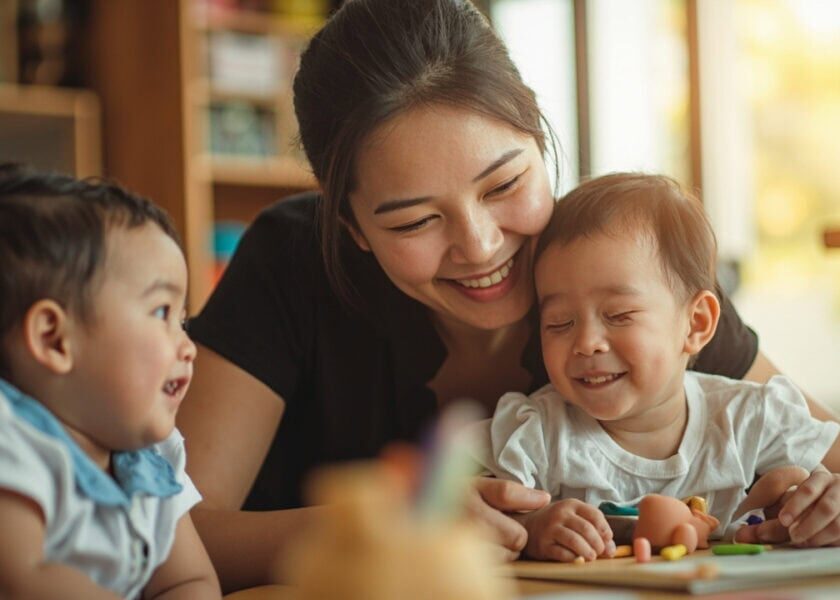
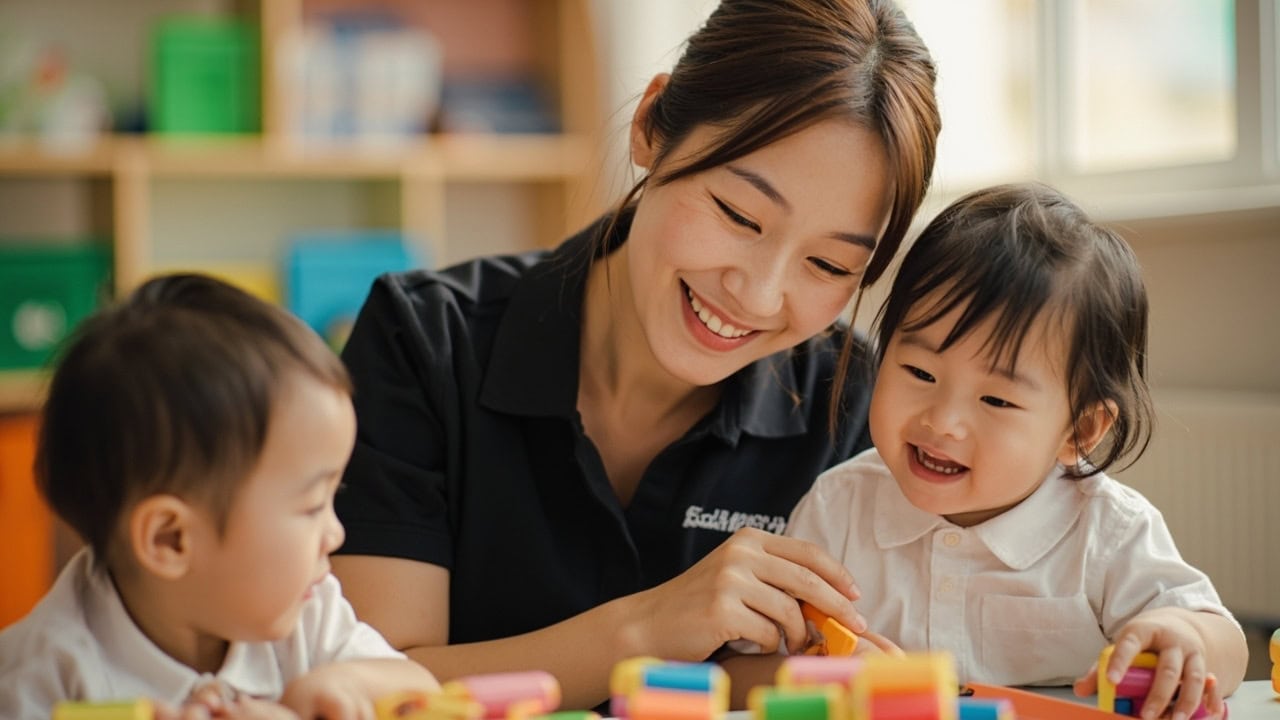
Watch two toddlers in a quality childcare setting. One has a truck. The other reaches for it. There is a moment — brief, charged, instructive — when both children register the conflict. A caregiver moves closer. Not to solve the problem, but to be present in it. She might narrate what she sees: “Both of you want the truck.” She might offer an option: “We have another one on the shelf.” She might simply stay nearby while the children work it out.
What is happening here is not just conflict resolution, though it is that. It is the slow construction of emotional regulation — the understanding that strong feelings can be felt, that another person’s desires are real and matter, that problems have solutions, that a trusted adult is nearby when the feelings are too big to hold alone.
Research consistently shows that children who develop strong emotional regulation skills in the early years arrive at primary school better equipped to focus, to persist with difficult tasks, to recover from setbacks, to be curious in the face of uncertainty. These are not soft skills. They are the foundations of everything we later call academic resilience, social intelligence, and executive function.
School Readiness: What Singapore Parents Actually Need to Know
There is a question that Singapore parents carry with particular weight, and it is worth addressing directly because it is real and it matters.
The question is about school readiness.
You have heard the term. You have seen it on school websites, in parent forums, in conversations at playgrounds. And you have wondered whether the hours your child spends in childcare are preparing them for what comes next — or simply filling time until school begins.
Here is the honest answer, based not on promises but on developmental evidence.
School readiness is not about knowing letters or numbers before you arrive. It is about a cluster of capacities that have almost nothing to do with content knowledge and almost everything to do with how a child has learned to learn:
- The ability to focus — sustained attention on a task or story
- The willingness to try something uncertain — comfort with not knowing the answer
- The skill of being in a group — taking turns, listening, being part of something
- The confidence to ask for help — knowing that adults are safe resources
- Emotional resilience — the ability to be frustrated and try again
- Curiosity — leaning forward when something new is presented
These capacities are built — painstakingly, repetitively, day by day — in environments that take children’s learning seriously: in sensory exploration that builds neural pathways, in language interactions that wire the machinery of thought, in social moments that teach the texture of other people’s feelings, in cognitive challenges that wire the circuits of problem-solving and imagination.
The children who walk into Primary 1 curious about what is there are not the ones who were drilled on alphabets. They are the ones who spent their early years in an environment that treated every ordinary moment as worthy of attention.
What Makes EduNanny Different: The Singapore Context
We live in a society where parents are pulled in multiple directions simultaneously. The cost of living, the expectations of extended family, the competitive clarity of our education system — all of these create pressures that other contexts simply do not have in the same combination.
Singapore parents are not more anxious than other parents. They are, in many cases, more analytically rigorous about the choices they make, because the stakes feel high and the information available is vast.
What this means is that you deserve more than reassurance. You deserve specificity. You deserve to understand, in concrete terms, what the environment you are choosing for your child is actually doing.
EduNanny operates under the ECDA Childminding Pilot, which means its approach is not ad hoc — it is structured around standards that have been developed and reviewed by the people who understand early childhood development most carefully in Singapore. The pilot pathways offer both home-based care and community or centre-based options, which means the model is flexible enough to fit the realities of different families’ lives.
The ratios in the infant room — up to one caregiver for every three infants — are not marketing figures. They are developmental ones. They reflect the research on how much individual attention young children need to thrive, and they make possible the kind of unhurried, responsive care we have been describing.
When your child is not waiting for attention, they are receiving it: in the small responsive moments that happen dozens of times a day. A gaze met and returned. A word offered when a child points. A hand steadied when a tower of blocks wobbles and falls. Those responses are not just kindness, though they are that. They are the building blocks of language, emotional regulation, and trust.
EduNanny understands that communication is not optional in this arrangement. When you spend your working hours apart from your child, the gap between you needs to be bridged by information. Caregivers who are trained to observe and document — who notice that your child has been working on a puzzle with increasing persistence, or that a new word appeared today, or that the small bump on the knee from yesterday has scabbed over nicely — those caregivers are not just keeping your child safe. They are building a portrait of your child’s day that you can carry with you until you are reunited.
Quality should not be a privilege available only to families with significant resources. The fee structures within the pilot are designed to be accessible, and CDA and Baby Bonus funds are usable, which means the financial architecture of your choice is coherent and manageable. These are not small things. They are the practical conditions that make it possible for you to choose quality care and sustain it.
What to Look for When Choosing Infant Care in Singapore
If you are evaluating childcare options, here are the questions that matter most, grounded in what developmental science tells us about what children actually need:
- Caregiver-to-child ratios: In the infant room, a one-to-three ratio allows for the unhurried responsiveness described above. Ask specifically about this number.
- Language-rich interaction: Watch for spontaneous serve-and-return exchanges. Do caregivers narrate what is happening? Do they respond to children’s signals, even small ones?
- Sensory and motor environment: Is there space to move? Are there materials that invite exploration — water, sand, blocks, objects to pour and stack? Or are children mostly seated or in front of screens?
- Social curriculum: When conflicts arise — and they will — how do caregivers respond? Do they step in immediately to solve, or do they stay present while children develop their own problem-solving?
- Daily rhythm: Predictability and transitions matter. A well-designed day with consistent routines helps children feel secure, and security is the foundation from which curiosity grows.
- Communication: Will you know what your child’s day looked like? Is there regular documentation, photographs, verbal handover? The best care keeps parents connected even across distance.
- Regulatory alignment: Is the programme aligned with ECDA standards or operating within an approved pilot? This matters for quality assurance and for accessing government support.
Making Those Hours Worthy of Your Child
There is one more thing worth saying, because it is the thing that parents carry most heavily.
The decision to place your child in childcare is often experienced as a compromise. You are giving something up. You are navigating guilt, logistics, the complicated arithmetic of modern parenting in Singapore.
But here is what years of understanding this subject teaches: the question is not whether your child benefits from time with you. Of course they do. The question is what happens in the hours you are not there — and whether what happens there is worthy of your child.
Because the hours apart are not lost hours. They are added to it — or they are not, depending on what is actually happening in that environment.
The children who grow up in responsive, developmentally intentional childcare settings are not damaged by the time away. They are built by it. They learn to separate and return. They learn that the world contains other trusted adults. They learn that learning happens everywhere, including here, in this room with these blocks and this caregiver and these other small people who are also figuring out how to be human.
EduNanny was built around this understanding. Not as a slogan or a positioning statement, but as a daily practice. The caregivers are trained to see what is happening in those ordinary hours and to tend to it with the same seriousness you would bring yourself. The environment is structured not just to keep children safe and fed and rested — though it does all of that — but to offer them the repeated, responsive, developmentally rich experiences that build the brain they will carry for the rest of their lives.
When you drop your child at the door in the morning, you are not abandoning them to an empty space. You are placing them inside a curriculum — a daily, invisible, profoundly consequential curriculum — and the question worth asking is not whether you should feel guilty about that, but whether the curriculum is good enough.
EduNanny believes it is. And the reason is not complicated. It is because every child deserves to spend their ordinary hours in an environment that knows what it is doing, that understands what is at stake in a morning of block-building and a lunch shared with friends and a caregiver who says your child’s name like it matters — because it does.
To learn more about how EduNanny approaches the ordinary hours with developmental intentionality, we would be glad to hear from you.