How Singapore Parents Find Quality Care for Two Children Who Are Different
The Moment Every Parent of Multiple Children Eventually Recognizes
There is a moment every parent with more than one child eventually recognizes. It does not announce itself. It arrives quietly, often at the end of a long day, when you are folding laundry or washing dishes and your mind drifts to the morning you just lived.
You think about how your eldest negotiated her breakfast with the kind of certainty that belongs to someone who has been in the world long enough to know what she wants. And you think about your youngest, who is still learning to walk, who still needs to be carried with a particular kind of tenderness, who cannot yet say what he needs so he shows you instead—in the way he reaches, in the way he cries, in the way he watches his sister with something that looks like both admiration and longing.
And in that quiet moment, you realize that the arrangement you once thought would work for both of them has begun to feel like a compromise. Not a bad one. Not a failing one. But a compromise nonetheless.
Because what your daughter needs now is different from what your son needs, and the place that was right for her at two is not quite right for him at ten months. Or perhaps they are together somewhere,, and you notice that she is being asked to wait, to share, to adjust, while he is still learning how to be separate from you. And you wonder whether somewhere in the logistics of caring for two, one of them is becoming invisible. Not from anyone’s fault. Just because managing multiple children is hard, and sometimes the loudest need gets met first, and the quieter one learns to wait.
This is not a failure of childcare. This is the reality of raising siblings in Singapore, where the options feel limited and the expectations feel enormous, where we are told to trust the process but also to advocate fiercely, where we are navigating rising costs and housing schedules and work demands and the quiet, persistent fear that we are not doing enough for each of our children individually while also trying to hold the family together as a whole.
You are not alone in this feeling. And it is not a feeling without substance.
The Real Challenge: Knowing Siblings as Individuals
The truth is that multi-child families in Singapore face a childcare challenge that is fundamentally different from the challenge facing parents of one child. It is not simply twice the logistics. It is the challenge of understanding that two children who share a home, who share a history, who share your last name and your hopes, still need to be known as individuals.
They need to be seen not as a pair, not as “the children,” not as siblings in the way that erases their particularity, but as specific, unrepeatable people with their own temperaments, their own rhythms, their own timelines for growing.
Your daughter is bold and social and loves the challenge of a new puzzle. Your son is thoughtful and careful and takes time to warm up, but once he trusts, he connects deeply. These are not just personality traits. They are the early architecture of who they are becoming. And the care they receive in these formative years—the care that sits alongside your own influence—shapes how that architecture develops.
The sibling relationship itself is a developmental resource. When children grow up together in quality care, something happens that cannot be replicated in isolation. Your children learn from each other—not just the obvious things, like how to share and how to negotiate and how to tolerate frustration. They learn the subtler things, too.
They learn that another person can have needs that are different from their own, and that those needs are not a threat. They learn that they can be separate from each other even within a close bond. They learn emotional regulation not from being taught, but from watching, from mirroring, from the daily practice of being in relationship with someone who is like them in some ways and utterly different in others.
A younger child in the presence of an older sibling often develops language and social skills more quickly. But the mechanism is not mechanical. It is relational. Your son watches your daughter speak, watches her be responded to, watches the way meaning moves between people, and he incorporates that into his own emerging sense of self. He is not imitating her. He is using her as a map for how to be a person in the world.
And your daughter, in caring for, competing with, playing with, and sometimes frustrating her brother, learns about power and fairness and her own capacity. She learns that she can be helpful and that she can be selfish. She learns that her feelings are valid and that other people’s feelings are also valid. These are not small lessons. These are the foundations of emotional intelligence, of empathy, of moral reasoning, of the capacity to be in relationship with others throughout a lifetime.
When Care Environments Fall Short
Here is the catch. For the sibling bond to be this kind of developmental resource, the care environment must be one that allows each child to be seen.
- If your daughter is constantly having to wait because her brother’s needs are more immediate, she learns that her needs are less important.
- If your son is constantly compared to his sister, or held up as an example, or positioned as the one who needs more help, he learns something about himself that may not be true.
- If the caregiver sees them as a unit to be managed rather than as individuals to be known, the sibling relationship becomes a source of strain rather than a source of strength.
This is the problem that most childcare arrangements have not solved. They are designed for one child at a time, or they are designed with a group dynamic that works for the average child, or they are designed with ratios and schedules that make individual attunement difficult.
When you have two children in care, these limitations are magnified. The toddler who needs a nap at ten does not fit neatly into the schedule of the three-year-old who has just discovered the joy of running. The infant who is learning to self-feed needs patient, unhurried support that the older child, ready for structured activities, does not need. The caregiver who genuinely loves both of them may still find herself stretched thin, choosing between needs, prioritising urgency over importance.
What you are looking for is not a miracle. It is a model of care that takes the complexity of siblings seriously. A model that understands that serving two children well is not simply twice the work but a qualitatively different kind of work, one that requires observation, differentiation, and the willingness to hold each child’s individual developmental trajectory in mind even while managing the group.
In practice, this means:
- Different temperaments require different approaches. A bold, social child thrives with new challenges and peer interaction. A cautious, thoughtful child needs space to warm up and time to build trust before engaging.
- Different stages mean different rhythms. An infant learning to self-feed needs unhurried, patient support. A preschooler ready for structured activities needs engagement that matches her growing capabilities.
- Different needs require active attention. When the caregiver sees siblings as individuals to be known rather than a unit to be managed, neither child becomes invisible.
What Quality Childminding Looks Like
Quality childminding for siblings is not about keeping them apart or giving each child separate attention in isolation. It is about a caregiver who holds each child in mind, who adjusts her approach, her language, her expectations, her warmth, to meet each child where they are.
It is the difference between management and care. It is the difference between a transaction and a relationship.
In practice, individual attunement in a multi-child setting looks like this:
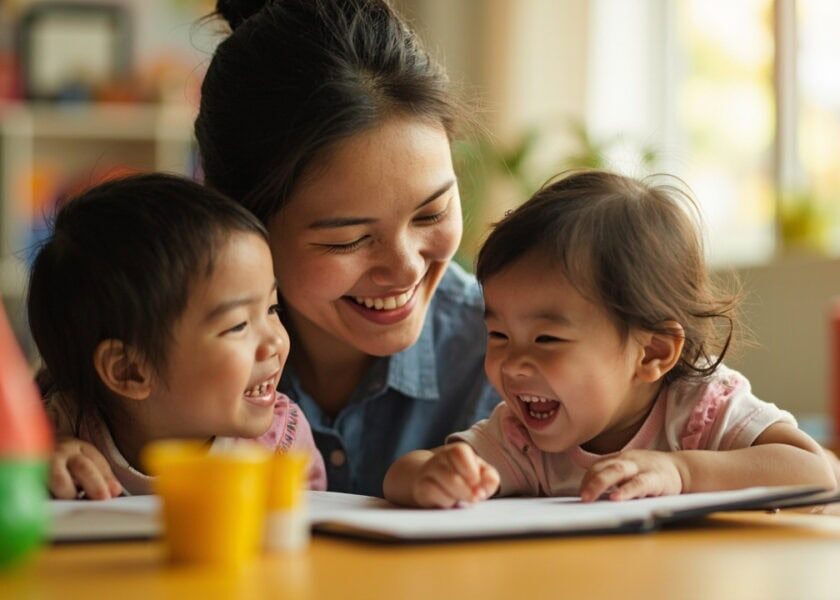
- The caregiver notices that your daughter is going through a language explosion and begins narrating more of the day to her, introducing vocabulary, asking questions that stretch her thinking.
- She notices that your son is working on a fine motor milestone, picking up small objects with increasing precision, and she creates opportunities for that practice without making it a lesson, without turning it into something that feels like work.
- She notices when they are in conflict and when they are in communion, and she understands that both moments are important—that the sibling bond is not about constant harmony but about learning to navigate difference.
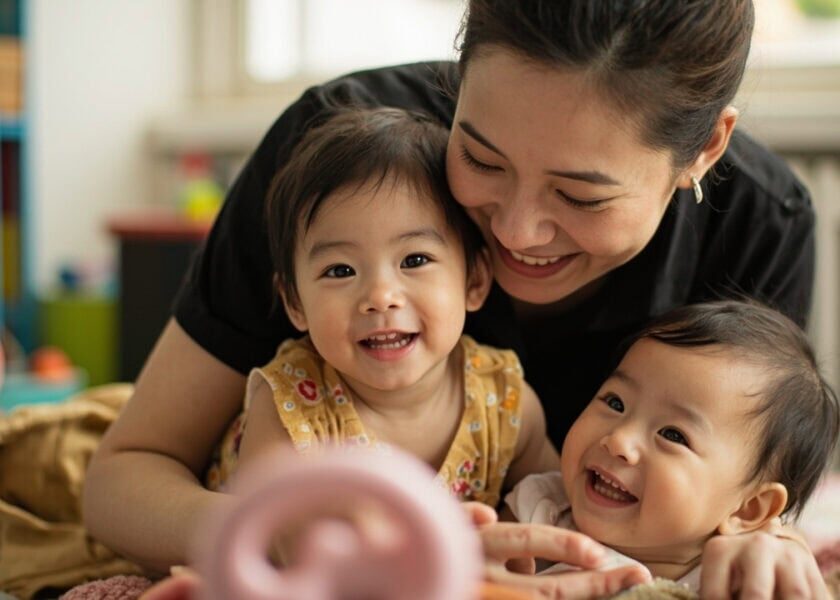
For parents, this difference is not abstract. It shows up in the small things you hear at the end of the day. It shows up when your daughter says the caregiver called her by name, not just as an afterthought but with recognition, with the kind of attention that says you are known here. It shows up when your son reaches for the caregiver’s hand at drop-off, not because you are not enough, but because she has become a person of trust in his life—a consistent, warm presence who has learned his particular rhythms, his particular needs, his particular way of being in the world.
EduNanny: Designed for Siblings
EduNanny operates within the ECDA Childminding Pilot, a government-supported framework designed to expand the range of quality care options available to Singapore families. The pilot recognises what parents have always known: that home-based, near-home care serves a need that centre-based arrangements sometimes cannot meet.
EduNanny offers a model of care designed for the realities of multi-child families:
- Individual attunement for each child—not just supervision, but observation and responsiveness to each child’s temperament, milestones, and needs
- A focus on the sibling bond as a developmental resource—creating space for children to learn from each other while ensuring neither becomes invisible
- Near-home care—in an environment that has the texture of home, with routines that can be flexible and adaptable
- Transparent communication—so parents are part of the care, even when not in the room
The near-home dimension matters here, too. When care happens close to where you live, in someone’s home or in a community setting within your neighbourhood, the transition is gentler. Your children are not travelling far to be in a strange place. They are in an environment that has the texture of home, with toys that are not institutional, with routines that can be flexible, with a caregiver who can adapt in ways that a larger centre sometimes cannot be.
And for you as a parent, there is a practical simplicity to it. Monday to Friday care blocks, transparent communication, visibility into what your children are experiencing. You are not left wondering. You are not left guessing. You are part of the care, even when you are not in the room.
Questions Parents Ask
“Will my younger child slow down my older child’s development?”
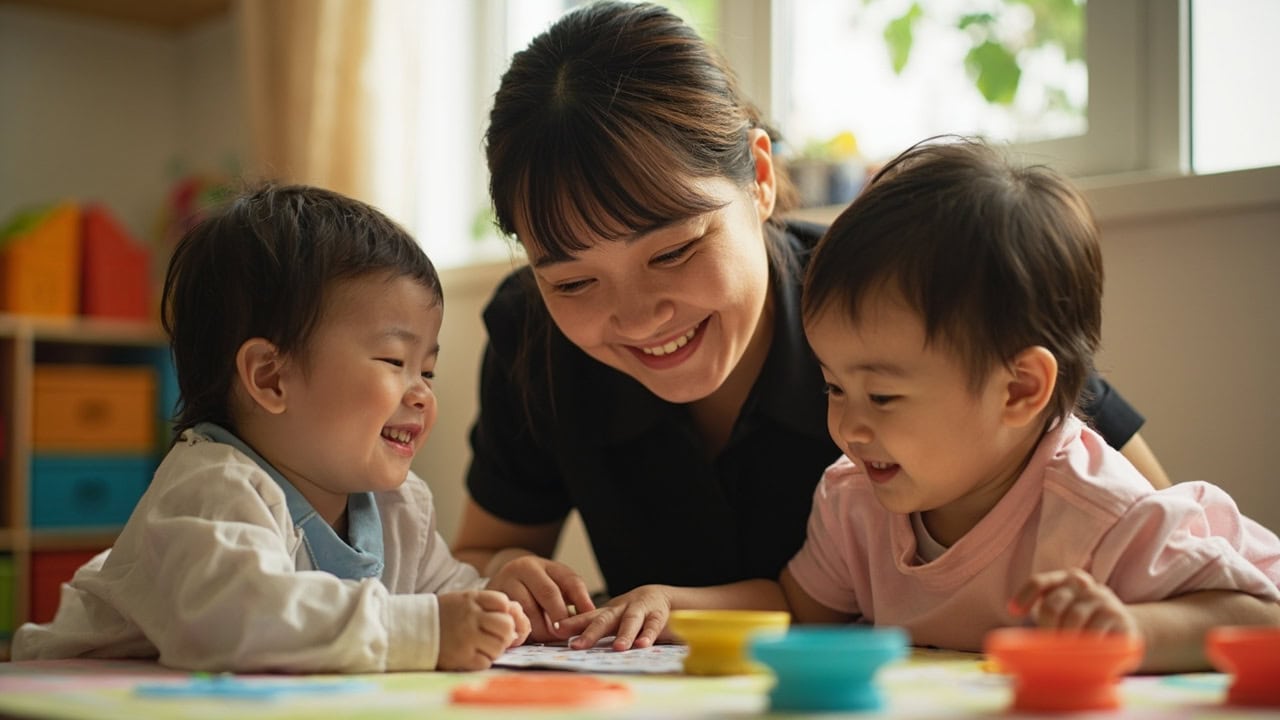
Not in a quality care environment. When each child is seen as an individual, the caregiver creates space for different activities, different levels of engagement, and different rhythms. Your older daughter can be challenged with new puzzles and language experiences while your younger son works on his motor milestones—with both happening in the same home, learning from each other, but not at each other’s expense.
“What if one child needs more attention than the other?”
In quality childminding, the caregiver learns to read both children. She understands that your bold older child may need less hands-on support but just as much attention and recognition. She understands that your younger child needs physical care but also emotional attunement, not just management. Individual attunement means holding both needs in mind—not just responding to the louder need.
“How is this different from a childcare centre?”
Centre-based care serves many children with schedules and ratios designed for group management. Near-home childminding offers a different ratio, which means the caregiver is not juggling so many children that she cannot notice the small things, the significant things, the things that tell you who your child is becoming. The environment itself is domestic, flexible, and adaptable in ways that institutional settings often cannot be.
“Will my children still develop a strong sibling bond?”
When each child is seen as an individual, the sibling bond is stronger, not weaker. Your daughter does not learn to resent her brother for taking attention away from her. Your son does not learn to define himself in comparison to his sister. Instead, they learn together, play together, navigate conflict together, and develop a bond rooted in genuine connection—not obligation or proximity. This foundation serves them throughout their lives.
What Your Children Carry Forward
Children who grow up together in quality care, where each is seen and each is known, develop something that children who are cared for in isolation do not develop in quite the same way:
- Strong individual identity—because they have been reflected back to themselves as distinct persons
- Security—because they have not had to compete for attention in an environment that could not accommodate them both
- A sibling bond rooted in genuine connection—the kind that comes from shared experience, from being known together, from learning side by side that the world is large and complex and that having someone who shares your history makes it a little more navigable
Your daughter and your son will carry this into school, into adolescence, into adulthood. The sibling bond is one of the longest relationships they will ever have. It is not guaranteed to be close or easy or conflict-free. But it can be profound. And the foundation for that profundity is laid in these early years—in the quality of the care they receive, in whether the environment sees them as individuals who happen to share a family or as a family that happens to contain individuals.
There will be hard days. There will be mornings when drop-off is tearful and evenings when you are not sure you made the right choice. This is parenting. It is not about perfection. It is about showing up, day after day, with as much wisdom and love as you can gather.
Finding the right care arrangement is part of that showing up. It is part of building the village—not as an abstract concept but as a practical reality, as a network of people who see your children and you and who choose to be present in the way your children need.
Your children are watching you figure this out. They are watching you worry and try and adjust and persist. They are watching you choose them, every day, in the decisions you make about who cares for them, how they are seen, what they are offered. They will not remember the details of these early years. But they will remember how they felt.
Safe. Known. Valued. Part of something.
Part of a family. Part of a community. Part of a life that is unfolding, one day at a time, toward something good.
You have the power to make that choice. Not a perfect choice, not a choice without constraints, but a real choice, informed by what matters most to you.
What matters most is that each of your children is known. That they are not reduced to a pair, not flattened into a category, not managed but nurtured. That when your daughter leaves for school and your son starts to walk and talk and become his own person, they carry with them the memory of being seen, of being valued, of being exactly who they are.
EduNanny is built for this. It is part of a pilot that recognises the diversity of Singapore families and the complexity of their needs. It is not a one-size-fits-all solution. It is an approach to childminding that takes seriously the idea that care is relational, that siblings are individuals, and that parents deserve to trust the people who hold their children.
If you are exploring care options for more than one child—if you are navigating the real tension between giving each child individual attention while honouring the sibling bond—EduNanny offers a conversation. Not a hard sell. Not a guarantee. Just a genuine discussion about what your family needs and whether this model of care might serve you.
Because every child deserves to be known. And every family deserves to trust that the people caring for their children understand what that means.
That is the work. That has always been the work. And it matters more than we sometimes let ourselves believe.
Explore whether EduNanny might be right for your family