How Singapore Parents Build Professional Childcare Without Losing Family Connection
The Cultural Reality of Raising Children in Modern Singapore
There is a moment that almost every Singapore parent knows.
It happens on a Sunday, usually around noon. The aunties have claimed their usual spots on the sofa. Someone has already turned on a drama rerun in the background. You are sitting at the dining table, passing teh tarik to your father-in-law, when your mother-in-law leans forward and says, “So, who’s looking after the baby when you go back to work?”
It is not really a question. It is a beginning—a door opening into a conversation that will cover what she did when her children were young, what her mother did, what the neighbour’s daughter does, and what she thinks you should be doing differently.
You smile. You answer. You say something reasonable about the arrangement you have made. And you watch her face cycle through several emotions in the space of three seconds.
This moment—with its weight of history and expectation and love and judgment all tangled together—that is where we need to begin. Not because the question is wrong. Not because the concern is unreasonable. But because it sits at the heart of something that Singapore parents carry quietly, something that no childcare guide has ever quite named: the feeling of being caught between two worlds, and being told you have to choose.
You are not imagining it. This tension is real, and it is not a problem to be solved. It is a condition of modern Singaporean life.
Singapore Has Never Stopped Being a Multigenerational Culture
The expectation that children are raised by families, that elders have wisdom to offer, that the bond between grandchild and grandparent is sacred—this has not changed. It is woven into how we think about family, about duty, about what it means to be a good son or daughter, a good mother or father.
And yet everything else has changed.
The village that used to surround a newborn now lives across the island. The grandparents who would have been home to help every morning are still working themselves, or recovering from years of work, or living in Jurong while their children have moved to Tampines. The nuclear family—the two parents, the child, the apartment that closes its door at night—is now the default unit of modern Singapore.
And into that small, self-contained unit, we are somehow expected to pour everything that a village used to provide.
The Unspoken Emotional Labour of Managing Family Expectations
Singapore parents improvise. They negotiate. They try to build bridges between what their families expect and what their lives require. They accept help when it is offered and feel guilty when they cannot accept it. They make childcare choices that feel right to them in the early morning silence of their bedrooms, and then spend the rest of the day bracing for the conversations that will follow.
Consider the scenarios that play out across Singapore every single day:
- A mother tells her own mother that she does not need her to come every day, because she wants her mother to rest, because she wants to figure out her own rhythm as a parent—and then lies awake at night wondering if she has hurt her mother’s feelings.
- A father is grateful to his mother-in-law for offering to help with the baby, but knows that her ideas about feeding and sleep and discipline come from a different era, and he is not sure how to respectfully disagree with someone who gave birth to his wife.
- A young couple chooses a care arrangement that makes logistical sense for their commute and their budget, and then spends every family gathering defending a choice that should not need defending.
This is the quiet, constant work of managing opinions. Of being the bridge between generations. Of wanting your child’s grandparents in their life, deeply and meaningfully, while also needing space to figure out who you are as a parent.
What Quality Infant Care Actually Looks Like
Here is what quality childminding is not: it is not finding someone to watch your baby while you work. It is creating a warm, attentive environment where your child can thrive and your family can stay connected.
Quality infant care in Singapore today means:
- Small ratios that allow for real attunement. One caregiver to a handful of infants at most. This means your child’s cues are noticed, responded to, understood. Not institutional. Personal.
- A home-based setting with the warmth of family. Not a massive centre with rows of cots. A space that feels domestic, safe, contained—somewhere your child can explore without feeling overwhelmed.
- Trained, vetted caregivers under recognized standards. Registration with ECDA’s Childminding Pilot means caregivers have met national standards for infant safety, development, and care.
- Transparent communication that keeps extended family in the loop. Not hearsay or worry, but real updates: what your child ate, how they napped, what they learned today.
- Visits welcomed, not tolerated. Grandparents who want to drop by should feel welcome, not like they are disrupting a rigid system.
- Affordability that does not add to new-parent anxiety. Fee structures within the pilot are designed to be accessible, and eligible subsidies and funds can be used.
These are not luxuries. They are the architecture of peace of mind—the elements that make it possible for you to leave your child in the morning and go to work without your chest feeling tight.
The EduNanny Model: Family Involvement by Design
We have become so accustomed to treating family and professional care as opposites. As if accepting help from a trained caregiver means rejecting your mother-in-law’s wisdom. As if wanting structured, professional care means your own parents were not good enough.
These are false choices that create unnecessary guilt. And they are false choices that a different kind of childcare model can dissolve.
EduNanny was built around a simple conviction: choosing professional care should not mean choosing distance from your family. The answer, delivered through every aspect of their model, is that it does not have to.
What This Means in Practice
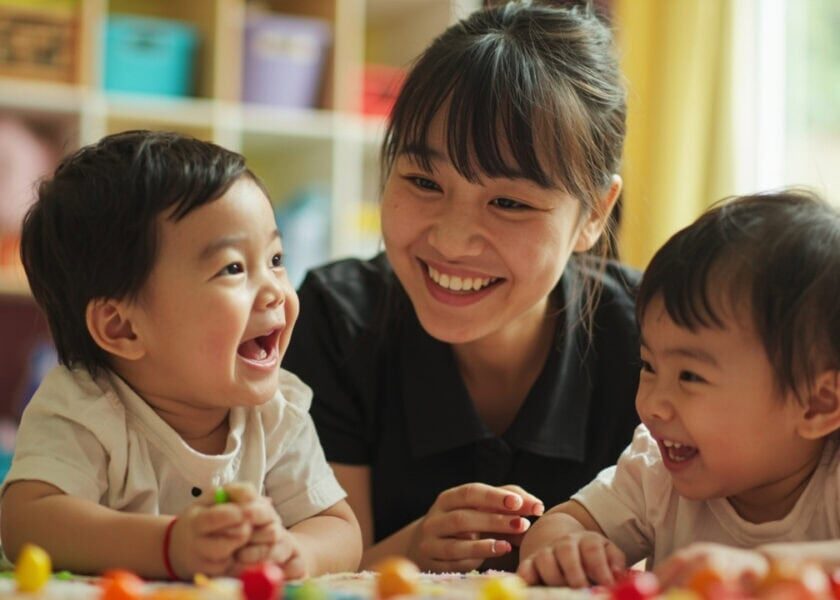
A caregiver, trained and registered under ECDA’s Childminding Pilot, welcoming your child’s grandparents into a space that is not their home but is not a stranger’s either.
A place where visits are encouraged, where progress is shared, where grandparents can see with their own eyes that their grandchild is safe, is loved, is thriving.
A communication structure that keeps extended family informed—not through hearsay or worry, but through real transparency, real updates, real presence in the child’s day even when they cannot be there every afternoon.
EduNanny’s caregivers are trained not just in infant development, not just in safety protocols and ECDA compliance, but in something harder to quantify: cultural attunement. The understanding that in Singapore, a child’s upbringing is not a private project between two parents. It is a shared inheritance.
A Real Afternoon: What It Actually Looks Like
Your child’s grandfather visits on a Wednesday afternoon. The caregiver has prepared a little something—a craft activity, a book she knows the child loves, a walk to the nearby park. He sits on the mat and watches his grandchild play, and the caregiver updates him on what the child has been doing, what she is learning, how she napped today. He goes home and tells your mother, who could not make it this time, every detail. She is not excluded from her grandchild’s life because she lives in the east and you live in the west. She receives updates. She feels included. She trusts what she cannot see every day.
Your mother, who was worried that a professional caregiver would not understand your child’s temperament the way she would, meets the caregiver and sees how she responds to your child’s cues. She sees that this is a person who is paying attention, who is skilled, who cares. She relaxes a little. Not because you convinced her with arguments, but because she saw it with her own eyes.
Your mother-in-law, who has strong opinions about everything and loves your child with a ferocity that can sometimes feel like pressure, finds that EduNanny’s communication structure gives her a window without a door to micromanage. She gets the updates she needs to feel connected. She is not left out, but she is also not in charge. And somewhere along the way, the Sunday lunch conversations start to feel less like interrogations and more like sharing.
Answers to Your Real Questions
“Will my parents feel replaced?”
The goal is not to replace your parents’ role—it is to create a structure where their involvement is sustainable and meaningful. When grandparents can visit, receive updates, and see their grandchild thriving, they tend to feel included rather than sidelined. The professional care arrangement becomes something that enables their involvement rather than competing with it.
“How do I handle family who disagree with my choice?”
You do not have to win an argument. You have to create conditions for trust. When your mother-in-law can visit the childminding space and see it for herself, when she receives regular updates about your child’s day, when she can see with her own eyes that your child is happy and well-cared for—the need to defend your choice fades. Actions, in this case, do the talking that words cannot.
“Is it actually affordable?”
EduNanny operates within the ECDA Childminding Pilot framework, which means fee structures are designed to be accessible. Your CDA funds and Baby Bonus can typically be used. The last thing a new parent needs is financial surprise—this should not add to your stress.
“What about safety and quality?”
Caregivers are vetted and registered under ECDA’s Childminding Pilot, which sets national standards for infant care. Some locations offer CCTV access for additional transparency. These are not just features—they are the foundation of trust, both for you and for your extended family.
A Practical Guide to Choosing Infant Care in Singapore
If you are beginning your search, here is how to think about it clearly:
| What to Consider | Why It Matters |
|---|---|
| Caregiver ratios | Small numbers mean your child receives real attention, not just supervision |
| Home-based setting | Home settings often feel warmer for infants; consider what feels right for your child |
| Training and registration | ECDA registration under the Childminding Pilot indicates vetted standards |
| Communication practices | Ask how updates are shared; extended family should have a window into your child’s day |
| Grandparent involvement | Are visits welcomed? Is there space for your family to stay connected? |
| Location and logistics | Near-home care reduces commute stress and makes family visits practical |
| Fees and subsidies | Understand what you can use: CDA, Baby Bonus, any available subsidies |
Do not rush this decision, but also do not expect it to feel entirely comfortable. The right choice will feel aligned with your values—not just what you believe about childcare, but what you believe about family.
Ask yourself: Does this arrangement honor the relationships that matter to us? Does it give our extended family a way to stay involved? Does it give us the professional support we need?
If the answer to all three is yes, you are probably on the right track.
Building a Village, Intentionally
Here is what I want you to hold onto.
Your child is going to grow up knowing what family means. Not in the abstract, not as a word in a textbook, but as a lived experience. She will know her grandparents, not as occasional visitors, but as present figures in her life. She will know her caregivers as people who loved her. She will know that her parents made thoughtful choices about her care, choices that were not made in isolation but in relationship with the family that surrounds her.
This is not a small thing. In a world that is increasingly isolated, increasingly nuclear, increasingly hurried, giving your child a web of connection is an act of profound intention. It is saying: you will not grow up alone. You will not have to choose between the old ways and the new ways. You will carry all of us with you.
And you, as a parent—you do not have to choose between honoring your heritage and building your own path. You do not have to manage this tension alone. The Sunday lunch does not have to be a battlefield of opinions. It can be what it was always meant to be: a family coming together, sharing a meal, delighting in the child who makes them whole.
Close family. Close to home. And close to the heart of what family has always meant, in Singapore, in every generation, and in the one that is just beginning.
If you are ready to explore what a childcare arrangement designed around your whole family looks like, EduNanny is here to answer your questions. No pressure. No obligation. Just a conversation about what you need and whether the fit is right.
#SingaporeChildcare #EduNannySG #InfantCareSingapore #ChildmindingPilot #MultigenerationalFamily #NearHomeChildcare #ECDAChildminder