Beyond Guilt: How Singapore Fathers Are Finding Childcare That Aligns With Their Values
The Morning Hand-Off: A Singapore Father’s Journey Through Early Parenthood
The light through the window is the same light it always is at this hour. Pale, then warm. The kind of light that makes everything in the room look soft and provisional, as if the day is still negotiable.
He holds his daughter against his chest and feels the weight of her—not her body, exactly, though that too, but something deeper than that. The weight of her needing him. The weight of her not knowing, yet, that the world is large and full of people who are not him.
This is the thousandth morning. Or the hundredth. In the first year, every parent loses count. What he knows is this: in a few minutes, the caregiver will arrive, or he will hand her over at a door, and the ache will begin. Not a sharp pain. Something quieter than that. The ache of a man who has learned, through fatherhood, that love has a texture he did not expect.
He thought it would be simple. He thought it would be joy and terror and the occasional exhausted blur. He did not expect this—the specific, recurring grief of handing your daughter to someone else and walking out into the day.
The hand-off is where it lives. The moment his daughter reaches one arm toward the caregiver, the way she does now, with a confidence she did not have three months ago. He watches this and feels two things at once: relief that she is unafraid, and the sharp, clarifying knowledge that she has learned this from him.
Every morning, he has stood at this threshold. Every morning, he has trusted. And every morning, she has watched him trust, and has trusted in turn.
This is what no one tells you about the first year. It is not just your child’s development that is being shaped. It is your own.
Quick Summary
- An honest look at the emotional reality of leaving your infant in Singapore’s childcare landscape
- Why proximity to your child’s care environment matters more than you think
- How near-home care can become an extension of your parenting, not a replacement for it
- Practical guidance for navigating the search for infant care in Singapore
- A framework for evaluating whether a caregiver or service truly aligns with your family’s values
The Search Begins with a Question You Can Barely Articulate
He visits places. He reads reviews. He asks questions that feel both inadequate and urgent: What will a day look like for her? Who will hold her when I cannot? What happens when she is unwell? Who will notice?
The answers he receives are variable. But the standard is singular. He wants someone whose care feels like an extension of his own. Someone whose rhythms align with his daughter’s needs. Someone who will speak to her with the particular attention that comes from knowing a child, not just minding one.
Singapore fathers are navigating something that has no easy name. The city-state is small, but the pressures are not. Long hours. Competitive industries. Commutes that swallow the best parts of the day. And beneath all of it, a cultural expectation that moves slowly, almost imperceptibly, from a model of the distant provider father toward something more present, more emotionally available, more genuinely engaged.
He wants to be present. Not just on weekends. Not just at bedtime. But in the daily, unglamorous work of raising a child. And he wants this not in spite of his work, but alongside it.
Near-Home Care: An Honest Choice, Not an Easy One
This is what brings him to near-home care. Not because it is the easy answer, but because it is the honest one. He has looked at centre-based options. He has weighed them carefully.
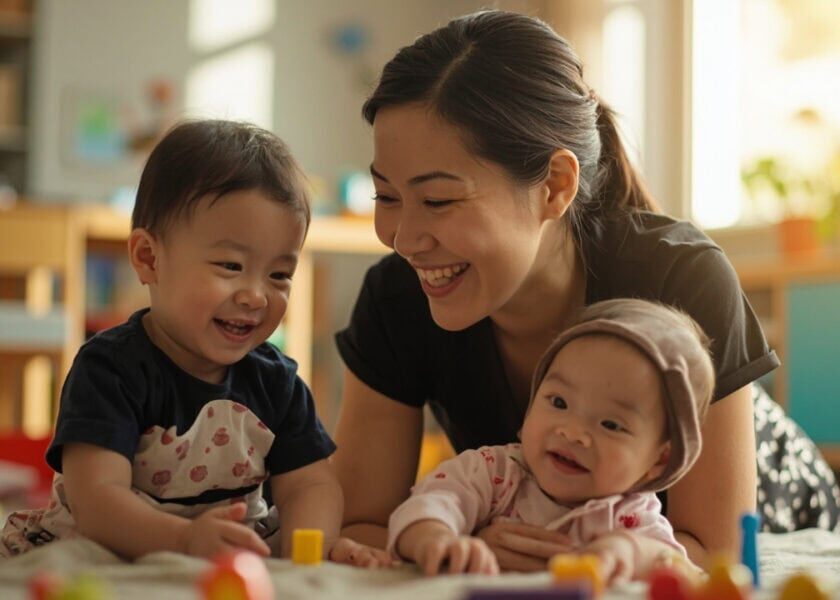
What he has found, in the searching, is that proximity is not a compromise. It is a considered choice. Near-home care means his daughter spends her days in an environment that has the warmth and scale of a home—not the institutional logic of a large facility, but the particular, irreplaceable texture of a domestic space. Kitchen sounds. Afternoon rest on a real mattress. The small, daily rituals that a home makes possible.
It means he can picture where she is and feel, for the first time since she was born, that he does not have to imagine it. He can know it. The distance is not measured in miles. It is measured in trust.
The Caregiver Becomes Something He Did Not Anticipate
In time, the caregiver becomes—not a stranger. Not an employee. A partner in the quietest, most important work he will ever do. He watches the way she speaks to his daughter: at eye level, with patience, with the particular attentiveness of someone who has learned this child not as a charge, but as a person.
He notices the small things she mentions in the evening updates: the way his daughter laughed at a particular sound, the new way she reaches for her bottle, the moment she sat still long enough to notice a butterfly outside the window. These are not data points. They are a language. A shared language of attention that he and the caregiver have developed, not through formal briefings, but through the daily accumulation of noticing the same child.
When this communication works—when he receives regular, honest, warm updates about his daughter’s day—it changes something fundamental. The distance between his world and hers shrinks. The caregiver is not a wall between him and his daughter. She is a bridge.
The Morning and Evening Thresholds: Where Fathers Reveal Themselves
The handover, when it works, is a small miracle of earned confidence. Morning and evening—the two thresholds of every working parent’s day. These are the moments when fathers reveal, to their children, whether they trust the world their child is entering.
An anxious hand-off communicates anxiety. A lingering, guilty hand-off communicates guilt. But a steady hand-off, one made with the quiet confidence of a man who has thought carefully about where he is leaving his child—this is what infants read. This is what they respond to.
His daughter has learned to reach for the caregiver because he has shown her, every morning, that this is safe. Because he has chosen carefully. Because he has built a bridge he trusts.
A child whose father is gone ten hours a day but returns warm, attentive, genuinely curious about her day—this child is not abandoned. She is waiting, yes. But she is waiting with a patience that comes from knowing that what she is waiting for is real.
The Evening Pick-Up: Where the Work Becomes Visible
He has come to love this moment with a ferocity that surprises him. The day is behind him. The work is set aside, at least for a few hours. He walks to the caregiver’s home, or his daughter is brought to him, and he sees her face change when she sees his.
Not always. Not perfectly. She is, after all, a toddler, and toddlers are not sentimental. But sometimes—just sometimes—her face opens like a door, and he sees himself reflected in her recognition, and he knows that this, this small and unrepeatable moment, is what he is working for.
The evening pick-up is not the end of care. It is the continuation of it. He takes his daughter into his arms and feels the day she has had settle against him. He asks questions. He listens. He becomes, in that hour, the father he wants to be—not because he has performed fatherhood, but because he has been given the conditions to simply show up and be present.
What Quality Childminding Actually Looks Like
Near-home care has given him this. Not as a convenience, though it is that too. But as a philosophy. The belief that a father’s presence is not diminished by distance when the care he has chosen honors his child’s need for warmth, attention, and safety.
But what does quality look like in practice? How does a parent evaluate whether a care arrangement truly meets these standards?
Signs of Genuine Care
- Consistent attentiveness: The caregiver notices and remembers details about your child’s preferences, rhythms, and emerging milestones—not as data to report, but as knowledge that shapes how they respond.
- Transparent communication: Regular updates that go beyond the formulaic. Observations about your child’s mood, curiosity, and development that suggest genuine engagement.
- Respectful interaction: Speaking to your child at eye level, with patience that does not feel performed or time-pressured.
- Environment as extension: A domestic space rather than an institutional one—where children can experience the texture of a real home, with its kitchen sounds, its afternoon rituals, its human scale.
- Partnership orientation: The caregiver sees themselves as working with you, not replacing you—translating your child’s day so you remain connected even when apart.
The ECDA Framework: Structure That Supports Presence
The practical dimensions of this choice matter, because love, in the real world, has logistics. The ECDA Childminding Pilot, within which EduNanny by BUTLER operates, offers a framework that is structured enough to be reliable and flexible enough to be humane.
| Element | Why It Matters |
|---|---|
| Infant ratios designed for attention | Not just for efficiency, but for the kind of attention that means your child is seen, not just supervised. |
| Monday to Friday care blocks | Consistency is not a luxury but a foundation of security for a developing child. |
| Home-based and centre-based pathways | Different families have different needs; the pathway should fit your life, not force your life to fit it. |
| Affordable fee structures | Proximity should not be a privilege of the wealthy; good care should be accessible. |
| CDA and Baby Bonus usability | Singapore has built systems to support families; good care should integrate with those systems. |
| Communication and transparency | The steady flow of information that allows a working parent to feel connected to their child’s day. |
Addressing the Real Concerns Singapore Parents Carry
Every parent who entrusts their child to someone else carries a private inventory of fears. These concerns are not weaknesses. They are evidence of love. Let us address them honestly.
“Am I abandoning my child by going back to work?”
This question carries a guilt that is both universal and deeply felt. The answer is not a dismissal of that feeling, but a reframe: leaving is not abandoning when the leaving is thoughtful. When the environment you choose reflects your values. When the person holding your child has earned your trust through consistent, attentive care. Presence is not diminished by distance when the care at that distance honors your child’s need for warmth and safety.
“How do I know my child is truly safe and well?”
This is where communication becomes essential. Not just any communication—the kind that flows from genuine engagement. When a caregiver notices and shares the small moments of your child’s day, they are not just reporting. They are demonstrating that your child has been seen. That she has been held in someone’s attention. That her day has mattered to someone who is not you, but who is, in a real sense, working alongside you.
“What if the caregiver doesn’t understand my child’s needs?”
The quality of care is not accidental. It is cultivated through ratios, training, and a culture of attention. In home-based care especially, there is a quality of relationship that is difficult to replicate in larger settings. The caregiver knows this child. Knows her rhythms, her preferences, the particular sound she makes when she is tired versus the one she makes when she is hungry.
This knowledge does not happen by chance. It happens when the conditions are right—when ratios allow for attention, when training builds capacity for observation, when the culture of the service values the slow work of knowing a child over the efficient work of managing a group.
“Can I really afford quality care?”
The ECDA framework includes affordable fee structures within the pilot, recognizing that proximity and quality should not be reserved for those with significant financial resources. CDA and Baby Bonus usability means Singapore’s existing family support systems can be applied directly to care arrangements. Good care is an investment—and like all investments, it should be accessible to those who need it.
Finding Care That Aligns With Your Values
If you are searching for infant care in Singapore, here is what the journey of this father suggests:
- Begin with your own values, not with options. Before you visit centres or meet caregivers, articulate what you are looking for. What does quality attention look like to you? What does safety mean in practical terms? What kind of communication would help you feel connected to your child’s day?
- Visit more than once. The first visit is always filtered through hope. Return at different times of day. Observe not just the caregiver, but the environment—the sounds, the rhythms, the feeling of the space when it is not performing for a visitor.
- Ask about ratios. Who will be caring for your child, and how many other children are in that person’s care? Attention is not just a feeling—it is a ratio.
- Ask about communication. What will you receive at the end of each day? How will you know what happened, what was noticed, what was learned? Updates should not feel like checkbox exercises—they should feel like glimpses into your child’s life.
- Notice how you feel during the hand-off. This is not sentimental advice. It is practical. If you feel anxious leaving your child, that anxiety will communicate itself. If you feel steady, that steadiness will communicate itself too. You are not just choosing a caregiver for your child. You are choosing a bridge for your relationship with your child.
- Trust the process, but verify. Small trials build to confidence. You do not have to commit forever on day one. Let the arrangement develop. Watch how the caregiver responds to your child’s emerging needs. Notice whether the communication deepens over time.
The EduNanny Philosophy: Infrastructure for Modern Fatherhood
EduNanny by BUTLER has built its approach not as a service model alone, but as a belief: that modern parenthood requires infrastructure. That a father’s desire to be present needs systems to support it. That the caregiver is not an afterthought or a stopgap, but a professional whose work deserves recognition and respect.
The belief is simple but demanding: that the morning hand-off should not be a source of guilt, but a moment of earned confidence. That the evening pick-up should be a continuation of connection, not a reunion after separation. That a father’s presence is not diminished by distance when the care he has chosen reflects the care he would give himself.
Your Journey Starts Here: A Tuesday Evening Worth Arriving At
And so he arrives, on a Tuesday evening, a few minutes early, as he has started arriving early on most evenings. He stands outside the door and breathes. The day is over. The work is done, or it will wait. His daughter is inside, and in a moment he will see her face, and the world will reorganize itself around the small, irreplaceable fact of her.
He has chosen this. He has chosen carefully. He has chosen proximity because it is honest. He has chosen near-home care because it allows him to leave without leaving.
And every evening, when he picks her up and she reaches for him with a trust that was never guaranteed and must always be earned, he understands something that he could not have understood before fatherhood: that presence is not a place. It is a decision. A daily decision, made in the quiet hours before dawn, in the rituals that shape a child’s world, in the choice to be fully there when he is there.
If you are a parent in Singapore navigating the search for infant care—if you are carrying the weight of wanting to be present and the reality of a life that requires you to leave—this article is for you.
The search is not easy. But it is worth doing carefully, because what you are choosing is not just a service. You are choosing the environment where your child will spend her first, most formative years. You are choosing the person who will hold her when you cannot. You are choosing a bridge between the world of work and the world of home.
Near-home care, when it is done well, is not a compromise. It is a commitment. An act of love made in the early morning light, in the decision to hand your child to someone you have come to trust, and to walk into your day with the quiet knowledge that she is well.
Explore what EduNanny by BUTLER offers, and discover how proximity and presence can coexist in the life you are building for your family.
#SingaporeChildcare #NearHomeCare #InfantCareSG #FatherhoodSingapore #EduNannySG #ChildmindingPilot #WorkingParentsSingapore #HomeBasedCare #PaternalAttachment #QualityChildcare