
Cradling a Nation with Near Home Pods The EduNanny Vision for Safe Joyful First Thousand Days in Singapore 2024 to 2027

Introduction: EduNanny’s Promise to Singapore’s Families
Good evening, Singapore. EduNanny by BUTLER is more than a service; it is a culture of care born in Singapore. Our promise is simple and profound: to cradle an infant’s first community with safety, proximity, and deep respect for how the human mind and heart begin. By blending centre-based and home-based childminding across the island, EduNanny offers Monday through Friday coverage from 7am to 7pm, with an ultra-low 1:3 infant ratio, modern, child-friendly layouts, optional innovation CCTV for transparency, and daily family updates. We strive to make quality care affordable—from $33 a day—and accessible through CDA/Baby Bonus. This work sits within a National Social Initiative under the ECDA Childminding Pilot and is supported by a Maximum Employment Mandate that dignifies caregiving careers while expanding access for families. Learn more or enroll at EduNanny.com and Childminding.EduNanny.com.
In this article, EduNanny deepens the conversation: how do we turn careful, scientifically grounded care into daily practice that fits Singapore’s real streets, schedules, and homes? We draw from Montessori’s respect for autonomy, Pikler’s gentle movement, Bowlby’s secure attachment, Vygotsky’s social learning, Erikson’s stages of trust, and contemporary safety norms—translating these insights into a living practice for Singapore’s communities. Below, you’ll find actionable guidance, practical examples, and EduNanny’s frontline perspective for parents, caregivers, and local communities who want to begin well with a child’s earliest days.
The Five Daily Languages of Care
Touch
Practice: Use consistent, consent-based handling that builds the body map and calms the nervous system. Examples you can apply today:
- Offer a gentle, unhurried carry and support during diapering, always explaining what you will do before you do it.
- Separate physical contact from overstimulation—soft holds during feeding, transitions, or soothing, with clear cues that the child can anticipate.
- Encourage caregiver-parent handovers that include a quick physical check of comfort objects, seating position, and a safe space for the child to settle in.
Tone
Practice: A soft voice, clear words, and warm facial mirroring help infants anticipate what comes next and feel seen.
- Name feelings and routines aloud: “It’s time for a feed now,” or “You’re all done with that activity—let’s explore something new.”
- Use progressive language that matches the child’s level of understanding, gradually increasing vocabulary with repetition and rhythm.
- Maintain gentle eye contact and a calm pace to support social learning and secure attachment.
Time
Practice: Predictable sequences create safety nets for young minds. Try this framework:
- Establish consistent daily rhythms: arrivals, meals, naps, outdoor play, and quiet time, adjusted to each child’s cues.
- Communicate upcoming transitions in advance and respect cues that indicate readiness for the next activity.
- Track a basic daily log of key moments—feeding times, naps, and notable responses—to help families feel informed and included.
Terrain
Practice: Prepare spaces that invite exploration while preserving calm and order.
- Design infant-friendly spaces with soft zones for floor play and movement, safe exploration mats, and age-appropriate open shelves at infant height.
- Minimize clutter and ensure clear movement paths to reduce distractions and risk during play and transitions.
- Use clean materials and regular sanitation routines to create a predictable and hygienic environment.
Trust
Practice: Every care act is a tiny contract kept. Build trust through consistent action and transparent communication.
- Greet families by name and explain daily care decisions briefly, then follow through on commitments.
- Maintain predictable routines and document daily achievements so children, and families, can reference progress.
- Foster a culture of continuity—if a caregiver changes, ensure warm handovers and routine alignment with the family’s preferences.
Safety by Design: Four Rings that Protect Every Child
People
Practices: Recruit and retain high-caliber caregivers who are trained, vetted, and coached in responsive caregiving and emergency readiness. Actionable steps:
- Implement a rigorous onboarding process including background checks, in-depth interviews, and a probation period with observed caregiving tasks.
- Provide ongoing coaching in safe sleep, feeding hygiene, and emergency response, plus access to professional development resources.
- Institute a transparent peer-support network where caregivers share best practices and reflect on challenging moments.
Place
Practices: Create centre-based and home-based sites with modern layouts and safety features that support calm, focused care.
- Ensure secured entry points, proper ventilation and air quality, and child-safe materials across environments.
- Maintain clean, clearly defined zones for feeding, resting, and play with visible safety guidelines posted in family spaces.
- Provide sanitary diapering areas, safe sleep equipment, and age-appropriate furniture to minimize risk.
Process
Practices: Establish clear protocols for illness, medication, and incidents, coupled with daily health checks and safe sleep audits.
- Develop a standardized illness policy, including symptom screening, isolation guidelines, and return-to-care criteria.
- Implement precise medication administration protocols with checks, consent, and proper documentation.
- Run incident response drills and maintain detailed incident logs to support continuous improvement.
Proof
Practices: Offer optional CCTV with privacy safeguards and digital logs, plus supervisor walkthroughs and open family channels for real-time clarity.
- Provide families with secure access to logs of feeds, naps, feeding, and diapering via a trusted platform.
- Schedule regular supervisor visits to validate practices and offer constructive feedback.
- Maintain transparent channels for families to ask questions and request clip reviews or summaries when needed.
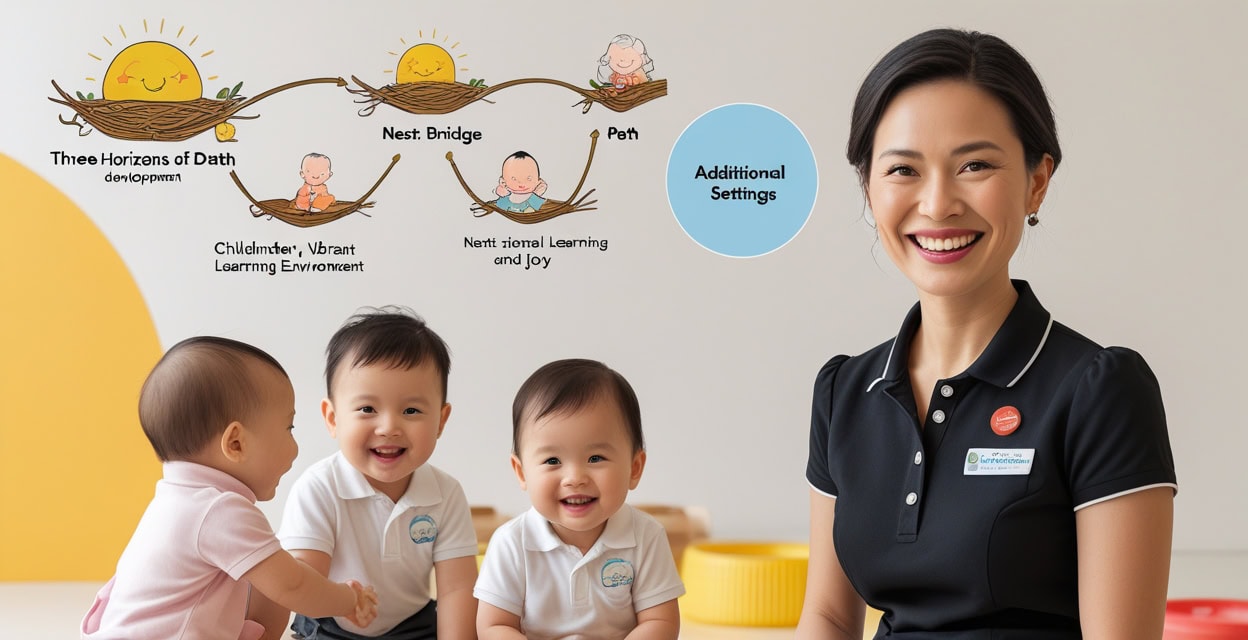
Three Horizons of Development: Nest, Bridge, Path
The Nest (0–9 months)
Focus: Secure bonds, regulated routines, gentle movement, and attuned feeding. Actionable guidance for families and caregivers:
- Prioritize responsive feeding and flexible sleep supports that respect each infant’s cues.
- Encourage gentle, developmentally appropriate handling that supports vestibular and tactile development.
- Document cues and responses to help caregivers tailor routines to each child’s temperament and needs.
The Bridge (9–18 months)
Focus: Scaffold mobility and language through meaningful repetition—rolling to crawling to walking; babble to first words; imitation to simple problem-solving.
- Provide safe spaces for exploration with age-appropriate toys that encourage problem-solving and gross motor skills.
- Support language through responsive turn-taking, naming objects, and modeling simple syllables and phrases.
- Use guided play to extend attention: pause at a moment of interest, then introduce a small challenge or new vocabulary.
The Path (18–36 months)
Focus: Purposeful independence—practical life tasks, early social skills, rich vocabulary, and self-help beginnings.
- Offer practical life activities that promote autonomy, such as feeding, dressing, and cleaning up with teacher guidance.
- Support social turn-taking through collaborative play and shared storytelling.
- Introduce robust language-rich experiences: labeling, descriptive narration, and open-ended questions to encourage thinking.
Across these horizons, EduNanny uses a simple pedagogical workflow: notice, name, and extend. Observe cues, articulate them in language the child can grasp, and gently extend play to grow confidence without overwhelm.

The Joy and Belonging Index: How We Know Children Are Truly Happy
Joy, belonging, and growth are not vague concepts—we measure them through daily, respectful observation and family collaboration. Look for:
- Calm body rhythms: predictable naps, steady appetite, and smooth transitions between activities.
- Curious engagement: focused attention, gentle persistence, and shared laughter during play.
- Secure relating: quick settling after goodbyes, bright reunions, and affectionate interactions with caregivers and peers.
- Growth signals: new gestures or words, improved coordination, and eagerness to attempt new tasks.
Families receive clear daily notes and periodic snapshots of learning stories. Joy is not noise; it is the quiet hum of a child who belongs.

The Profession of Everyday Nation-Builders: Why Childminding Matters
At EduNanny, childminders are not a stopgap; they are a respected profession with real pathways. The Maximum Employment Mandate opens dignified roles across Singapore’s neighbourhoods, supported by coaching, progression opportunities, and peer communities. When we invest in caregivers, we invest in children—and in families who depend on both.

Day-in-the-Life Sketch: Bringing EduNanny to Life
7:35am: A caregiver greets your child by name and starts a calm handover. Your child’s comfort object is close, and the first feed time is logged in.
9:50am: On a soft exploration mat, your child reaches for a new texture. The caregiver names the moment: “Rough sponge—what does it feel like?” A small smile, a new neuron fires, a tiny victory noted.
1:05pm: After a structured nap routine, a calm waking ritual with gentle singing begins. The caregiver narrates the transition back to play to avoid jolting startles.
4:20pm: A shared book activity—pointing, turn-taking, and early language work. The child is invited into conversation, not merely kept busy.
6:45pm: Pickup, with a concise day summary of feeds, diapers, naps, and skills explored. Families view optional CCTV clips and digital logs for transparency and peace of mind.

What Makes EduNanny Work in Singapore’s Real World?
- Choice of Setting: Centre-Based for vibrant, resourced hubs; Home-Based for near-home familiarity; Distance Support for continuity during travel or caregiver transitions—video check-ins, tele-coaching, and continuity plans.
- Convenience with Standards: Monday to Friday, 7am–7pm, with islandwide availability and alignment to ECDA Childminding Pilot guidelines.
- Accessibility: Affordable from $33/day with fees payable by CDA/Baby Bonus, because quality care is a public good, not a luxury.
- Transparency and Design: Optional innovation CCTV, modern layouts, meticulous cleanliness, and a 1:3 infant ratio that enables attuned, responsive care.
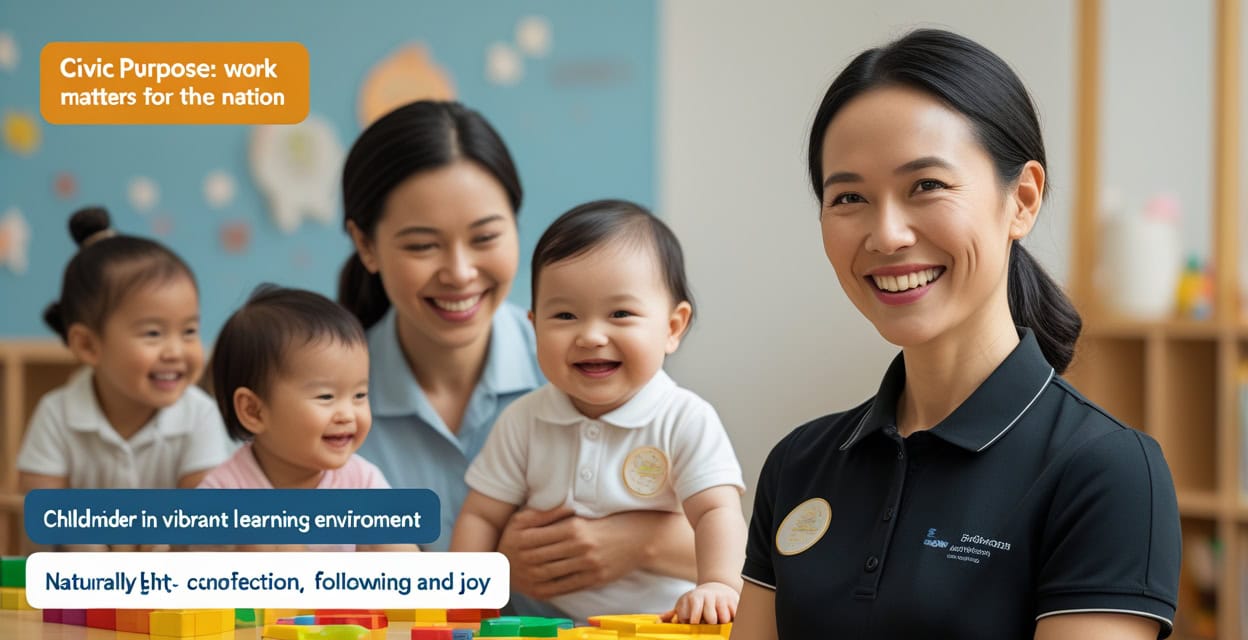
Civic Purpose: Why This Work Matters for the Nation
In the first thousand days, the brain builds highways of trust, attention, and regulation. When these roads are well laid, life’s traffic flows more smoothly: learning accelerates, friendships deepen, stress is more manageable, and setbacks become detours rather than derailments. Childminding done right is not babysitting; it is public infrastructure for human development and national resilience.

Who, What, When, Where, How, and Why: The Core Questions of EduNanny
Who
Infants and toddlers from Singapore’s diverse families, plus the caregivers who commit to this vocation. Our community includes working parents, extended family arrangements, and employers seeking stable, thriving teams.
What
A 1:3 model of infant care that prioritizes safety, secure bonds, and purposeful play, supported by trained professionals, modern environments, and open family communication.
When
Hours that support working families: Monday to Friday, 7am–7pm, with routines tuned to each child’s rhythms and family needs.
Where
Across Singapore’s neighbourhoods in centre-based and home-based settings, with distance options to maintain continuity during life’s twists and turns.
How
Through excellence in practice, rigorous safety design, convenient access, transparent tools, and a public mindset that elevates caregiving as a profession worthy of respect and support.
Why
Because the first relationships teach every other relationship. Because a nation’s strength includes how gently it begins. Because with trusted, well-trained caregivers and families at peace, children grow up with competence, calm, and hope.

Conclusion: A Call to Begin Together
EduNanny invites families to enrol, observe, and participate in a shared ethic of care. It invites caregivers to pursue a professional path that offers meaning, progression, and peer support. It invites communities to invest in a public infrastructure of human development—where every child’s first hours are held with safety, belonging, and limitless potential. If EduNanny resonates with your family’s needs or your heart for this work, visit EduNanny.com or Childminding.EduNanny.com. Explore options—Centre-Based, Home-Based, Distance Support—along with transparent, affordable care from $33/day and the ECDA-supported framework that makes it possible. Let us begin our children’s days the way we want them to live their lives: safely, joyfully, and with room to grow.
Excellence. Quality. Centre-Based and Home-Based options. Distance support. Convenience. Affordable care from $33/day. The ECDA Childminding Pilot. A National Social Initiative with a Maximum Employment Mandate. Fees payable by CDA/Baby Bonus. Innovation CCTV. Modern layouts. And always, the 1:3 promise. Thank you, Singapore.
SEO keywords: [#earlychildhoodcareSingapore, #EduNannySingapore, #infantcare1to3ratio, #MontessoriPiklerBowlbyInformedCare, #SingaporeChildmindingPilot]