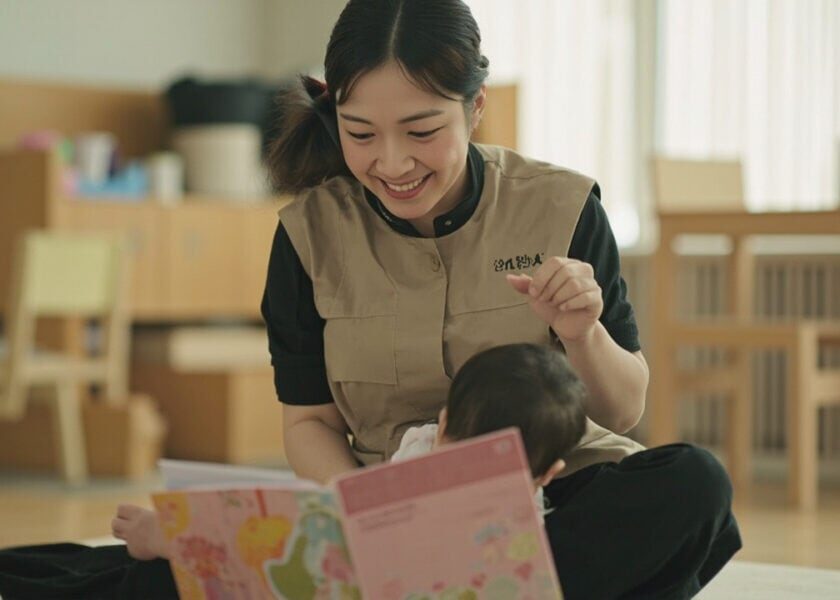
The Real Test of Childcare Is What Happens When Plans Change
Childcare in Singapore: What Nobody Tells You About Finding Care That Actually Holds
It is 6:15 a.m. Your phone buzzes. The message is from your child’s caregiver: she is unwell and cannot come today. An hour later, your office calls—they need you in early. You look at your sleeping toddler, and the architecture of your day collapses quietly, without ceremony.
This is not an edge case. This is Tuesday.
But here is what nobody tells you about childcare: it is not really tested on the good days. It is tested on the morning your office calls you in an hour before your usual departure. It is tested when the carefully constructed scaffolding of your week suddenly has a gap where care used to be. It is tested when your toddler refuses to settle with anyone new, and you have three hours to get to a meeting you cannot miss.
And yet, most conversations about childcare in Singapore are built around a different day entirely. They assume the ideal scenario—steady schedules, predictable handovers, a child who adjusts easily and a caregiver who is always there.
That version of childcare exists. It just does not exist most of the time.
What This Article Covers
- Why most childcare arrangements are designed for ideal conditions, not real family life
- What childcare resilience actually means—beyond surface stability
- The specific stress scenarios Singapore families face and how quality care handles them
- Why the parent’s role is to be an architect of care, not just a consumer
- What EduNanny builds differently—and why it matters for your family
The Fear Beneath Every Childcare Decision
The fear that sits beneath most parental decisions about childcare is not that it will be bad. It is more specific than that.
It is the fear that childcare will fail precisely when you cannot afford for it to fail. That the system you trusted will crack exactly at the moment you need it most. That you will be left, once again, scrambling to patch something together while your child watches you unravel.
This fear is not irrational. It is pattern recognition.
Parents in Singapore have lived it—in the WhatsApp group chats at 6 a.m., in the last-minute calls to grandparents, in the annual dread of the school holiday cliff. They have learned, often through experience, that many childcare arrangements look solid until they are pressed. And then they do not flex. They fracture.
So let us talk about what it actually takes for childcare to hold.
Stability Is Not Enough
When we talk about quality childcare, the word that usually comes up is stability. But stability is only half the conversation.
Stability is the absence of disruption. It means things are consistent, predictable, calm. A stable childcare arrangement holds its shape under normal conditions.
Resilience is something more precise. It is the capacity to absorb disruption without losing the essential things—the child’s safety, the routine’s rhythm, the relationship with the caregiver who knows your child and what they need.
Think of it this way: a stable arrangement is like a building in fair weather. It looks solid. It functions well. But it was designed assuming the sun would keep shining.
A resilient arrangement is one designed with the assumption that storms will come. It is built to flex. It holds—not because nothing ever goes wrong, but because it has the structural capacity to bend without breaking.
How Fragile Childcare Fails: Warning Signs Every Parent Should Know
Fragile arrangements fail in predictable ways. If you know what to look for, you can recognize these patterns before they become your problem.
No Substitute Plan for Caregiver Absence
A caregiver falls ill. In a fragile arrangement, the response is silence followed by panic. You receive no message. You arrive at pickup to find a stranger holding your child. You spend the afternoon wondering whether your child cried, whether they were fed on time, whether the substitute knew about the rash on their leg that needs monitoring.
This is not hypothetical. It happens to every family eventually. A cold. A family emergency. A leave day. The question is not if—it is what happens when.
Schedule Changes Require Impossible Notice
The 7 a.m. call telling you today is different from yesterday. In a fragile arrangement, your options are to accept a reduced service or find something else. There is no conversation. No exploration of what might be possible. Just binary acceptance of limitation.
Transitions Are Treated as Resets
When a child moves from infant care into a new environment, the quality of that transition determines whether the trust built in the first relationship carries forward or has to be rebuilt from the ground up. Fragile arrangements treat transitions as administrative events—not as delicate processes that require active management, bridges, and continuity.
Communication Only Works When Things Are Smooth
You receive weekly email updates. Everything looks fine. But when something goes wrong—when you need to know something urgently, when you have a question that does not fit the standard format—you discover that communication was designed for the easy days, not the hard ones.
The Parent Is the Single Point of Continuity
In a fragile arrangement, the parent is the glue holding everything together. You are the one who remembers the details, who bridges gaps, who compensates when the system fails. This works until you are exhausted, or sick, or simply cannot be there. The arrangement should hold continuity as a structural responsibility—not rely on parental superheroics.
What Durable Childcare Actually Looks Like
Durable childcare is designed differently. It assumes that disruption is not an exception—it is the operating condition.
There are two kinds of childcare in the world. Reactive care holds its shape until it cannot. It performs well under ideal conditions. It assumes that life will be manageable, that schedules will hold, that disruptions will be rare and small. When reality intrudes, it responds with rigidity or breakdown. Either way, the parent absorbs the cost.
Adaptive care is different. It is structured enough to provide the consistency children need for security, and flexible enough to change shape when the family’s circumstances demand it. This is not chaos dressed up as responsiveness. It is thoughtful design. It is care that has been built to last, not just built to impress on an enrollment tour.
Familiar Caregivers, Not Interchangeable Parts
A durable arrangement does not treat caregivers as interchangeable parts. It builds a team—people who know your child, who have been briefed, who can step in when someone is absent. When the primary caregiver is unwell, your child is not handed to a stranger. They are settled with a familiar adult who already knows their routines, their preferences, their cues for hunger or fatigue or distress.
Real-Time Communication, Not Weekly Updates
Before you have to ask, you receive a message. Your child is already settled. The substitute has been briefed. The continuity your child depends on has been held—not just maintained, but actively protected.
This is not about constant updates or helicopter-level surveillance. It is about basic transparency: knowing who is with your child, what is happening, and that you will be informed if anything requires your attention.
Structural Flexibility Built Into the System
When you need to extend care hours at short notice, the conversation is possible. When your schedule changes unexpectedly, there is a path through it. The structure is designed to flex—not as an exception, but as a feature. The team has thought about this. They have built processes that can adapt.
Transitions Managed as Bridges, Not Gaps
When a child moves between care environments or caregivers, durable childcare creates bridges. It does not treat change as a reset. The relationships, the trust, the emotional security your child has built—they carry forward. The handover is deliberate, not rushed or clinical.
The School Holiday Stress Test
Six weeks. In June and November, the carefully constructed scaffolding of the school year comes down, and for families who rely on structured care, what is left is a landscape of improvisation.
Grandparents who may or may not be available. Annual leave that runs out before the second week. Camps and programmes that fill in days, not weeks. The emotional and logistical weight of filling gaps that were never meant to be filled.
School holidays are not a complaint about the calendar. They are a stress test for every family care system. They show you what your arrangement can actually do—not what it promises on a calm, regular Tuesday in March.
Families who have built resilient care systems experience those holidays differently. They do not experience them as a crisis to be managed, but as a known variable—a period that requires planning, yes, but not panic. The care arrangement does not collapse under the change in schedule. It adapts. It absorbs the shift in rhythm. And parents can breathe, because they know the system they built is functioning under load, not despite it.
From Anxious Consumer to Intentional Architect
There is a shift that happens when you stop thinking of yourself as a consumer of childcare and start thinking of yourself as its architect.
It changes what you look for. It changes the questions you ask. It changes whether you feel like you are constantly defending your choices or building something that works.
Questions the Consumer Asks
- Is the ratio good?
- Is the environment safe?
- Are the caregivers trained?
- Does this programme look impressive on paper?
These questions matter. But they are incomplete.
Questions the Architect Asks
- When something goes wrong—when the plan changes, when I need it most—will this arrangement hold?
- What does this programme look like on a hard day, not just a good one?
- How is this structured to flex tomorrow?
- What happens in the first hour of an unexpected change?
- Who holds the continuity when the primary caregiver is absent?
- How does communication work when things are smooth—because that is the only reliable predictor of how it works when things are not?
You stop asking whether childcare is perfect. You start asking whether it is durable.
And that is a more useful question—because perfect does not exist. Durable does.
What EduNanny Builds Differently
EduNanny by BUTLER is built around a specific conviction: that childcare should flex with real family life, not collapse under its weight.
Not to promise a childcare arrangement that never experiences disruption—nothing human can promise that—but to build one that has the structural resilience to flex without fracturing. To hold the continuity that matters to your child and the adaptability that matters to your family.
A Regulatory Foundation for Real Standards
EduNanny operates within the ECDA Childminding Pilot, which provides a regulatory framework grounded in genuine standards of care—standards designed not for the brochure but for the reality on the ground. This is not a technicality. It means the programme has been evaluated against actual conditions families face, not idealized scenarios.
The Home-Based Advantage
The home-based pathway offers something that centre-based care, with its unavoidable exposure to large-group illness cycles, cannot easily replicate: a smaller, more contained environment where a child who is unwell or unsettled can receive genuinely individual attention.
In infant care, where ratios matter enormously and where the difference between one-to-one and one-to-three attention is not abstract, this is not a minor detail. It is the architecture of safety.
Accessibility as Intention
The pilot’s fee structures are designed to make this level of care accessible, not as a concession but as an intention. For families navigating the real costs of quality care, this accessibility changes who can build resilient arrangements and who is forced to accept fragile ones out of necessity.
For families eligible for the Child Development Account and Baby Bonus schemes, those financial pathways apply here too—because EduNanny believes the families who most need adaptive, reliable care should be able to access it.
Communication as a Structural Feature
There is something important about what EduNanny has built in how it communicates. Transparency is not a marketing claim here. It is a structural feature.
When parents can see what is happening in their child’s day, when communication flows before you have to ask for it, when there is clarity about who is caring for your child and why—trust is not something you are asked to extend blindly. It is something the programme earns through consistent, visible reliability.
Infrastructure That Supports Human Connection
For the moments when you need answers quickly—when you are in a meeting and you need to know if your child ate lunch, when you need to check what today’s routine looks like, when a simple question should not require a phone call—EduNanny’s Thomas AI Chatbot is available to give you timely, accurate information.
Not as a replacement for human connection, but as infrastructure that supports it. A tool that keeps the system running smoothly so that the human care at its centre can remain exactly where it belongs: focused on your child.
The Compound Value of Resilient Childcare—and the Question Worth Carrying
None of this is perfect. Perfect childcare does not exist. What exists is care that is honest about its limits and clear about its strengths. What exists is care that has been designed with real family life in mind, not the imaginary version.
But here is what I have observed about the families who build the most durable childcare arrangements: they are not the ones who found the perfect programme. They are the ones who found a programme willing to flex alongside them, and who built their partnership with it deliberately, over time, with clear expectations and mutual accountability.
That is the compound value of resilient childcare. It does not just solve today’s problem. It builds something that accumulates.
When your child moves through transitions with a sense of security rather than disruption, that is built on prior adaptations that were handled well.
When you can accept a last-minute work commitment without guilt because you trust your care arrangement to hold, that confidence is built on every previous instance where the arrangement did hold.
When your child develops genuine, healthy attachment—not to a single perfect caregiver but to the concept of reliable, loving care—they are building something that will serve them long after the toddler years are gone.
You are building relational security. You are building family resilience. You are building the conditions in which your child can thrive, not because life is perfect, but because the people and systems around them are capable of adapting when life is not.
Here is the question I want to leave you with.
It is not whether you have found good childcare.
It is whether the childcare you have found is built to flex when life does.
Not if schedules change. When they do.
Not if a caregiver is absent. When they are.
Not if your family experiences disruption. Because you will.
The families who thrive in this city are not the ones who avoid those moments. They are the ones who built systems—care systems, family systems—designed to absorb those moments without breaking. Who found partners willing to adapt. Who stopped treating flexibility as a luxury and started treating it as a structural requirement.
EduNanny is not a promise that nothing will go wrong. It is a promise that when things do go wrong, you will not face them alone. That your childcare is not a static enrollment but a living system, designed to bend, to adjust, to hold your family steady when the ground shifts beneath you.
Your family life is real. It is unpredictable. It is beautiful and exhausting and full of moments you could not have planned for.
You deserve a childcare partner that was built for exactly that—not the idealized version of your family, but the actual one.
The one that shows up on the hard days.
The one that holds when it matters most.
That is the childcare worth building.
And that is what EduNanny is here to help you build.
Ready to explore what resilient childcare looks like for your family? Connect with EduNanny by BUTLER and discover how the ECDA Childminding Pilot can support your family’s real needs—not just the ideal ones.
At EduNanny, we believe thoughtful, development-oriented childcare should be accessible to families who need it most. Learn more about our approach or reach out to start a conversation about what your family truly needs.