
EduNanny Near Home Infant Pods Singapore 1 to 3 Pilot December 2024 to December 2027 Safety Joy and Holistic Development

Introduction: What is EduNanny Infant Childminding?
EduNanny by BUTLER is honoured to be appointed by the Early Childhood Development Agency (ECDA) as one of three operators in Singapore’s national Childminding Pilot for Infants (1 December 2024 to 31 December 2027). Our mission is clear: offer families a trusted, affordable, near-home option where one certified childminder cares for a maximum of three infants at any time—in a home or community setting designed for safety, attachment, and joyful learning. This is infant care that feels human, looks modern, and works for working families.

Why This Matters Now
- Families need proximity, consistency, and price transparency.
- Infants need secure attachment, unhurried moments, and expert eyes on their signals.
- Communities benefit when care is high-quality, professional, and local.
Practical implications for families: choose near-home options to reduce commute stress; look for predictable hours that align with work schedules; seek transparent pricing with clear subsidies. For caregivers, prioritize unhurried routines, sensitive observation, and stable routines that honor each infant’s unique tempo.

EduNanny’s Promise in Practice
Ultra Low Ratio
1 childminder to 3 infants (maximum) means more responsive caregiving per child. In practice, this translates to timely comfort, individualized feeding cues, and deeper attunement to each infant’s signals. Expect consistent staffing so caregivers know your child’s preferences and patterns.
Ultra Low Density
Small, calm micro-pods in home and centre settings reduce overstimulation and support focused engagement. Families can observe spaces that are clean, organized, and designed to encourage safe exploration and gentle learning.
Hours that Match Working Life
Monday–Friday, 7am–7pm with subsidised half-day (5 hours) or full-day (10 hours) blocks. Practical tips: align calendars with work shifts, request flexible drop-offs within the 7am–7pm window, and plan for occasional adjustments during parent-teacher planning days.
Affordable
From $33 per full day and $16.50 per half day (before GST), with CDA/Baby Bonus accepted during subsidised hours. Action steps: check eligibility early, gather documentation for subsidies, and compare total monthly costs against private nanny or centre-based options.
Islandwide Access
Near-home placements across Singapore enable shorter commutes and easier family routines. Explore options in your neighbourhoods and consider how proximity supports daily life and emergency contingencies.
Transparent Protection
CCTV provided in community spaces and offered in caregiving zones of participating homes with informed consent. Parents receive clear information about cameras, privacy boundaries, and how footage is used to protect children and support accountability.
Certified EduNanny Childminders
Background-checked, trained in infant first aid and core care skills, supported by professional standards and coaching. Practical step: ask for credentials, observe a trial day, and request ongoing coaching plans for continuous improvement.
A Clear Health Stance
No Sick Child Policy during care hours to protect all infants, with supportive rebooking and guidance for families. Practically, families receive timely notifications about illness policies, guidance on when to rest, and clear return-to-care criteria.
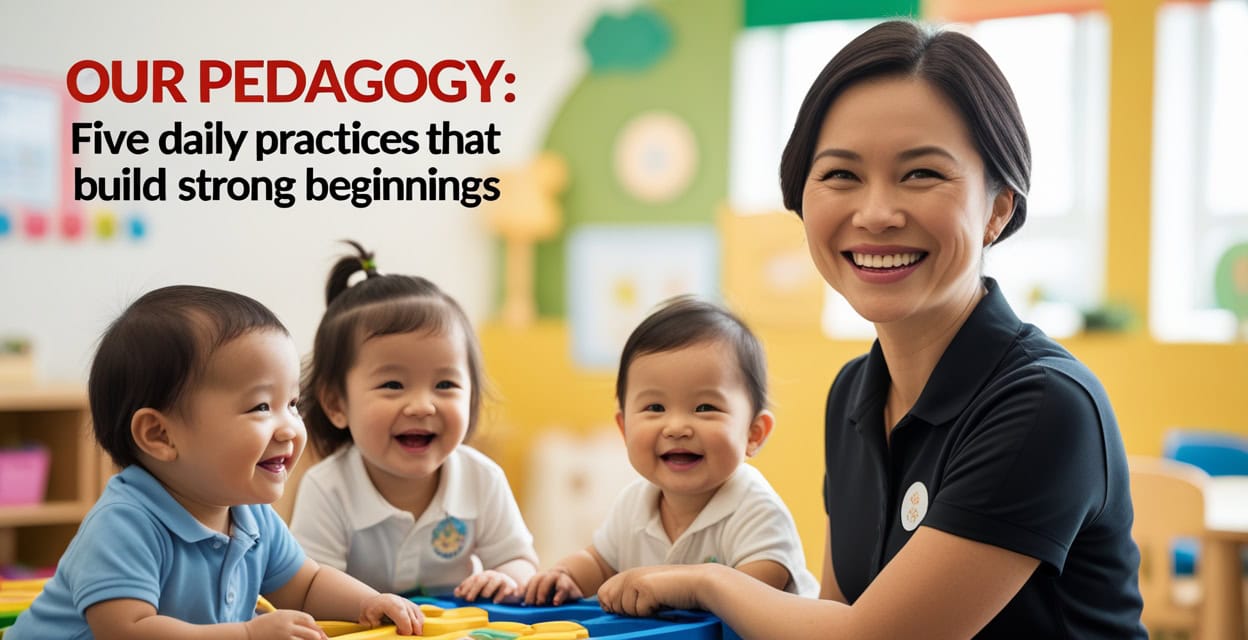
Our Pedagogy: Five Daily Practices that Build Strong Beginnings
EduNanny’s practice framework is inspired by developmental science and translated into daily routines that you can observe, participate in, and reinforce at home.
1) Attachment before agenda
Inspired by Bowlby and Pikler, we prioritise responsive care and unhurried routines. Feeding, diapering, and settling are sacred one-to-one moments in which infants learn trust, reciprocity, and their own rhythms. Actionable ideas for families:
- Ask your childminder to narrate a feeding or diapering moment with gentle prompts and eye contact, reinforcing that you value the moment as an opportunity for connection.
- Share your infant’s cues at drop-off: “My baby settles with a soft song and a back rub.” This helps the caregiver align with your family’s rhythm.
- Encourage a post-nap routine where the caregiver sits with the infant, holds steady eye contact, and offers a simple, soothing sequence before returning to activities.
2) Movement as the first language
Grounded in Pikler and Montessori, spaces invite self-initiated movement—tummy time, reaching, rolling, cruising—because a confident body supports a confident mind. Practical tips:
- Request observation notes showing milestones (e.g., “rolled from tummy to back today,” “attempted assisted sit”).
- Ask caregivers to rotate safe exploration activities daily (soft mats, low shelves, uncluttered floor space) to support gross motor skills.
- Share at home a short daily movement routine that mirrors what the child experiences at EduNanny, helping consistency across environments.
3) Tiny talk, big brains
Following Vygotsky and language science, narrate care, mirror sounds, sing, and sign. We build “serve-and-return” conversations to wire attention, memory, and social understanding. Practical examples:
- Use simple, age-appropriate language during feeding and play: name objects, describe actions, imitate sounds.
- Incorporate sign language basics for early communication (e.g., “more,” “eat,” “sleep”).
- Record a short weekly language log for your child’s development and discuss progress with your EduNanny consultant.
4) Playful inquiry over busywork
Drawing on Piaget and Malaguzzi, we curate simple, sensorial experiences—light, texture, cause-and-effect—to help infants explore, repeat, and master. Practical approaches:
- Offer age-appropriate sensory stations (water play with supervision, soft textiles, safe mirrors) to spark curiosity without overstimulation.
- Document “learning moments” with a photo-note and a short caption to review progress with families during updates.
- Rotate a small set of toys weekly to sustain interest and prevent overstimulation.
5) Consistency that respects individuality
We honour family culture, sleep cues, feeding preferences, and developmental tempo. Predictable routines with personal adaptation allow infants to feel safe enough to be curious. Practical tips:
- Publish a family rhythm card: daily wake times, meal windows, nap windows, and soothing routines to align expectations.
- Discuss sleep preferences and safe sleep cues; ensure care routines are adapted to your child’s needs while maintaining safety standards.
- Schedule regular family check-ins to adjust routines as the child grows and developmental needs change.
Safety by Design: Seven Layers of Assurance
EduNanny’s safety architecture blends people, place, and practice with transparent communication and responsive governance.
1) People
– Comprehensive background checks on childminders, conducted by ECDA, including checks on criminal history.
– For services in home settings, checks extend to those with regular access to the home environment.
– Mandatory training in infant first aid, hygiene, food safety, and safe sleep.
2) Place
– Home and community spaces certified for cleanliness, hazard minimisation, and infant-safe layout.
– Modern, uncluttered caregiving zones designed to reduce risk and increase supervision.
3) Practice
– Industry-standard protocols, daily checklists, and incident management procedures.
– No Sick Child Policy during hours of care; we guide families on when to rest, when to return, and how to protect the cohort.
4) Supervision
– 1:3 maximum ratio at all times.
– CCTV in community spaces; in-home CCTV offered in caregiving zones with privacy-respecting conditions and parent-childminder consent.
5) Health and hygiene
– Hand hygiene, sanitisation schedules, safe preparation of feeds, and stringent nappy-changing procedures.
– Clear medication permissions, documentation, and monitoring when agreed in advance with parents.
6) Sleep and safe positioning
– Evidence-based safe sleep practices: firm surface, no loose bedding, flat on the back unless medically indicated, and vigilant checks.
7) Transparency and responsiveness
– Parents receive clear agreements, daily communications, and channels for feedback.
– If standards are breached, operators can be removed from the pilot. We welcome accountability—it keeps infants safe.

The Work of Happiness: Why Joy is Developmental
Happiness isn’t decoration; it is a developmental nutrient. A calm pod, a familiar voice, and room to try again without pressure build dopamine-anchored learning loops. Laughter during peekaboo is not trivial—it trains attention, anticipation, and social timing. We coach our childminders to notice micro-moments of joy and turn them into scaffolds for learning and confidence. Practical applications for families:
- Incorporate daily joyful moments, such as a special rhyme or a predictable “peekaboo” sequence, to anchor secure attachment.
- Celebrate small milestones with both caregiver and parent, reinforcing a positive loop of learning and trust.
- Observe and share a “joy journal” entry weekly to highlight moments of curiosity, social responsiveness, and emergent language.

The Purpose of the Childminder: Craft, Not Gig
A childminder in EduNanny is a trained professional, a steady attachment figure, and a cultural bridge between home and the wider world. This is not gig work. It is purpose-driven craft.
- Dignity of work: Our Maximum Employment Mandate invests in training and neighbourhood placements that create quality jobs close to home.
- Continuous development: Regular coaching, supervision, and peer learning lift practice from “adequate” to “excellent.”
- Partnership with parents: We co-design routines, align expectations, and document growth to support consistency across care and home life.

What EduNanny Makes Possible for Families in Singapore
- Centre-based and home-based options: Aimed to match commute, comfort, and cost needs with flexible placement choices.
- Distance and convenience solved: Near-home placements and islandwide reach reduce travel time and stress.
- A National Social Initiative: Aligned with ECDA’s Pilot, raising standards without imposing undue burdens on families.
- Excellence and Quality framework: Ongoing coaching, supervision, and modern layouts maintain warmth and humanity.
- Innovation-friendly model: Transparent operations, CCTV transparency, and clear operating hours for predictable routines.

A Few Practical Notes Parents Ask Us
- Eligibility: Singapore Citizen infants, 2 to 18 months, not concurrently enrolled in ECDA-licensed infant care centres.
- Flexibility: Choose the number of days per week and select half-day (5 hours) or full-day (10 hours) blocks within 7am–7pm.
- Fees: Half-day $16.50; full-day $33.00 before GST during subsidised hours. CDA/Baby Bonus can be used.
- Health: No Sick Child Policy protects the pod; we help with rescheduling and return-to-care guidance.
- CCTV: Mandatory in community spaces; offered in caregiving zones of participating home settings with agreed privacy boundaries.

Who, What, When, Where, and How—Why Childminding Matters
- Who: Infants who need continuity, parents who need reliability, and trained childminders who bring professional care into the neighbourhood.
- What: A 1:3, near-home infant childminding service that blends safety, attachment, and playful learning—at a price point families can sustain.
- When: Weekdays, 7am–7pm, during the ECDA Pilot from 1 December 2024 to 31 December 2027.
- Where: In community spaces with modern, transparent layouts and in carefully prepared home environments across Singapore.
- How: Through rigorous selection, training, checks, small pods, CCTV in appropriate settings, and daily partnership with parents.

And the why? Because the first 1,000 days are a once-only window
Secure relationships today become resilience, language, and executive function tomorrow. The public good begins in private moments: a patient feed, a safe nap, a gentle hand guiding a first roll. EduNanny exists to make those moments consistent, expert, and close to home.
Benefits at a Glance
- Ultra Low Ratio and Low Density: 1:3 care in calm micro-pods.
- Certified and Background Checked Childminders: with infant first aid and core skills verified.
- CCTV Provided: in community spaces; offered in caregiving zones of participating homes with consent.
- Clear Health Protocols: No Sick Child Policy for safety and smooth rescheduling.
- National Initiative: ECDA Childminding Pilot, with oversight and continuous improvement.
- Excellence and Quality: Coaching, supervision, and modern layouts that balance warmth and professionalism.
- Choice of Settings: Home-Based and Centre-Based options for flexibility.
- Affordability: From $33/day full-day (before GST); CDA/Baby Bonus accepted during subsidised hours.
- Convenience: Islandwide near-home placements, Monday–Friday, 7am–7pm.
- Innovation: Transparent operations, modern environments, and an EduNanny Concierge to support families.
How to Sign Up
Take the first step toward strong beginnings for your infant:
- Visit https://edunanny.com/edunanny-ecda-childminding-service/
- Fill out the form or enquire via WhatsApp from the page.
- Receive a response from our EduNanny Concierge Team.
- Confirm your appointment for a site visit (home or community space).
- Enrol and meet your childminder.
You can also explore EduNanny.com and Childminding.EduNanny.com for more details.

Closing
Montessori taught us to prepare the environment; Piaget reminded us to respect developmental stages; Vygotsky urged us to scaffold; Pikler showed us the dignity of free movement; Bowlby proved that attachment is the engine of growth. EduNanny brings that wisdom to your neighbourhood—small, safe pods of care where infants are known by name, not number; where parents are partners; where childminders are professionals; and where Singapore’s future is cradled with precision and heart.
If you are a parent, we welcome you. If you are a caregiver, we will train and stand beside you. If you are a community partner, come walk with us.
Because infant care is not a service. It is a covenant—between families, professionals, and a nation that chooses to invest in the very beginning. EduNanny is ready. Let’s build strong beginnings, together.