The Body-Based Secret to Your Child’s School Readiness
The Body Is Not Separate from Learning
In the way we talk about education, in the way we think about school readiness, we have created a fiction: that the mind arrives at learning and the body simply carries it there. That a child sits down to learn, and the brain, somewhere behind the eyes, processes information, solves problems, and produces knowledge.
But the child sitting at that table with the broken pencil is not a brain in a jar. Your daughter is a body. A whole, sensing, moving, feeling body. And that body is not separate from her capacity to learn. It is, in ways that modern neuroscience has made beautifully clear, the first and most important learning organ she possesses.
Before your daughter could speak her first word, she was learning through her body. She was taking in the world through sensation: the texture of your skin, the sound of your voice, the feeling of being held. These sensations did not just register passively. They built her brain. Every time she reached for a toy, every time she rolled over, every time she pulled herself up to stand and then fell and then stood again, she was constructing neural pathways that would later become the foundation for every cognitive skill we value: attention, memory, language, reasoning.
The sensory-motor system is not a prelude to learning. It is learning. It is the architecture on which all other learning is built.
What Sensory Integration Actually Means for Your Child
Consider what it actually takes for your child to sit still at a desk, attend to a teacher, and process new information. What looks like a simple, passive behavior is actually one of the most complex achievements of early childhood. It requires your child’s brain to receive information from her inner ear about where her body is in space. It requires messages from her joints and muscles confirming her posture. It requires her visual system to focus and sustain attention on a single point while filtering out the movement in her peripheral vision, the sound of another child shifting in their seat, the distant noise from the corridor.
This is sensory integration. And it does not happen automatically. It develops through movement. Through rolling and crawling and climbing and tumbling. Through the play that we have sometimes come to think of as just play, when in fact it is the work of building the very capacities that will allow your child to sit, and listen, and learn.
Studies following children from infancy through school have found again and again that motor development in the early years predicts academic achievement in ways that early academic training simply does not. Children who have had rich sensory-motor experiences in their first five years arrive at Primary One with bodies that are ready to learn.
Children who enter Primary One with academic knowledge but weak sensory-motor foundations often struggle in unexpected ways. They are the ones who fatigue quickly. Who cannot sit still. Who lose focus. Who appear to be lazy or unmotivated when in fact their bodies are simply not ready for the demands being placed on them.
The children who thrive in Singapore’s academic environment are not necessarily the ones who started earliest. They are the ones whose bodies were ready.
The Fear Every Singapore Parent Carries
I want to speak directly to a fear that I know many of you carry, because I have seen it in the faces of parents at our doors, in the questions they ask, in the worry they express late at night when they cannot sleep. The fear that you are falling behind. That other children are getting ahead. That somewhere, in some classroom with worksheets and flashcards and accelerated curricula, children are being given an advantage that yours will not have.
Here is what I want you to understand: that fear is not your failure. It is the result of a system that has confused preparation for school with the things children actually need to succeed in school and beyond.
Singapore’s primary schools are demanding. The curriculum moves quickly. The expectations are high. And so parents feel, with genuine reason, that they must prepare their children academically before they arrive. And so the pressure begins earlier and earlier. Nursery classes that look like Primary One. K2 curricula that would have been P1 material a generation ago. Enrichment programmes that promise your child will not be left behind.
I understand this fear. I do not dismiss it. But I also want to be honest with you about what the research consistently shows: children who enter Primary One with strong sensory-motor foundations, who are confident in their bodies, who can attend and regulate and process, do not just cope with academic demands. They excel. Not because they already know more content. Because they have the infrastructure to learn.
What Quality Childcare Actually Looks Like
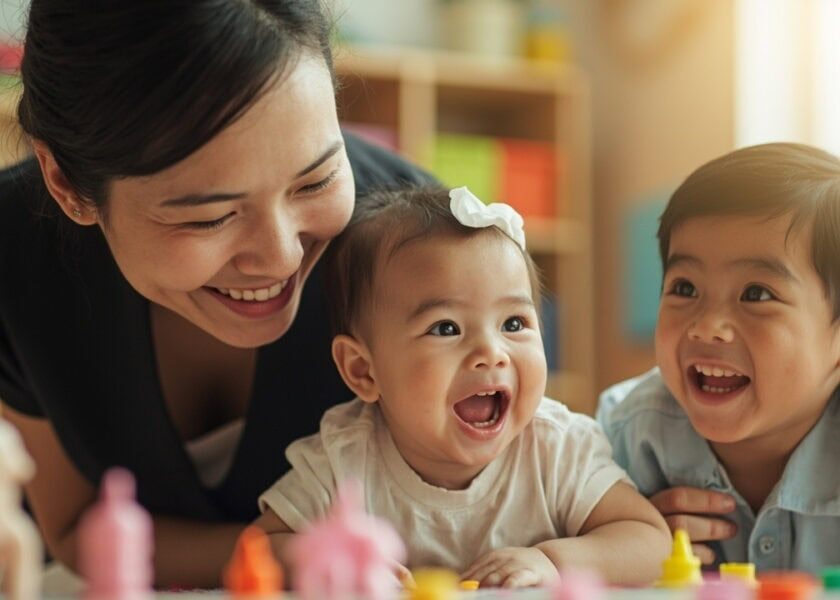
When you walk into a quality childcare environment, you should see children moving. Not just in the playground, though that matters. You should see movement integrated throughout the day: children carrying things, climbing, navigating obstacles, problem-solving with their bodies, not just their minds.
You should see sensory experiences woven into everything: sand and water, paint and clay, textures and temperatures and smells. This is not accident. This is not just keeping children entertained while parents are at work. This is deliberate, science-informed care that understands that every moment of play is building neural architecture.
The child who dumps out a bucket of blocks and rebuilds it is not just playing. She is developing spatial reasoning, motor planning, persistence, problem-solving. The child who climbs a structure and figures out how to get down is not just having fun. He is maturing his vestibular system, the system that will later allow him to sit still and attend.
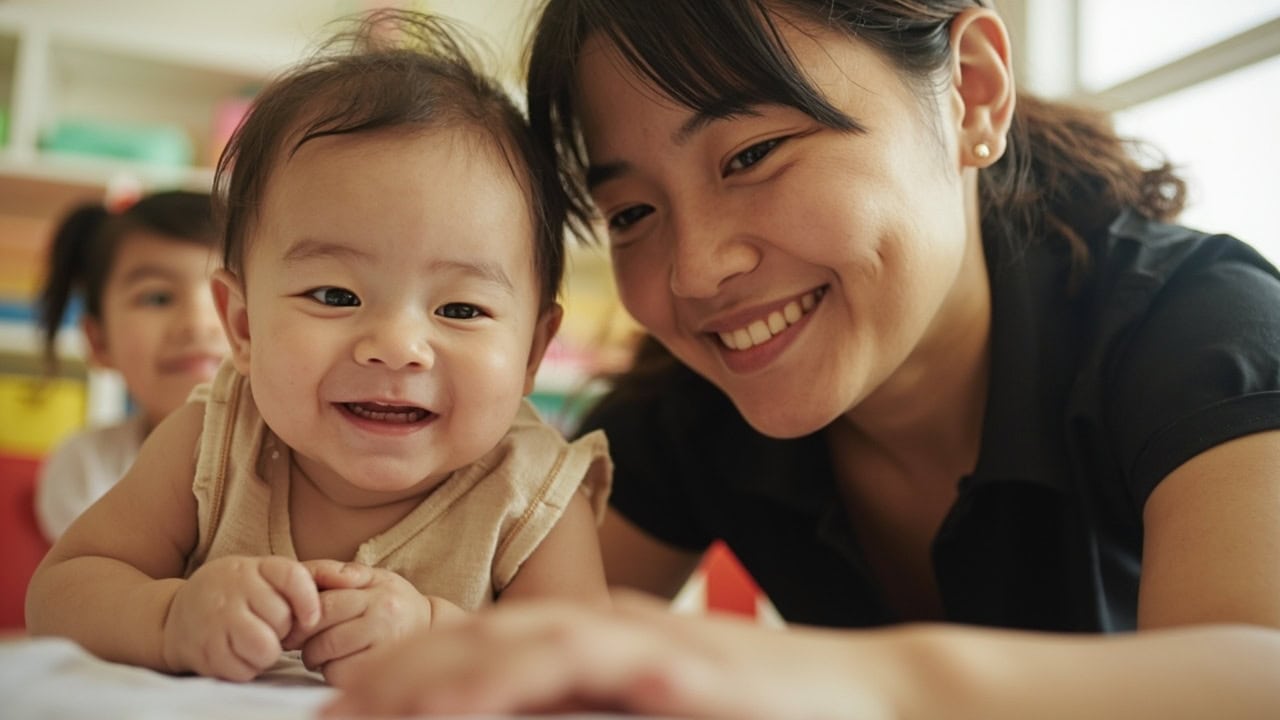
You should see caregivers who understand this. Who do not just watch children play but who facilitate play, who create environments rich with sensory opportunity, who know that the child who is having a meltdown may not need discipline but may need movement, may need deep pressure input, may need sensory regulation before he can access the cognitive parts of his brain.
When visiting a childcare centre or childminder, look for these indicators:
- Movement throughout the day, not just at designated play times
- Sensory-rich materials available: sand, water, paint, clay, textures
- Caregivers who engage with children during play, not just supervise
- Caregivers who understand why a child might be struggling and respond to developmental needs
- Environments that allow for physical challenge and risk-taking within safe limits
- Open communication with families about developmental approaches
Questions to Ask When Visiting a Childcare Provider
- How is movement integrated into the daily routine, not just at designated play times?
- What sensory experiences are available to my child throughout the day?
- How do caregivers understand the connection between sensory-motor development and learning readiness?
- What is the caregiver-to-child ratio, especially for infants and toddlers?
- How do you support a child who is struggling to regulate emotionally or physically?
- What is your approach to play, and how do you see its relationship to development?
- How do you communicate with families about their child’s developmental progress?
EduNanny’s Approach: Building the Foundations That Last
This is the childcare that your child needs. Not instead of academic preparation. Before it. Beneath it. As its foundation.
At EduNanny Singapore, we believe that your child is not a vessel to be filled with content. Your child is a whole person, a body and a mind and a spirit, learning and growing in ways that we are only beginning to understand. Our role is not to accelerate that learning by pushing academics onto young bodies before they are ready. Our role is to create the conditions in which your child’s natural developmental process can unfold optimally.
This means environments rich with sensory opportunity designed to build neural architecture through every moment of play. It means caregivers trained in developmental science who understand the sensory-motor foundations of learning and can facilitate play in ways that build the brain. It means intentional care ratios with up to one caregiver for every three infants in our youngest classrooms, because the quality of early relationships is not separate from the quality of early development.
We maintain ratios that allow for genuine attention, because we know that every interaction between a trained caregiver and a child is building the brain. We do not take that responsibility lightly.
Making Quality Care Accessible
I want to speak to a tension that is very real for many families in Singapore: the economic reality of childcare costs. The decision about where to send your child is not made in a vacuum. It is made in the context of what you can afford, what your employer offers, what fits with your commute, what your extended family can help with.
EduNanny offers pathways designed to be accessible within pilot fee structures, and we help families navigate the subsidies and schemes that are available to them, including the use of Child Development Accounts and Baby Bonus funds. Our commitment is to Singapore-wide relevance. Whether you live in Bishan or Bukit Merah, Jurong or Tampines, we believe that every child in this country deserves access to care that understands their development, not just their supervision.
We also participate in the ECDA Childminding Pilot, a government initiative that recognises childminding as an essential service for Singapore’s families.
It Is Never Too Late
For children who have not had the sensory-rich early experiences we have been discussing, for children who are already showing signs of struggle, the body continues to develop. The nervous system continues to mature. The right support, the right environment, the right opportunities for movement and sensory experience, can still build the foundations that were not built earlier.
Your daughter, the one gripping the pencil with her whole hand, the one looking up at you with uncertainty, she is not broken. She is not behind. She is a child whose body is still learning how to do what we are asking it to do. And with the right support, she will get there. Not because we push harder, but because we build what needs to be built first.
Your child’s body knows what to do. It is learning, right now, with every movement, every sensation, every moment of play. Your job, and our job, is to trust that process. To give it the time and the environment it needs to unfold.
The Choice That Matters
There is a question that every parent in Singapore eventually asks themselves, usually in the quiet hours, usually when the guilt and the worry and the second-guessing feel overwhelming:
Am I doing the right thing? Am I choosing the right school? The right enrichment? The right childcare? Am I giving my child what they need to succeed in this world that is so competitive, so demanding, so unforgiving?
Here is what I want you to know. The right thing is not a worksheet. The right thing is not a flashcard. The right thing is not a curriculum that promises to give your child an edge.
The right thing is a childhood. A full, rich, sensory-motor childhood in which your child’s body is allowed to do what bodies are meant to do: move, explore, feel, experience. In which your child’s brain is built, slowly and surely, through the only process that actually works: play.
This is what EduNanny offers. Not just care. Not just supervision. Not just a place for your child while you work. A developmental partner who understands what your child needs and why, who is committed to building the foundations that will serve your child not just in Primary One, but in Primary Six and Secondary School and beyond.
When you leave this article and return to the noise of Singapore’s educational marketplace, with its advertisements for early academic programmes and its promises of school readiness, I want you to carry one idea with you:
Your child’s body is the learning organ nobody talks about.
The pencil grip your daughter struggles with is not a character flaw. It is a sensory-motor challenge that, with the right support, will resolve. The attention your son cannot sustain is not a motivation problem. It is a nervous system that needs more time to mature through movement and play.
Choosing developmental care is not choosing a lesser path. It is not opting out of the competition. It is building the foundation on which all lasting achievement is built. The children who enter Primary One with regulated bodies, calibrated sensory systems, and the neural infrastructure to learn will not just cope with Singapore’s academic demands. They will thrive.
And that, I believe with all my heart, is the greatest gift you can give your child.
EduNanny Singapore is committed to giving every child in Singapore access to care that understands their development, not just their supervision. From infant care to childminding services, we build the foundations that serve your child for life.
Every decision we make is in service of your child’s body, and what it needs to learn.
Have questions about your child’s development or looking for care that puts their foundations first? Reach out to our team or learn more about how EduNanny approaches early childhood care.