The Morning Your Child No Longer Clings at Drop-Off
The Morning That Changes Everything
For months, perhaps years, drop-off has been a negotiation. A negotiation with tears, with clinging, with the particular ache of leaving a child who was not yet sure the world would hold them without you. And then, one morning, it is not.
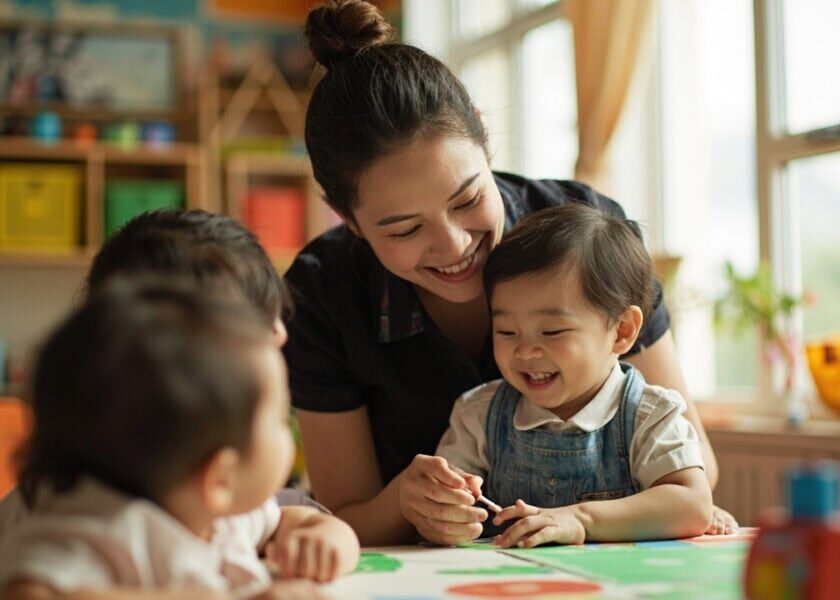
One morning your child waves you away. Turns back to the caregiver. Is already engaged in something before you have finished saying goodbye.
You feel relief. You feel gratitude. And then, if you are being honest with yourself, you feel something else — something quieter, something almost wrong to name, as if naming it would make you a lesser parent or ungrateful for the good you have been given.
That something is this: you are being needed differently now. And different is not the same as less, but it can feel like less. It can feel like a small, private grief that has no mourning period, no ritual, no recognition from anyone else who is not living inside your particular version of this.
What Quality Childcare Is Actually Designed to Do
We spend a great deal of time talking about childcare in terms of what it does for children. Their development, their safety, their growing brains and widening worlds. All of that matters deeply.
But there is another story being written in parallel — one that rarely gets spoken aloud — and that is the story of what quality childcare does to the parent who chose it.
Here is the truth that is not always easy to hold: the very best childcare is designed to make itself less necessary. Every quality programme, every skilled caregiver, every carefully considered environment — they are all, at their core, engines of independence. They are building a child who will one day not need them anymore.
And if they are doing their work well, they are also, quietly and without fanfare, rebuilding you.
The morning where your child walks away without looking back — that is success. That is the precise moment when you know, with a clarity that needs no evidence, that you chose well. Your child is not anxious. Your child is not clinging. Your child is stepping into a space that feels safe enough to leave, and that is the highest compliment a childcare arrangement can ever pay itself.
The paradox runs deeper than it first appears. The better your child is doing, the more your child is outgrowing the version of themselves that needed you most intensively. The crying that used to happen at drop-off, the tears that marked your departure as a small crisis — those are not happening anymore. And you are relieved. And you are grateful. And you are also, somewhere beneath the relief, a little bit lost.
For the first months and years of your child’s life, your primary function — the thing you were summoned to do again and again, the thing that defined the shape of your days — was emotional management. You were the safe harbor. You were the one who made the world feel manageable. And now, increasingly, your child is finding that sense of manageability elsewhere. Within themselves. Within the routines and relationships they have built in your absence.
This is exactly right. This is what should happen. But it requires something of you that no one prepared you for: it requires you to let go of being needed in the way you were needed, without letting go of love.
On one side of this threshold is the parent you were — the parent who was everything to a child who saw no distinction between themselves and the world. On the other side is the parent you are becoming: the parent who learns to love not by being indispensable but by being present, not by being the sole source of comfort but by being a steady, known, chosen presence in a life that is growing larger.
This is not diminishment. This is expansion. But expansion hurts sometimes. Growth always does.
What Quality Childminding Looks Like in Practice
For parents in Singapore navigating this journey, understanding what separates quality care from the rest matters enormously — not because you are looking for perfection, but because you are looking for the right kind of growth.
Here are the markers that distinguish a childcare arrangement designed to build independence:
- Secure attachment before separation. Your child should be developing the inner security that makes leaving possible. If your child is constantly in distress at drop-off months in, that is information worth taking seriously.
- Caregiver ratios that allow for genuine attention. In infant care, ECDA guidelines cap ratios at specific levels. Home-based arrangements like those in the ECDA Childminding Pilot may offer even smaller ratios — closer attention per child, deeper relationships, more responsive care.
- Consistent routines that build predictability. Children who know what comes next are children who can relax. Routines are not restrictions — they are the scaffolding that lets your child reach outward.
- Communication that keeps you in the story. Parents who are genuinely informed about their child’s day are parents who can let go more fully. When you trust what is happening in your absence, you are freed to trust the growth happening there.
- An environment that is warm, not just safe. Safety is the baseline. Warmth — the kind that makes a child genuinely happy to be there — is the sign that the care is doing what it is meant to do.
In Singapore’s childcare landscape, parents can choose between centre-based and home-based pathways. Centre-based care offers structure, resources, and peer interaction. Home-based childminding — the kind offered through the ECDA Childminding Pilot — offers something different: a smaller, more intimate setting where the caregiver becomes a genuine extended family figure, and where the environment mirrors the rhythms of a real home rather than an institution.
Neither is inherently better. What matters is which arrangement is actively building your child’s capacity to belong, to trust, to explore — and ultimately, to walk away from you with confidence and come back with joy.
Questions Singapore Parents Often Ask
Will my child forget me if they are in care?
No. What your child is building in quality care is not a replacement for you — it is a foundation that makes your presence more meaningful, not less. A child who is secure in your love does not forget it. They are simply expanding their capacity to hold more of the world.
Does choosing childcare mean I am less invested in my child?
The opposite. Research consistently shows that parents who choose quality care thoughtfully — who invest time in finding the right fit, who stay engaged with their child’s experience, who use the arrangement to grow alongside their child rather than step away from them — are parents who are deeply invested. Choosing childcare is not passive. It is an act of love that requires you to do the harder emotional work of evolution.
How do I know if the care is actually good for my child’s development?
Look for signs of secure attachment: Does your child look forward to going? Do they mention their caregiver with warmth? Do they come home from care tired in the good way — the way that comes from being engaged and stimulated, not distressed? These are the indicators that matter most.
What if I feel guilty about wanting or needing childcare?
Guilt is often a sign that you care deeply, not that you are doing something wrong. The question is not whether you feel guilty but whether your child is thriving — and whether the arrangement serves your whole family across time. Quality care benefits the entire family system. A parent who is supported is a parent who shows up differently for their child.
The Partner Who Walks This Path With You
This is where EduNanny by BUTLER enters the story — not as the place where your child goes, but as the place that understands what you are going through.
As part of the ECDA Childminding Pilot, EduNanny has taken on something that is both practical and deeply human: they have committed to walking the full arc of the childcare journey with families. Not just the early days when everything is new and the parent is learning to trust, but the middle days when the routines have settled and the relationship has deepened, and the later days — perhaps the most poignant ones — when your child is clearly becoming someone who does not need to be managed or soothed in quite the same way.
What EduNanny offers, within the framework of both home-based and centre-based pathways, is a structure that honors this evolution. With infant ratios that allow for genuine attention — up to one to three in the infant space — your child’s caregiver is not just keeping your child safe. They are building something. They are building the kind of secure attachment that will ultimately become the foundation for your child’s ability to walk into rooms with confidence, to form other relationships, to believe that leaving is not the same as being abandoned.
And they are building something for you, too — even if you do not always see it.
EduNanny understands something that sets them apart: parents who choose quality care are not choosing to delegate their children. They are choosing to participate in a process that will transform them. They are choosing — whether they know it or not — to be willing to let their child need them less in the service of needing them differently.
This understanding shapes how EduNanny works with families every day. Their communication approach — transparent, regular, and grounded in real evidence — means you are not left to wonder whether the separation is good for your child. You are given the ongoing story of your child’s day, and with it, the quiet reassurance that what you cannot witness in person is still being held with care.
What You Are Really Choosing
When you choose quality childcare, you are choosing more than a schedule. You are choosing a partner in your child’s growth and in your own. You are choosing to trust someone else with the most important thing in your life — not because you have to, but because you have found a place worthy of that trust.
You are choosing to be brave enough to let your child need you less so that your child can become someone who needs you differently — and more freely.
And you are choosing to walk a path that will ask more of you emotionally than you may have anticipated, because the best things in parenting always do.
Here is what I want you to know, directly, if you are in the middle of this feeling right now. Perhaps your child has just started showing signs of this shift — the first morning drop-off where there is no tear, the first time they run ahead to a caregiver without looking back. Perhaps you are in the thick of it already, and the changes have become so regular that you have almost stopped noticing them, except in the quiet moments when the absence of need catches you off guard.
You are not failing. You are not being replaced. You are not less important than you were when your child was smaller and more entirely dependent on you. You are being asked to become someone new. And the person your child needs you to become is not a lesser version of who you were. It is a more complex, more resilient, more spacious version. A version that can hold both the pride and the sadness. A version that can celebrate your child’s growing selfhood without feeling erased by it.
The child who runs ahead now is not leaving you behind. They are inviting you to walk alongside them on different terms. They are saying: I am ready for you to know me not just as the person I was when I needed you most, but as the person I am becoming. I am ready for a relationship that is not held together by my fear but by my fascination with the world. I am ready for you to see me, really see me, as someone who can do things on my own — and still choose to come home to you.
That is the invitation. And it is one of the most beautiful invitations parenting has to offer.
There will come a day — perhaps sooner than you think — when the childcare chapter closes. When the routines you have come to know so well, the caregivers who have become trusted figures, the environment that has been a second home, all of that shifts into memory.
On that day, you will look at your child and see someone who is ready for the next chapter. Someone who has been made ready, in large part, by the quality of care you chose for them when they were small. You chose well. Even on the days when you were uncertain. Even on the days when you second-guessed your decision to return to work, to share the raising of your child with others, to trust someone else with the most important thing in your life.
You chose well. Because the evidence of that choice is standing in front of you — running ahead, waving, turning back to say come on.
And you will. You will keep coming. Because the love that drove you to find the best possible care for your child when they were small is the same love that will carry you through this evolution. It does not diminish. It transforms. It becomes the kind of love that can let go and hold on at the same time. The kind of love that can stand at the door and watch your child walk away and know, in your bones, that this is what you were always preparing for.
Begin the Conversation
EduNanny Singapore is here to walk this path with you — not just in the early days, but across the whole arc, through the tears and the triumphs, through the clinginess and the confidence, through the first wave goodbye and the thousandth. They are here for the family you are becoming, and they understand that what that family looks like will not always look the same as what it looked like before.
That is not a flaw in the system. That is the system working exactly as it should.
If you are ready to explore what quality childminding can look like for your family — and what it can mean for this extraordinary, evolving relationship you are building — EduNanny welcomes the conversation. Not as a service provider making a pitch, but as a partner who has seen this story play out again and again, and who knows that when it goes well, it goes beautifully.
For families in Singapore, EduNanny offers a structure designed around this full understanding. The practical dimensions — pilot fee structures, CDA and Baby Bonus eligibility for qualifying families, Monday to Friday care blocks that fit the rhythms of working life across Singapore — are the scaffolding that makes it possible to access this kind of care without it becoming a source of financial strain or logistical chaos.
When the practical dimensions are handled, parents are free to do the harder work: the emotional work of being in evolution alongside their child.
Your child is growing. Let them. And when the pang comes — because it will come, it always comes — let it come alongside the pride. Let it come as evidence of what you have built. Let it come as proof that you are in the middle of something extraordinary, even when it feels ordinary.
You are raising a person who will one day walk into the world with everything they need to thrive. And you had the wisdom to build that foundation — not alone, but with partners who understood the full weight of what you were entrusting to them.
That is no small thing. That is everything.
Quick Summary
- Quality childcare is designed to make itself less necessary over time — that is the goal, and it is working when it happens
- The shift from being needed constantly to being needed differently is one of the most profound emotional transitions in parenting
- The parent whose child no longer cries at drop-off is often the parent feeling the most quietly complex emotions — and that is completely normal
- EduNanny, as part of the ECDA Childminding Pilot, understands this full arc and structures care around it
- What you are building by choosing quality care is not just a child who can separate — it is a child who can return with joy
- Your role is not diminishing. It is expanding into something more reciprocal, more resilient, and deeply meaningful
Learn more about who EduNanny is or start a conversation with the team.