Your Child’s Brain Is Being Built Right Now
Why the Early Years Are Extraordinary
Between birth and age three, your child’s brain forms more than one million new neural connections every second. Let me say that again, because the magnitude of it is easy to miss: one million. Every second.
The brain is not passively waiting to receive information during these years. It is actively building itself—pruning unused pathways and reinforcing the ones that fire again and again. It is deciding which connections matter and which do not. This process is not metaphor. It is biology. And it happens, overwhelmingly, before your child ever walks into a primary school classroom.
Singapore parents understand this instinctively. You see it in the way you speak to your infants, the toys you choose, the songs you sing, the rhythms you establish. You understand that the early years are not simply a waiting room before real life begins. Your child is already living, already learning, already becoming.
What Science Tells Us Is Happening
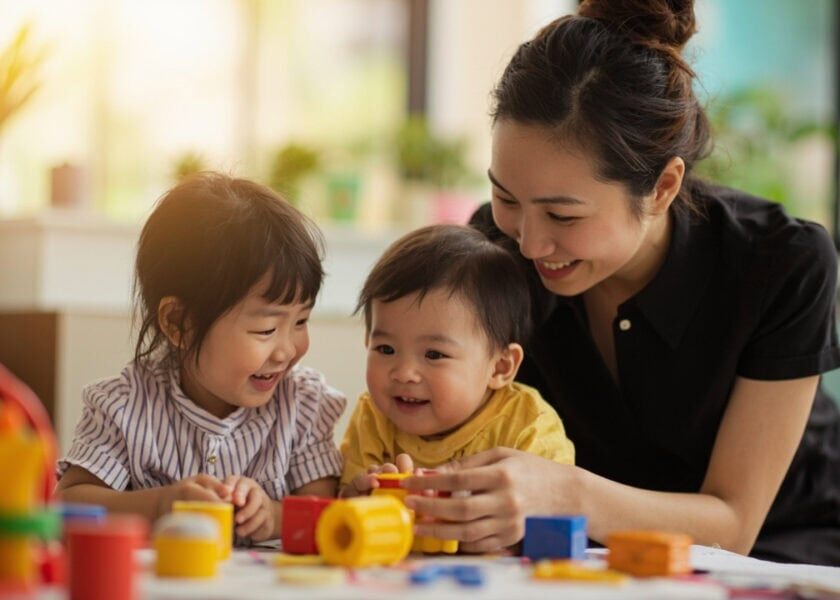
In quality childcare, your child is not being supervised. They are being educated—in the deepest, most foundational sense of the word. Here is what research shows is actually happening during those hours you are apart:
- Brain development is accelerating. Quality childcare environments actively participate in the most critical window of human neural development.
- Attachment patterns are being shaped. Secure bonds with caregivers build emotional regulation skills that last a lifetime.
- Language is being acquired at maximum speed. By age three, a child’s brain has developed approximately eighty percent of its adult vocabulary capacity.
- Social skills are being formed. Peer interaction builds empathy, conflict resolution, and social confidence that extends into adulthood.
- Motor and cognitive development are intertwined. Every climb, pour, and puzzle piece is building neural pathways that support future learning.
The hours your child spends in quality childcare are not subtracted from their development. They are added to it. They are compounding.
How Your Child Grows in Quality Care
Understanding that the early years matter is one thing. Seeing how your child actually develops during those hours is another. Let us trace the major domains of growth unfolding in every quality childcare environment.
Emotional Foundation: Attachment and Regulation
Everything else in early childhood development rests upon a foundation that most parents have heard of but understand least in practice: attachment.
Attachment is not simply the bond between parent and child. It is the internal working model your child is building—right now, in these early years—about how the world works. It is the template they will use, for the rest of their lives, to understand relationships, to regulate their emotions, to trust or not trust other people, to approach or avoid new situations.
In quality infant care, your child is forming attachment relationships—not replacing the one they have with you, but building a secondary network of secure bases from which they can explore. When a well-trained caregiver responds consistently to your infant’s cues, when they engage in the back-and-forth that researchers call serve-and-return interaction, they are doing something neurologically profound. They are helping your child’s brain practice the circuits of connection.
Your one-year-old is frustrated because the block tower keeps falling. In a childcare environment where attachment is understood as curriculum, a skilled caregiver does not simply rebuild the tower for them. They sit beside the child. They name the feeling. They offer words—frustrated, hard, try again. They stay present while the child works through the disappointment.
In that small moment, your child is learning something that will serve them in every relationship they will ever have: that big feelings are survivable, that someone will stay with them through the hard moment, and that words can help make the feeling smaller.
Language: Building the Architecture of Communication
The window for language acquisition—for the effortless absorption of sounds, structures, and meanings—is concentrated in these early years, and it is sensitive to environment in ways that are humbling. By age three, a child’s brain has developed approximately eighty percent of its adult vocabulary capacity.
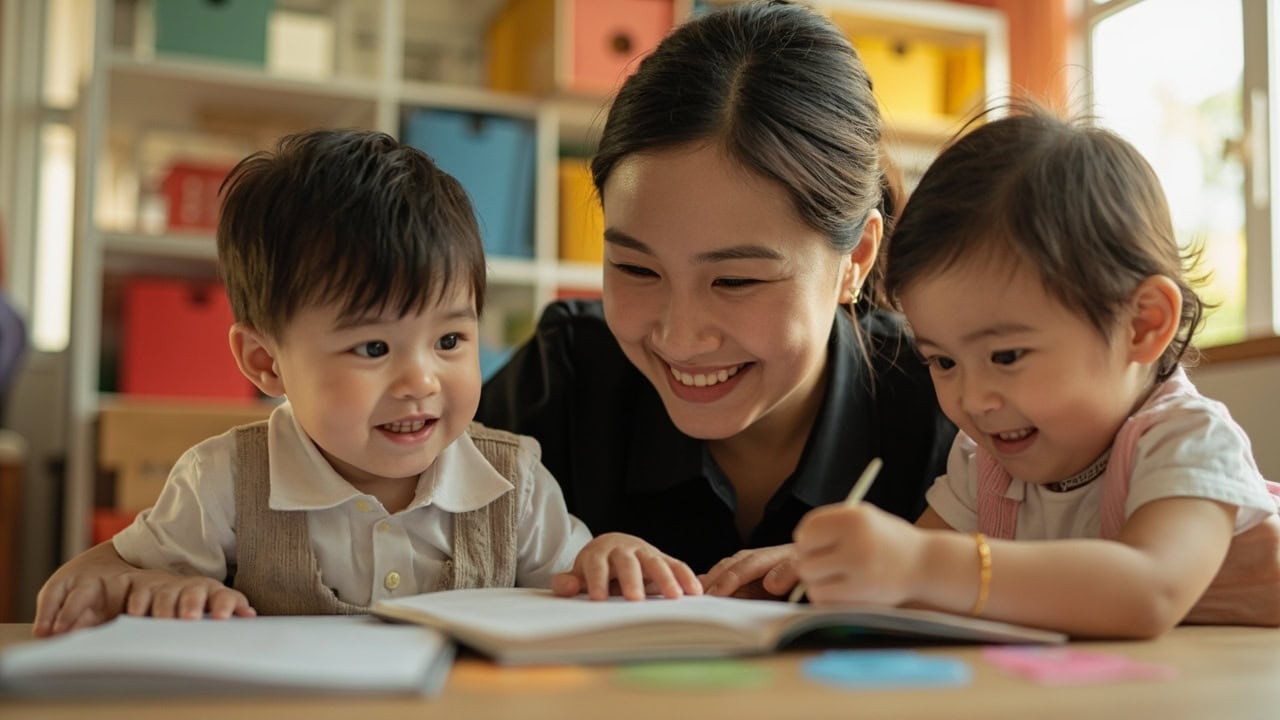
Quality infant care provides what researchers call a high-quality language environment. This is not simply talking to your child. It is the kind of talking that happens when a trained caregiver narrates a child’s actions in real time, expands on their attempts at communication, introduces new words in meaningful contexts, and engages in extended conversational exchanges.
Consider the difference between these two moments:
Scenario one: A caregiver glances at a toddler’s drawing and says, “Good.”
Scenario two: A caregiver sits down, points to a shape in the drawing, and says, “You drew a circle. I see circles everywhere—look, the clock is a circle too. What else can you find that is round?”
In the second scenario, your child receives multiple exposures to the word, meaningful context, and the cognitive engagement that deepens word learning. Over hundreds of such interactions in a day, in a week, in a month, the differences compound. They compound into vocabulary size, into sentence complexity, into the ability to understand and be understood.
Language is about communication—the ability to express needs, to ask for help, to negotiate, to listen, to understand another person’s perspective. Quality infant care is building the communication architecture that will house every human skill your child will ever need.
Social Skills: Learning to Be a Person Among People
Social development is one of the most misunderstood aspects of early childhood. We tend to think of it as something that happens naturally, as if children will simply absorb social skills the way they learn to walk or talk. But social competence is not automatic. It is learned. It is practiced. It requires environments specifically designed to offer the right kinds of social challenge at the right stages of development.
In quality childcare, your child encounters peers. They learn, for the first time in a sustained way, that other children have needs and desires that may not align with their own. They experience the frustration of waiting, the negotiation of sharing, the complexity of choosing a friend. They learn that their actions affect other people’s feelings, and that other people’s actions affect them.
What makes quality childcare different from informal playgroups is the scaffolding a trained caregiver provides. When a conflict arises over a toy, a skilled caregiver does not simply intervene and resolve it. They support the children in resolving it themselves—offering language, modeling problem-solving, asking questions that guide rather than dictate:
“You both want the truck. What could we do? You have an idea. Can you tell her? She is looking at you. Can you hear what she is saying?”
In these moments, your child is practicing the most complex human skill there is: getting along with other people.
Movement and Cognition: Bodies Building Minds
Motor development—the growth of large muscles and small, the refinement of movement, the coordination of body and mind—is a critical domain of early childhood learning that is often overlooked. And yet it is foundational.
The ability to move with confidence and control is linked to cognitive development in ways that research is only beginning to fully understand. When your child climbs, they are not just exercising their legs. They are building neural pathways that support spatial reasoning, that enable planning and sequencing, that contribute to mathematical thinking.
In quality infant care, movement is not an afterthought. It is structured into the day—gross motor play developing strength and coordination, fine motor exploration building dexterity necessary for writing and independent functioning.
And here is the thing that often surprises parents: movement is not separate from learning. A child pouring water from one container to another is learning about volume, prediction, and cause and effect. A child using child-sized scissors is developing hand strength and bilateral coordination that will later support writing. A child climbing a structure and deciding whether they can make the jump is engaging in risk assessment, executive function, and the understanding of their own body in space.
Every movement is a lesson. Every physical encounter with the world is building something.
Cognitive Development: Thinking, Problem-Solving, Wonder
Quality infant care environments are thoughtfully designed. They are carefully considered spaces where every element has a purpose, where materials are chosen for their developmental value, where the environment itself becomes a teacher—open-ended materials that invite exploration, low shelves that make choices accessible, clearly defined zones that support different types of play.
But the environment is only part of it. The human interaction is what transforms a room full of materials into a developmental powerhouse.
When a caregiver notices that a child has been staring at a puzzle for several minutes and has not yet attempted it, they do not rush in to help. They observe. They consider whether the child needs more time or a slight invitation. They offer a small provocation: “I wonder if this piece goes here”—without taking over the problem-solving process.
They understand that the learning is in the struggle, not in the solution being handed to you.
This is cognitive scaffolding at its finest. It is the art of being present without being intrusive, of supporting without substituting, of challenging without overwhelming. And it is happening—in small moments like these—throughout your child’s day in quality care.
Addressing the Concern: Replacement vs. Partnership
I want to take a moment to address something that I know is on the minds of many Singapore parents who are considering or using infant care.
There is a concern—sometimes spoken and sometimes not—that childcare is a substitute for parental care. That by placing your child in quality childcare, you are somehow replacing what you would give them at home.
I want to be clear about this, because the science is clear about it too: you are not replacing anything.
What your child receives in quality childcare is additive. It builds on the foundation you are establishing. Your child’s relationship with you and their relationship with their caregiver are not in competition. They are complementary.
When your child comes home from childcare and is delighted to see you, that is not evidence of some failure of the childcare bond. It is evidence of a child who has experienced secure, quality care and who now has the emotional security to explore separation and return to reunion with confidence.
This is the paradox that parents often struggle to hold: your child needs you, and your child also needs other responsive adults. Both are true. Both are necessary. And when both are provided in a quality environment, the outcome is not confusion or divided loyalty. It is a child who is more adaptable, more socially confident, and more emotionally secure than they would be with only one relationship to draw from.
The caregiver in quality infant care is not a replacement parent. They are a trained professional who is participating in your child’s development in partnership with you. And the best childcare arrangements are exactly that—a partnership, with communication, with transparency, with mutual respect for the role each of you plays in your child’s life.
How to Recognize Quality Childcare
Understanding that quality childcare matters is one thing. Knowing how to recognize it is another. Here is what to look for—and what questions to ask—when you are evaluating your options.
Signs of Quality Care
- Responsive interaction: Caregivers talk with children, not at them. They narrate actions, expand on words, and engage in back-and-forth conversation even with infants.
- Emotional attunement: Caregivers notice distress and respond with comfort, name feelings, and stay present through difficult moments.
- Active observation: Skilled caregivers watch first, then decide whether support is needed—rather than always intervening.
- Problem-solving support: When conflicts arise, caregivers guide children toward solutions rather than simply resolving things for them.
- Structured environment: Materials are accessible, purposeful, and changed based on children’s developmental needs and interests.
- Parent communication: You receive regular updates about your child’s day, development, and discoveries—not just photographs.
Questions to Ask
When visiting a potential childcare arrangement, consider asking:
- How do you support a child who is frustrated or upset?
- What does a typical day look like?
- How do you handle conflicts between children?
- How will I know what my child is learning and experiencing?
- What training do your caregivers have in child development?
EduNanny’s Approach
Understanding what quality childcare is building becomes connected to ensuring that what is being built is the right thing, in the right way, with the right support.
EduNanny by BUTLER represents a particular vision of infant care and childminding in Singapore. It is a vision grounded in the understanding that the early years are not incidental, that the brain is not passively waiting, that what happens in these hours matters profoundly and lastingly.
This understanding translates into practice through the ECDA Childminding Pilot, through home-based care that brings quality into a familiar environment, and through centre-based pathways where community and structured learning come together.
Intentionality in Practice
What distinguishes quality childcare is not a single feature. It is a philosophy of intentionality—asking at every point: what does this child actually need right now, and how can we provide it in the most developmentally supportive way possible?
- The ratios reflect this. With up to one-to-three infant care in the EduNanny model, your child receives the individual attention that developmental science tells us is essential in the earliest years. In these ratios, your infant’s cries are heard quickly. Your toddler’s attempts at communication are responded to. Your child’s explorations are supported rather than hurried along.
- The training reflects this. Caregivers in the EduNanny network are trained professionals who understand the science of early development, who can recognize developmental milestones and variations, who know how to scaffold learning and support emotional regulation. They are partners in your child’s development, not just supervisors.
- The transparency reflects this. Communication with parents, CCTV measures where deployed—these are not defensive gestures. They are expressions of a genuine belief that parents deserve to know what is happening with their children. That trust is built through openness, not through silence.
- The structure reflects this. Monday to Friday care blocks that align with the rhythms of working families in Singapore. Subsidies and support structures through CDA and Baby Bonus that make quality care accessible, not a privilege reserved for few.
Beyond Service: A Philosophy
Within the EduNanny ecosystem, Thomas—the AI companion—exists because the team understands that parenting in Singapore is not simple. That the questions do not stop at the school gate. That between drop-off and pick-up, between one developmental milestone and the next, there are questions and concerns that deserve thoughtful answers.
Thomas is not a replacement for human guidance. It is an amplification of it—available when questions arise, responsive to the specific circumstances of each family, grounded in the same developmental science that informs every other aspect of the approach.
This is the difference between a service and a philosophy. A service provides what it promises. A philosophy thinks about what you need before you know to ask for it.
Bringing It Home
If you are a parent in Singapore who uses or is considering infant care or childminding, I want you to carry something forward from this article.
I want you to carry a shift in how you see that morning goodbye.
When you drop your child at quality childcare, you are not leaving them somewhere safe while you go to work. That is true, and it matters, but it is not the whole truth.
The whole truth is this: you are placing your child in a developmental environment that is actively, intentionally, scientifically building their brain. You are giving them access to responsive caregiving that strengthens their capacity for connection. You are offering them language-rich interactions that expand their ability to communicate. You are placing them among peers where they are learning to be a person in relationship with others. You are giving them a body that is moving and growing and learning through purposeful play. You are surrendering them to an environment that is teaching them to think, to solve problems, to regulate emotions, to wonder.
You are not leaving your child with a service. You are placing your child in a curriculum. The most important curriculum they will ever encounter. And it is happening right now, in these early years, in every hour that you are apart.
So the next time you are sitting in that carpark, or walking back to the MRT, or standing at your desk in those first hours after drop-off—I want you to try something different.
I want you to imagine—not what your child is enduring in your absence, but what they are experiencing:
- The caregiver who noticed they were tired and offered quiet comfort
- The friend who shared a block and learned the lesson of taking turns
- The song that introduced new words in a rhythm that made them easy to remember
- The climb up the structure that built not just leg muscles but courage and self-belief
- The story that was read, and the questions that were asked, and the conversations that were had
Your child is not waiting for you to come back and teach them. They are learning, right now, in ways that will stay with them for the rest of their lives.
And you—by choosing quality care, by investing in this environment, by showing up at drop-off and pick-up with all the complexity of your love and your hopes and your questions—you are participating in something extraordinary.
You are building a person.
And they could not be in better hands.
Ready to explore what quality infant care and childminding can offer your child? Connect with EduNanny to discuss your family’s needs, or learn more about the EduNanny approach.