Finding a Caregiver Who Truly Knows Your Baby in Singapore
The Question Every Parent Carries
There is a moment — quiet, fleeting, almost ordinary — that happens every morning in homes across Singapore. A parent lifts their child from the changing table, settles them into fresh clothes, gathers the diaper bag, and then stands at the door. In that moment, they place their child into someone else’s arms.
It is a transfer of trust so complete, so total, that we rarely stop to examine its weight. And yet, that weight is precisely what we should examine — because in that instant, a parent is not simply handing over logistics. They are handing over the person they love most in the world, and with that child, they are entrusting something far more fragile than a schedule or a routine. They are entrusting the earliest architecture of a human life.
Ask any parent what they think about in that moment, and they will give you answers that sound practical on the surface. They worry about feeding times, about naps, about whether the temperature in the room is right, about whether there will be enough outdoor time. Those concerns are real — they matter, and a good caregiver attends to all of them.
But if you press gently, if you create the space for honesty, you will find something deeper underneath. It is a question that most parents carry quietly, sometimes without even articulating it to themselves. It goes something like this: when I am not in the room, is my child truly known? Is the person holding my baby paying attention in the way that matters? Is she watching not just for safety, but for meaning? Is she seeing what my child is trying to say before words exist to say it?
That question is the right question. It is the question that separates adequate care from the kind of care that actually shapes a child’s life.
What Professional Attunement Really Means
At its core, professional caregiver attunement is the trained ability to read a child’s cues accurately and respond with timing and tone that matches what the child actually needs — consistently, across hundreds of interactions, every single day.
Here is what this means for your child:
- Before words exist, your baby communicates through subtle signals — turning away when overwhelmed, stiffening when overstimulated, small sharp cries when something is wrong. An attuned caregiver reads these signals as communication, not fussiness.
- Every responsive interaction teaches your child that their signals matter, that communication works, and that the world is a place where they will be heard.
- Over time, these thousands of attuned moments build something profound: secure attachment, stronger neural pathways for emotional regulation, and the foundational confidence to explore, learn, and connect.
What Professional Attunement Looks Like in Practice
Let us talk about what that answer looks like — not in abstract terms, but in the daily reality of what a child experiences when they are in the presence of a caregiver who has been professionally trained to do more than keep them safe. A caregiver who has been trained to pay attention.
The First Languages Before Words
When a baby is three months old, she cannot tell you she is feeling overwhelmed by the noise in the room. She cannot point to her chest and say her heart is racing. What she can do is turn her head away, stiffen her body, or let out a small, sharp cry.
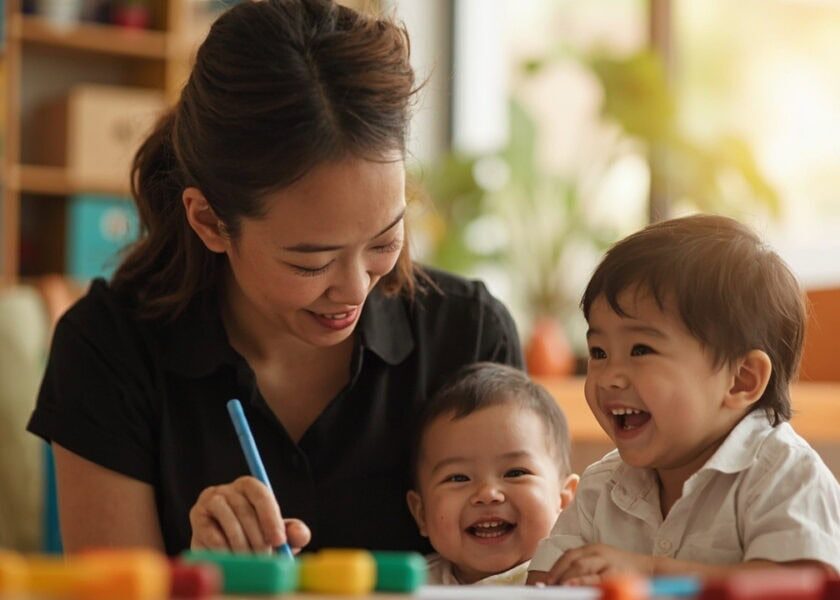
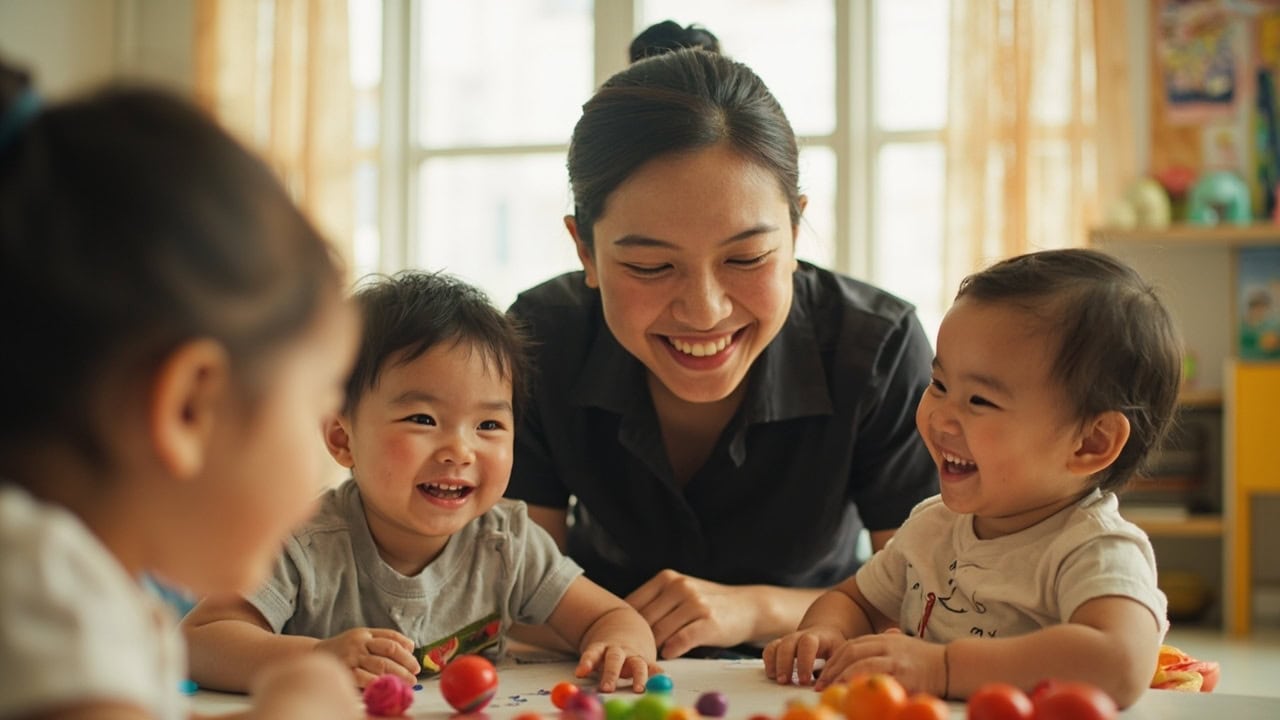
These are her first languages — communication that predates words by months or even years. An untrained eye might see a fussy baby. An attuned caregiver sees a child who is saying something specific, something that deserves a specific response. She lowers the noise, dims the lights, speaks softly. She moves slowly, gives the child space to regulate.
And in doing so, she is not just calming a baby. She is teaching that baby something profound about the world: that her signals matter, that communication works, that when she reaches out — even before she can reach with words — someone is there to receive her.
Attunement Is a Trained Skill
This is what we mean when we speak about professional attunement. It is not a feeling. It is not maternal instinct, though maternal instinct is a beautiful and powerful thing. Professional attunement is a skill — a trained, practiced, deliberate skill that transforms responsiveness into a developmental tool.
It is the ability to read a child’s cues accurately, to respond with timing and tone that matches what the child actually needs, and to do this consistently, across hundreds of interactions, every single day. This is what separates watching from knowing. This is what separates adequate care from care that builds.
The Science of What Caregiver Attention Builds
Decades of research in developmental psychology have shown us that children who experience consistently attuned caregiving develop stronger neural pathways in the prefrontal cortex — the part of the brain responsible for emotional regulation, for impulse control, for the capacity to focus and to recover from stress.
They develop what researchers call secure attachment: an internal working model of trust that tells them the world is a place where their needs are noticed and met.
A child with secure attachment enters a room full of other children with a different quality of curiosity than a child who has learned, through inconsistent or inattentive care, that signals may go unanswered. The first child explores. The second child watches for danger. Both responses are rational. But only one of them is the foundation for confidence, for learning, for the belief that effort leads to reward.
This is what a professionally attuned caregiver builds — not in a single day, not in a single interaction, but in the accumulation of thousands of attuned moments. And this is what most parents are actually searching for when they begin the process of finding childcare, even if they do not yet have the language for it.
How to Recognise Attunement When You See It
So what does this look like in practice? How does a parent recognise professional attunement when they see it?
Observe the How, Not Just the What
When you visit a caregiver — when you sit in that space and watch — notice not just what the caregiver does, but how she does it.
Language scaffolding: Notice whether she narrates what she is doing as she does it, giving the child a running commentary on the world: “I’m going to pick up the red block now. Red. It feels smooth, doesn’t it?” This is not idle chatter. It is the steady, patient introduction of vocabulary and meaning at a pace the child can absorb.
Physical attunement: Notice whether she gets down on the floor at the child’s level, rather than remaining above, administering to the child from a distance. Notice whether she mirrors the child’s expressions back — if the baby makes a face, does the caregiver make it back? This mirroring is one of the oldest forms of human connection, and in skilled hands, it becomes a tool for teaching emotional recognition.
Watch How She Handles Difficult Moments
Notice how the caregiver handles transitions — the difficult moments when a child moves from one activity to another, or when a child is distressed.
A caregiver who is attuned will name the emotion before she tries to solve the problem. “You are feeling frustrated that the puzzle piece won’t fit. That is hard.” She validates before she redirects. She acknowledges before she moves forward.
And in doing so, she is teaching the child something that will serve them for their entire lives: that emotions are information, that they are not to be feared or suppressed, and that having a feeling does not make you bad or broken — it makes you human.
These are the observable signatures of professional attunement. And if you know what to look for, you will find them in the caregivers who have been trained to look for them too.
The EduNanny Approach: Built Around Attunement
EduNanny was built around one principle: the caregiver is not simply the person who cares for your child. The caregiver is the primary developmental figure in your child’s early life, outside of you. That is a significant responsibility, and it deserves to be treated as such.
Training Grounded in Developmental Science
Every caregiver who joins EduNanny enters a training structure grounded in developmental science and attuned caregiving practice. They learn to read cues, to scaffold language, to support emotional regulation, to understand the difference between a child who is tired and a child who is overstimulated and a child who is hungry — distinctions that matter enormously in the first years, when children communicate so much through their bodies.
They learn that responsiveness is not optional. It is the work itself.
Part of the ECDA Childminding Pilot
EduNanny is proud to be part of the ECDA Childminding Pilot. We believe that professional childminding deserves to be recognised as what it truly is: a vocation that requires skill, training, and respect.
The pilot framework reflects this — it establishes home-based and community pathways that give families real options, maintains ratios that allow for genuine attention — up to one caregiver for every three infants — and does so within a fee structure that makes quality care accessible to every family who believes their child deserves it.
CDA and Baby Bonus funds can be used through the pilot, because we want the financial architecture to support what the caregiving architecture is building.
Transparency You Can Count On
We also believe that transparency is not optional in care this important. When you entrust your child to a caregiver, you deserve to know what is happening in your child’s day — not in vague terms, but in specific, meaningful observations.
EduNanny’s caregivers document and communicate with parents regularly, so that the attunement happening in care hours is visible, shareable, and continuous with the relationship you are building at home. Where CCTV measures are deployed, they serve not as surveillance but as trust infrastructure — a commitment to openness that lets you focus on what matters: knowing your child is in hands that are truly paying attention.
A Practical Guide for Choosing Infant Care in Singapore
If you are in the process of evaluating childcare options, here are the questions that matter most.
Questions to Ask a Prospective Caregiver
- How do you respond when a baby turns away or stiffens their body — what does that signal mean to you?
- How do you handle a child who is frustrated or upset? What comes first — calming or problem-solving?
- What does a typical day look like in terms of language interaction with the children? How do you introduce new words and concepts?
- How do you communicate with parents about what happens during the day?
- What training have you had in child development, and how does it inform your daily practice?
Red Flags to Watch For
- A caregiver who does not get down to a child’s eye level during interactions
- Responses that are primarily disciplinary rather than attuned — “stop crying” instead of “you are feeling frustrated”
- No visible language scaffolding — narration, commentary, conversation with pre-verbal children
- Resistance to sharing documentation or communicating regularly with parents
- A focus on logistics without any reference to emotional or developmental engagement
Making Quality Care Financially Accessible
Quality should not be reserved for families with the highest budgets. The ECDA Childminding Pilot makes professional childminding more accessible through subsidies and support. CDA and Baby Bonus funds can be applied, meaning the financial architecture of Singapore’s family support system is aligned with what your child’s development actually needs.
The Standard That Deserves Your Trust
We built EduNanny because we believe that every child deserves a caregiver who is professionally attuned — a caregiver who is not just present, but attentive. Not just responsible, but responsive. Not just watching, but knowing.
We built it because we believe that Singapore’s parents deserve a choice that is not just adequate. You deserve a standard that is worthy of the trust you are placing — not just a service that keeps your child safe and fed and rested, but a partnership in development that treats your child’s earliest years as the extraordinary, unrepeatable opportunity they are.
The question you have been carrying — the quiet question behind every search, every visit, every conversation you have had with yourself in the small hours — is not really about logistics. It is about whether your child is being seen.
With EduNanny, the answer is yes. Every day, in every interaction, your child is being seen. Your child is being heard before they can speak. Your child is being responded to before they know to ask. Your child is being built up, interaction by interaction, by someone who has made it her professional purpose to pay attention in the way that changes everything.
That is not a small thing. That is everything.
Ready to explore what professionally attuned childminding looks like for your family? Connect with EduNanny to learn more about our caregiver model, our participation in the ECDA Childminding Pilot, and how we support Singapore families in giving their children the developmental foundation they deserve.