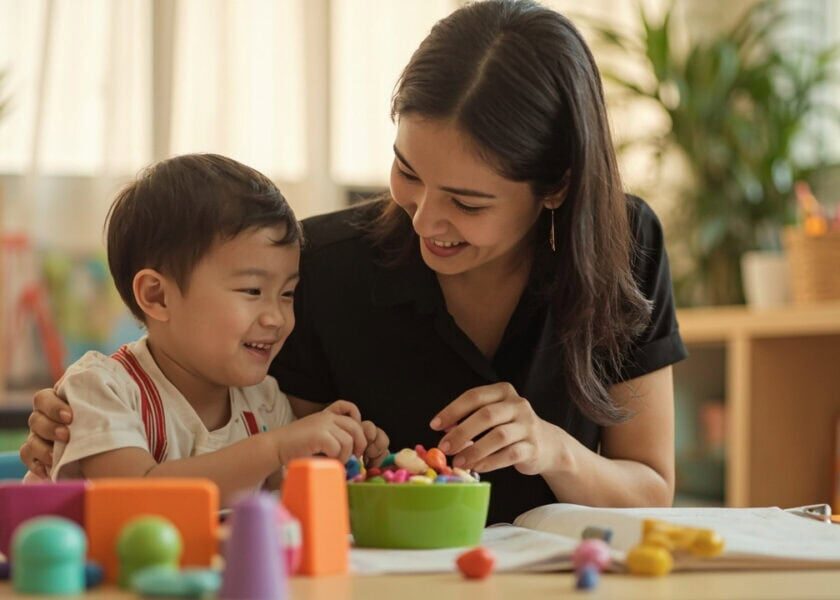
Your Child Will Change. Can Your Childcare Keep Up?
There Is a Moment Every Parent Remembers
It is not dramatic. It does not announce itself. But it arrives quietly, and when it does, something shifts.
You are handing your infant to a caregiver. Perhaps it is the first time. Perhaps it is the tenth. And as you watch that caregiver receive your child — not just holding them, but noticing them — you feel something you did not expect.
You feel seen. Not you. Your child.
The way your baby turns her head when she is tired. The particular rhythm of her settling. The sound she makes when she is hungry, versus the one she makes when she wants to be held closer. The caregiver is reading these signals not as a checklist, but as a language. And your child is speaking it fluently, in a place that is not home.
That moment — that quiet recognition — is the beginning of something most parents do not have a word for until they feel it begin to change.
The Quiet Question Every Parent Eventually Asks
Your child will grow. And as they grow, a question will form in the back of your mind. It may come at eight months, or fourteen months, or two years. It is not a question you planned to ask. But it is there, persistent and private:
Can this survive?
Can the relationship we built — the one built on this caregiver knowing my child — can it survive my child becoming someone new?
This is the question no one talks about openly. We speak easily about choosing childcare, about finding the right fit, about the first days of settling. But we rarely speak about what happens when the child you enrolled is no longer the child you have.
When the infant who needed to be held becomes the toddler who needs to climb. When the toddler who needed words finds them — and suddenly everything is a question. When the child who loved circle time begins to wonder about the bigger children in the next room.
These are not problems. These are milestones. But they press against something real: the fear that your child’s childcare is built for who they were, not who they are becoming.
This fear is not irrational. It is, in fact, the most honest thing a parent can feel. Because deep down, what you are asking is not really about childcare at all. You are asking: Is the understanding real? Or is it temporary?
Static Caregiving vs. Developmental Continuity
Here is what we believe, and what EduNanny Singapore is built to answer: that understanding can be real. That it can last. And that the difference between a childcare service that survives your child’s growth and one that does not has everything to do with what that service was designed to do in the first place.
Most childcare is designed around stability. Fixed routines. Age-appropriate curricula. Clear boundaries. Children do need structure, and they do need environments calibrated to their developmental stage.
But structure is not the same as rigidity, and calibration is not the same as responsiveness. A childcare service can be beautifully organized for infants and still be unprepared for what happens when those infants become toddlers — not because anyone did anything wrong, but because the system itself was never designed to track growth. It was designed to manage age groups.
This is where the real distinction lives. There is a difference between static caregiving and what we call developmental continuity — the sustained, attentive understanding of a child as they move through the stages of early childhood.
Developmental continuity means the caregiver who knows your child’s sleep cues at six months is also watching for what happens when those cues change at twelve months. The routines your child has come to trust are not abandoned when a new developmental phase arrives, but gently evolved — because the caregiver understands that your child’s need for consistency does not disappear when their need for autonomy increases.
Transitions between care stages — from infant care to toddler care, from toddler care to school readiness programming — are not beginnings. They are continuations. The thread does not break. It extends.
The Early Years: A Continuous Unfolding
The infant who is building the neurological architecture for emotional regulation is also laying the groundwork for language, for motor development, for social trust. These domains do not develop in isolation. They are intertwined, each one influencing the others, each one requiring a caregiver who sees the whole child — not just the child at this moment, but the child as they are becoming.
Consider how quickly this unfolds in practice. A six-month-old who is just beginning to reach for objects is already activating the same cognitive pathways that will, in eighteen months, enable symbolic play. The toddler who is resisting bedtime is expressing the same self-assertion that will, in three years, help them advocate for themselves in a classroom. Development is not a sequence of finishing and starting. It is a single, layered process — and a caregiver who can read it as one is a caregiver who can meet your child where they actually are.
In the earliest months: Building foundations
Infant care is, by necessity, focused on foundations. Secure attachment. Predictable rhythms. The infant’s world is sensory and physical — they need to feel safe enough to explore, fed enough to grow, held enough to know that the world is a place where their needs will be met.
What many parents do not realize is that these foundations are not separate from later development. They are the beginning of later development. The secure attachment built in the first year becomes the emotional regulation capacity of the toddler. The trust established through consistent caregiving becomes the independence explored through climbing and testing and saying no. The work of infant care is never only about the infant — it is about setting the trajectory that everything else will build upon.
When the infant becomes a toddler: Evolving without abandoning
Then the infant becomes a toddler. And the work of care must evolve — not abandon, but evolve.
The toddler no longer only needs to be held. They need space to climb, to test, to say no. They are developing autonomy at a staggering pace, and they need caregivers who can hold the boundary while also releasing it — who can say yes to independence while still being a safe landing when independence becomes overwhelming.
A caregiver who knows this child from infancy is not starting from zero. They already know how this child responds to frustration. They already know the particular way this child processes new experiences. They can adjust their approach not by guessing, but by understanding.
Consider the difference in concrete terms. A toddler who is new to a caregiver at eighteen months will need time — weeks, sometimes — to feel safe enough to explore. But a toddler whose caregiver has been watching them since birth already knows that this child takes thirty minutes to warm up, that they need to observe from the edges before joining group activities, that their frustration threshold is lower when they are tired. That knowledge is not a luxury. It is the difference between a toddler who feels understood and a toddler who feels lost.
Toward school readiness: The years that actually prepare a child
As children move toward Primary One, the demands on childcare shift again. School readiness is not about academics, not really. It is about executive function — the ability to focus, to follow multi-step instructions, to manage transitions, to sit with discomfort, to ask for help, to understand the social dynamics of a group.
These are skills built over years, not weeks. They require a childcare environment that has been preparing the ground for them all along — gradually introducing the concepts of patience, of turn-taking, of sustained attention, of emotional self-regulation, long before the child ever walks into a Primary One classroom.
When parents ask us what school readiness actually requires, this is what we tell them: it requires that your child has been in an environment that has been paying attention — that has been noticing where they struggle and where they shine, gently stretching their capacities, expanding readiness in step with growth.
What Quality Childminding Looks Like in Practice
How do parents know if their childcare is genuinely tracking their child’s growth? This is one of the most important questions a parent can ask, and it deserves a clear answer.
The first sign: Developmental communication
Not the transactional kind — not the daily report of meals and naps. The developmental kind. A caregiver who can tell you not just what your child ate, but what they were curious about today. What frustrated them. What they tried and failed at, and how they responded. What they are beginning to show interest in that they were not interested in last month.
This kind of communication requires a caregiver who is observing with intention, not just watching with vigilance. It is a fundamentally different kind of attention — and it is only possible when the caregiver has the time and the ratio to look closely.
The second sign: Visible adaptation
When you raise a concern — about feeding, about sleeping, about a new behavior that has appeared at home — you should feel that the caregiver takes it seriously, incorporates it into their approach, and that you can follow up and see the change reflected in how they interact with your child.
This does not mean your every request must be fulfilled instantly. But it means your child’s development is being held as a shared responsibility, not a private transaction. When the way your child responds to frustration at home begins to shift in the care environment too, that is a sign that someone is paying close attention.
The third sign: Transitions that feel like continuations
When your child moves to a new care stage, the transition should feel prepared. You should receive information about what is changing and why. The receiving caregiver should have been briefed, not just on your child’s habits, but on your child’s temperament, their current interests, their particular sensitivities.
The move should feel like a graduation, not a relocation. Your child should not arrive at the next stage as a stranger. The thread of understanding should extend, unbroken, into the new environment.
EduNanny Singapore: Built for This Work
EduNanny operates under the ECDA Childminding Pilot, which reflects a growing recognition that home-based and community-based care pathways offer something centre-based models alone cannot always replicate: intimacy, individualized attention, and the kind of responsive caregiving that allows a caregiver to truly know the child in front of them.
With infant ratios of up to one to three, our childminders have the capacity to observe, to notice, to remember. They are not managing a classroom. They are caring for a small number of children with the kind of focus that allows nothing important to be missed.
This ratio is not an accident. It is a structural commitment to developmental continuity. Because when a caregiver is responsible for fewer children, they can track not just what those children need today, but what they needed last month, and what they are beginning to need now. They can see the emergence of new behaviors not as disruptions to routine, but as signals — your child’s way of saying, I am changing. I need you to see who I am becoming.
Our communication practices are built around transparency — daily updates, regular developmental check-ins, and open channels for parents to raise concerns and receive thoughtful responses. Our caregivers are trained not just in caregiving, but in developmental observation, in recognizing the significance of behavioral shifts, and in adapting their approach accordingly.
Transitions between care stages are designed with care, ensuring that the thread of understanding is maintained as your child moves forward. When your child moves to the toddler stage, we share what we observed — not just that the move happened, but what it means for who your child is becoming.
For families who prefer additional visibility, CCTV measures and open communication protocols create the kind of environment where trust can fully develop because there is nothing hidden. These are complements to relationship — nothing replaces the daily human connection between caregiver and child.
For Singapore Families: Details That Matter
In Singapore, the pressures on families are real. Long working hours, competitive school transitions, the expectation that children will be ready for a system that moves quickly. The temptation is to treat childcare as a logistics solution: somewhere to bring your child while you work, with the hope that it will also prepare them for what comes next.
But logistics cannot hold a child through the complexity of their own development. Only understanding can do that. Singapore parents deserve more than a facility that can hold their child. They deserve a partner who can track their child.
EduNanny operates Monday to Friday, with care blocks aligned to the rhythms of working family life. Fees within the ECDA Childminding Pilot are structured to be accessible, and our team can guide families through the use of the Child Development Account and Baby Bonus schemes, ensuring that financial considerations do not become barriers to quality care. Whether your family prefers a home-based arrangement or a community-based pathway, we work to find the configuration that best fits your child’s needs and your family’s circumstances.
| Service Dimension | What EduNanny Provides |
|---|---|
| Care Ratio | Up to 1:3 for infants — small enough for genuine observation |
| Communication | Daily updates and regular developmental check-ins |
| Transitions | Prepared handovers that maintain developmental continuity |
| Governance | ECDA Childminding Pilot — structured, regulated, accountable |
| Accessibility | CDA and Baby Bonus scheme guidance available |
Our Commitment to Every Family
If you are reading this and wondering whether your child’s needs might shift in ways that feel hard to meet — that concern is valid, and it is worth naming. No childcare arrangement is static, and a service that claims otherwise is not being honest with you.
What EduNanny offers is not a promise that nothing will ever need to change. It is a promise that when things do change, the response will be grounded in the same developmental understanding that has been in place from the beginning.
What we are offering, ultimately, is not a service that ends when your child outgrows a stage. It is a commitment to staying with your child through every stage — to being the constant that adapts, rather than the static service that expires.
Parents do not just want someone to watch their child. They want someone to see their child. And they want that seeing to continue — to persist, to deepen, to evolve — as their child becomes more and more of who they are.
EduNanny was founded on this belief. Not as a slogan, but as a daily practice. The way our caregivers are trained, the ratios we maintain, the communication structures we have built, the transitions we have designed — all of it exists to serve a single purpose: to grow with your child.
- Your infant will become a toddler, and we will be ready.
- Your toddler will develop new words, new ideas, new ways of being in the world, and we will be watching, learning, adjusting.
- Your child will approach the threshold of formal schooling, and they will arrive there not as a stranger to care, but as someone who has been known and nurtured all along.
Your child is going to grow. That is the whole point. And when they do, we will still be there — not because we have to be, but because we want to be. Because watching a child grow is the deepest privilege of this work, and it demands that we grow with them.
To learn more about EduNanny’s approach to childcare and childminding in Singapore, or to explore whether our ECDA-registered childminding services are the right fit for your family, we invite you to connect with our team.