The Four Capacities That Predict Primary 1 Success in Singapore
What School Readiness Actually Requires
When Singapore parents think about preparing a child for Primary 1, the images that come to mind are often concrete and academic: the child who knows their alphabets, who can count to a hundred, who can write their name, who has already begun reading simple words. These are visible markers. They appear on assessments. They can be measured and compared.
But educational research has been telling us something different for some time now — and what teachers will often confirm in private conversations with parents: academic content knowledge is actually one of the least predictive factors in long-term school success. What truly determines whether a child thrives in Primary 1 and beyond is something more fundamental, more internal, and far more important to develop during the years before formal schooling begins.
The Four Dimensions of Real School Readiness
The research converges on a cluster of capacities that researchers and educators call executive function. Executive function is the brain’s management system. It includes working memory — the ability to hold instructions in mind while following them. It includes cognitive flexibility — the ability to switch between tasks or rules when a situation changes. And it includes inhibitory control — the ability to pause before acting, to resist impulses, to stay focused on something that is not immediately interesting.
These capacities are not taught in the way alphabets are taught. They are built through daily experience, through play, through relationships, through the gradual challenge of tasks that require persistence and self-direction. The period between ages three and five represents a particularly sensitive window for their development. The brain at this age is remarkably malleable, forming and strengthening the neural pathways that will support these functions for life.
Alongside executive function, there is oral language — and this does not mean the ability to recite vocabulary or name objects on command. It means the capacity to understand and use language in all its complexity: to follow multi-step instructions, to narrate experiences in logical sequence, to engage in conversation that involves listening, processing, and responding. Oral language is the medium through which all learning happens in Primary 1.
There is also fine motor control — the ability to hold a pencil correctly, to cut along a line, to manipulate small objects with precision. These are not trivial skills. They are foundational to writing, to art, to science practical work. A child who struggles with fine motor control will find handwriting exhausting, and exhaustion erodes engagement, and disengagement erodes confidence.
And then there is something that is hardest to measure but most frequently identified by experienced Primary 1 teachers as the make-or-break factor: social-emotional readiness. The ability to cooperate with other children, to share, to take turns, to manage frustration when things do not go as desired. The ability to form relationships with adults who are not primary caregivers. The ability to be part of a group, to understand group norms, to function within a structure that is not entirely centred on their own wants and needs.
Why This Matters for Singapore Parents
These are the real dimensions of school readiness. Not a checklist of content knowledge, but a constellation of underlying capacities that allow a child to access content, engage with teachers, collaborate with peers, and navigate the social and emotional demands of a classroom with confidence.
In Singapore’s competitive educational environment, this distinction matters enormously. Parents often look for readiness signals in the wrong places — the enrichment centre that promises early literacy, the tuition programme that claims to give children a head start. These are not inherently harmful. But they address the surface, not the foundation. And when parents focus exclusively on academic content, they may miss the deeper work that makes academic learning possible.
The False Trade-Off: Why It Falls Apart
Here is the question that matters: where are these capacities built? Where does a child develop executive function, oral language, fine motor skills, and social-emotional competence? Where do the neural pathways for working memory and self-regulation strengthen?
The honest answer is: everywhere. These capacities develop through every interaction, every experience, every challenge and support cycle that a child encounters in their daily life. They develop through play, through conversation, through the natural consequences of trying and failing and trying again.
And this is precisely where the false trade-off that haunts many Singapore parents falls apart.
The prevailing narrative in Singapore’s childcare landscape often positions school readiness as something that happens in enrichment centres, through targeted programmes, through academic curriculum, through tuition. If that were the only path, parents would face a genuine dilemma: choose between professional childcare and school readiness preparation.
But that narrative is incomplete. It misses the fact that the most powerful school readiness building does not happen in a specific programme with a specific label. It happens in the quality of daily engagement, the responsiveness of caregivers, the design of learning environments, the presence of age-appropriate challenges, the richness of language exposure, the opportunities for child-directed play within a supportive structure.
In other words, it happens in the places where children spend most of their waking hours in the years before Primary 1. And for most Singapore children, those places are childcare settings.
What Quality Intentional Childcare Looks Like
Consider what this means in practice. In a quality childcare setting, children are not simply supervised. They are engaged.
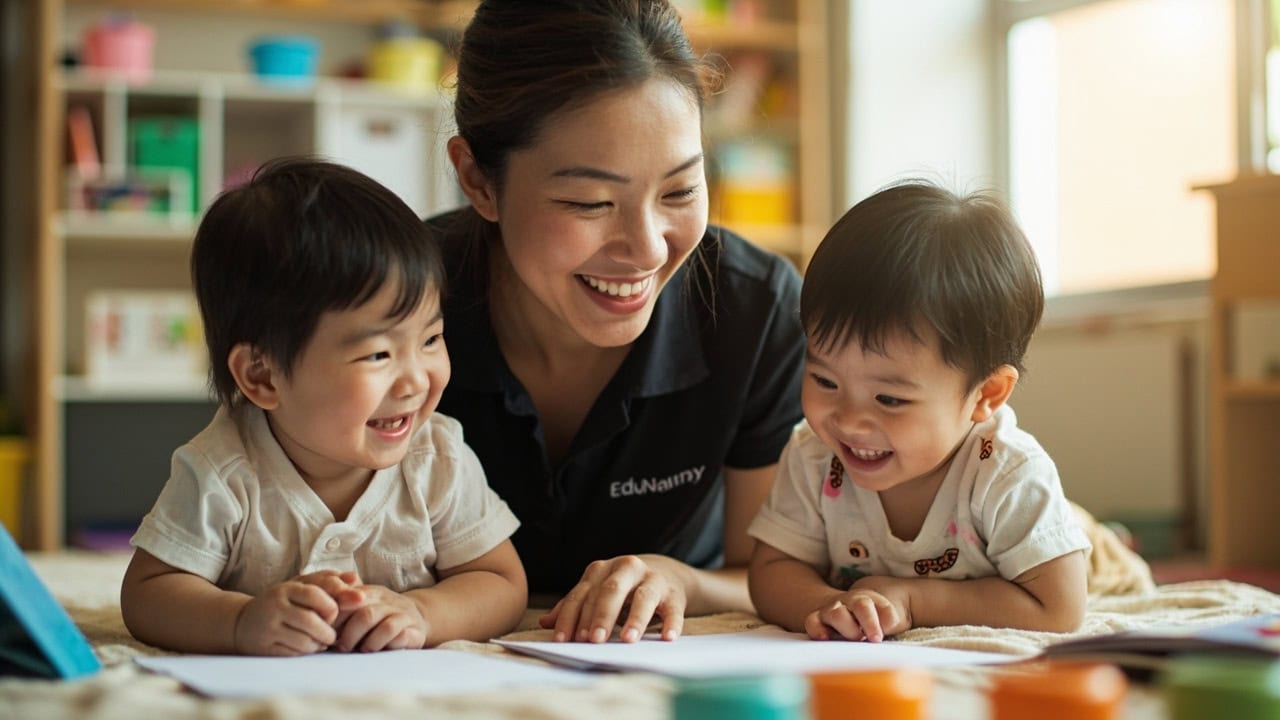
Language exposure is rich, interactive, and responsive — not a video playing in the background, but conversation that follows the child’s lead, that expands their utterances, that introduces new vocabulary in context. A caregiver notices a child building a block tower and narrates the process: “You’re making it taller. What happens if we add one more? Look, it’s wobbling. How can we make it more steady?” This is oral language development in its most natural and effective form, and it happens dozens of times a day in quality care settings.
Fine motor development is woven through activities that children find inherently engaging: playdough and clay, threading and lacing, peg boards and tweezers, tearing and pasting, drawing and colouring. These are not filler activities. They are purposeful experiences that build the hand strength, dexterity, and visual-motor coordination that Primary 1 will demand.
Social-emotional development is supported through structured opportunities for cooperative play, through facilitated conflict resolution when tensions arise, through the modelling of emotional language and regulation strategies. A child who learns to say “I feel frustrated” instead of hitting, who learns to wait for a turn, who learns that adults can be trusted and helpful — this child is building the social foundation that makes Primary 1 classroom participation possible.
Executive function development happens through play environments that offer just enough challenge to require persistence, through routines that create predictability while allowing for flexibility, through caregiver interactions that support rather than replace the child’s own problem-solving efforts.
This is what quality intentional childcare looks like. It is not a replacement for enrichment. It is not a trade-off against academic preparation. It is, in fact, one of the most powerful school readiness engines available — if it is done well.
How to Evaluate Whether Your Childcare Is Building Readiness
Singapore parents are not lacking in options. The childcare landscape is vast, and within it there is enormous variation in quality. Some settings provide excellent, intentional developmental care. Others provide adequate supervision. Others fall somewhere in between.
Without a clear framework, parents often end up evaluating based on surface features: the cleanliness of the environment, the friendliness of the staff, the proximity to home or work, the cost. These are not irrelevant considerations, but they miss the question that matters most. The question is not whether the childcare is nice. The question is whether it is building the capacities your child needs for Primary 1.
Five Indicators That Predict School Readiness
1. Language Interaction Quality
Do the caregivers speak to the children, not just at them? Is there back-and-forth conversation, not just instructions and corrections? Do children have opportunities to talk, to narrate, to ask questions? One practical test: observe whether a caregiver responds to a child’s utterance by expanding it. If a child says “dog big,” does the caregiver respond with “Yes, that dog is very big. It’s bigger than that one. What colour is it?” This kind of responsive language interaction is one of the most powerful predictors of oral language development.
2. Fine Motor Opportunities
Is the environment rich with materials that require hand-eye coordination and manipulation? Are children engaged with these materials regularly, or are they sitting passively for long periods? Ask to see a typical day’s schedule. Observe whether the activities offered build towards the physical skills Primary 1 will require.
3. Social Interaction Structure
Are children given opportunities to play together, to negotiate, to share, to resolve conflicts with adult support? Or is the environment heavily controlled, with children kept separate and occupied individually? Cooperative play is not just a social nicety — it is where children develop the skills they need to function in a Primary 1 classroom.
4. Structure and Child-Direction Balance
Too much structure, and children do not develop independence, self-regulation, or creative problem-solving. Too little structure, and they do not develop the ability to function within expectations and routines. The right balance is one where children have freedom within clear boundaries, where they are challenged but not overwhelmed, where caregivers scaffold rather than direct.
5. Caregiver Responsiveness
Do caregivers notice when a child is struggling? Do they offer support at the right moment — not too early, not too late? Do they treat children with respect, as capable and competent beings who are still learning? The quality of caregiver-child interaction is the single most important factor in any early childhood setting. Everything else is secondary.
If parents begin evaluating childcare programmes through this lens, the choices narrow considerably — and the confidence in those choices grows substantially.
For Parents Carrying the Quiet Fear
You are the parent who has enrolled your child in professional childcare. Maybe you returned to work because you needed to, or because you wanted to, or because both reasons were true at once. You love your child deeply. You want the best for them. But there is a quiet voice, sometimes louder at night, that wonders if you are making a sacrifice. That wonders if your child will be less ready, less prepared, less able to thrive because you chose this path.
I want you to hear this clearly: the research does not support the trade-off you fear.
Children who receive quality professional care during the years before Primary 1 do not, as a group, show deficits in school readiness compared to children with full parental presence. What the research consistently shows is that the quality of care matters enormously, and that quality care produces outcomes equal to or better than outcomes for children without quality care experience. The critical variable is not whether a child is in childcare. It is whether the childcare is good.
And quality care is not just about academic outcomes. It is about the whole child. Children in quality care settings develop stronger social skills, better emotional regulation, more independence, and greater confidence in navigating relationships with adults outside their immediate family. These are not peripheral benefits. They are the core of what Primary 1 actually requires.
What EduNanny Singapore Does Differently
EduNanny Singapore was built with a different purpose in mind. Not just to care for your child while you work, but to work alongside you in building something essential — the kind of foundational readiness that makes Primary 1 not a stressful beginning, but a confident one.
EduNanny operates as part of the ECDA Childminding Pilot, a government-recognised initiative that sets standards for quality home-based and community-based childcare across Singapore. This is not a generic childcare arrangement. It is a structured programme with oversight, training requirements, and accountability for developmental outcomes.
The infant ratios in EduNanny settings are kept intentionally low — up to one to three infants — which means each child receives meaningful individual attention throughout the day. This is not a luxury feature. It is a direct predictor of the quality of caregiver-child interaction that builds language, cognition, and secure attachment.
Care is available across Singapore, with pathways that include home-based arrangements, community settings, and centre-based options depending on what suits your family best. The flexibility exists because families are not all the same, and the arrangement that works best for one family may not be the right fit for another.
For families concerned about affordability, EduNanny is designed to be accessible within the pilot fee structures. Payments can be made using the Child Development Account and Baby Bonus funds, which means the financial logistics of quality care are manageable rather than burdensome.
And because transparency matters to parents, EduNanny maintains communication practices that keep you informed about your child’s day — not just through photographs of activities, but through genuine insight into their development, their interactions, their progress.
Choosing With Clarity and Confidence
The false trade-off between professional childcare and school readiness preparation is based on a misunderstanding of what school readiness actually requires. Remove the false trade-off, and you free yourself to make a better decision — not based on fear, but on evidence. Not on guilt, but on understanding. Not on the assumption that childcare and readiness are competitors, but on the recognition that they can be, and should be, partners.
When you choose childcare that is intentional about school readiness, you are not choosing between your career and your child’s future. You are choosing both. When you choose a childcare programme that systematically builds executive function, oral language, fine motor skills, and social-emotional competence, you are investing in the very foundation that Primary 1 will reward.
The years between three and five are not a waiting period. They are not a gap to be filled before real learning begins. They are the most consequential developmental window for the capacities that will determine how your child learns, interacts, and grows for the rest of their schooling life.
The question is not whether to invest in these years. Every parent already does. The question is whether that investment is purposeful, intentional, and aligned with what actually matters.
EduNanny Singapore exists for parents who ask that question honestly, who take school readiness seriously, and who deserve a childcare partner who takes it just as seriously.
Ready to explore what intentional school readiness care looks like for your family? Speak with the EduNanny Singapore team to learn more about how their ECDA Childminding Pilot programme supports your child’s development through the critical years before Primary 1.
#SingaporeSchoolReadiness #ChildcareSingapore #Primary1Preparation #ExecutiveFunctionDevelopment #EduNannySingapore