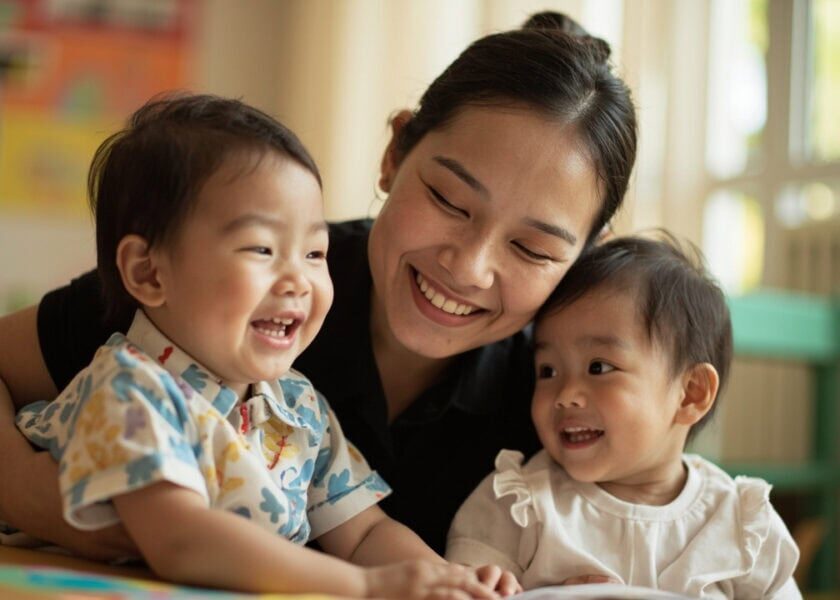
Why Your Child’s Secure Attachments Matter in Singapore
What If My Child Loves Their Caregiver More Than Me?
Perhaps when your toddler talked about their nanny with a kind of delight that briefly, achingly, made you wonder where you fit. Perhaps simply as a low hum of worry beneath the practical logistics of childcare that never quite goes away, no matter how much you trust the person you have chosen.
Here is what I want you to know: that feeling is not a sign that something is wrong. It is not a sign that you should have stayed home, or that you are failing, or that your child will somehow be diminished by the love they are giving and receiving elsewhere.
That feeling is the echo of an older idea about attachment, one that science has gently but firmly moved beyond. Understanding why can change not only how you feel about childcare, but how you see your role as a parent.
Quick Summary: What Science Tells Us
- Children are wired for connection, and their capacity to love grows with each healthy relationship they form
- A secure bond with a caregiver is additive, not substitutive — it enriches your child’s overall capacity to attach and trust
- What you want is a child who can love deeply across their world, not a child who needs only you
- Choosing professional care is an act of parental love, not a compromise
The Science Behind Multiple Attachment Figures
For a long time, cultural narratives suggested that children have a limited capacity for love — that forming a bond with one person meant taking something from another. Mothers were told their presence was irreplaceable, that any substitute would leave a lasting mark.
This narrative carried within it a quiet cruelty. It made parents feel guilty for needing help. And it made caregivers invisible, as though the relationships they built were somehow not real, not important, not worth naming.
But attachment science tells a different story.
How Modern Attachment Research Reshapes Our Understanding
John Bowlby, whose foundational work gave us the concept of the secure base, understood that children are not attachment vessels that can only hold so much. They are wired for connection, and their capacity to love grows, not shrinks, with each healthy relationship they form.
A child who feels safe with their caregiver does not love their parent less. They love more broadly, more confidently, more securely.
Developmental psychologists call this multiple attachment figures. In the first thousand days and well beyond, children benefit from more than one secure base. The primary attachment to a parent remains foundational, but it is not weakened by the presence of other significant relationships.
In fact, research consistently shows the opposite: children who form secure secondary attachments often show stronger social-emotional development, greater independence, and more robust relationships across the board.
What This Means in Practice
When your child has someone reliable to turn to during the hours you are at work, they are not replacing you. They are building an internal working model of what trust looks like, what responsiveness feels like, what it means when someone loves you well.
That model gets carried home. It shapes how your child greets you at the end of the day. It shapes how they are able to settle, to transition, to open themselves up to the full range of their emotions with you because they know, on a cellular level, that they are held.
Signs Your Child’s Caregiver Bond Is Healthy
It is one thing to understand the theory. It is another to recognize it in your own child. Here are the real, observable signals that your child’s bond with their caregiver is healthy and additive rather than concerning.
Signs of Secure Caregiver Attachment
- Genuine happiness: Your child is happy to see their caregiver, not just familiar with them. There is warmth in the greeting.
- Comfort-seeking: Your child can be comforted by the caregiver when hurt or upset. This shows they feel safe.
- Easy transitions: Your child can transition back to you at the end of the day without confusion or distress. They do not resist going home, and they do not resist returning.
- Affection freely given: Your child shows the caregiver affection naturally, without hesitation.
- Curious and exploratory: In the caregiver’s presence, your child explores, plays boldly, and engages with their environment. When you feel safe, you explore.
- Seeks play, not just needs: Your child seeks out the caregiver for play and companionship, not just for food or comfort.
- Talks about the caregiver as a person: Your child speaks about them as someone they love, not just a function that serves them.
- Shares joy with you: At the end of the day, your child may be excited to show you what they did, to share their joy with you — because the caregiver bond has not replaced you. It has enriched your child’s capacity to connect.
The Two-Question Test
Ask yourself:
- Does my child seem genuinely happy in the caregiver’s presence, not just compliant?
- Does my child come home to me full of stories and openness, ready to engage rather than withdrawn or anxious?
If the answer to both is yes, your child’s attachment pattern is healthy. The caregiver bond is serving your child well, and it is serving your family.
Addressing the Concerns Singapore Parents Carry
“Will my child forget me?”
No. Children do not forget their parents. What they do is generalize from the secure base you provide into other relationships. Your child knowing they are loved at home is precisely what allows them to form other healthy bonds. The attachment you have built is not fragile. It is the anchor.
“Should I feel guilty for needing help?”
No. Guilt is often a signal that we are navigating something difficult and meaningful. But in this case, the guilt is rooted in an outdated understanding of attachment. Choosing professional care for your child is not a compromise. It is not a fallback. It is a deliberate act of parental love — you saying, I want my child to have more than one secure base.
“What if my child seems to prefer the caregiver?”
Children sometimes show more overt excitement with caregivers because the caregiver represents fun, novelty, and play in a different way than parents do. This is not a sign that you are less important.
It is a sign that your child feels safe enough with you to also be frustrated, to test boundaries, to save their most vulnerable moments for you. That is the privilege of being the primary attachment figure. It is not always expressed in excitement at the door.
The Quiet Truth Anxiety Does Not Let You See
When your child runs to their caregiver with joy, when they wave goodbye without tears because they genuinely trust where they are going, they are not moving away from you.
They are running toward the world with the confidence that comes from being deeply loved at home.
What you want, if you are honest about it, is not a child who needs only you. That is not a sign of health; that is a sign of anxiety, for the child and for you. What you want is a child who can love deeply, attach securely, and trust the people around them to be good to them.
Your role as the primary secure base remains intact. The primary attachment to a parent remains the cornerstone of a child’s development. Your presence, your responsiveness, your unconditional love form the bedrock. But that bedrock does not exist in isolation. It exists in a context, and that context can be rich with other caring adults who reinforce the same message: you are safe, you are loved, you can explore.
What Quality Childminding Looks Like in Singapore
Not all professional care is created equal. Understanding what quality looks like can help you make decisions with confidence.
What to Look For
- Individualized attention: In quality care, ratios are kept low. Your child is known, seen, and responded to as an individual.
- Responsive relationships: The caregiver notices your child’s cues, matches their emotional states, and provides consistent, warm responses.
- Transparent communication: You should feel connected to what happens during the day, not disconnected from your child’s experience.
- Safe, enriching environment: The space should support exploration, attachment, and developmentally appropriate play.
- Trained and supported caregivers: Professional care means caregivers who understand attachment, child development, and the weight of the trust you are placing in them.
Questions to Ask Any Caregiver or Agency
- What is the caregiver-to-child ratio in your care?
- How are caregivers trained in attachment and child development?
- How will I receive updates about my child’s day?
- What does a typical day look like for my child?
- How do you support the transition between home and care?
- What are the options for integrating CDA or Baby Bonus funds?
What to Observe
- Does the caregiver respond to your child’s cues in real time?
- Do the children in care appear curious, engaged, and comfortable?
- Do caregivers speak about the children as individuals, not just tasks to manage?
- Is the environment warm, clean, and organized in a way that supports exploration?
- Do you feel heard and respected in your own concerns and preferences?
EduNanny: Building a Second Secure Base
At EduNanny by BUTLER, we understand that our caregivers are not interchangeable. They are people who have chosen this work, who are trained and supported, and who bring their full attention to every child in their care.
EduNanny operates within the ECDA Childminding Pilot, which means our caregivers are part of a structured, supported program designed to deliver precisely this kind of quality care. We know that Singapore parents face real pressures — the cost of living, the demands of careers, the logistics of raising small children. We are not here to add to that burden. We are here to walk alongside you with something that works.
How EduNanny Supports Secure Attachment
- Home-based care with low ratios: Up to one to three infants per caregiver, meaning every child receives the attention and responsiveness that secure attachment requires. We are not a daycare where children are watched. We are a place where children are held, known, and loved within professional standards.
- Transparent communication: For families where CCTV measures are deployed, you can see what your child sees. You receive regular updates and genuine observations — not just photographs but narratives of how your child is developing, what they are curious about, where they are growing.
- Accessible fee structures: CDA and Baby Bonus funds are usable. Monday to Friday care blocks provide the consistency that children and parents both need.
- Pathways for every family: Whether home-based or through community and centre-based options, whatever your family’s arrangement looks like, there is a way in.
When your child builds a bond with their EduNanny caregiver, that bond is real. It is additive. And it serves your family.
This Is You Loving Your Child Well
Choosing professional care for your child is not a compromise. It is not a lesser option, a fallback, an admission that you could not do it alone. It is a deliberate act of parental love.
It is you saying:
- I want my child to have more than one secure base.
- I want them to know the world is a place where reliable, responsive, caring adults exist.
- I want them to come home to me full of stories, full of trust, full of the confidence that comes from being loved well by more than just me.
That is not a parent who loves less. That is a parent who loves more wisely, more generously, more aware of what children actually need to thrive.
The science is clear. The stories are real. And the anxiety you have carried is not a flaw in your parenting. It is a sign that you care deeply about the right things.
You are giving your child more. You always have been.
When your child looks at the person caring for them and feels genuinely safe, that is not a transaction. That is a relationship, and it has weight. And when you see that safety in your child’s eyes, you can rest knowing that your child is held, known, and loved in your absence, just as they are in your presence.
You chose this. You chose it with love. And that love is doing exactly what you hoped it would.
Ready to explore what a second secure base can look like for your family? Connect with EduNanny today to learn more about our home-based childminding options within the ECDA Childminding Pilot.
#SecureAttachment #SingaporeChildcare #InfantCareSingapore #ChildmindingPilot #EduNannySG #MultipleAttachment #ParentingInSingapore #QualityChildcare #ECDAChildminder