How Attunement Changes Everything in Singapore’s EduNanny Homes
What Good Childminding Looks Like in Practice
Before we go further, it is worth naming something that developmental psychologists have understood for decades but that remains remarkably difficult to deliver at scale: attunement.
Attunement is the quality of being tuned in. It is the caregiver’s ability to read a child’s signals accurately, to respond in ways that match what the child needs in that moment, and to do so consistently over time. It is not the same as warmth, though warmth is its foundation. It is not the same as love, though love may grow from it.
Attunement is a trained and sustained practice. It is the professional skill of noticing—systematically, reliably, every day—until the noticing becomes instinct.
In an EduNanny home, the caregiver learns each child over months. She learns their rhythms: the approximate times they nap, the foods they reach for first, the moments of the day when they are most alert and exploratory, and when they need proximity and comfort. She learns their temperaments: the child who processes new experiences by watching before acting, the child who dives in headfirst and adjusts, the child who needs more transition time between activities.
She learns their communication: the cry that means hunger, the cry that means overstimulation, the sound that means I want that before language exists to say so.
What does this look like in practice?
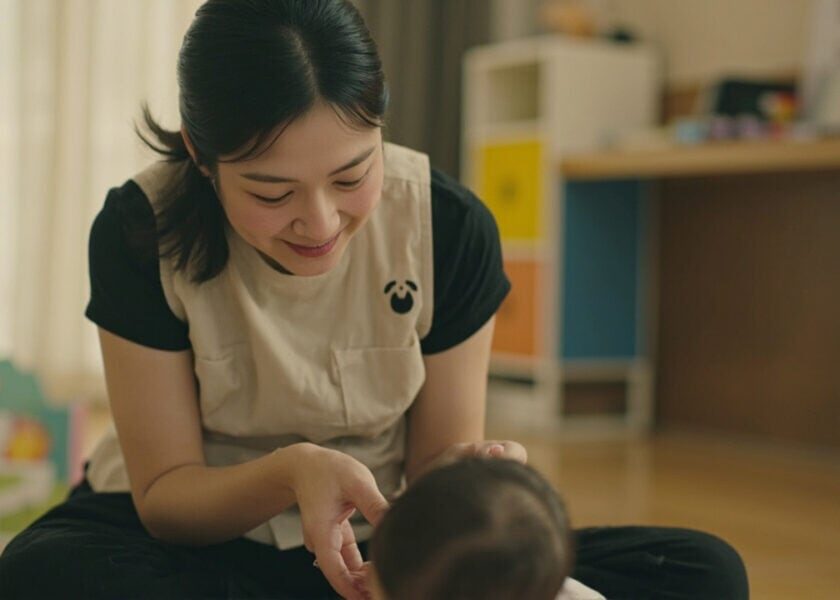
A morning in an EduNanny home. The caregiver has prepared the space: soft light, age-appropriate toys visible and accessible but not overwhelming. She greets the child and parent at the door, giving the child time to transition from parent to caregiver, not rushing the handoff. She bends down to the child’s level. She speaks in warm, unhurried tones. The parent leaves. The child, in most cases, settles within minutes because the environment is familiar and the caregiver is a known, trusted person.
Mid-morning. A child is exploring a container and objects. She is developing fine motor skills, spatial reasoning, the concept of inside and outside. The caregiver sits nearby—not interfering, not narrating excessively, but present. She notices when the child’s focus intensifies and steps back to allow that focus to deepen. She notices when the child starts to lose interest or become frustrated and gently introduces a new element or offers a moment of co-presence that re-engages her.
This is scaffolding. It happens in dozens of micro-moments throughout every day, often without either the caregiver or the child being aware that learning is occurring.
Lunchtime. A different child is being introduced to a new food. The caregiver has noted from parent communication that this child is a cautious eater, and she approaches it without pressure. She places a small amount on the tray. She eats some herself, modeling pleasure and curiosity. She allows the child to touch, explore, refuse, and try again on their own terms. This is responsive feeding, and it is part of a larger practice of respecting the child’s pace while gently expanding their world.
These are not exceptional moments. They are the substance of an EduNanny day. And the reason they matter so profoundly is that they are happening every day, consistently, with the same caregiver, for the same children. The learning compounds. The trust deepens. The child is not just being minded. They are being known.
The Architecture of an EduNanny Day
Daily rhythm is foundational to how EduNanny works. Understanding why requires a brief shift in perspective.
Rhythm is not the same as rigid scheduling. A rigid schedule says: naptime is at ten o’clock, regardless of what the child needs. Rhythm says: we move through our day in a predictable sequence, which gives this child the security of knowing what comes next, and the flexibility within that sequence to respond to what this particular child needs in this particular moment.
For infants, who are still constructing their understanding of the world, predictability is not a preference. It is a developmental necessity.
When a child knows that morning greeting and play happen, then snack and stories, then outdoor time or movement, then nap, then lunch, then more play and a gentle wind-down—they are building internal architecture. They are learning to anticipate, to trust that their world is reliable, to invest their energy in exploration rather than vigilance.
This security is the platform from which all development launches. A child who feels safe is a child who can afford to be curious. A child who trusts their caregiver to respond is a child who can tolerate the frustration of learning to walk, or the confusion of a new word, or the social complexity of playing alongside another child.
A typical EduNanny day might include:
- Morning greeting: arrival, eye contact, warm words, unhurried transition from parent to caregiver
- Activity time: structured around developmental goals but responsive to the child’s energy and interest
- Snacks and meals: treated not as logistical necessities but as social and sensory experiences
- Outdoor or movement time: supporting motor development and sensory integration
- Rest: offered with consistency so that the body learns to release into sleep
- Gentle wind-down: preparing for the reunion with parents
These are not slots to be filled. They are the architecture of the day, and that architecture is itself a form of care.
Why Home-Based, Small-Scale Care Is Different
Singapore parents have no shortage of childcare options. Centres operate across the island, with many offering excellent programmes and qualified staff. For many families, these arrangements work well.
But there are structural differences worth understanding.
In a centre, even a high-quality one, your child may be in a room with six to twelve other infants, cared for by two or three rotating staff members. Shift changes happen. Transitions occur. The caregiver who knows your child’s sleep cues on Monday may not be the same caregiver who settles them on Tuesday.
The institutional model is built around efficiency, consistency of programme, and regulatory compliance—legitimate goals that produce legitimate care. But efficiency is not the same as attunement. Programme consistency is not the same as individual responsiveness. Regulatory compliance is not the same as the kind of deep, personalised knowledge that allows a caregiver to notice what only a parent would normally notice.
EduNanny is built around a different logic. It says: the most important unit of care is the relationship. The most important condition for that relationship is consistency. The most important practice within that relationship is observation and response.
Everything else—the physical environment, the daily rhythm, the caregiver training, the ratios—is in service of that single goal: creating the conditions in which one trusted adult can come to know one child, and in which that child can thrive because they are known.
EduNanny: A Home, Not a Facility
EduNanny is a childminding service developed by BUTLER, operating under Singapore’s ECDA Childminding Pilot. It is home-based care, which means the environment is not a classroom or a centre with rotating staff and shifting schedules. It is a home, where a dedicated caregiver welcomes a small number of children—never more than three infants at a time—into a consistent, predictable, and deeply personal setting.
The pilot structure matters because it means EduNanny is part of a deliberate national effort to expand the quality and accessibility of infant care in Singapore. It is not a boutique experiment or a luxury-only offering. The fee structures are designed to be affordable, and eligible families can access support through CDA accounts and Baby Bonus schemes, making quality care a realistic option rather than a privilege reserved for those with considerable means.
Caregivers are trained, supported, and sustained within a framework that treats their work as skilled professional practice, not domestic labour by another name. The caregiver-to-child ratio is deliberately small: three infants maximum.
This is not a bureaucratic technicality. It is the condition of possibility for attunement itself. A caregiver responsible for six infants in a centre with rotating shifts cannot achieve what a caregiver responsible for three infants in a consistent home setting can achieve.
Staying Connected to Your Child’s Day
You are navigating one of the world’s most demanding educational cultures, in a city where the cost of living requires most households to have two working parents. You are making decisions about your child’s earliest experiences under a degree of scrutiny and competition that previous generations of parents never faced. The stakes feel impossibly high, and the timeline impossibly compressed.
You are also, if you are like most parents we speak to, genuinely torn. You want your child to be safe, of course. You want them to be loved. But beneath those non-negotiable basics, there is something else—a longing that is harder to name.
You want your child to be seen. You want whoever is caring for them to notice the things you notice. To know that your son calms when he is held on his left side because he prefers looking to the right. To know that your daughter goes still and watchful before she gets cranky, and that this is her warning window, not the moment to push food at her. To know that someone will notice the day your child finally masters the pincer grip and celebrates it silently, in a way that feels like a private victory you both share.
The fear underneath the fear is this: that in any childcare arrangement, even a good one, your child becomes a number, a schedule, a routine. That they are managed. That the specific, unrepeatable person they are gets smoothed out by the requirements of group care, institutional efficiency, or simple staff turnover.
EduNanny was designed with this fear at its centre—not to dismiss it, but to answer it honestly.
Parents often ask how they will know if their child is developing well. They want transparency. They want to trust but verify. This is reasonable, and EduNanny takes it seriously.
Communication with parents is built into the model, not tacked on as an afterthought. You will receive regular updates about your child’s day—not just that they ate and slept, but how they engaged, what they explored, what they seemed to enjoy, where they showed signs of challenge or breakthrough.
Many EduNanny caregivers use simple, daily documentation that builds over time into a developmental narrative: a story of your child’s growth that you can share with them when they are older.
Where deployed, transparency measures such as CCTV provide an additional layer of reassurance—not as surveillance but as partnership. You are not dropping your child into a black box. You are placing them in a home with open practices and accountable professionals.
The Thomas AI Chatbot offers another dimension of support, answering questions, providing guidance, and serving as a bridge between what happens in the EduNanny home and what you are navigating at home. It is one example of how EduNanny thinks beyond the transactional—the hourly rate, the scheduled hours—and asks: how do we support this family throughout their experience with us?
The Village That Knows Your Child
When you leave your infant with someone else, you are not just outsourcing logistics. You are making a statement about trust, about vulnerability, about the limits of what you can do alone.
And when that someone else is going to spend more waking hours with your child than you are—at least during certain seasons of your life—you want to know that those hours are not wasted. You want to know that your child is not merely safe and fed and diapered, but that they are being enriched. That they are being noticed. That when they do something wonderful, someone is there to witness it, and to tell you about it, and to feel a small sense of shared pride.
This is not about replacing you. No one can replace you. It is about extending the circle of people who know your child, who are invested in their flourishing, who bring their own warmth and attention to the task.
The caregiver who knows your child becomes, over time, a kind of co-parent in the best sense—not in terms of authority or decision-making, but in terms of presence, observation, and care. They hold a piece of your child’s story. They remember things you have forgotten. They notice things you have not yet seen.
They are, in a quiet and uncelebrated way, part of the village it takes to raise a child.
EduNanny makes it possible for that relationship to form and deepen, because it gives the caregiver the time, the ratios, the training, and the environment to do so. It treats the caregiver as a professional and the child as a person. It treats the relationship as the work, not the backdrop to the work.
What to Look for When Choosing Infant Care
If you are currently researching childcare options in Singapore, here are some questions worth asking—regardless of which service you ultimately choose:
- Who will actually be caring for my child? Ask about staff consistency, not just staff qualifications. A qualified caregiver who changes frequently is not the same as a consistent caregiver who builds knowledge over time.
- What does a typical day look like? Look for a rhythm that feels predictable but not rigid. The best schedules are frameworks that allow responsiveness, not scripts that override it.
- How will I know what my child is doing? Ask about communication practices. Daily updates, developmental documentation, and transparent sharing are signs of a service that takes partnership seriously.
- What is the caregiver-to-child ratio? This matters not just for safety, but for the quality of attention each child receives. Smaller ratios create the conditions for deeper observation and response.
- How does the caregiver approach development? Look for evidence of active observation—not just keeping children safe and occupied, but noticing their emerging skills, interests, and patterns, and building on them deliberately.
Your Child Will Be Seen
Small observations. Specific details. The moment when you realise someone has been paying attention.
These moments are not, in themselves, extraordinary. They happen every day in every EduNanny home. A caregiver noticing that a child reaches for the same stuffed animal when they are tired, and making sure it is within reach before nap time. A caregiver noticing that a child responds better to a lower tone of voice when they are overstimulated, and adjusting accordingly. A caregiver noticing that a child’s latest obsession is the colour red, and incorporating more red objects into the day.
These are not dramatic interventions. They are not the stuff of parenting manuals or milestone celebrations. But they are the substance of a childhood. They are the texture of being known.
And they are, arguably, the most important thing a childcare arrangement can offer—not because safety doesn’t matter, or because curriculum doesn’t matter, or because credentials and ratios and regulations don’t matter. They all matter.
But underneath all of that, the question that parents are really asking, the question that keeps them awake at night and brings them to EduNanny’s door, is simpler and more profound:
Will my child be okay?
Not just physically safe. Not just supervised. But okay. Known. Seen. Developing in ways that matter, at their own pace, in the context of a warm and attentive relationship.
We cannot promise you that your child will be extraordinary, because that is not our role. Our role is to create the conditions in which your child can become whoever they are meant to be.
We do this through daily rhythm, which builds security. Through consistent, trained, sustained attention, which builds trust. Through observation and response, which builds learning. Through a home-based environment that is warm and human and scaled small enough for each child to be a person, not a number.
We do this because we believe that the first thousand days of your child’s life are not just a period to be survived until school begins. They are the foundation. They are the architecture on which everything else is built.
And the people who care for your child during those days are not babysitters or supervisors or service providers. They are, in the deepest sense, developmental partners.
When you choose EduNanny, you are not choosing a childcare slot. You are choosing a relationship. You are choosing a home where your child will be known. You are choosing the quiet, ordinary, daily practice of attunement, and the profound difference it makes over time.
Your child is not a number. They are not a schedule. They are not a routine.
They are a person, with their own temperament, their own pace, their own way of seeing the world and being in it.
And at EduNanny, they will be seen.