Why Your Childcare Choice Today Shapes Decades of Family Life
You Are Already Thinking in Decades
Every family, whether it knows it or not, is building infrastructure. The word may feel clinical when applied to something as intimate as your home, but infrastructure is simply the foundation that determines what a system can eventually hold.
Roads are infrastructure. So is the trust between two people. So is the way a child learns, in the first three years of life, that the world is reliable and that other people can be depended upon. When you choose how your infant will be cared for in these early years, you are not making a logistical decision. You are laying the first load-bearing wall in a structure that will bear the weight of your family’s emotional life for decades.
You are already thinking in decades. You already understand that the school you choose, the neighbourhood you live in, the values you try to model — these are not short-term decisions. You have simply not had a childcare conversation that meets you at that level of seriousness.
This article is that conversation.
The First Thousand Days: Where Confidence Begins
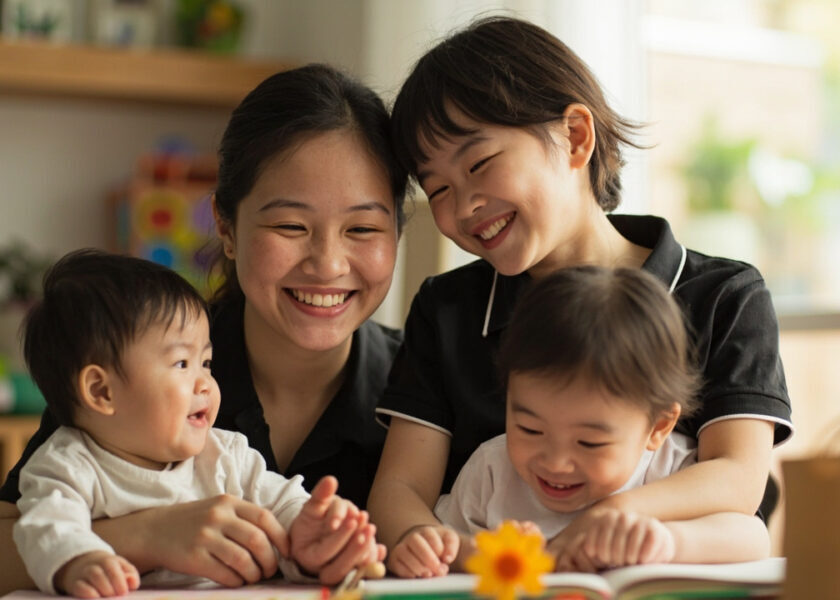
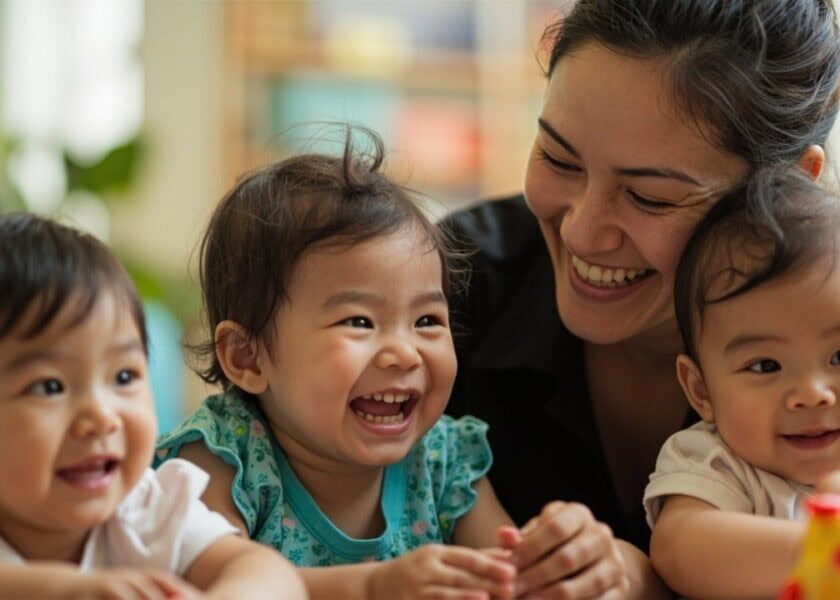
When an infant receives consistent, responsive, professionally delivered care from the earliest days, something changes in the architecture of that child’s inner world. The child does not simply learn that their needs will be met — though that is foundational. The child learns that the world is organised in a reliable way. That there are people who are present, who pay attention, who remember what they like and what they fear.
The child is building a model of reality, and that model will shape how they approach every relationship, every challenge, every uncertainty for the rest of their life. Child confidence is not a personality trait that some children are born with. It is a slow-building capacity that grows from thousands of small experiences of being held securely, being seen accurately, and discovering that they can count on their world.
This is the work of the first thousand days, and it is work that deserves more than a transactional relationship with a caregiver who rotates every few months.
- A caregiver who remembers that your child prefers the blue cup and becomes distressed when offered the red one
- Consistent responses to crying that teach your infant their communication has meaning
- A care environment where your child builds familiarity with routines, faces, and rhythms
- The gradual emergence of exploratory behaviour because your child knows there is a secure base to return to
The Family System You Are Building
The Sibling Bond
The bond between siblings is one of the longest relationships a person will ever have. In Singapore, where family size is often small, that sibling relationship carries enormous weight. It is the childhood friend who becomes the adult confidant. The person who shares your parents’ ageing and your parents’ memory. The one who can finish your sentences because you grew up in the same emotional weather.
That bond does not simply emerge. It is shaped, in its earliest form, by the quality of care both children receive.
When a younger sibling joins a household where the older child has already developed a secure attachment to their caregiver, the transition is different. The older child does not feel replaced. The younger child does not enter a household already stressed by inconsistent care. Both children grow up understanding that there is a reliable place outside of their parents where they are known and valued.
The Marriage
There is one relationship that tends to erode quietly in the early years of parenting, without anyone declaring an emergency: the one between you and your partner.
When two people become parents in Singapore, they are often navigating a demanding economic environment that requires both partners to work long hours. The transition to parenthood is already one of the most significant stressors a marriage can face. Research consistently shows that couples experience a sharp decline in relationship satisfaction after the birth of the first child, and that this decline is most pronounced in the early years when the logistical demands are highest and the couple’s capacity for intentional connection is lowest.
What is less often discussed is how the quality of childcare directly affects this trajectory.
When a family has reliable, professional, thoughtfully delivered infant care, it creates something that is desperately needed but rarely named: margin.
- Margin for the parents to remember that they chose each other before they chose parenthood
- Margin for an unhurried conversation over dinner that is not a debrief of the day’s logistics
- Margin for the kind of rest that makes patience possible
- Margin for the kind of tenderness that sustains a marriage across the long years of raising children
The families who work with thoughtful care providers tell us this consistently. They did not come expecting their marriage to improve. They came because they needed help with their infant. But over time, they begin to notice something. The tension in their shoulders on weekday mornings has eased. The arguments that used to escalate over who forgot to pack the diaper bag have diminished. There is more laughter in the house, and more of the laughter is between the adults.
Grandparents and Their Place
Singapore has one of the world’s highest rates of grandparent involvement in childcare. This is a cultural strength, not merely a logistical convenience. Grandparents carry family memory. They offer children a sense of rootedness that extends beyond their immediate household. The intergenerational bond is a source of identity, of values, of the particular warmth that comes from being loved by someone who has already lived the chapter you are currently in.
But there is a shadow side to this arrangement that families rarely discuss openly.
When grandparents become primary caregivers out of obligation rather than choice, when the joy of grandparenting is replaced by the grind of full-time childcare, something is lost. The child loses the grandparent who is present because they want to be, not because they have to be. The grandparents lose the role they imagined for themselves — the ones who spoil, who tell stories, who represent the fun edge of family life.
Thoughtful early care, delivered by trained professionals, does not replace grandparents. It gives them back their place.
When a family has a reliable care system in place, grandparents can return to being grandparents. They can visit on their own terms. They can engage with their grandchildren from a position of abundance rather than depletion.
What Quality Childminding Looks Like
At this point, you may be nodding along with the philosophy but wondering what it looks like in practice. Here is what you should expect from care that truly qualifies as family infrastructure:
- Consistency: Your infant should have the same caregiver or small team of caregivers over time, not a rotating cast of strangers
- Responsiveness: Caregiver-to-infant ratios that allow for genuine attention, not just supervision
- Professionalism: Trained caregivers who understand child development, not just someone who can keep a child safe
- Communication: Regular, clear updates that let you know what is happening without anxiety driving you to check constantly
- Transparency: Open environments where you can see into your child’s day
- Partnership: A relationship where your values as a parent are respected and integrated into your child’s care
These are not luxuries. They are the minimum requirements for care that builds rather than merely babysits.
The EduNanny Approach
EduNanny by BUTLER approaches infant care not as a childcare service that happens to care about your family, but as a family support system that happens to provide childcare.
EduNanny is part of the ECDA Childminding Pilot — a recognition that Singapore’s government understands what we have always believed: that professional, home-based and community-based childminding is not a stopgap solution. It is a foundational part of a healthy family ecosystem.
What EduNanny Offers
- Care blocks structured around Monday through Friday — because we know that is when parents need reliability most
- Infant ratios of up to one caregiver for every three infants — not a regulatory minimum we are proud to meet, but a deliberate design choice that reflects our understanding that responsiveness in the first years is not negotiable
- Clear communication protocols and open dialogue with families, because trust in infant care is built through consistent action, not promises alone
- Where deployed: CCTV access that allows you to see into your child’s day without anxiety driving you to check constantly
- Affordability support through the Child Development Account and Baby Bonus, because families who need thoughtful care most should not be priced out of it
Thomas: Support When You Need It
We have also developed Thomas, an AI-powered conversational tool that sits alongside our care. Thomas is not a replacement for human guidance. It is the infrastructure for the questions that arise at 10 p.m. when you cannot wait until morning, for the small uncertainties that do not warrant a call but deserve an answer, for the kind of real-time support that makes you feel less alone in the decisions you are making every day.
Parenting in Singapore can feel isolating even in a crowd of family. Thomas is the presence in your pocket that says: you are not navigating this alone.
Addressing Your Real Concerns
“Am I outsourcing something I should be doing myself?”
You are not outsourcing your parenting. You are building a support system that allows your family to thrive. The families that work with us are not disengaged parents — they are engaged parents who have recognised that quality care is a pillar, not a replacement, for parental involvement.
“How do I know I can trust someone with my infant?”
Trust is not built through promises. It is built through transparency, consistency, and time. Our approach is designed to give you visibility into your child’s day, clear communication about what is happening, and the confidence that comes from knowing your infant is with trained professionals who understand the weight of this work.
“Is this affordable for our family?”
We support the use of available instruments like the Child Development Account and Baby Bonus. The pilot fee structures have been designed to make quality care accessible, and we believe that the families who need thoughtful care most should not be priced out of it.
“Will my child form an attachment to their caregiver instead of me?”
Children are remarkably capable of forming multiple healthy attachments. What your infant needs is a secure base to explore from — and that secure base can include consistent, responsive caregivers alongside parents. The key is consistency and quality. When care is reliable and warm, it supplements rather than supplants your bond with your child.
A Framework for Choosing
Here is what we suggest you look for when evaluating infant care options:
- Ask about continuity. Will your child have the same caregiver over time, or will they face a rotating cast of faces in their first vulnerable years?
- Ask about ratios. How many infants does each caregiver care for? More infants means less individual attention — and in the first years, attention is not optional.
- Ask about training. Do caregivers understand child development, or are they simply watching children? There is a significant difference.
- Ask about communication. How will you know what is happening with your child? What systems are in place to keep you informed without creating anxiety?
- Ask about values alignment. Does the care provider see themselves as a partner in your family’s journey, or as a transaction to be completed?
- Ask about the long view. Is the conversation focused on solving today’s logistics, or on building something that will age well?
The Invitation
You are not raising a child. You are raising an adult.
The infant who reaches for your hand today will one day navigate a world we cannot fully imagine, with relationships we cannot yet predict, carrying the inner architecture you are helping to build right now. The sibling who learns to share a caregiver’s attention is learning something that will shape how they negotiate, collaborate, and love for the rest of their life. The marriage that receives support in the early years is the marriage that will be the bedrock of your family’s next chapter.
Every decision in the early years is a deposit or a withdrawal from the family’s emotional account, and the withdrawals are not always obvious at the time they are made.
You are not choosing what your child will eat for lunch next Tuesday. You are choosing what kind of inner security they will carry into every room for the rest of their life. You are choosing whether your family will be a system that compounds toward closeness, or one that erodes under the weight of preventable stress.
We know this framing may feel new to you. It may feel like more weight than you want to carry when you are already exhausted and making decisions under pressure. But consider this: you are already carrying this knowledge somewhere beneath the surface.
The parents who thrive in the long run are not the ones who found certainty. They are the ones who found a framework that holds.
EduNanny is offering you that framework today. Not a transaction. Not a service. An infrastructure. A system that will hold your family steady while every member grows.
Choose your child’s care the way the best families choose their foundations: with long-term clarity, with an understanding of what compounds and what erodes, and with the confidence that comes from knowing you have built something that will hold.
The family you are quietly building over years is worth that kind of seriousness.
And so are you.
Ready to explore what infrastructure looks like for your family? Connect with EduNanny by BUTLER to learn how we can support your family’s foundation — not just today, but for the decades ahead.
EduNanny is a development-oriented childminding service for families in Singapore. Learn more about our approach or explore our services.