What Your Child’s Body Is Learning Before Words Come
The Architecture Before the Words
Before a child speaks their first word, before they solve their first puzzle, before they learn to share or take turns or write their name, there is a deeper architecture at work. It is the architecture of the body itself—sensory integration and motor development—the invisible foundation upon which everything else is built.
This is not a story about milestones you need to track or anxieties you need to manage. This is a story about understanding what is actually happening in the first years of your child’s life, and why the people who care for your child during the hours you are apart from them are so important to that story.
Let us invite you to see what trained eyes already see.
The Body as First Language
The body is a child’s first language. Long before words develop, movement is how children communicate—with the world, and with themselves.
A baby who kicks her legs with excitement is not just expressing joy. She is testing her own strength, mapping the relationship between intention and motion, building the neural pathways that will one day allow her to run, to climb, to navigate the world with confidence.
A toddler who pauses before stepping off a low stool is not hesitating out of fear. He is calculating, processing sensory information about height and distance and his own body’s capabilities, making decisions that will become automatic only after hundreds of such moments of guided, attentive practice.
This is sensory processing. It happens quietly, continuously, beneath the surface of everyday moments. The brain is constantly receiving information from muscles and joints and skin, from eyes and ears and the inner ear’s balance system, and it is learning to organize that information into coherent action.
Consider what this means in practice. A child reaching for a cup is not simply reaching. His brain is coordinating vision and hand-eye coordination, adjusting grip strength based on what his fingers feel, maintaining balance in his posture, filtering out background noise so he can focus.
Every successful reach builds capacity. Every moment of supported, responsive interaction teaches his nervous system that it can trust itself to navigate the world. This is why sensory integration is not a clinical term to be filed away. It is a living process, and it is happening in your child right now.
What Trained Caregivers Actually See
Now consider what it means when this process is supported well—when a caregiver is trained to observe it, when the environment is designed to offer the right kinds of sensory experiences at the right developmental moments, when a child is given the space and time to move, to explore, to fall and try again.
That child begins to feel comfortable in their own skin. They begin to trust their body. They begin to believe, at a fundamental level, that the world is navigable, that their actions have meaning, that they are capable.
Research in developmental neuroscience shows us that physical competence and emotional security are deeply intertwined. A child who feels confident in movement is a child who feels confident in the world. And a child who feels confident in the world has a foundation—not a guarantee, but a foundation—for emotional resilience, for social ease, for the willingness to try, to fail, to learn.
The Difference Between Being Watched and Being Seen
Here is what many parents in Singapore tell us when they first come to EduNanny:
“I want to trust my child’s caregiver. I want to believe my child is in good hands. But I don’t know what to look for. I don’t have the language. I watch my child at pickup and I see a little person who seems happy or seems tired or seems different in some way I can’t name, and I feel like I should understand more than I do.”
This is one of the most honest, most common experiences of modern parenthood. You love your child with a ferocity that is almost too large to contain. But loving them and understanding what you are seeing are two different things. And when the hours of childcare stretch across the week, you naturally wonder: what is really happening in there?
We hear you. And we want to give you an answer that is real.
Observing Your Child at Pickup
The answer is not a checklist. It is not a set of milestones you need to monitor with anxiety. The answer is a shift in perspective—a new way of seeing what is already in front of you, every time you pick up your child.
The next time you arrive at pickup, look at your child’s body. Not as an abstract measure of development, but as the instrument through which they are learning everything about being human.
Notice how they move. Notice the quality of their movement:
- Is there ease in their gait, or tension?
- Do they reach for you with open hands, or do they seem retracted, self-contained?
- When they sit on the floor, do they shift and adjust naturally, finding their balance, or do they seem stiff, uncomfortable in their own bodies?
- When they play, do they explore with their whole body, or do they seem hesitant, easily overwhelmed, quick to shut down?
These are not diagnostic questions. They are observational ones. And they are the same questions that trained caregivers learn to ask—not to label, but to understand.
What This Looks Like in Practice
A mother picks up her eighteen-month-old son from her EduNanny caregiver. The caregiver says:
“Today he climbed the low slide ladder for the first time. Not the slide itself—just the ladder. He stopped at the top, looked around, and then carefully came back down. He did this four times. Each time, he seemed more confident in his grip, more sure of his balance. By the fourth time, he was almost playful about it—he knew his body could do this.”
What does this mother now know? She knows that her son’s body confidence is growing. She knows that he is learning to trust his own physical capabilities. She knows that the sensory processing of height, distance, and balance is becoming smoother, more integrated.
She knows that in the hours she was not present, there was a caregiver who noticed, who documented, who understood, and who is now sharing this moment with her as part of a larger story of growth. This is not a small thing. This is a window into your child’s developing self.
Or consider a different example. A baby girl, seven months old, has been in home-based care for three months. Her caregiver notices that in the past two weeks, she has begun to reach for objects with both hands—and then, increasingly, with just one hand, while the other hand stabilizes her body.
She is developing unilateral reach, a fine motor skill that is foundational for hand dominance, for writing, for the precise manipulations that will later allow her to feed herself, to dress herself, to use tools.
The caregiver shares this observation with the parents at pickup. She explains what she sees, why it matters, and how she is supporting it. The parents leave not with a clinical report, but with a story. Their daughter’s hands are learning. Her brain is wiring itself for precision and intention. And someone noticed.
Movement, Agency, and the Hours That Matter
There is a word we use in early childhood development: agency. It means the capacity to act, to influence, to make meaning.
A child’s agency begins in the body. It begins with the discovery that they can reach and something will respond. That they can move and the world will shift. That they can cry and someone will come.
This is the foundation of selfhood.
When we support sensory integration and motor development—when we offer environments rich in movement and sensory exploration, when we provide caregivers trained to observe and respond, when we give children the time and freedom to move and learn and grow—we are not just preparing them for school. We are giving them the embodied sense that they matter, that their actions have effect, that the world is a place where they can be active, capable, and connected.
This is why the hours your child spends in childcare matter so profoundly. Not because the centre or the home-based environment is a substitute for your love—they could never be that. But because the quality of those hours shapes the architecture of your child’s development in ways that are real, measurable, and lasting.
In the hours you are apart, the architecture of their nervous system is being built. The connections that will support their attention, their emotional regulation, their social ease, their willingness to learn—they are forming now, in the sensory-rich, movement-filled moments of early childhood.
And the people who are present during those moments—their caregivers—have an extraordinary privilege and an extraordinary responsibility.
What Quality Childcare Looks Like
This is the invisible work of quality childcare. And it is invisible precisely because it looks like play.
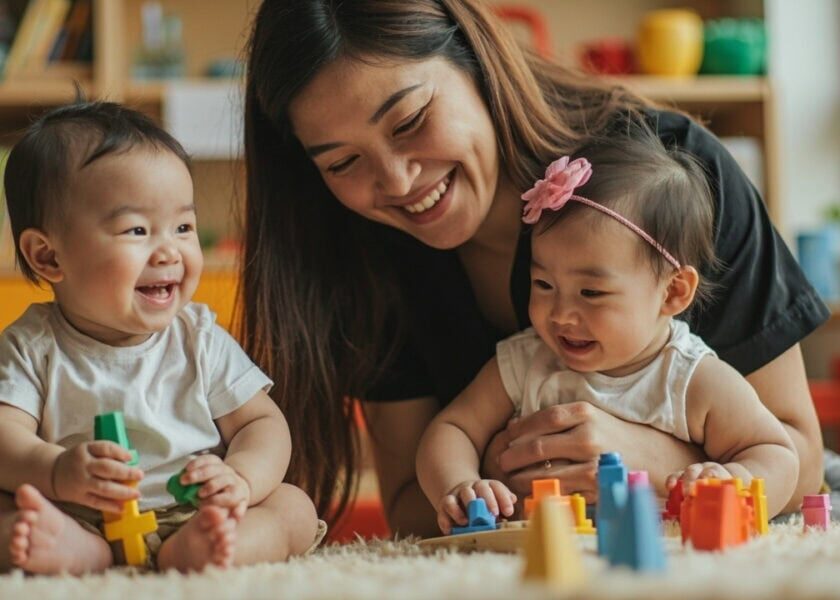
It looks like a child stacking blocks. It looks like a baby rolling a ball. It looks like a toddler running in the garden, or a crawler making their way across the room with fierce determination.
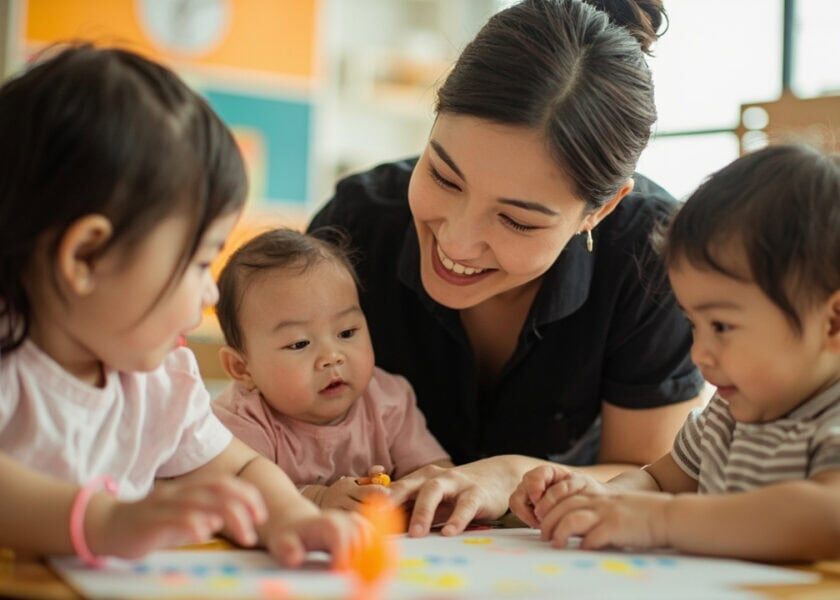
To untrained eyes, it might look like simple fun. But to a trained caregiver, it is a language. It is communication. It is the body speaking its emerging capacities into existence.
So what should you look for when evaluating childcare options in Singapore?
- Caregiver-to-child ratios: A child’s nervous system learns to regulate through responsive, consistent interaction. That is only possible when the caregiver has the capacity to be responsive. Look for ratios that allow for individual attention.
- Caregiver training in development: The difference between a child being watched and a child being seen lies in caregiver training. Ask about how caregivers are prepared to observe and interpret physical and sensory development—not just safety protocols.
- Movement-friendly environment: Quality childcare environments offer space and opportunities for sensory-rich play, not just passive entertainment.
- Parent communication: Look for caregivers who can articulate what they observe, not just report that your child “had a good day.” The developmental debrief at pickup is not a formality—it is a conversation about growth.
- Transparency: Where CCTV measures are in place, they should exist to build trust, not to monitor. Communication between caregivers and families should be open and ongoing.
EduNanny’s Approach and Your Partnership
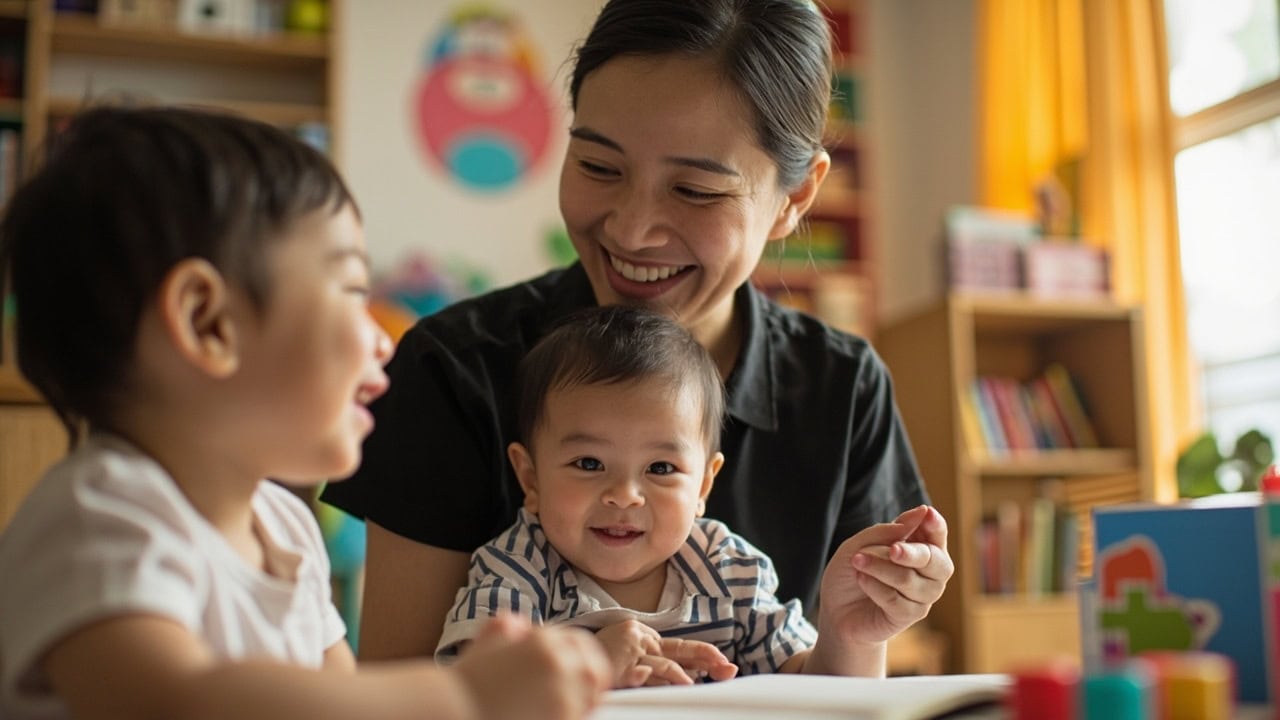
At EduNanny by BUTLER, we have built our model around the belief that every child deserves to be seen by someone who understands what they are seeing.
Our caregivers are trained, not just in safety and logistics, but in development. They are trained to observe, to document, to interpret, to share. They are trained to recognize the difference between a child’s exploratory movement and a child’s distressed movement. They are trained to support, not to overshadow. They are trained to trust the child’s own process while remaining present and attentive.
Our caregivers understand that a toddler’s attempt to stack three blocks is not a simple play activity—it is a message from a developing brain, a demonstration of emerging fine motor control, spatial reasoning, and persistence.
They understand that a baby’s reaching for a face is not a reflex—it is a social act, a declaration of connection, an expression of the trust that has been building in the relationship between that baby and the caregiver who has been consistently present.
They understand that a child’s movement through a room—stopping, looking, processing, deciding—is a thought process made visible, and that interrupting that process with unnecessary guidance or redirection can disrupt the very learning that is happening.
Questions Parents Ask Us
“How do I know if my child’s development is on track?”
The honest answer is that developmental trajectories vary, and no single observation at pickup can tell you everything. But quality childcare is not about providing you with a diagnosis—it is about providing you with ongoing, informed observation. Trained caregivers watch for patterns over time. They notice whether your child is building on their previous abilities, whether they are being challenged at the right level, whether they seem engaged and comfortable in their own bodies.
“What if something seems wrong?”
Trained caregivers know the difference between a child’s exploratory movement and a child’s distressed movement. They are positioned to notice when something seems off—not to diagnose, but to observe and share. If a caregiver notices consistent patterns that may warrant further attention, they will communicate this to you with care and specificity. The goal is never to alarm, but to inform.
“Will I feel connected to my child’s day?”
The developmental debrief at pickup is designed precisely to address this. It is a conversation about your child’s growth, shared in language you can use, connecting what you observe at home with what we observe during the day. It is an invitation to become a more informed, more confident observer of your own child.
Our Commitment to Singapore Families
We are part of the ECDA Childminding Pilot, which means our home-based and centre-based pathways operate under standards designed to protect and nurture the youngest children. We offer both pathways because families are diverse, needs are different, and the right fit matters.
Our infant ratios—up to one caregiver for every three infants in our care—ensure that every child receives the individual attention that physical and sensory development requires. This is not a luxury. It is a developmental necessity.
We know that affordability matters to Singapore families. The pilot fee structures, the usability of CDA and Baby Bonus funds—these are not afterthoughts. They are designed to make quality care accessible, because we believe that the children who benefit most from attentive, trained caregiving should not be only those whose families can pay a premium.
This is a matter of equity and of belief: that every child deserves to be seen.
The Pickup Moment, Reimagined
So the next time you pick up your child and you notice something has shifted—the way they move, the way they look at you, the way they reach or speak or play—you will know.
You will know that something real is happening. You will know that there are trained eyes observing it, documenting it, nurturing it. You will know that your child is being seen.
And you will know that you are not imagining it.
You are not imagining the moments of growth, the emerging skills, the quiet transformations that happen in the hours of childcare. You are not imagining your child’s developing confidence, their growing trust in their own body, their expanding sense of what is possible.
You are not imagining that you are a good parent, that you are making good choices, that your love for your child is enough.
It is more than enough. It is the beginning of everything.
And now, with understanding, with language, with the support of caregivers who are trained to see what you are learning to see, you have something even more powerful. You have the ability to witness your child’s growth not with anxiety but with wonder. Not with uncertainty but with knowledge. Not alone, but in partnership with the people who are there when you are not, doing the invisible, essential work of early childhood.
Curious about how EduNanny’s trained caregivers support your child’s development from the very first moments? We would be glad to hear from you and answer any questions you may have as you explore your childcare options in Singapore.