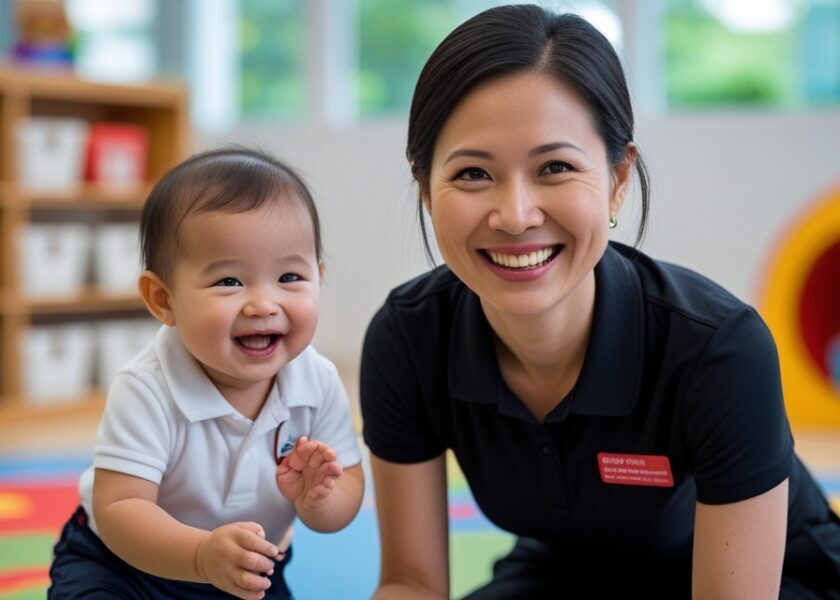
Why Your Child Deserves More Than a Number in Infant Care
“`html
What This Article Covers
- Why being known matters more than any curriculum in the first thousand days
- Why caregiver-to-child ratios are the single most concrete predictor of individualized attention
- The real difference between customization and genuine personalization
- How home-based care creates structural conditions for depth that larger settings struggle to replicate
- What to look for — and ask — when evaluating infant care in Singapore
- How EduNanny’s model is designed around the principle of knowing your child
Why Being Known Matters in Early Childhood
When you imagine your child in a care setting, what are you most hoping they experience? The learning outcomes? The safety record? The quality of the meals?
Those things matter — of course they do. But if you sit with that question for a moment longer, what most parents describe is something simpler and deeper than any curriculum. They want someone to see their child. Not to manage them. Not to process them through a routine. To see them — their particular temperament, their current anxieties, the things that make them light up, the things that make them pull away.
They want their child to be known.
This is not a soft or sentimental wish. It is a developmental need.
In the earliest years of life, the brain is building its architecture for everything that comes after — how a child relates to others, how they manage emotion, how they learn, how they form a sense of themselves as a person who matters and whose experience is valid.
That architecture is built not through worksheets or flashcards or structured activities. It is built through relationships. Through the experience of being responded to — of crying and having someone come, of reaching out and finding a hand, of expressing a need and watching it be met.
Every instance in which a child is seen and responded to as themselves — not as one of several, not as a slot in a rotation — is depositing something essential into the foundations of who that child will become.
The Structural Reality Behind Individualized Attention
A classroom of twenty children, however caring the teacher, means twenty names, twenty temperaments, twenty sets of needs competing for attention in a finite day. A schedule — necessary and reasonable — means that sometimes a child’s particular need arrives at a moment when the routine has already moved on.
This is not a failure of individual caregivers. It is a structural reality. You cannot manufacture individual recognition in an environment that is, by design, optimized for managing groups.
And this is precisely why the ratio of caregivers to children is not merely an administrative detail. It is the single most concrete predictor of whether your child will be known as an individual or processed as a member of a group.
When a caregiver is responsible for one, two, or three infants — the ratio that defines home-based childminding through the ECDA Childminding Pilot — the mathematics of attention change completely.
There is time to notice the slight fever before it becomes a fever. There is time to observe which books a child returns to again and again, and to wonder what it is about that particular story that resonates. There is time to notice that today, for the first time, a child who usually hangs back at the sandbox edge has picked up a shovel, and to mark that moment as significant.
These are not trivial observations. They are the raw material of genuine development — the stuff that tells a caregiver who this child is, what they are working on, where they are growing, and where they might need support. And they only become visible when there is sufficient time and space to look.
Customization Is Not the Same as Personalization
You will see some childcare settings describe themselves as providing personalized care because they offer flexible meal options or let you choose your child’s nap time. That is customization — helpful and responsive to parental preference. But it is not the same as a caregiver who knows that your child is working through a phase of separation anxiety, and who has quietly adjusted the morning drop-off routine to give your child the particular kind of warm, unhurried greeting that helps them transition.
That is personalization in the deepest sense. It is rooted not in a menu of options but in a relationship — in the caregiver’s accumulated knowledge of this specific child, built over time through sustained observation and genuine attentiveness.
Customization is about offering choices. Personalization is about knowing your child well enough to anticipate needs they have not yet expressed.
What Genuine Individualized Care Looks Like
When individualized attention is working as it should, you will see it in small moments:
- A caregiver who knows that your child always saves the last bite of their biscuit for later — and finds that quietly fascinating rather than something to redirect
- A caregiver who has seen enough of your child’s range of emotions to know that today’s quietness is different from yesterday’s, and to wonder about it gently rather than miss it entirely
- A caregiver who can tell you not just what your child ate for lunch, but how they ate it — slowly, carefully, or with the focused intensity of a child who is working through something
- A caregiver who adjusts the environment because they have noticed your child is tired before the scheduled rest time, not after your child has already become overtired and dysregulated
These are not extraordinary acts. They are ordinary ones. But they only become possible when there is enough time, enough continuity, and enough attention available to the individual child.
The Home-Based Advantage
The home environment is, by its nature, a smaller world. Fewer children means fewer variables. A caregiver in a home setting can afford to slow down. She does not have to keep pace with the logistical demands of managing a larger group. She can follow the child’s lead. She can notice the moment when a child’s play has taken an unexpected turn and let that turn become something meaningful. She can let a conversation develop naturally rather than steering it back to the planned activity because the clock says it is time to move on.
This is not to say that large centre-based settings cannot provide warm and caring environments. Many do, and they play an important role in Singapore’s childcare ecosystem. But the question is not which model is morally superior. It is a more practical one: given what developmental understanding tells us about how young children thrive, and given the specific structures that enable or constrain that thriving, which environment makes it genuinely possible for a caregiver to know your child as a whole person?
The answer, when you look at it clearly, is the environment with fewer children, deeper caregiver continuity, and a relational structure built around individual observation.
What to Look for When Choosing Infant Care in Singapore
Singapore parents have real concerns when evaluating care options — and those concerns deserve honest answers.
Safety and Supervision
In a home-based setting with ratios of up to one to three infants, supervision is not diluted across a larger group. A caregiver’s attention is concentrated, not divided. This is not a philosophical point — it is a practical one about how attention actually works.
Communication and Transparency
Trust is built through transparency. Some EduNanny settings include communication measures that give parents genuine visibility into their child’s day — not curated glimpses, but real, ongoing information about what their child is experiencing and what is being observed. Parents should feel they are leaving their child somewhere they can remain connected to.
Financial Accessibility
For many families in Singapore, this is the thing that determines whether the ideal care option is actually within reach. Care is available across Monday to Friday blocks, and within the pilot structure, fees are structured to be accessible. Singapore’s CDA and Baby Bonus schemes are applicable, which means the financial architecture that the government has thoughtfully put in place to support families can be brought to bear on this choice.
Continuity of Care
Deep continuity matters. The more consistent the caregiver relationship, the more accumulated knowledge exists about your child. When evaluating any care arrangement, it is reasonable to ask about continuity structures — how absences are handled, how knowledge is preserved and transferred, and how relationships are maintained across transitions.
Questions to Ask During Your Visit
- Ask about ratios. How many children is each caregiver responsible for? For infants, smaller is genuinely, measurably better in terms of individual attention.
- Ask how they track development. Is there a system for documenting not just milestones but patterns, preferences, and emerging interests? Genuine observation is active, not incidental.
- Ask about communication. How do they share what they observe about your child? Is it a monthly report, or is there ongoing dialogue? When a child is truly known, what a parent needs is not a summary but a relationship with the person caring for their child.
- Observe the caregiver during your visit. Is she moving through the environment with purpose, or rushing between tasks? Does she seem able to slow down and follow a child’s lead?
- Ask about the schedule. Is it rigid or flexible enough to follow a child’s cues? Can a child’s particular need interrupt the routine when it needs to?
- Ask about transitions. How are mornings handled? How does drop-off work? These moments reveal a great deal about how individualized the care actually is.
How EduNanny Is Built Around Knowing Your Child
At EduNanny, this is not a philosophy adopted recently. It is the organizing principle of everything we do.
As part of the ECDA Childminding Pilot, we offer home-based childminding with ratios of up to one to three infants — small enough for every child to be genuinely known, every day. Our caregivers are not just trained to deliver care. They are trained to observe, to document, and to build an understanding of each child as a unique individual over time.
That means tracking developmental patterns, noting preferences, understanding triggers, and communicating honestly with parents about what they see. Not in a report that arrives monthly, but in an ongoing conversation — because when a child is truly known, what a parent needs is not a summary but a dialogue.
We have also developed the Thomas AI Chatbot as a resource for parents navigating the everyday complexity of raising young children in Singapore — the questions that arrive at odd hours, the uncertainties that do not feel urgent enough for a clinic call but are too specific for a Google search, the practical logistics of managing work, family, and a child’s evolving needs.
Thomas is part of our commitment to supporting not just the child in our care but the entire family — because individualized care does not end at the front door of the home setting. It extends into how we communicate, how we answer questions, and how we make parents feel supported rather than judged.
The Question Worth Sitting With
Here is what we know about children who grow up feeling known: they develop something fragile and irreplaceable — a foundational sense that they matter, that their experience is valid, that they are not simply a passenger in their own lives but a person with genuine presence.
That sense does not come from a curriculum. It comes from the accumulated experience of being responded to — of crying and being held, of reaching out and being met, of being seen as themselves, again and again, by the people who care for them.
In the setting you choose for your child in these irreplaceable early years, is there enough space — in the schedule, in the group, in the caregiver’s attention — for your child to be known? Is there space for the small detail, the quiet observation, the moment that cannot be scheduled? Is there space for your child to be seen?
At EduNanny, we believe there should be. We have built our model around that belief, structured our ratios to make it possible, trained our caregivers to pursue it with intention, and designed our communication to keep parents connected to what their child is experiencing every day.
Not because we think we have found the only right way to care for children. But because we think this — a small setting, a known caregiver, a genuinely individualized relationship — is what the children in our care deserve.
A child who is not a number. A child who is not a slot in a schedule. A child who deserves, in every sense of the word, to be known.
If you are exploring infant care options in Singapore and want to understand whether home-based childminding might be the right fit for your family, we invite you to speak with us directly. We are happy to answer your questions, walk you through our approach, and help you think through what matters most to you in this decision.
The early years are brief. They deserve careful thought.
Speak with EduNanny about your family’s childcare needs ›
“`