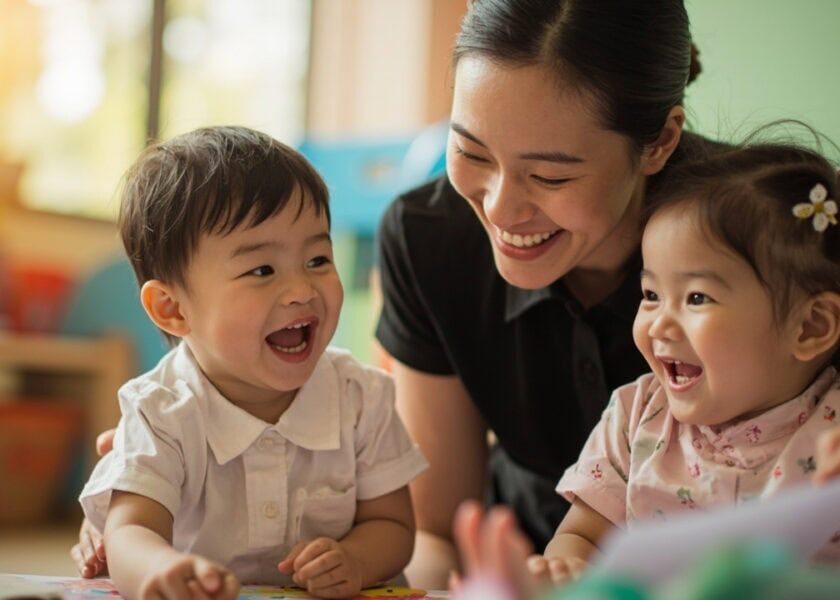
What Your Child Shows You After Childcare Reveals Everything
You Cannot Watch the Care. You Can Watch Your Child.
There is a moment every working parent in Singapore knows. It happens in the morning, somewhere between the front gate and the car. Your child is not yet two years old, or perhaps three, and you are explaining, again, that Mama or Papa will come back.
You have rehearsed this. You have been told it helps. But what you are really doing is talking to yourself as much as to your child. You are reminding yourself that you made the right choice. That this person, this arrangement, this place you spent weeks researching and visiting and cross-referencing, is where your child will spend the hours you cannot give them.
You chose this. Now you must leave.
This is the daily separation paradox of modern parenthood: you selected the care, you walked through the doors, you asked the questions, you trusted your instincts about a stranger holding your child. And yet you cannot be there. You cannot see what happens between the morning goodbye and the afternoon reunion. You are asked to believe in something you cannot witness, and that belief must be complete enough to let you function at work, to focus on deadlines, to answer emails while your child is somewhere else, learning how to be away from you.
Here is what this article offers instead of another checklist or framework. It is about what you can actually see, after the fact, when your child comes home. Because the truth that many in this industry do not say plainly is this: you chose care you cannot observe, but you can observe the child who received it. And that observation, done with intention and understanding, is the most reliable evidence of quality that exists.
The Five Domains Where Quality Care Reveals Itself
When you pick up your child at the end of the day, you are not just collecting a small person. You are receiving a message. Your child has been navigating the world without you for hours — social situations, new experiences, growing capabilities, relationships with adults who are not you. Everything that happened in that time will show up somewhere in their behavior, their words, their mood, the way they move through the door.
Children are not mysterious. They are transparent. What they cannot yet articulate in language, they communicate in every other way. The question is whether you know how to read it.
There are five specific areas where quality childcare produces changes you can see at home.
1. Social Confidence
A child in quality care learns, over time, to be comfortable with adults who are not their primary caregivers. You will notice this when your child begins to greet their caregiver by name, when they approach new children in the playground without clinging, when they demonstrate an ease in social situations that grows month by month.
This does not happen automatically. It happens when a child has been in an environment where adults are consistently warm, responsive, and reliable. It happens when the caregiver ratio allows for genuine individual attention — when your child is not one of ten infants in a room, but one of a very small number, in the care of someone who knows their rhythms, their preferences, their particular ways of expressing need.
2. Language Warmth
Children in language-rich environments do not just acquire vocabulary faster, though they do. They develop something more fundamental: a warmth in communication, a joy in being heard and responding. You will notice this when your child starts using words you have not taught them, when they point to things and name them with evident pleasure, when they attempt to have conversations at the dinner table, stringing together observations and questions with increasing complexity.
What matters most is not the measurable vocabulary growth. What matters is the relational dimension — the sense that your child has discovered that words connect them to people, that communication is a bridge, not just a function.
3. Motor Confidence and Physical Autonomy
Watch how your child moves through the world after a day in quality care. A child who is being given opportunities for safe physical exploration — gross motor play, outdoor time, supervised but not restricted movement — will demonstrate increasing confidence in their body. They will climb more readily. They will attempt stairs with a kind of determination that suggests they have been allowed to try and fail and try again in a supportive environment.
Physical autonomy is deeply connected to emotional autonomy. A child who is trusted to explore their physical world develops a broader sense of their own competence. A child who asks to do things themselves, who resists being carried when they can walk, who insists on attempting a task before accepting help — this is a child who is learning what they are capable of.
4. Emotional Regulation
This one is more subtle and takes time to observe. Young children in quality care, over months, begin to demonstrate increasingly sophisticated ways of managing big emotions. They do not become emotionless. They become more capable.
You will notice this when your child, who once would have collapsed into a tantrum at every frustration, begins to show moments of self-composure that surprise you. When they pause before reacting. When they use words instead of screams, at least some of the time. When they recover more quickly from disappointment.
This is not because they have become different children. It is because they have been in an environment that models regulation, that names emotions, that offers comfort without eliminating the experience of the feeling.
5. Independent Problem-Solving
This is the marker worth noticing most carefully. A child who is in quality care, where they are given space to try things on their own before adults intervene, will begin to demonstrate persistence and ingenuity in solving problems. You will see this when your child encounters an obstacle and, instead of immediately crying for help, pauses and attempts a solution. When they figure out how to open a container, how to build a tower, how to navigate a puzzle. When they show you, proudly, something they figured out without being shown.
Independent problem-solving is the visible evidence of a child who feels safe enough to try, secure enough to fail, and trusted enough to succeed on their own terms. It is one of the highest outcomes of quality infant care, and it is legible to any parent who is paying attention.
These five areas do not exist in isolation. A child who is developing social confidence is also developing emotional regulation. A child who is gaining motor autonomy is building the foundation for independent problem-solving. They reinforce each other. Together, over time, they add up to something you can see clearly when you know what to look for: a child who is thriving.
Reading the Reunion Moment
Consider the reunion itself. Some children run to their parents with wide, delighted smiles, already babbling about something that happened — the red truck, the singing time, the friend who shared the crayons. This is a child who has been engaged, present, living fully in the hours apart from you.
A child who comes out hesitant, hanging back, needing a moment to reorient — this is also information. A child who is irritable, melting down, harder to soothe than usual — also information. None of these responses are verdicts. They are data.
When your child comes through the door, notice three things:
- The greeting. Do they run to you? Hesitate? Seek comfort first? Each response tells you something about how their day felt and how securely attached they are in this arrangement.
- The language. Do they try to tell you something? Do they name things with pleasure? Do they string observations together? The words they bring home are evidence of the language environment they have been in.
- The behavior. Are they calm, energized, irritable, settled? Do they attempt things they could not do last month? Do they show you something new? The small behavioral details accumulate into a picture of how your child is developing in your absence.
Ask yourself each evening: what has my child been like today? Not the general answer. The specific one. Did they seem glad to see you? Did they want to tell you something? Did they show you a new skill? Did they demonstrate a confidence you recognized but also something new?
If you can answer these questions, you are already reading the evidence. You are already doing what quality assessment looks like for a parent.
What Quality Childminding Actually Looks Like
These observable developmental outcomes do not happen by chance. They require specific conditions that parents can understand and evaluate, even if they cannot directly witness them every day.
Caregiver ratios are foundational. When an infant is one of three in a caregiver’s attention rather than one of ten, something fundamental changes. The caregiver knows that child’s rhythms, their hunger cues, their particular ways of expressing discomfort or joy. This knowledge produces the warmth, the responsiveness, and the consistency that underpin every developmental domain described above.
Consistency matters more than credentials alone. Trained caregivers are important. But the research on infant development is clear: the most significant factor in early care is the consistency of the relationship. A child who sees the same familiar faces day after day develops security. A child whose caregivers rotate frequently is spending emotional energy adapting rather than growing.
Communication is a two-way relationship. Quality providers build in regular touchpoints — not just reports that everything was fine, but specific, developmental information. What did your child seem interested in today? What frustrated them? What did they try that was new? This kind of communication is the mechanism by which your daily observations at home connect to what happens during the day.
Environments should feel alive. When you visit a childcare setting, notice whether it feels stimulating and warm, not just clean and organized. Are there books within reach? Are there opportunities for gross motor movement? Does the space suggest that children are allowed to explore, to make messes, to try things? A sterile, overly controlled environment may look impressive on a tour but often reflects an adult-centered approach rather than a child-centered one.
What to Look For When Choosing Infant Care in Singapore
Here is a practical framework for evaluating childcare options, based on what actually produces observable developmental outcomes:
| What to Evaluate | Why It Matters | What to Ask or Look For |
|---|---|---|
| Infant-to-caregiver ratio | Determines whether your child is seen as an individual or managed as part of a group | How many infants per caregiver? Aim for no more than three per caregiver for infants |
| Caregiver consistency | Stable relationships produce security; rotating staff disrupts attachment | Will the same caregiver care for my child daily over months? How often do staff change? |
| Communication structure | Bridges the observation gap between your home and their day | What will I hear each day about my child’s experience, mood, and development? |
| Physical environment | Should allow safe exploration, not just safety compliance | Are children free to move, climb, explore? Is the space stimulating and warm? |
| Language environment | Predicts vocabulary growth and communication warmth | Do caregivers talk to children throughout the day, not just during structured activities? |
| Emotional approach | Predicts your child’s developing emotional regulation | How do caregivers respond to distress? Is comfort offered without eliminating feelings? |
| Developmental orientation | Distinguishes quality care from mere supervision | Is there a visible approach to nurturing independence, problem-solving, and curiosity? |
Visit more than once if you can. Come at different times of day. Observe how children and caregivers interact when you are not being guided through a formal tour. Ask to speak with other parents if possible. And most importantly: ask the provider what you should expect to see in your child after a month, three months, six months. A provider who can articulate clear developmental expectations is a provider who has thought carefully about what they are doing and why.
EduNanny Singapore: Built on Observation, Not Blind Trust
EduNanny Singapore is built on a simple but powerful premise: we do not ask you to trust us blindly. We ask you to watch your child. We ask you to notice. We ask you to bring your parental wisdom to the reunion moment each day. Because we believe that when your child is in the right environment, you will see it — not because we tell you what to see, but because the evidence will be right there in your child’s face and voice and behavior and growing capabilities.
EduNanny is part of the ECDA Childminding Pilot, operating under a framework that recognises the importance of home-based and community-based care pathways for infants and young children in Singapore. We offer care across different settings to meet the needs of families, with options that allow for flexibility and accessibility.
Our infant ratios are maintained at up to one to three, ensuring the individualized attention that makes the developmental outcomes we have discussed possible. When a caregiver can truly know each child — when your infant is not lost in a group but seen, named, understood — social confidence follows. Language warmth grows. Motor autonomy develops. Emotional regulation deepens. Independent problem-solving emerges. The ratio is not a minor detail. It is the condition that makes everything else possible.
Our caregivers are trained, consistent, and deeply committed to the children in their care. Communication is built into our model. Where deployed, transparency measures including CCTV provide additional reassurance for parents who want it. But the most important transparency we offer is not technological. It is developmental. We want you to see your child’s growth. We want you to walk away each day with something to observe, something to celebrate, something to understand.
We understand the financial realities of raising young children in Singapore. Our pilot fee structures are designed to be accessible, and we support the use of CDA and Baby Bonus schemes to help families manage costs. This is not an afterthought. It is part of our commitment to making quality care available to families who need it.
We also understand that parenting questions do not respect schedules. The anxiety about whether your child is doing okay does not arrive only during office hours. Our Thomas AI Chatbot is available to help parents navigate questions about child development, care decisions, and the small daily uncertainties of parenting — an extension of our human support when you need it most, at the moment you need it.
Trust What You See When You Come Home
There is a question I want to leave you with. It is not a question about childcare quality in the abstract.
It is this: what has your child been like when you pick them up this week?
The answer to this question, observed over time with intention, is the most honest assessment of your childcare arrangement that exists. Not the tour. Not the brochure. Not the reassuring words of the centre director. Your child. The visible proof of invisible care.
We chose our name carefully. EduNanny is not just a service descriptor. It is a statement of purpose. We are about education in the deepest sense — not just the academic preparation that comes later, though we care about that too. The education that begins at birth, that happens in every interaction, every environment, every moment of safe exploration and warm connection.
Your child is not a mystery waiting to be solved by experts. Your child is a person waiting to be understood by the people who love them most. We are here to support that understanding. To create the conditions that make your child’s development visible. To be the partner who helps you read what is in front of you with clarity and confidence.
When you cannot see the care, look at the child. And when you look at the child, you will know.
You will know because your child will show you. They will show you in their social ease and their language warmth and their motor confidence and their emotional regulation and their independent problem-solving. They will show you in the way they run to greet you, in the way they attempt to tell you about their day, in the way they demonstrate the growth that has happened while you were apart.
You chose this care. Now trust what you see when you come home.
Your child is telling you everything. Listen.
If you would like to learn more about how EduNanny supports families in Singapore, please visit our homepage or read more about our approach. We welcome you to reach out to us with any questions.