Why the Morning Goodbye Shapes Your Child’s Security for Life
The Morning Goodbye: Why That Moment at the Door Matters More Than Anything Else
There is a moment every morning. It happens in car parks and drop-off zones, in corridors outside infant rooms, at doorways where small hands reach back. It is the moment you hand your child to someone else and walk away.
And for every parent who has done this—done it again, and again—that moment carries a weight that no evening homecoming can quite erase.
You know this already. You live it.
Maybe you have perfected the casual wave, the cheerful “Mummy will be back soon,” the quick kiss on the forehead before turning and walking at a measured pace to avoid running. Maybe you replay those final seconds on your commute, wondering if your child’s tears had stopped, if the caregiver’s arms were warm enough, if your little one understood that you were coming back. Maybe you have caught your reflection in the glass door and wondered whether you looked as uncertain as you felt.
Here is what this article will cover:
- Why the morning goodbye is the most honest test of your childcare arrangement
- What separation anxiety really means—and why it is a milestone, not a problem
- How your child reads your emotions with extraordinary precision
- What quality actually looks like during the morning handoff
- How secure attachment develops over time
- What EduNanny’s ECDA Childminding Pilot offers Singapore families
Why This Moment Matters More Than the Tour, the Curriculum, or the Evening Reunion
Separation anxiety is not a problem to be solved. It is a developmental milestone to be navigated. Somewhere between eight and fourteen months, most children begin to understand object permanence—they now know you exist even when you are not in the room.
And this, paradoxically, is what makes your leaving so difficult.
Your child is not crying because she dislikes the childcare centre. She is crying because she knows you are gone, and she knows you matter, and she has not yet learned that you always come back.
This is not weakness. It is not poor preparation. It is the extraordinary cognitive achievement of a growing mind, expressed in the only language a ten-month-old has: distress.
In Singapore, where many parents return to work within months of birth, this milestone often arrives before families feel ready. The infant care enrolment timeline does not wait for developmental schedules. The commute does not pause for attachment theory. Parents find themselves navigating the morning goodbye while still processing their own emotions about returning to work—often while managing guilt, exhaustion, and the logistics of a city that starts early.
Here is what many parents give themselves too little credit for: your child is reading you with extraordinary precision. Long before she can form sentences, long before she can articulate what she feels, she is watching your face, your posture, your breath, your hesitation at the door.
She knows when you are anxious. She knows when you are trying to hide it. She knows, in some cellular way, whether the adults around her are trustworthy.
This is not a criticism. It is an invitation.
Because if your child is attuned to your emotions, then the most powerful tool you have in shaping her morning experience is not the centre you selected—it is your own emotional regulation in those critical minutes. Not pretending to be fine. Not suppressing everything and walking out rigid. But genuinely settling yourself, so that what your child reads in you is not fear but confidence. Not doubt but trust.
This does not mean you must be perfect. It means showing up, again and again, until your consistent calm becomes its own kind of message: this place is safe, these people are safe, and Mummy or Daddy always comes back.
What Quality Actually Looks Like During the Morning Handoff
The morning handoff is not merely a transfer of physical custody. It is a trust-building ceremony, repeated daily, that either strengthens or erodes your child’s sense of security.
What does quality look like in that moment? Let me be specific.
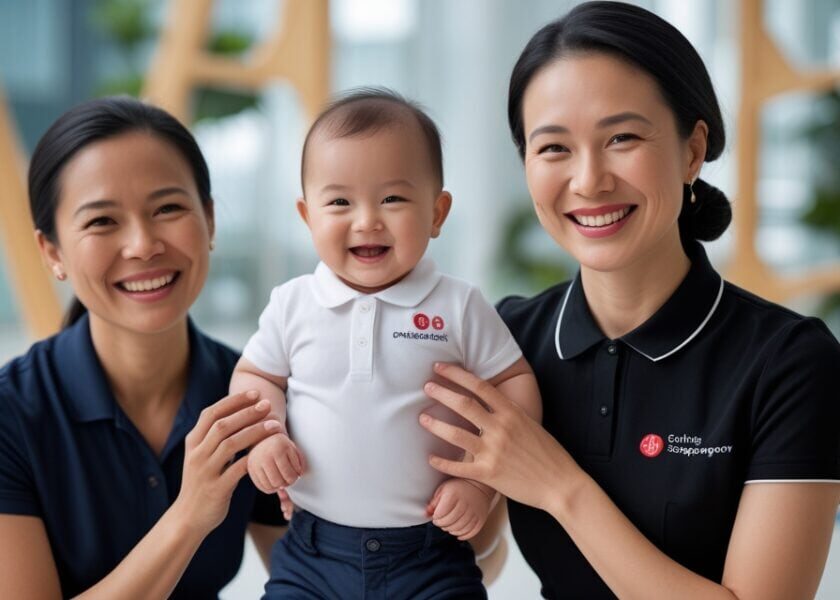
A caregiver who kneels down to your child’s level before taking her into her arms. Who speaks to your child in the third person, warmly and deliberately—”Sofia is going to have such a wonderful morning with Auntie Liu today”—so that your child hears herself named and valued. Who receives your child with an open, unhurried posture, not glancing over your shoulder at the clock or the next arrival.
Who takes a moment to acknowledge your leaving—perhaps with a brief, genuine exchange that your child can observe—before gently turning your child’s attention to the morning’s first invitation: a toy, a song, a ritual of entry.
This is not magic. It is not even particularly complicated. But it is the difference between a handoff and a handover. Between a transaction and a transition.
Signs of Quality in the Morning Caregiver
- Kneels to your child’s eye level before greeting
- Speaks to your child by name, warmly and specifically
- Receives your child with unhurried, open body language
- Does not rush the transition or glance at the clock
- Has a small ritual—a song, a toy, a greeting—that your child recognizes
- Shows genuine recognition of your child as an individual
- Offers a brief, calm acknowledgment of your leaving
What to Watch for When You Visit
When you visit an infant care setting—or an EduNanny arrangement—watch the handoff. Watch how the caregiver receives your child.
- Does she look at your child or over your shoulder at the clock?
- Does your child seem to recognize her?
- Is there warmth in the greeting, or just efficiency?
- Does she speak to your child like a person, not just a task?
- Do you see the small rituals—a cup, a song, a familiar toy—that signal consistency?
Ask yourself: can I trust this person with my child’s mornings? Not because she promised everything would be fine. But because you watched her, for those few minutes, and you saw her be present.
The Research Behind Secure Separation
Research on attachment tells us something important: it is not the number of hours your child spends away from you that determines her security. It is the quality of the care she receives in your absence.
A child can spend full weekdays away from her parents and develop perfectly secure attachment if those care experiences are consistent, responsive, and warm. Conversely, a child in part-time care with inconsistent caregivers can experience persistent separation anxiety because the uncertainty itself is destabilizing.
This is why consistency matters so much in infant care. The same caregiver, the same space, the same morning routine—these are not luxuries. They are the architecture of security.
EduNanny’s Approach to the Morning Transition
EduNanny by BUTLER operates within the ECDA Childminding Pilot, offering Singapore families pathways that are flexible, accessible, and grounded in developmental best practice. Whether through home-based arrangements or community and centre-based settings, EduNanny maintains infant ratios of up to one to three—small enough that your child is not just a face in a group, but a known individual with known needs, known preferences, known small comforts.
This matters in the morning because a caregiver who knows your child can receive her with genuine recognition. “There’s my favourite girl, I saved the yellow cup for you today.” That is not performance. That is the product of sustained familiarity. That is what small ratios make possible.
EduNanny understands that parents need to leave with real confidence, not just polite reassurance. Communication and transparency are built into the model. Where CCTV measures are deployed, parents can access them. Where daily updates are part of the arrangement, they arrive without prompting. You do not have to wonder what happened after you left. You can know.
The fees within the pilot are structured to be affordable, and payment mechanisms include CDA and Baby Bonus usability—because this care should not only be excellent, it should be accessible to families across Singapore who need it. Monday to Friday care blocks give working parents the consistency their children need for genuine attachment development, not the erratic patchwork that leaves everyone unsettled.
EduNanny’s caregivers are trained not just in safety and curriculum, but in attunement—in reading a child’s emotional state, in receiving parental anxiety with grace rather than judgment, in building the ritual of trust that makes the morning transition something other than trauma.
When the Morning Goodbye Starts to Change
You may be wondering whether the morning goodbye will ever stop being hard.
The honest answer is this: it changes. The raw, breathless anxiety of those early weeks softens into something more manageable—not because the leaving becomes easy, but because you begin to see evidence.
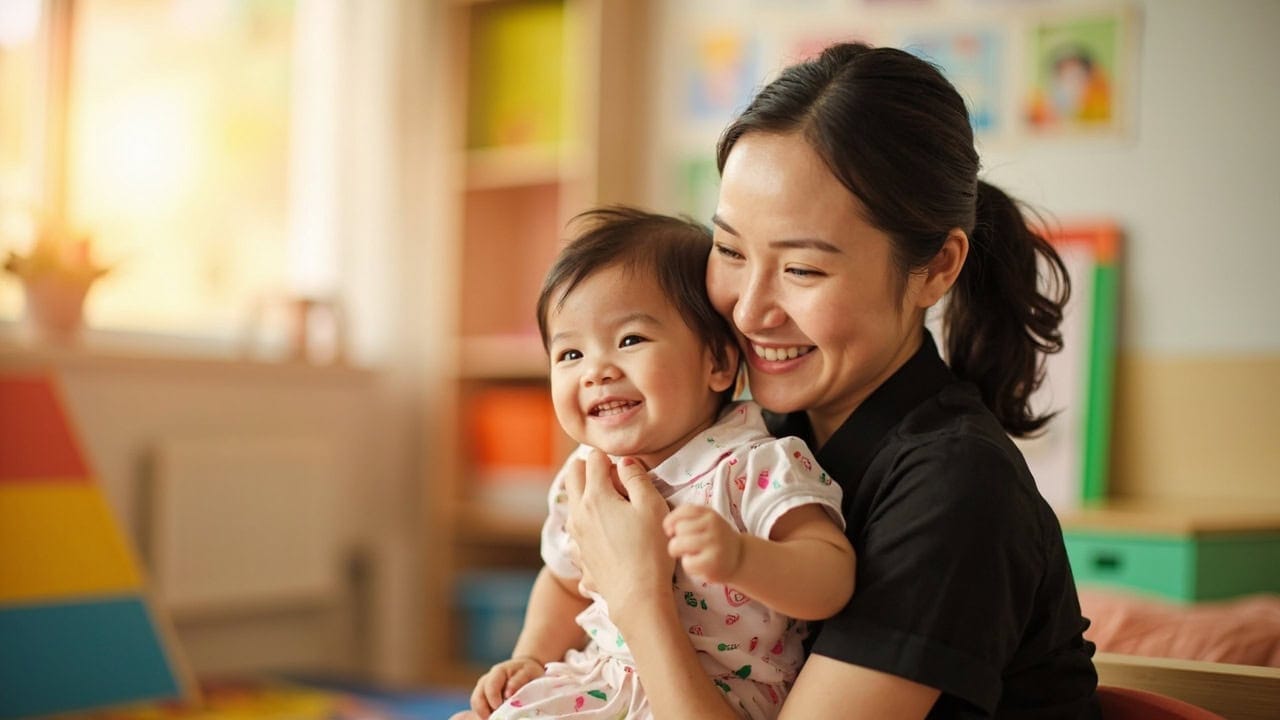
Your child is not coming home shattered every day. Your child is not crying the moment you arrive. Your child is, perhaps, beginning to wave. Beginning to look back at you with a smile. Beginning to ask for the caregiver by name, or to mention her during dinner as if she is family.
These are not trivial signs. These are the observable markers that secure separation is taking root. Your child has learned something profound: that when Mummy or Daddy leaves, it is not abandonment. It is a temporary absence, followed by reunion. That the caregiver is a safe person. That the morning goodbye, though not beloved, is survivable.
Signs the Morning Goodbye Is Working
- Your child’s tears decrease over time, even if they never disappear entirely
- Your child waves or shows brief recognition before you leave
- Your child mentions the caregiver positively outside of drop-off
- Your child settles within minutes of your departure
- Evening reunions are joyful, not anxious
- There are regressions after holidays—but they pass
Know this: it is not linear. A child who waves cheerfully on Monday may sob on Tuesday after a weekend at home. This is normal. This is the rhythm of attachment, not evidence of failure.
You Are Not Doing This Alone
If you are reading this while already enrolled in infant care, if the morning goodbye is already part of your daily rhythm, and if it still hurts—please hear this: you are not doing it wrong.
The fact that it is hard means you care. The fact that you replay those final seconds, that you wonder and worry, that you catch your reflection and wonder if you looked uncertain—this is what loving your child looks like from the inside.
You are showing up, every morning, for the hardest part of the day, and you are leaving your child in the care of someone who has promised to love them as if they were her own.
That matters. That is enough.
The morning goodbye was never meant to be a solo performance. It is a partnership—a three-way dance between you, your child, and your caregiver. And the quality of that partnership determines everything about how your child experiences separation.
The right partner does not make the goodbye easy—but they make it bearable, and eventually, manageable.
The Morning Goodbye, Transformed
The morning goodbye ultimately asks of us not that we will never feel uncertain, but that we will stay present long enough to see whether the care our child receives deserves our trust.
And if it does—if your child is met with warmth, with familiarity, with genuine engagement—then you can leave each morning not without anxiety, but with something better.
With evidence.
With the knowledge that your child is not just safe, but held. That the caregiver is not just watching, but connecting. That the ritual of goodbye is not a wound, but a bridge—connecting your child’s world at home to the world outside it, and teaching her, day by day, that love does not end at the door.
That is what EduNanny is building, one morning at a time.
And that is why this daily moment—this ordinary, difficult, tender morning parting—matters more than any tour, any brochure, any well-designed curriculum. Because this is where trust is lived. This is where your child’s security is forged. This is where you discover, in the small specific details of a caregiver’s greeting, whether you have found the right partner for this extraordinary, exhausting, irreplaceable work of raising a child.
If you are navigating the morning goodbye in Singapore—if you are researching infant care or childminding, weighing your options, wondering whether you can trust anyone else with your child’s mornings—we would welcome the conversation.
Explore what EduNanny’s ECDA Childminding Pilot offers your family.
Learn more about who we are or get in touch to start a conversation about your family’s needs.