Beyond Supervision: Why Secure Attachment Changes Everything
The Question Every Singapore Parent Asks
There is a moment every parent in Singapore knows. It happens at the door of a childcare centre, or at the threshold of a home, when you kneel down to your child’s level and promise that you will come back. You watch their face — the flicker of uncertainty, the way their small hand reaches for yours — and you feel the weight of what you are leaving behind.
Not just their physical care. Their sense of safety. Their understanding of the world.
This is the quiet anxiety that lives beneath every childcare decision. Not a question of facilities or credentials or even curriculum. The question that truly matters — the one that keeps parents awake at 2 a.m. — is simpler and far more tender:
Will my child be happy? Will they feel safe? Will someone know them the way I do?
We understand that question. And we have built our work around answering it — not with checklists or promises, but with something more fundamental. The relationship your child forms with their caregiver is not one factor among many. It is the foundation upon which everything else stands or falls.
What Quality in Childcare Really Means
When we talk about quality in childcare, the conversation usually turns to measurable things. Staff-to-child ratios and certifications. Safety protocols and curriculum frameworks. Meal plans and nap schedules. These matter, of course. But they are the architecture around the relationship — not the relationship itself.
You can have impeccable facilities and still place your child in an environment where they feel unseen. You can have highly qualified staff and still witness a child who is present but not thriving.
The research on early childhood development is unambiguous. The first thousand days of a child’s life are not simply a developmental window — they are the period during which the architecture of emotional security is built. Children are not born knowing how to trust; they learn it. They learn it in the small moments:
- The caregiver who notices when they are tired before they cry
- The caregiver who speaks to them in a tone that communicates safety
- The caregiver who remembers that red is their favourite colour and that they like their rice slightly mashed
These are not sentimental details. They are the building blocks of attachment.
When a child sees the same familiar face each morning, something profound happens in their developing nervous system. The stress response that naturally occurs upon separation begins to quiet. Research consistently shows that young children with consistent caregivers show lower cortisol levels, fewer behavioural problems, and greater emotional regulation than children in high-turnover settings. These are not soft outcomes. They are measurable differences in how a child’s brain develops in response to relational security.
What Secure Attachment Looks Like in Childcare
When we talk about secure attachment in a childcare context, we are describing a very specific experience for the child:
- The knowledge that their needs will be met — not perfectly, not identically to how a parent would meet them, but consistently and responsively
- The gradual understanding that they can be in this place, with these people, and still be themselves
- The freedom to explore and test boundaries and make mistakes, because there is a secure base to return to
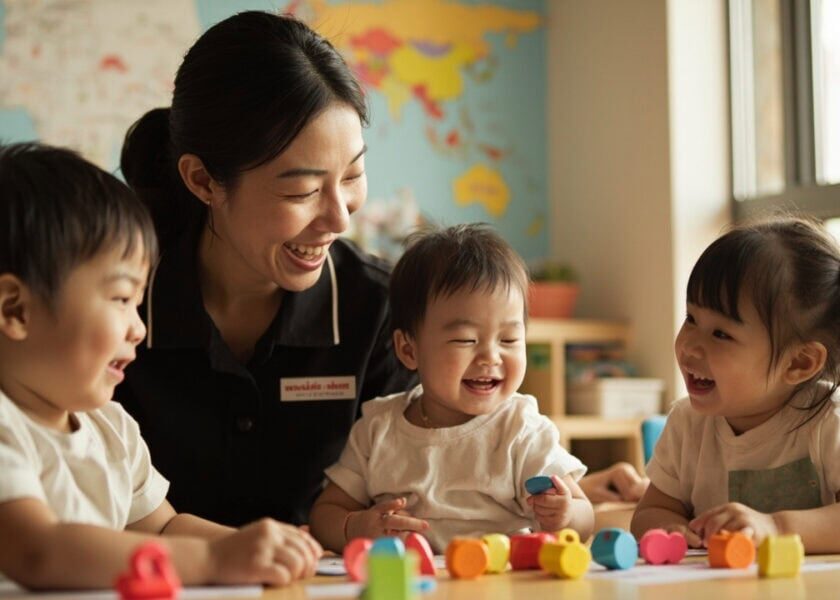
This plays out in the ordinary moments of a child’s day — in the way they hesitate at the door in the morning, and then let go. In the way they reach for a familiar hand before stepping onto unfamiliar ground. In the way they begin to talk about their caregiver not with anxiety but with the casual comfort of someone describing a trusted friend.
What you will see, when the bond is healthy and secure, is something more subtle and more profound:
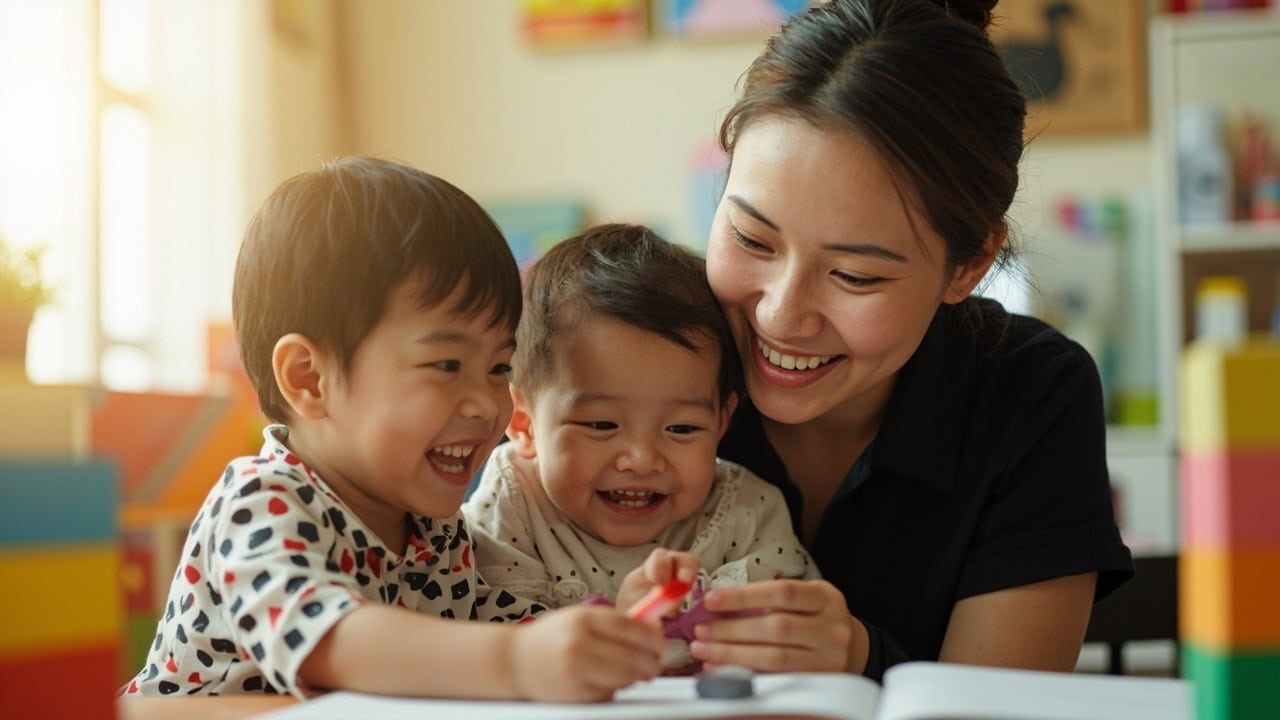
- A child who is comfortable being themselves. Curious without anxiety.
- A child who settles after arrival. They might cry upon separation — a normal response — but they calm relatively quickly, not because they have been distracted, but because they have learned that this environment holds them.
- A child who glances toward their caregiver not in fear, but in the casual, confident way of someone checking that their base camp is still there.
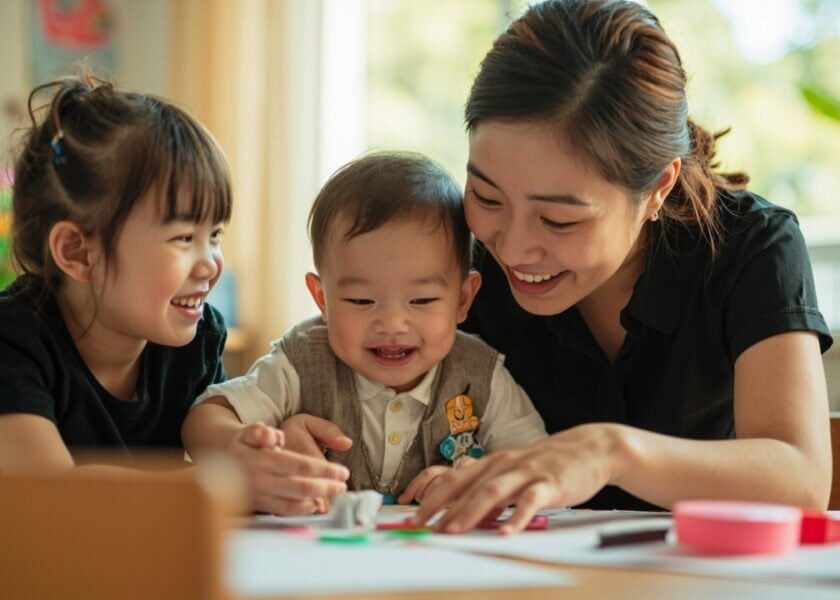
- A caregiver who kneels to a child’s level rather than looming above them.
- A caregiver who narrates what they are doing not for an audience, but because the child needs to understand what is happening around them.
- A caregiver who notices distress before it escalates and moves toward it — not to suppress, but to accompany.
When this is happening, you will feel it. You will feel it when you drop your child off and there is no prolonged goodbye drama, because your child trusts that you will leave and you will return. You will feel it when you pick them up and they are not hollow-eyed or shut down, but present, engaged, themselves.
How EduNanny Builds These Bonds Intentionally
What EduNanny has always understood is that answering the parent’s deepest question — will my child be truly known? — requires something more intentional than most childcare models provide. It requires deliberate relationship-building, beginning on the very first day.
When a child enters care with EduNanny, they enter a process designed to honour their emotional reality. The early days are not about teaching or socialising or activities. They are about trust.
A new caregiver does not immediately assume the primary relational role. Instead, there is a gradual, sensitive transition — one that acknowledges that attachment cannot be rushed, only invited. We have structured our approach around what developmental psychologists call the “circle of security”: the principle that children develop trust not when they are constantly held, but when they are given a safe base from which to explore and a secure haven to which they can return.
Our caregivers are not selected for credentials alone. They are chosen for their capacity to be present, to notice, to respond with warmth that feels genuine rather than performative.
They are trained to understand the difference between a child who is crying because they are genuinely upset and a child who is crying because they are testing whether their world will hold. They learn to read the child who is quiet not because they are fine, but because they have learned that their signals do not register.
Every EduNanny caregiver carries this understanding into every interaction: that the relationship is not a backdrop to the work of childcare. It is the work.
Built for Singapore Families
We know that what we are describing sounds, to some, like a luxury. The idea that childcare should be about genuine relationship-building feels almost idealistic when families are juggling work demands, financial pressures, and the relentless logistics of Singaporean life.
But this is precisely why it cannot be an afterthought.
For Singapore parents — where both parents often work, where extended family may not be nearby, where the cost of living demands dual incomes — the early years of a child’s life unfold in the context of childcare. This is not a parenthesis in family life. For many children, it is a primary environment during the most developmentally significant period they will ever experience.
The question of whether that environment is one of mere supervision or genuine relational security is not a philosophical question. It is a question about who your child is becoming.
Our Programme and the ECDA Childminding Pilot
EduNanny operates within the ECDA Childminding Pilot, which reflects a growing recognition in Singapore that childcare must be flexible, responsive, and grounded in the realities of family life. Whether care is delivered in a home-based setting, a community setting, or a centre-based environment, the principle remains the same: every child deserves to be known.
We maintain infant ratios that allow for genuine attention — the kind that notices when a child’s lip is trembling before the tears arrive, the kind that means every child is known, not just managed.
Quality and Accessibility
We understand that quality should not require wealth. The pilot fee structures have been designed to make this approach accessible to families across Singapore, not only to those who can afford premium packages.
Many families find that CDA funds and Baby Bonus can be directed toward these costs, and our team helps parents navigate the practical details without making it feel like a bureaucratic burden. The care operates Monday through Friday, in structured blocks that align with the rhythms of working families. We do not expect parents to contort their lives around our schedule. We have built our schedule around what families actually need.
Staying Connected to Your Child’s Day
Parents sometimes tell us that what drew them to EduNanny was not our philosophy alone, but the way that philosophy is enacted in practice. They mention the communication — not the kind that arrives as daily reports filled with data, but the kind that makes them feel connected:
- A photograph shared at the right moment
- A note about how your child asked for “more” at lunch, which is news you would have missed otherwise
- A caregiver who remembers to mention that your child was particularly interested in the ladybugs in the garden today, because they know that you would want to know
Where deployed, our transparency measures — including CCTV access — exist not because we distrust our caregivers, but because we understand that trust must be supported by evidence. We want parents to feel that they can check in, that the door is never closed, that they are partners in their child’s day even when they are not physically present. This is not about surveillance. It is about inclusion.
Thomas, our AI chatbot accessible through our platform, extends this connection beyond daytime hours — offering guidance grounded in evidence and responsive to the specific realities of Singapore parenting. It does not replace the caregiver relationship. It extends it.
A Service to Parents Too
There is something worth naming here: the profound service that quality childcare provides is not only to children. It is to parents.
The guilt that many mothers and fathers in Singapore carry is not trivial. It is the product of cultural messaging, of impossible expectations, of a society that simultaneously demands full parental presence and full professional contribution. When parents leave their children in care, they are not failing. They are making a decision that reflects love, pragmatism, and hope — hope that their child will be cared for in a way that reflects their own care.
When the caregiver-child bond is strong, something shifts in this equation. The parent is freed — not from love, but from anxiety. They can return to work not with the background hum of worry, but with genuine peace. They can trust, because they have seen evidence. They can let go — not of their child, but of the fear.
We have seen this transformation in families we serve:
- A father who told us, quietly, that he used to dread the mornings because his son would cry and he would feel like a failure
- A mother who said she finally understood what it meant to drop her child off and feel no guilt, only confidence
- A grandparent who observed the caregiver with their grandchild and said, through tears, “I can see that he loves her, and I can see that she knows it”
These moments are not marketing. They are evidence of what happens when the relationship is right.
Questions to Ask When Choosing Infant Care in Singapore
If you are currently researching childcare or infant care options in Singapore, here are the questions that matter most — beyond the checklists of ratios and certifications:
- Will my child see the same caregiver each day? Consistency is not a preference. It is a developmental necessity.
- How does the setting handle transitions? A quality programme will have a deliberate, gradual approach to introducing your child to their caregiver.
- What will I be told about my child’s day? Look for communication that reflects genuine attention — not template reports, but real observations.
- How does the caregiver interact with children at eye level? Visit unannounced if possible. Watch how adults position themselves physically in relation to the children.
- How does my child respond after a settling period? After the initial transition, you should see a child who is curious, comfortable, and genuinely themselves.
The Threshold
Let us return to that threshold we began with.
The moment of leaving your child. The promise you make. The quiet prayer that they will be okay.
We cannot promise perfection. No honest childcare provider can. What we can promise is this: that every decision we make is oriented toward the same goal you hold as a parent. That your child will be safe. That your child will be known. That your child will form a bond with their caregiver that supports them — not just in the months and years of formal childcare, but in the neural pathways they are building right now, in the emotional templates they are carrying forward into every future relationship.
When your child runs to their caregiver, not because they have to, but because they want to — that is the evidence.
When you feel, upon pickup, not relief alone but genuine warmth — that is the evidence.
When your child wakes in the night and you realise they have not mentioned the caregiver in a frightened way, but in a casual way, the way they might mention a beloved teacher or a friend’s house — that is the evidence.
We believe that every child deserves this. We believe that every parent deserves the peace of knowing it is happening.
EduNanny exists as an answer to a question that Singapore parents have been asking for too long without adequate response. Your child will be cared for. Your child will be known.
And when that bond is right — when the relationship is what it should be — you will feel it. We promise you that.
EduNanny provides infant care and childminding services for families across Singapore. If you are searching for childcare that treats your child as an individual — not a number, not a schedule, but a person deserving of genuine care and attention — we would welcome the opportunity to speak with you.
Learn more about our programme, our fee structures, and how we support families through the ECDA Childminding Pilot.