Why Sustained Partnership Matters in Singapore Childcare
The Question Behind the Search
This is where the search for childcare begins. For most parents, it is also where the story seems to end: find a provider, enroll your child, and hope for the best.
But this is not where the story ends. It is where the story begins.
The question that matters is not simply “How do I choose the right childcare?” It is something deeper and more sustaining: how do I build a relationship with my child’s caregivers that will serve my child for years, not just days? How do I stay engaged, participate meaningfully, and know that the partnership I am forming is genuinely supporting my child’s development?
These are the questions that discerning parents in Singapore are beginning to ask—and they are the questions that shape everything EduNanny was built to answer.
Why Partnership Matters More Than Standards Alone
In Singapore, we are fortunate to live in a society that takes early childhood seriously. Frameworks, accreditations, quality standards, and a growing ecosystem of providers who understand that infant care is not babysitting—they are all signs of real progress.
The ECDA Childminding Pilot, of which EduNanny is a part, represents an important recognition: families need options that fit the rhythms and realities of Singapore’s working parents, that meet children where they are. This is meaningful progress.
But frameworks alone do not make a relationship. Standards alone do not create the kind of sustained, attentive, developmentally-rich care your child deserves.
What makes the difference is partnership.
Partnership is not a word we typically associate with childcare. We talk about services, providers, facilities, curricula. We talk about choosing well. But we rarely talk about what happens after the choice is made—about how a parent remains an active, informed, confident participant in their child’s care over years rather than merely a consumer who made a good decision at a single point in time.
EduNanny operates from a fundamentally different premise. We believe quality infant care is not something you purchase. It is something you build, together, over time.
The relationship between a parent and a child’s caregiver is not a transaction that concludes at enrollment. It is an ongoing dialogue, a shared observation, a collaborative reading of the child’s development that deepens and enriches as the months and years pass.
Co-Observation: Reading Your Child Together
This is what sustained partnership looks like in everyday life:
- The caregiver who takes notes not because a form requires it, but because they are genuinely curious about your child’s development and want to share what they observe
- The parent who asks questions not because they doubt the caregiver’s competence, but because they understand that their engagement makes the partnership stronger
- Regular communication that goes beyond “did they eat and sleep okay” to “what are they interested in right now? What frustrates them? What made them laugh today?”
- The kind of transparency that builds trust not through one grand gesture, but through the accumulation of small, consistent acts of sharing
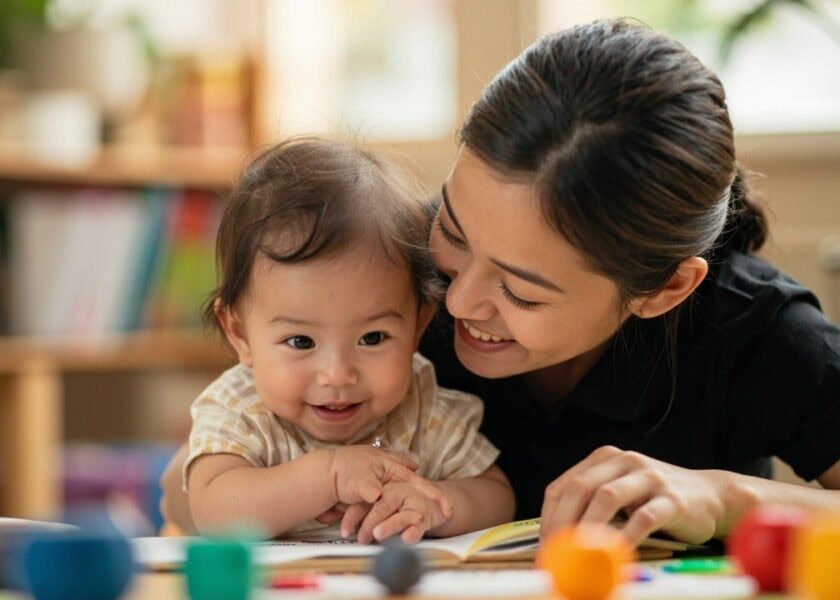
When your infant begins to show interest in stacking blocks, it is not just the caregiver who notices. You hear about it. You try stacking blocks at home. You see your child’s concentration and joy, and you share that observation back.
When your toddler begins to assert independence in ways that are sometimes challenging, the caregiver can tell you about the contexts in which this emerges. You share what you are seeing at home. Together, you begin to understand your child more fully than either of you could alone.
This is developmental continuity—the understanding that your child is not one person at home and another at childcare. They are one child, living one integrated developmental story, and the adults in their life have the privilege and responsibility of being part of that story together.
The Structural Conditions That Enable Partnership
Partnership requires the right conditions to flourish. For EduNanny, this means deliberate choices about how we operate.
Our home-based and community-based pathways are designed not just for logistical flexibility, but because smaller settings allow for deeper observation, more individualized attention, and relationships that are not diluted across dozens of families.
Our infant ratios—kept to one caregiver for every three children—mean that caregivers can truly know each child in their care. They notice the small changes that signal development. They respond to individual needs rather than managing group dynamics. These are not abstract principles. They are the structural conditions that make sustained partnership possible.
Pathways Designed for Singapore Families
EduNanny offers pathways that recognize the diversity of Singapore families. Whether through home-based care, community-based settings, or center-based options, the commitment to quality partnership remains consistent.
- Care blocks run Monday through Friday, structured to provide the continuity that meaningful relationships require—because developing trust and observing development takes time
- Pilot fee structures are designed to make quality care accessible, with eligible subsidies through CDA and Baby Bonus available
- Singapore-wide relevance is built into the model, recognizing that families across our island deserve access to care that is genuinely excellent
Addressing Your Real Concerns
What Partnership Is Not
I want to address something that I know may be on your mind, because I have heard it from parents again and again.
For many parents, the idea of ongoing participation can feel like one more demand on an already stretched capacity. Singapore parents are navigating demanding careers, long commutes, extended family obligations, the high cost of living. The last thing anyone needs is another thing to feel guilty about, another standard they are failing to meet.
So let me be clear about what I am not saying.
I am not saying that good childcare requires perfect parental engagement. I am not saying that if you are exhausted, overwhelmed, or sometimes rely on your child’s caregiver to carry more of the relationship than you can in a given season, something has gone wrong.
Partnership means it can flex and adapt. There are seasons of deeper involvement and seasons of necessary trust. The relationship between you and your child’s caregiver is alive. It responds to your child’s development, to your family’s circumstances, to the trust that builds over time.
Trust as a Practice, Not a Feeling
Trust must be built and maintained over time—not the kind of trust that is established once, through a tour and a background check, but the kind that is renewed daily through transparency, communication, and the small evidence that your child is safe and flourishing.
Trust, in this context, is not a feeling you have about a decision you made months ago. It is a practice. It is what happens when your child’s caregiver remembers to tell you about the book your daughter kept asking to read again. It is what happens when you receive a photo that captures exactly the expression you would have loved to see. It is what happens when you ask a question and receive a thoughtful, detailed answer.
Where transparency tools are deployed—whether through regular updates, communication platforms, or carefully considered access—they serve not as surveillance, but as windows into your child’s day, as evidence that the partnership is real.
The Dignity of the Caregiver
When we talk about childcare as partnership, we are not just elevating the parent’s role. We are elevating the caregiver’s role.
We are recognizing that the person who cares for your infant is not a service functionary executing tasks. They are a professional, a skilled observer, a contributor to your child’s development whose expertise deserves respect and engagement.
In Singapore, the ECDA Childminding Pilot has helped professionalize and recognize the role of childminders. But professionalization is only part of the story. The other part is relational.
When parents approach childcare as partnership, they are saying to the caregiver: I see you as a collaborator, not just a service provider. I value your observations. I want to hear what you notice about my child. I trust you enough to share my parenting challenges with you, and I am curious about yours.
Research consistently shows that caregiver stability and relationship continuity are among the most important predictors of quality early childhood care. Caregiver stability is not just about keeping the same person over years. It is about creating conditions in which caregivers feel valued, respected, and genuinely connected to the families they serve.
What to Look For: A Practical Guide for Choosing Infant Care
If you are researching childcare options in Singapore, here are questions that go beyond the typical checklist:
Questions About the Relationship Model
- How does this provider view the relationship between parents and caregivers—as a service transaction or an ongoing partnership?
- What systems are in place for regular, meaningful communication beyond daily health updates?
- How are caregiver observations shared with parents, and how are parent observations incorporated into care?
- What do continuity and stability look like in this setting over months and years?
Questions About Structural Conditions
- What are the caregiver-to-child ratios, and why do they matter for your child’s individual attention?
- Is care designed for smaller groups where caregivers can truly know each child?
- How does the setting support developmental continuity between home and childcare?
Questions About Transparency and Trust
- How is trust built and maintained between caregivers and families over time?
- What does regular parent engagement look like in practice?
- Are there opportunities for you to participate in your child’s care journey beyond drop-off and pick-up?
The Answer to the Question You Carry
Let us return to the question I posed at the beginning—the question that parents carry in their hearts long after the childcare search is officially over:
How do I give my child the best possible start, and how do I know if I am getting it right?
The answer to this question is not found in a single moment of perfect choice. It is not found in the most prestigious center or the most glowing review.
It is found in the sustained, attentive, collaborative relationship that you build over time with the people who care for your child. It is found in the daily practice of partnership—in the communication and observation and mutual respect that deepen as the months and years pass.
It is found in the understanding that your child’s development is not a product to be delivered but a story to be shared.
EduNanny was built for this. We are not interested in being a transaction that ends at enrollment. We are interested in being a long-term partner in your child’s development, in the kind of sustained relationship that becomes more valuable, more trusting, and more developmentally rich as the years go by.
An Invitation to Begin
If you are a parent in Singapore, I want to leave you with this: the desire you feel to give your child the best is not a burden to be managed. It is a compass. It points you toward engagement, toward participation, toward the kind of active involvement in your child’s care that transforms it from a service you purchase into a partnership you build.
The choice you make today about childcare matters. But what matters more is the relationship you nurture over years, the trust you build with your child’s caregivers, the shared observation of your child’s development that makes you a true partner in their earliest and most formative years.
Not just care, but partnership. Not just a choice, but a relationship. Not just the first step, but the full journey.
Your child’s first five years are not a problem to be solved. They are a story to be told, together. And we would be honored to be part of that story with you.
If you are exploring infant care or childminding options in Singapore and want to learn more about how EduNanny builds sustained partnerships with families, we welcome you to begin a conversation with us.
To learn more about our approach, visit EduNanny Singapore or explore our participation in the ECDA Childminding Pilot.