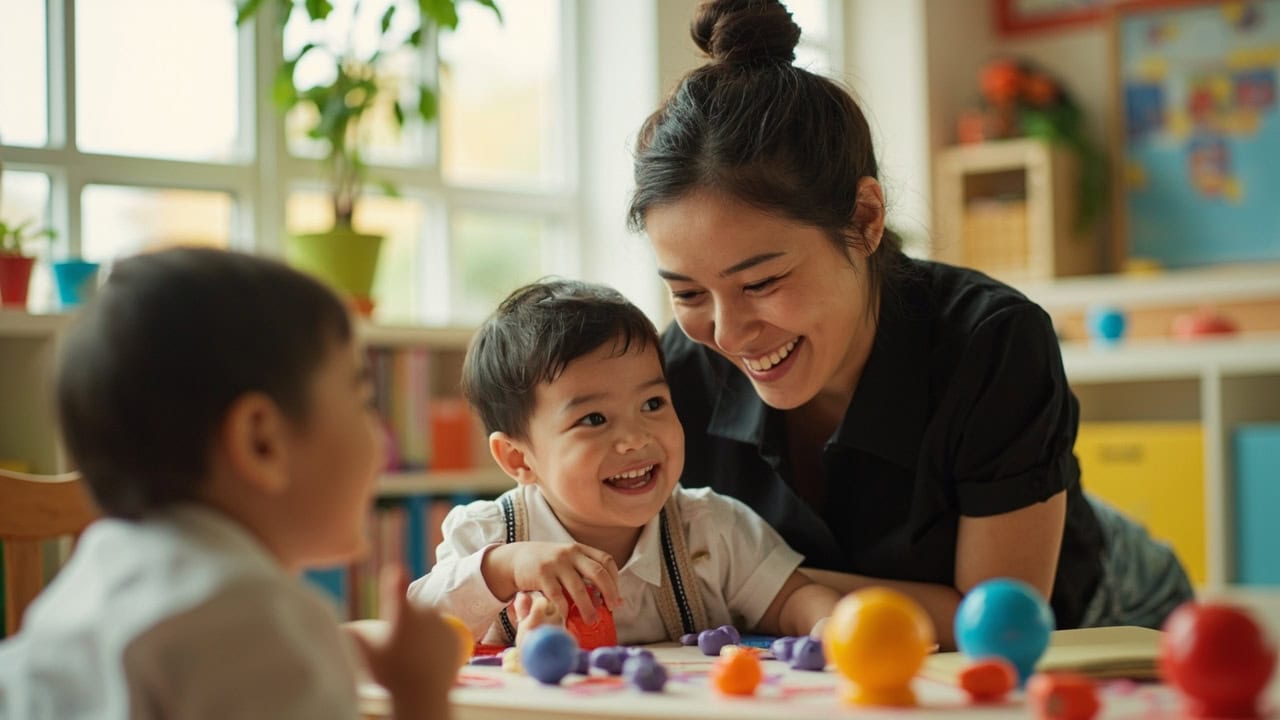
What Your Child Is Really Telling You After Childcare
The Moment Every Singapore Parent Knows
You drop your child at childcare in the morning. The transition goes smoothly, or perhaps it does not. Either way, you leave with your child in someone else’s care, and you carry that day forward like a question you cannot fully form.
Later, you receive an update. Positive. Reassuring. Even detailed. And yet, something in you does not settle. Not because you distrust the caregiver. Not because anything is wrong. But because you realize you have no real framework for evaluating what you are being told.
You are grateful for the update. You are dependent on it. And you wish, quietly, that you did not have to be.
This is not a failure of instinct. It is a gap in literacy. And it is one of the most universal, underdiscussed tensions that parents in Singapore carry when their children are in someone else’s care.
This article offers a way through: not comfort, but competence. Not the promise that your child will be fine, but the skill to read for yourself whether they are.
Why Updates Alone Are Not Enough
We have built an entire industry around reassuring parents. Calm music. Warm colors. Open-door policies. Photo updates. Daily reports. All of it designed to make parents feel better. And those things matter. Feeling secure matters.
But here is what the industry has largely failed to offer: a way for parents to become genuinely competent in their own observations. A way to look at your child in the evening and understand what you are seeing. A way to trust your care arrangement not because you have been reassured, but because you have learned how to read the signals your child has been sending you all along.
Children communicate their emotional and developmental state every single day. They do it through how they greet you when you return. Through the energy they carry. Through the questions they ask. Through the way they move through familiar spaces.
A child who is genuinely thriving in their care environment will show it. A child who is struggling, even subtly, will show that too. The information is there. The question is whether we have been taught how to receive it.
Most parents have not. They have been given platitudes about trusting the process. They have been told to follow their gut. They have been assured that love is enough. And while love is everything, it is not a methodology. It is not a lens.
Behavioral literacy for parents is not the kind that comes from reading a checklist and panicking over every deviation. It is the kind that comes from understanding development well enough to know what is ordinary, what is worth noting, and what deserves attention. The kind that makes you a more confident parent, not a more anxious one.
When you know what to look for, you stop Googling every behavior in a panic. You stop second-guessing every update you receive. You become the kind of parent who notices things — and that noticing changes everything.
Your Observation Framework: Reading Your Child After Childcare
Consider what you might notice if you were looking. In the first hour after pickup, your child’s behavior is data. Here is how to organize what you are seeing.
Energy and Emotional Tone
How does your child seem when you see them? Not just happy or sad, but what is the quality of their energy?
- A child who is genuinely settled will often show calm alertness — interested in their surroundings, responsive but not frantic
- A child who is overstimulated may be unusually clingy, whiny, or have difficulty self-soothing
- A child who is under-stimulated or bored may seem flat, disengaged, or excessively passive
- Occasional tiredness after childcare is normal, especially for younger infants. What matters is the pattern over time.
How They Orient Back to You
Notice how quickly and how completely your child reorients to you after pickup. This is one of the most reliable signals of attachment security.
- Genuine ease: Your child notices you, shows recognition, and can be comforted or engaged without prolonged distress
- Anxious reunion: Your child takes a long time to settle, cries inconsolably, or seems hypervigilant even after you arrive
- Flat or avoidant: Your child shows little reaction to your arrival, turns away, seems disconnected from you and from the caregiver
None of these are diagnoses. But patterns over time matter. A child who consistently shows anxious reunion may be signaling something about their experience during care. A child who seems avoidant may be adapting in a way that deserves attention.
How They Talk About Their Day
If your child is verbal, pay attention to how they describe their experience.
- Do they reference the caregiver, and if so, how? With warmth? With neutrality? With an emotional charge that seems disproportionate?
- What activities do they mention? Do they speak about play, friends, food, routines? Or do they go silent when asked?
- Do they ask to go back? Do they express dread? Do they seem indifferent?
If your child is not yet verbal, watch how they play out scenes. A toddler who gesturally recreates feeding time with their caregiver is processing that experience. What emotions accompany the play? Is the caregiver figure treated warmly, indifferently, or with distress?
Developmental Indicators
Children show their developmental progress through behavior. Observing your child at home can give you real information about what is happening during care hours.
- Motor development: Is your child refining their gross motor skills — climbing, running, jumping? New skills emerging at home often reflect active opportunities during care.
- Language: New words, increased sentence complexity, or growing comprehension often emerge when children are in rich social environments.
- Social-emotional behavior: How does your child play alongside others? Can they share, take turns, negotiate? These skills develop through peer interaction.
- Cognitive curiosity: Does your child show interest in exploring, problem-solving, asking questions? An engaged child often reflects an engaging environment.
Relational Signals
Perhaps most importantly, watch the relationship between your child and their caregiver through the lens of your child’s responses.
- Does your child show genuine affection for their caregiver, or does the affection seem performative or rote?
- Do they reference the caregiver positively unprompted — talking about them at home, drawing them, asking about them between sessions?
- When something goes wrong — a minor bump, a disappointment — who does your child look to for comfort? This can tell you something important about where they feel secure.
From Observation to Partnership
Parents who learn to read these signals report something remarkable: the anxiety they carry for months begins to dissolve. Not because the care has changed. But because their ability to interpret what they see has sharpened.
This is the difference between hoping your child is okay and knowing it. And that knowledge changes your relationship with your caregiver too.
When you can observe your child’s post-childcare behavior with genuine understanding, something shifts in the partnership with your caregiver. It is no longer a one-way report. It becomes a conversation between two attentive adults who are both watching the same child from different angles and bringing their observations together.
That is not a partnership built on sentiment. It is a partnership built on shared literacy. And it produces something more reliable than reassurance ever could: actual alignment in understanding.
Understanding how to read your child is one side of the equation. The other is finding a care arrangement that makes observation possible — where your child’s signals are visible because the environment is designed for attention, not just management.
In Singapore, childcare arrangements exist on a spectrum. Center-based care serves many families well. Home-based and community-based childminding offers something different: smaller ratios, more individualized attention, and a setting where each child’s patterns can be genuinely tracked.
Quality childminding is not simply supervision. It is sustained, skilled, developmental attention. It treats every interaction as a signal, every routine as an opportunity, and every child as someone whose inner life is worth understanding.
The EduNanny Approach
Where this becomes particularly relevant is in how EduNanny Singapore has built their model. Not around the promise of eliminating your anxiety, though they understand that anxiety is real and valid. But around the belief that parents who observe well and caregivers who communicate clearly are a force multiplier for child development.
EduNanny positions itself not as the authority who decides whether your child is okay. It positions itself as your partner in learning how to know for yourself.
This is embedded in the structure. Under the ECDA Childminding Pilot, EduNanny operates with small ratios, which means caregivers can genuinely observe each child throughout the day, not just manage groups. It means the communication you receive is not templated, but actual. It means that when you have a question about something you noticed at home, there is time and attention available to discuss it with someone who also knows your child.
Home-based and community-based pathways offer different configurations to suit different family rhythms. But the underlying philosophy is consistent: quality care and informed parenting reinforce each other.
Communication That Supports Observation
The daily communication culture at EduNanny is built on the premise that you should not need to wonder. Your child is being seen, and what is being seen is being shared. Not because the system demands it, but because that is how the work is done.
Where deployed, CCTV measures offer an additional layer of clarity. But more importantly, this transparency is part of a culture — one where parents are not dependent on surveillance to trust, because trust is being actively built through consistent, meaningful communication.
Practical Support for Singapore Families
There is a practical dimension here that deserves attention. Singapore parents navigate childcare across a wide spectrum of arrangements, and the anxiety about cost and accessibility is real.
The pilot fee structures have been designed to make quality childminding genuinely reachable. CDA and Baby Bonus funds are usable, which means the financial architecture already in place for families can be brought to bear on this choice. Monday to Friday care blocks align with the rhythms of working parents.
These are not afterthoughts. They are structural decisions that reflect an understanding of what Singapore families actually need to make this work.
Ongoing Support When You Need It
Parent questions do not arrive on a schedule. They emerge at 8pm when you are watching your child play and wondering whether that behavior is typical. They arise over the weekend when you are trying to describe something to a partner. They come up in the spaces between updates, between visits, between the moments when you need guidance and do not have access to your caregiver.
The Thomas AI Chatbot is available to support parents with these questions. It is not a replacement for human judgment. It is a bridge — a way to stay connected to guidance and thinking when you need it, at the pace that parenting actually moves.
Addressing Your Concerns
Most parents who worry that they are being paranoid are actually being attentive. There is a difference between noticing a pattern and catastrophizing a single incident. Behavioral literacy helps you distinguish between the two.
When you have a framework for understanding what is typical, you can note deviations without panic and recognize patterns without immediately assuming the worst. That is not paranoia. That is what competent observation looks like.
Behavioral literacy is not about diagnosis. It is about noticing. If you observe something that concerns you — a marked change in behavior, a regression in skills, a persistent distress that does not resolve — your framework tells you that this is worth discussing, not dismissing.
With a caregiver who shares your commitment to observation, that conversation becomes possible. You bring your home observations. They bring their care environment observations. Together, you form a more complete picture.
Anxiety often comes from helplessness — from feeling like you cannot evaluate what is happening, and are entirely dependent on others to tell you if your child is okay. When you learn to observe, you gain agency. And agency reduces anxiety, even as it increases responsibility.
You may notice more. But you will also understand more. And that understanding is what replaces the anxious loop of wondering with the calm clarity of knowing.
No care arrangement replaces a parent’s presence. But quality childminding, when it is done well, is not a compromise. It is a legitimate, rich developmental environment that, when connected to informed, observant parenting, creates conditions for extraordinary growth.
The first years matter enormously. And the people who tend to children in those years — when parents are working, when families need support — carry a responsibility that deserves recognition and partnership, not suspicion.
Begin Your Observation Journey
In a city that moves fast, that measures productivity and optimizes for efficiency, the choice to slow down and truly observe a child is quietly radical. It says: this person matters. What they are experiencing matters. I am going to learn how to understand them, not just provide for them.
The goal is to move from helplessness to clarity. From “I hope this is working” to “I can see what is happening.” From dependence on reports to genuine understanding.
That is what transforms a parent from someone who receives information to someone who can produce their own informed perspective. The caregivers at EduNanny are not peripheral to this mission. They are central to it. They are trained. They are observed. They are given the ratios and the culture that allow them to do the work properly.
What we are building together, parents and caregivers, is not just supervision. It is attention. Sustained, skilled, developmental attention that treats every interaction as a signal, every routine as an opportunity, and every child as someone whose inner life is worth understanding.
Your child tells you something every day. The question is whether you have been taught to hear it.
EduNanny Singapore stands for this not as a slogan, but as a practice. A way of working that starts from the premise that parents can be competent observers, that caregivers can be true partners, and that children, seen clearly, will show you everything you need to know to support them well.
You do not need to eliminate doubt. You need to sharpen what you notice. The two are not the same. Doubt is the background noise of caring deeply. But noticing is a skill, and skills can be learned.
Connect with EduNanny Singapore to learn how their childminding approach supports both quality care and your own development as an observant, confident parent. Explore your options and take the first step toward understanding, not just reassurance.