Why Secure Attachment and Quality Childcare Go Together
What Every Singapore Parent Carries Alone (and Why You Shouldn’t)
There is a thought most Singapore parents carry quietly — in the early mornings before anyone else is awake, in the car on the way to work, in the long pause before they pick up their child from their first week of childcare. It is not a thought they often say aloud, because it sounds, even to themselves, like an admission of something they should not feel.
But it is real, and it is there, and it goes something like this:
What if my child does not need me as much because of this? What if they bond with someone else? What if I am loving them less well by asking someone else to love them too?
You are not a bad parent for having that thought. You are a parent who loves deeply enough to be afraid of losing something precious. That fear is not weakness. It is the shadow side of devotion. And it is the most honest thing you can bring to the decision about who cares for your child.
Here is what this article wants to tell you: that fear is built on a misunderstanding. Not of your love, but of how love and attachment actually work in the developing child. Once you understand what attachment truly is, the entire question changes. It stops being about whether you should feel guilty for needing help. It starts being about how you can choose the right kind of help to build the very thing you are most afraid of losing.
This is not an article about why childcare is good enough. It is about why quality professional childcare, when done right, is not a compromise. It is a partnership in your child’s emotional development.
What Attachment Actually Is (And What It Is Not)
The word “attachment” has become almost a wellness cliché. We talk about attachment parenting, attached parenting, secure attachment as a goal. But the science behind it is more precise — and more freeing — than the pop culture version suggests.
Secure attachment is not about exclusivity. It is not built through the number of hours you spend with your child alone, nor through the purity of your caregiving being entirely your own. It is built through something far more specific: consistency, warmth, and responsiveness.
When a child knows that their emotional and physical needs will be met — that the adults around them will respond when they signal distress or joy or curiosity — they learn something profound about the world. They learn that people are trustworthy. That their feelings matter. That they are worthy of attention and care.
This learning happens in the first thousand days with extraordinary speed. The neural pathways that govern how your child will understand relationships for the rest of their life are being laid down right now. That is why this matters so much. Not because you must be the only one delivering these lessons, but because you must ensure they are being delivered well.
What the research actually shows
Here is the part that surprises many parents: multiple caregivers can contribute to secure attachment. They can, and often do, build upon it rather than dilute it.
- Secure attachment is built through consistency, warmth, and responsiveness — regardless of who provides it.
- Children can be securely attached to more than one caregiver. Additional warm, consistent caregivers often strengthen a child’s overall sense of security.
- Quality matters more than quantity of caregivers. One warm, attentive caregiver builds attachment. Multiple distracted, inconsistent ones do not.
- The right childcare does not replace your bond. It reinforces the same emotional lessons you are teaching at home.
This is not a controversial finding in developmental psychology. Decades of research have shown that children form multiple attachments. A child can be securely attached to both parents, to grandparents, to a regular childcare provider. The presence of additional warm, responsive, consistent caregivers does not weaken the primary attachment. In many cases, it strengthens the child’s overall sense of security — because they have learned that the world contains trustworthy people, not just one.
The fear that your child will love their caregiver more than you is understandable. But it mistakes the nature of what attachment is. A child’s attachment to their primary caregiver is not like a cake that gets smaller when someone else takes a slice. It is more like a foundation. And when that foundation is solid, adding more floors does not undermine it. It builds upon it.
What a Securely Attached Child Actually Looks Like
You might expect that a child in professional childcare would show more anxiety, more clinginess, more behavioral problems. The research says otherwise.
Securely attached children in quality childcare settings tend to be more adaptable, not less. They are comfortable with separation because they have learned that parting is temporary and reunion is certain. They can engage comfortably with new people because they have a secure base to explore from. They show less — not more — separation anxiety, because they trust the system around them.
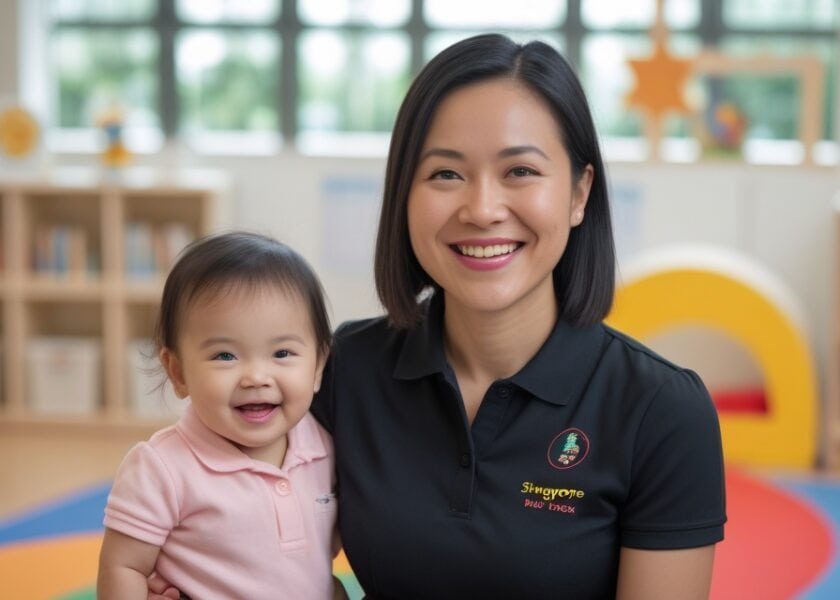
When you pick up your child from childcare, what you want to see is not that they ignore the caregiver and run to you exclusively. That is one possible interpretation, but it is not the only healthy one. What you want to see is something more subtle and more beautiful: your child is glad to see you, but they are also glad to see their caregiver when you arrive. There is warmth in both directions.
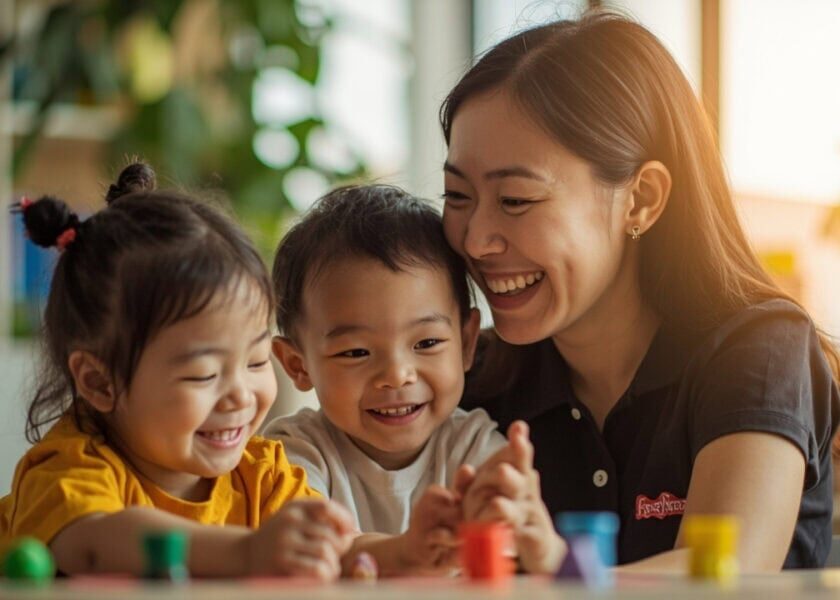
Your child might wave goodbye to their caregiver with genuine affection. They might ask about their caregiver on weekends. These are not signs that your bond is weaker. They are signs that your child has learned to trust and love the adults in their life — starting with you.
A securely attached child is also comfortable exploring. If your child toddles away from you to investigate a toy, then looks back with a smile to check you are there — that is attachment working. It is the balance of exploration and connection, the ability to venture out and the confidence to return. This happens whether you are the only caregiver or one of several.
How to Choose Childcare That Builds Attachment
What you want from a childcare arrangement is not a caregiver who replaces you. You want a caregiver who expands your child’s experience of warm, trustworthy care — who reinforces the same emotional lessons you are teaching at home: you are safe, your needs matter, the people who love you will respond.
So how do you know if a childcare arrangement is building attachment rather than competing with it?
1. Responsiveness
The caregiver should know your child’s rhythms, their cues, their favourite comfort objects. They should respond quickly when your child signals distress — not with distance or routine, but with warmth. Watch how the caregiver interacts with all the children, not just yours. Does the environment feel emotionally alive? Are the children genuinely engaged with the adults, not just supervised?
2. Consistency
Your child should have regular caregivers, not a rotating cast of strangers. The research is clear: inconsistency is what disrupts attachment, not the presence of multiple caregivers. When your child knows who they will see each morning, when the caregiver knows your child’s particular needs and preferences, that continuity builds the trust that attachment requires.
3. Partnership With You
The best childcare arrangements do not try to replace your role. They communicate with you actively, share observations, ask about your child’s routines at home, and make space for your relationship with your child to be central. A caregiver who wants to be your partner in your child’s development understands attachment. A childcare arrangement that treats you as an informed, valued collaborator is one working with your bond rather than against it.
| What Builds Attachment | What Disrupts Attachment |
|---|---|
| Consistent, warm, responsive caregiving | Inconsistent or frequently changing caregivers |
| Prompt response to a child’s signals | Emotional unavailability or dismissal of distress |
| Multiple trusted adults reinforcing security | Isolation from any positive adult interaction |
| Active communication between home and caregiver | A caregiver arrangement that operates in a vacuum |
Questions to ask when researching childcare in Singapore
- Who will actually care for my child? Ask about caregiver consistency. Will your child see the same person most days, or a rotating team? Attachment requires familiarity.
- How does the caregiver respond to distress? Observe or ask about their approach. A caregiver who calms, not just manages, is building attachment.
- How will I know what my child’s day was like? Regular, meaningful communication is not a bonus. It is how you stay connected to your child’s life even when you are apart.
- Is this arrangement designed for my child, or for the convenience of the system? Small ratios, individualized attention, and warmth signal quality.
- Do I feel heard when I ask questions? You should feel like a partner, not a customer. The right arrangement welcomes your involvement.
EduNanny Singapore: A Model Built on Attachment Science
At EduNanny Singapore, these principles are not an afterthought. They are the foundation.
EduNanny operates under the ECDA Childminding Pilot, a program designed to bring professional, quality home-based and community-based childcare to families across Singapore. It is a model built on the understanding that parents need practical support — and that support must be excellent. Because excellence in infant care is not about supervision. It is about nurturing.
What does that look like in practice? The pilot maintains ratios of up to one to three infants, meaning your child receives the kind of focused, individualized attention that builds security. Care blocks run Monday through Friday, offering the flexibility that working parents in Singapore genuinely need without the fragmentation of less structured arrangements.
The caregivers in the EduNanny network are trained, vetted, and supported. They are not anonymous. They are known. Your child builds a relationship with their caregiver over time, and that consistency is what allows attachment to flourish.
And because EduNanny understands that trust requires transparency, communication is built into the model. Parents receive regular updates — meaningful information about their child’s day, their development, their moments of discovery and difficulty. Where deployed, CCTV measures provide additional reassurance, not because trust is absent, but because modern parenting is anxious and that anxiety deserves to be acknowledged and addressed.
The practical dimensions matter too. The pilot fee structures are designed to be affordable. Your Child Development Account can be used, and Baby Bonus savings are applicable, because quality care should not require financial acrobatics to access.
Beyond all of this, EduNanny’s approach treats the parent-child bond as sacred — and as something that can be supported by professional care rather than threatened by it. Every choice in the model, from the ratios to the communication practices to the caregiver training, is oriented toward the same goal you have: raising a child who feels secure, who trusts, who knows they are loved.
EduNanny’s Thomas chatbot is also available as a parenting companion — answering questions, providing guidance, and supporting you through the everyday uncertainties of early childhood. It helps close the gap between the moments when you feel uncertain and the moments when you feel capable. Supporting your child means supporting you. Because a parent who feels understood is a parent who shows up better — and that, too, is part of what builds secure attachment.
You Are Not Failing by Needing Help
Even when you understand the science, the anxiety does not always fully dissolve — and that is okay. Understanding attachment intellectually does not immediately rewrite the emotional worry that lives in your chest every time you drop your child at the door.
Singapore parents are navigating something genuinely difficult. You are building careers and families simultaneously. You are managing the pressures of a competitive environment while trying to be present, warm, attuned parents. You are managing costs and commutes and the logistics of modern life while being told — often by voices inside your own head — that you should be doing more, being more, giving more.
You are doing enough.
Asking for help is not evidence that you are failing. It is evidence that you are paying attention to what your child actually needs — which includes a parent who is not burned out, not anxious beyond bearing, not running on empty.
Choosing quality childcare is not a concession to reality. It is a choice to give your child more. More warmth, more engagement, more consistency, more security. It is a choice to build a village around your family, as humans have always done, as every child thrives when they do.
The research is clear. The fear is understandable but misplaced. And the right kind of childcare does not compete with your bond. It amplifies it.
Your child will learn from the example you set about what it means to build a life with others. They will learn that asking for help is not weakness. They will learn that love is not diminished by sharing. And they will learn, through the consistency and warmth of the caregivers you choose, that the world is a trustworthy place.
That is what secure attachment gives a child. Not just in the first thousand days, but for life. The ability to form healthy relationships, to explore with confidence, to know that they are worthy of care.
This is the gift you are giving your child — even in the moments when you feel uncertain about whether you are doing it right.
You are. You are doing it right.
And EduNanny is here to walk beside you in it.
Ready to explore what quality, attachment-focused infant care looks like with EduNanny Singapore? Get in touch with our team to learn about availability, fee structures, and how the ECDA Childminding Pilot can support your family.