Beyond Grandparents: How Singapore Families Build Childcare Teams
The Reality of Mixed Childcare in Singapore
In Singapore, more than anywhere else I can think of, we live inside a beautiful complexity. Our families are close. Our parents are present. Our grandparents offer care with open hands and deep love — hands that have held our own childhoods, now reaching forward to hold our children’s.
This is not incidental. This is who we are as a culture. We have built something extraordinary: a society where multigenerational care is the norm rather than the exception, where grandparents are not peripheral figures but central pillars in the architecture of family life.
And yet there is a tension that most parenting advice refuses to name. It is the tension between gratitude and longing. Between what is offered and what is needed. Between the profound respect we feel for our parents’ willingness to help and the equally profound awareness that what we want for our children might look different from what they are able to provide.
This is not ingratitude. This is not disrespect. This is the honest, complicated reality of raising children in a world that has changed faster than any two generations should have to bridge.
Here is what we have learned from the families who come to us: most of them did not arrive because they lacked help. They arrived because help, however loving, was not quite enough — not because grandparents are doing anything wrong, but because the demands of modern parenting are different from what they were twenty or thirty years ago.
Early childhood development science has advanced. We understand that the quality of responsiveness, the richness of language exposure, the consistency of routines, the safety of exploration — these things build brains in ways that matter profoundly. And so many Singapore parents find themselves caught in a space where they are grateful beyond words for what grandparents provide while simultaneously aching to supplement that care with something structured, something professional, something designed with developmental intentionality.
This is not a failure. This is wisdom.
Redefining the Village: Childcare as Architecture
Now, here is where most families stop themselves. They believe, somewhere deep in the place where cultural loyalty lives, that choosing professional childcare means rejecting family childcare. That it is a statement, a betrayal, a quiet act of choosing strangers over the people who raised them.
I want to take that belief gently and lay it down, because it is not serving you or your children or your grandparents.
Professional childcare does not replace your village. It strengthens it.
Think about what happens when you add a trained, intentional caregiver to your family’s childcare ecosystem:
- Grandparents suddenly have relief. They can be grandparents again — present and playful, instead of carrying the full weight of daily care.
- The Sunday dinners become easier because the week’s exhaustion has been shared.
- Your children receive more attention, more varied interaction, more cognitive stimulation — not because grandparents were inadequate but because no single caregiver, however devoted, can provide everything a developing child needs.
- The village grows. The village does not shrink.
This is what the families who thrive in this space have discovered. They stopped thinking about childcare as a binary choice — family or professional — and started thinking about it as an architecture. A structure with many rooms, each serving a purpose, none invalidating the others.
How a Childcare Team Works
In this architecture, each caregiver brings something irreplaceable:
- Grandparents bring history, unconditional love, cultural continuity, and the comfort of deep familiar bonds.
- Professional caregivers bring trained observation, developmental knowledge, consistency in approach, and learning environments designed with intentionality.
- Helpers, where families have them, bring their daily presence and their own relationships with the children.
- Parents bring their vision, their values, their ultimate authority over how their children are raised.
Together, this is not a compromise. This is a childcare team.
The Hardest Part: Talking to Your Family About It
Building that team requires something that Singapore families are not always taught to do — something that can feel deeply uncomfortable in a culture that prizes harmony and respects elders. It requires conversation. Clear, kind, ongoing conversation about roles and expectations and boundaries.
What That Conversation Looks Like
It means sitting down — perhaps over a meal, perhaps during a quiet moment when tempers are not frayed — and saying clearly: here is what we are choosing and why.
It means sharing your vision for your children’s days without apology but also without condescension. It means acknowledging, out loud, the tremendous gift grandparents provide.
It means asking, genuinely asking, what they want their role to be, because for many grandparents, being asked rather than assumed upon is itself a form of respect.
It means discussing, together, how to create consistency in the small things that matter enormously:
- How we respond to crying
- How we encourage independence
- What language we use when a child is frustrated
- Whether screen time happens
- How meals are offered
These are not battles to be won. They are conversations to be had, again and again, until the shared language becomes habit, becomes the family’s way.
When It Works
When families do this well, something remarkable happens. The children do not register the complexity at all.
They simply experience a world where multiple caring adults are aligned, where the expectations are consistent, where they are safe to explore because the rules around them are clear. They do not learn that there are different standards with grandmother and with their caregiver. They learn that there is one family, with many loving members, who have worked together to create a world that holds them well.
Addressing the Guilt You Carry
There is a particular kind of guilt that Singapore parents feel when they hire professional help while grandparents are willing and present. It can sound like:
- “My mother raised four children without any of this. What right do I have to want more?”
- “If I truly trusted my in-laws, I would not need this.”
- “I am teaching my children that family is not enough.”
Let me offer you a reframe.
Your parents raised you in their context, with their knowledge, in a world that asked different things of children and families. You are raising your children in your context, with your knowledge, in a world that asks different things.
This is not a judgment on their choices. It is an honoring of yours.
Choosing professional childcare is not a statement that what your parents provided was wrong. It is a statement that you have access to resources they may not have had, and you are choosing to use them. That is not betrayal. That is inheritance.
You are taking what they built — the foundation of safety and love and family closeness they created — and building upon it something new that honors everything they did while responding to everything you know now.
What Quality Childminding Looks Like — and How EduNanny Delivers It
Quality infant care is not babysitting. It is the laying of neural pathways that will shape a human being for their entire life. That is not hyperbole. That is developmental science, and it deserves to be taken seriously.
When done well, quality childminding includes:
- Trained caregivers who understand infant development, responsive caregiving, and the role of language exposure in early brain development.
- Intentional engagement — caregivers who observe, interact, and support growth rather than simply supervise.
- Home-based settings where children are most comfortable, reducing transition stress and supporting attachment security.
- Small ratios so that each child is seen, known, and their individual rhythms noticed.
- Transparency so parents know what their child’s day actually looks like.
- Consistency in routines and approaches that aligns with what families are building at home.
For infants in their first year of life, when neural development happens faster than it ever will again, this kind of attentive care is not a nice-to-have. It is foundational.
How EduNanny Fits Into Your Family’s Village
We have thought long and carefully about what it means to enter a family’s life as part of their village rather than as a replacement for it.
EduNanny is part of the ECDA Childminding Pilot, which means our caregivers operate under a framework designed not just for childcare but for the kind of thoughtful, relationship-centered care that Singapore families deserve.
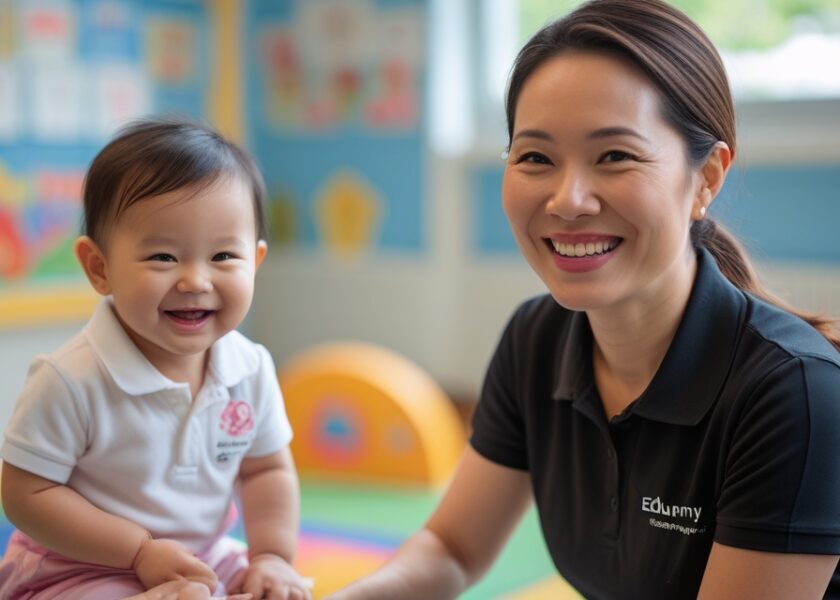
Our caregivers are trained, not just experienced. They understand infant development, responsive caregiving, the importance of language exposure, the role of safe exploration in building confident children. They do not simply watch children. They observe them, engage them, support their growth with intentionality.
Home-based care means our caregivers come to you, into the environment where your children are most comfortable, where the routines of your household already exist. For a child, especially an infant, home is their safe base. Having care come to them rather than being transported somewhere else reduces stress and supports attachment security. For your family, it means you are not adding another drop-off to your morning — the care arrives in your space and integrates with the rhythms you have already established.
Small ratios matter. Up to three infants per caregiver in home-based settings means that your child is not one of twelve in a room. They are seen. They are known. Their individual rhythms, their emerging personalities, their small triumphs and big feelings — these are noticed because there is space to notice them.
Transparency is not optional. Where our CCTV measures are deployed, families have access, because we believe that trust is built through openness, not through promises alone. You should know what your child’s day looks like. You should be able to see the moments you are missing. You should never wonder whether the care you have chosen is the care your child is receiving.
Accessibility matters. Our pilot fee structures are designed with affordability in mind, because quality care should not be a privilege for the wealthy. We work with CDA and Baby Bonus, because these are resources the government has made available precisely to support families in giving their children strong starts, and we want every eligible dollar to flow toward the care we provide.
Monday to Friday care blocks are designed around working parents’ actual schedules, because childcare that does not fit your life is not childcare you can actually use.
Support Beyond Direct Care
Beyond the care itself, we have built tools because we understand that modern parenting requires modern support.
Our Thomas AI Chatbot is available to help families navigate the questions that arise between visits: developmental milestones, sleep challenges, feeding concerns, the thousand small uncertainties that parents face and often have nowhere to turn for quick, reliable answers. Thomas is not a replacement for professional medical advice, but he is a first resource, trained on evidence-based early childhood information, available whenever you need him.
Questions to Ask When Choosing Infant Care
If you are beginning to think about professional childcare for your family, here are some questions worth asking:
- How does this care integrate with my existing support system? A good provider should strengthen your village, not replace it.
- What training do the caregivers have? Experience matters, but understanding infant development matters more.
- What is the caregiver-to-child ratio? For infants, smaller numbers mean more attention.
- How will you create consistency with our family’s approach? Ask how they handle feeding, sleep, and discipline in ways that align with your values.
- Can I see what my child’s day actually looks like? Transparency is not optional when you are trusting someone with your child.
- How do you communicate with families? Ongoing, clear communication should be built into the service.
- How do you handle it when our approaches differ? This tells you whether they see themselves as part of your team or as an independent operation.
When you choose professional childcare that works with your family rather than against it, something shifts that extends far beyond the daily logistics.
Your parents get to be grandparents again. They get to show up for visits and play, to be the people your children run to with joy rather than the people responsible for managing the difficult moments alone. Grandparent relationships deepen when they are not carrying the weight of daily care.
Your children get a richer environment — multiple caring adults who are aligned, consistent, and bringing different strengths to their development. They learn that families can be structured in many ways, that asking for help is a strength, and that love can come from many directions.
And you get something equally important: sustainable parenting. The kind where you are not running on empty, where the exhaustion is shared, where you have the capacity to be present for your children rather than depleted by them.
The smartest families in Singapore are not the ones who do it alone. They are the ones who design their childcare architecture with intention.
You Are Allowed to Build This
Here is what I want you to take away.
You are not choosing between your village and professional care. You are not disrespecting your parents by wanting more than they alone can provide. You are not failing at parenthood because your family is willing and you still need help.
You are doing exactly what good parents have always done: building the village your children need, which sometimes means asking the village to grow.
And you are not alone in building it.
If you are standing in that space I described — in the quiet hours, asking whether you are allowed to want what you want for your children — I want you to know: you are. You are allowed to want structure and developmental intentionality. You are allowed to want respite for your parents and consistency for your children. You are allowed to build a childcare team that reflects your family’s actual complexity.
EduNanny is here. We are part of your village now, and we take that role seriously. Not just in the care we provide, but in the way we show up: with respect for your elders, with clarity about our role, with commitment to the children entrusted to us, with the ongoing willingness to communicate, adapt, and grow alongside your family as your needs evolve.
Your children deserve a rich, consistent, caring environment. Your parents deserve to be grandparents, not martyrs. And you deserve to raise your children with confidence, clarity, and the support that makes sustainable parenting possible.
That village is not a dream. It is right here, waiting. And we would be honored to help you build it.
Ready to explore how EduNanny can strengthen your family’s childcare team? Reach out to learn more about our home-based infant care and childminding services in Singapore. We work with families across all arrangements — whether grandparents are your primary support, you have a helper, or you are navigating something more complex. Every village looks different. We will help you build yours.
#SingaporeChildcare #InfantCareSingapore #ChildmindingSingapore #EduNannySG #MultigenerationalParenting