The Quiet Signs That Reveal a Truly Great Childcare Centre
Reading the Environment: What the Space Tells You
Begin before the door opens. Stand in the corridor and listen. What do you hear? Not the absence of noise, but the quality of it.
A well-designed early childhood environment manages sound deliberately. High ceilings, soft furnishings, materials that absorb rather than amplify. You should be able to hear children, but not be overwhelmed by them.
If you step into a room that feels loud and chaotic, that is one kind of information. If you step into a room so quiet you wonder where the children are, that is another kind. In Singapore’s humid climate, where childcare centres run air-conditioning throughout the day, the acoustic environment can shift dramatically. Your nervous system will register the difference even before your mind does.
Now cross the threshold. Look at eye level first. Not the display boards with photographs of activities, not the artwork on the walls. Look at what a two-year-old sees when they walk through this space.
Is there anything at their height? Interactive textures, mirrors, faces of other children? Or is everything arranged for adults to appreciate from standing height? This is about whether the people who designed this space thought about who actually lives here.
Notice the temperature. Not just whether it is comfortable for you, but whether it seems designed for children’s comfort. Young children cannot advocate for a warmer room. They cannot take off a layer when they are too hot or ask for a blanket when they are cold.
Watch how the adults in the room are dressed. If they are in cardigans and the children are in short sleeves, someone is paying attention to the wrong body. This is sensory literacy. It is simply noticing what the environment feels like for someone who cannot yet verbalize what they need.
What Experienced Observers Notice
- The quality of sound before you enter — whether it feels managed for children, not just for adults
- Eye level at a child’s height — whether the space acknowledges who actually lives there
- Temperature and clothing choices — whose comfort the room is designed for
- The quiet moments between caregiver interactions — these reveal attunement better than the obvious ones
- How transitions happen — rushed or gradual, managed or respected
- Free play — protected time or a gap in the schedule
- Children’s faces — not happiness, but the quality of engagement
- What staff say to each other when they think no parent is listening
None of this requires expertise. It requires only willingness to notice.
Reading the Caregivers: Beyond Warmth to Attunement
Now look at the caregivers. Not for warmth, though warmth matters. Look for something more specific: attunement.
Watch how a caregiver responds to a child. Not the obvious moments, when a child is distressed or asking for something. Look for the small, quiet moments in between.
- The caregiver who notices a child glancing toward the window and quietly moves them closer to the light.
- The teacher who hands a tissue before the child reaches for their nose.
- The way a caregiver’s body positions itself when a toddler is reaching for something, leaning in just slightly, not to take over but to be ready.
These are the moments that reveal attunement. Not every child is crying and needs help. But every child is constantly communicating, and the attuned caregiver is reading that communication all the time, not just when it becomes loud enough to demand attention.
With Infants, You Can Only Watch
When you observe caregivers with infants, pay particular attention. With verbal children, you can ask questions. With infants, you can only watch.
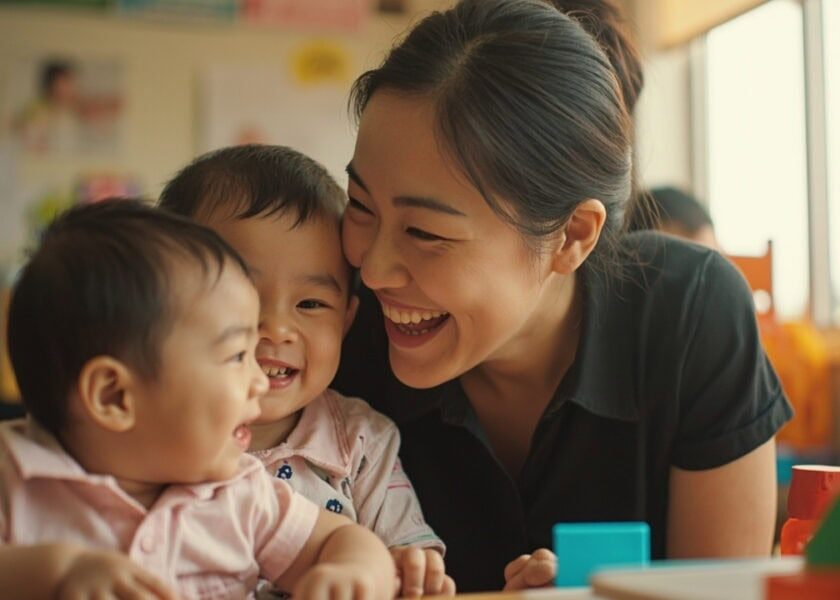
How does the caregiver hold a baby? Not just safely, but comfortably, in a way that suggests they have thought about how this position feels. When the infant makes a sound, does the caregiver pause, even briefly, and respond as if what the infant said mattered? Is there a sense of conversation, even without words?
The way an attuned caregiver speaks to an infant is different from the way they speak to a toddler or a group of children. Listen for that difference. Listen for whether the caregiver is reflecting the infant’s experience back, narrating what the infant might be feeling, using words that acknowledge that this small person has an inner life worth recognizing.
What Staff Say When No Parent Is Listening
Notice something else. When you are not directly speaking to a caregiver, watch how they speak to each other. Listen to whether the language they use about children, when they think no parent is listening, is respectful and specific.
Do they refer to children by name, with reference to their particular needs, their particular rhythms? Or do they speak in generalities, about the group, about routines, about schedules? The language adults use when they are not performing for parents tells you something real about what they actually believe about the children in their care.
Reading the Program: Rhythm, Transitions, and Intentionality
Consider the rhythm of the day. Not the schedule itself, which will be explained to you on paper, but what the actual day feels like when you are inside it.
Is there time? Is there a sense that children are allowed to linger, to finish what they are doing, to move slowly through transitions? Or does everything feel hurried, as if the children are being managed toward the next activity?
Transitions: The Most Revealing Moments
Watch the transitions. These are the most revealing moments in any early childhood setting. When children move from free play to circle time, or from one room to another, or from activity to snack, you will see the philosophy of the program made visible.
- Does the transition feel calm, with adults who seem unhurried even when they are moving things along?
- Or do you see children being redirected with some urgency, gathered quickly, managed with efficiency?
A program that values children’s need for gradual transitions will build time for them. A program that values efficiency will cut them short, and you will see the effects in children’s behaviour.
Free Play: The Counterintuitive Importance
Look for unscheduled time. This is perhaps the most counterintuitive thing to notice, but it matters enormously.
When you visit, there may be an activity underway. That is expected. But notice whether there are moments when children have nothing specifically directed at them, when they are simply in the room with materials available and adults nearby but not organizing anything.
Free play is not a gap in the schedule. It is not something that happens when there is nothing better to do. It is, in many ways, the most important part of the day. A program that respects children’s development will protect this time. A program that is performing activity for parents may fill every moment.
What Children Show You During Free Play
When you see free play, watch what children do. This is your most honest data source, and it requires no interpretation skills at all.
Do children seem absorbed in what they are doing? Do they move with ease? When a conflict arises, as it will, how does the room respond? Do caregivers step in with a sense of genuine care and problem-solving, or do they manage with a quick fix that silences the situation but does not resolve it?
The way a room handles conflict tells you everything about what the adults believe about children’s needs.
The Faces: Not Happiness, But Engagement
Now notice the faces. Not just whether children seem happy — happiness is complicated, and a childcare centre is not a theme park. Look for something more specific: the quality of engagement.
- Are children’s faces open and present?
- Do they make eye contact with each other and with adults?
- Do their expressions shift and respond to what is happening around them, or do they seem flat, withdrawn, or overstimulated?
There is a quality of ease that you can recognize. It is not the absence of all negative emotion. Children get frustrated. Children have difficult moments. But there is a baseline of comfort and safety that you can feel when you are in a room where children are genuinely all right.
Look at the adults’ faces too. Watch whether caregivers look tired in a way that suggests depletion, or whether they look engaged and present, even if they are tired. Watch whether they seem to be enjoying themselves. This matters more than it might seem. When adults are genuinely engaged, children feel it. When adults are merely enduring, children feel that too.
What You Will Discover at EduNanny
When you visit EduNanny by BUTLER, you will notice something different. Staff are not surprised when you ask questions. They do not seem unsettled by observation. They move through their day with a confidence that suggests they have nothing to hide and everything to share.
This is not accidental. EduNanny was built on a simple belief: that parents deserve to see exactly what is happening, not a curated version of it. When you visit, you are not a visitor being managed. You are a parent looking for something you will recognize when you find it.
Built for Singapore Families
We know what Singapore parents are navigating. The pressure of work demands that do not pause for childcare decisions. The financial weight of raising children in one of the world’s most expensive cities. The well-meaning advice from everyone who has an opinion about what you should do. The guilt that somehow surfaces no matter what you choose. And beneath all of it, the genuine, urgent desire to get this right, because the stakes feel impossibly high.
EduNanny is part of the ECDA Childminding Pilot, which means our practices have been developed with Singapore’s own quality standards in mind, and our fees are structured to be genuinely affordable for Singapore families.
Whether you choose our home-based pathway or our community and centre-based options, you will find ratios that allow for the kind of individual attention children deserve. For infants, that can mean a ratio of up to one caregiver to three children, an intimacy that larger settings simply cannot offer.
Our care runs Monday through Friday, in blocks that work with real family schedules. We have designed our payment structures so that you can use your Child Development Account and Baby Bonus, because financial logistics should not add unnecessary stress to an already demanding decision.
Transparency as Practice
We communicate openly. We share what is happening in your child’s day, not just when something goes wrong. We have implemented transparency measures, including communication tools and CCTV where appropriate, not because we are required to, but because we believe you deserve to know what your child’s day looks like even when you are not there to see it.
Ask yourself what feels arranged for your benefit versus what feels natural to the room. Is there evidence of children’s work everywhere, including the messy and imperfect kinds, or only the finished products? When you speak to staff, do they seem comfortable with silence, or do they rush to fill any pause with reassurance?
Comfort with silence is a sign of confidence. Rushing to reassure can sometimes indicate that the centre is more concerned with how they appear than with what is actually happening.
For Parents Choosing Infant Care
Choosing care for an infant is different from choosing care for an older child. Your baby cannot tell you if they were held enough, if their cries were answered, if the room felt safe. You are making this decision with incomplete information, and that is genuinely hard.
Here is what matters most for infant care:
- Responsive caregiving: Watch for caregivers who respond to infant cues before they become cries.
- Consistent relationships: Ask about caregiver turnover and whether your child will have primary caregivers or rotate through many faces.
- Communication from day one: How will you know what happened during the day? For infants, this is even more important because your child cannot tell you themselves.
- Respect for the whole child: Is feeding, sleeping, and comfort approached with flexibility and attention to your child’s individual rhythms?
You deserve to feel confident in your choice, not just on the day you enroll, but every morning when you hand your child over. The right place will not erase the difficulty of separation, but it will give you something to lean against. You will leave your child feeling not anxious but simply parting, with the quiet knowledge that they are in a place that sees them.
Come and See for Yourself
If you are beginning your search, or if you have been searching for a while and still have not found the feeling you are looking for, we invite you to visit EduNanny. Not with a checklist. Not with a set of questions you feel obligated to ask. Just with your attention and your instincts and your willingness to notice what this place is telling you.
We believe you will recognize something here. And we believe that recognition will stay with you, not just on the day you enroll your child, but every morning when you hand them over and every afternoon when you pick them up.
Visiting a childcare centre is not a test you can pass or fail. It is a conversation happening in a language you already know, in signs and sounds and moments that do not require expertise to read. You have always known what children need. You have simply never been asked to notice it in this particular way before.
What to Notice During Your Next Visit
| What to Observe | What You Are Really Looking For |
|---|---|
| Sound quality in the room | Whether the space was designed with children’s nervous systems in mind |
| Eye level at child height | Whether children are the intended occupants of this space |
| Temperature and clothing | Whose comfort the environment prioritizes |
| Caregiver responses in quiet moments | Whether attunement is present when no one is watching |
| How staff speak to each other | What they actually believe about the children in their care |
| Transitions between activities | Whether children are managed or respected |
| Free play time | Whether it is protected or treated as a gap |
| Children’s faces | The quality of engagement, not just happiness |
| Staff faces | Presence versus depletion |
| Communication culture | Whether you are a partner or a customer |
This guide is meant to support your judgment, not replace it. Trust what you notice. You know more than you realize.
The feeling of being in the right place. The feeling of trust that does not require constant verification. The feeling of partnership that makes the hard parts of parenting a little lighter.
EduNanny by BUTLER is here because children deserve this. Because parents deserve this. Because Singapore families deserve a childminding option that takes their concerns seriously and earns their trust through what it does, not just what it says.
Come and see. We are ready to show you.
At EduNanny, we believe the right childcare relationship begins with trust — and trust begins with seeing. Learn more about EduNanny or get in touch to arrange a visit. You can also read more about us and our commitment to thoughtful, development-oriented care for Singapore families.