Why Consistent Care Matters for Your Baby’s Developing Brain
The Science of Secure Attachment
In the first years of life, a child’s brain builds itself at a speed it will never match again. Neurons form connections at a rate of more than one million per second. The architecture being constructed in those early years — the architecture of a human being’s emotional foundation — is not metaphor. It is biology.
And at the center of that biological construction is one organizing principle above all others: the secure attachment bond.
This is not a trend, a philosophy, or a pedagogical approach. This is twenty-first century neuroscience and decades of developmental psychology converging on the same truth: a child who has at least one consistent, emotionally available caregiver — one who responds to their needs reliably, who is familiar enough to be predictable, who becomes, in the language of attachment theory, a secure base — is building something extraordinary in their brain.
They are building the capacity to regulate their own emotions. They are building the neurological architecture for trust. They are building the foundation for every relationship they will ever have.
The Truth About Multiple Attachments
Here is the part that matters most for parents who choose professional care, and it is the part that too few people take the time to explain properly.
The secure attachment bond does not have a single slot. It is not a limited resource that gets divided up between the people who love your child. The research — and this is critical, because I know how much parents need this to be true — is very clear: young children are capable of forming multiple healthy, secure attachments.
What they need is not one person and one person only. What they need is consistency. Predictability. Familiarity. The ability to know, in their bones, that the person caring for them understands their cues, anticipates their needs, and is emotionally present.
This is why caregiver continuity becomes not a nice-to-have, not a premium feature, not a checkbox on a list of childcare benefits. It becomes the single most developmentally significant thing that quality care can provide.
How Familiarity Changes Your Child’s Brain
When an infant is cared for by the same familiar face day after day, something measurable happens in their brain. The stress response system calibrates differently. Cortisol patterns stabilize. The amygdala — the brain’s alarm center — does not have to constantly re-evaluate whether this new person is safe.
The child’s nervous system can relax into exploration and learning because it is not perpetually occupied with threat assessment. This is not a small thing. This is the difference between a brain that can grow and a brain that is simply managing uncertainty.
In a brain that is still forming its most fundamental pathways, the presence of a known, trusted caregiver changes the actual neurochemical environment. Oxytocin flows. The brain’s reward systems engage. The child is not merely being supervised. The child is being known.
What Happens Without Continuity
Research shows that the effects of caregiver turnover compound over time. Each transition requires a child to essentially start over — to read new faces, learn new routines, recalibrate their sense of what is safe.
This is not merely unsettling in the way that change is unsettling for adults. For an infant whose entire model of the world is being formed, this is a repeated disruption of the most foundational learning there is: other people are reliable. The world is predictable. I am held.
What Secure Attachment Looks Like in Professional Care
For parents, the signs of healthy attachment in professional care are observable — and knowing what to look for can transform anxiety into assurance.
When you arrive to pick up your child:
- Your child may show a moment of hesitation — this is entirely normal. It is not distress. It is the brief recalibration of a child who has been content, who has been genuinely engaged, and who is simply adjusting from one trusted relationship back to another.
When you speak with your child’s caregiver:
- They speak about your child with specificity — with details, with observations, with the kind of knowledge that only comes from sustained, attentive presence.
- They know that this particular child stretches their arms a certain way when they are ready to be lifted, that this child settles more quickly when they hear a specific tone of voice.
When you observe your child:
- Your child is not merely physically safe in care but is visibly curious, socially comfortable, emotionally regulated in ways that reflect a growing confidence in the world.
These are the markers of what secure attachment looks like when it is happening in professional care. And they are only possible when continuity is prioritized at every level of how a service is designed.
Why You Don’t Need to Fear Professional Care
Let me be direct, because I know how important honesty is when you are making a decision about your child’s earliest years.
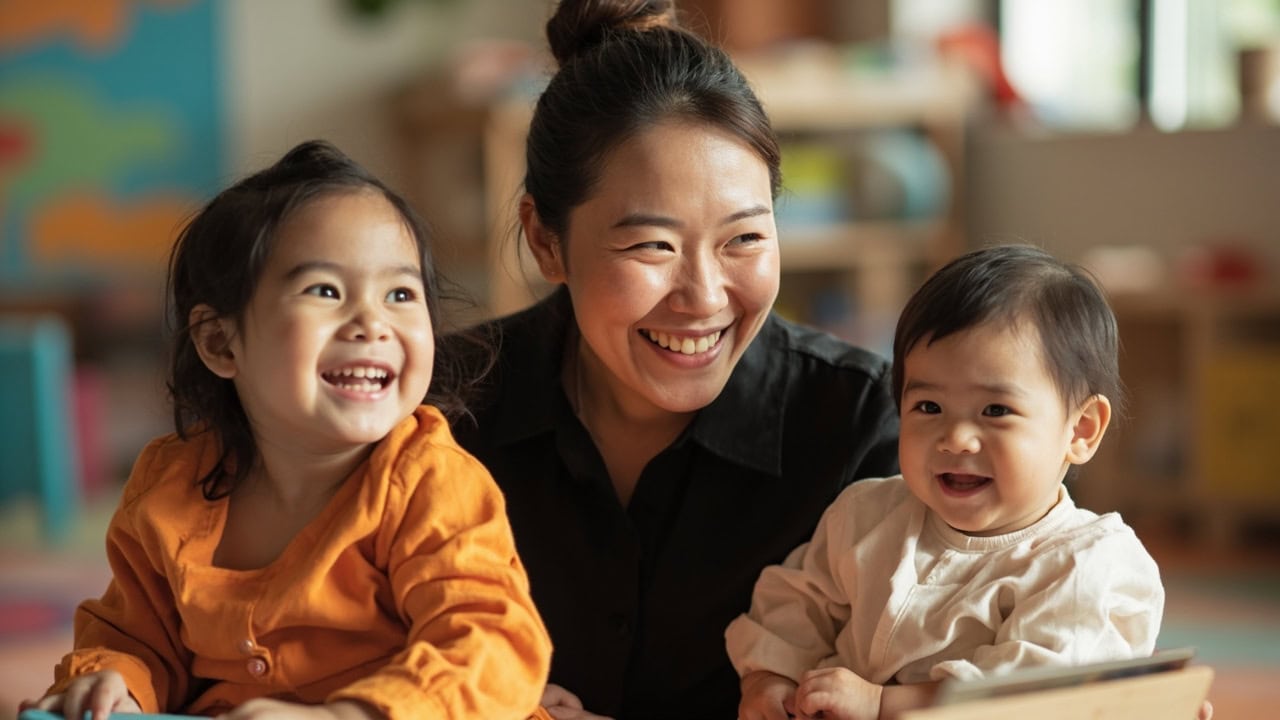
Professional care does not replace the irreplaceable bond between parent and child. Nothing does. That bond is formed in the intimacy of your home, in the particular language of your family, in the ten thousand small interactions that no caregiver can or should replicate.
What the science firmly supports is this: a secure, consistent relationship with a professional caregiver does not erode that bond. It complements it. It frees it.
When your child knows that they are safe and known in their care setting, they bring that security back to you. They are not divided. They are not confused. They are enriched by an additional relationship that reinforces the same message: you are valued, you are held, the world is trustworthy.
This is one of the most beautiful paradoxes of secure attachment in professional care: the child who has a genuinely secure secondary attachment often shows more security in the primary attachment, not less. Because the emotional regulation skills that develop in a consistent caregiving relationship generalize. Because a child who has learned to trust one person deeply is a child who is learning to trust.
If you are carrying that quiet morning question — will this change what we have? — I want you to set it down, at least for a moment. The science is on your side. A child can carry more than one secure bond, and when those bonds are built on consistency, attentiveness, and genuine human presence, they do not compete. They cooperate. They strengthen each other.
The EduNanny Model: Why Continuity Is Structural
EduNanny operates within the ECDA Childminding Pilot, and that is not simply a regulatory designation. It is a framework that reflects a genuine commitment to what developmental science has shown us about how young children thrive.
In this model, caregiver continuity is not aspirational. It is structural.
- Ratios that allow for genuine attentiveness — up to one to three infants in care — so every child has the opportunity to develop a true relationship with their caregiver. Not a passing acquaintance. Not a series of introductions. A relationship.
- Monday through Friday care blocks, designed for the realities of working parents across Singapore.
- Fees structured within the pilot framework to be accessible, with payment pathways that include CDA and Baby Bonus, because the last thing parents need is administrative complexity layered on top of an already demanding season of life.
At every level, the design reflects an understanding that what a child needs most is not novelty. It is presence. It is familiarity. It is the person who was there yesterday and will be there tomorrow, building, day by day, a bond that becomes the bedrock of how your child understands the world.
Caregivers Who Are Not Interchangeable
The caregivers in the EduNanny model are not interchangeable. They are not staff. They are not service providers in the transactional sense of that word. They are the people who are present during some of the most formative hours of a child’s life. They are doing work that is, in every meaningful sense, foundational.
When we talk about caregiver continuity, we are not only talking about what it does for children. We are talking about a professional model that values the caregiver as a person, invests in them as a practitioner, and creates the conditions for them to do their work with depth and with genuine connection.
You cannot build a secure attachment on a foundation of transience. You cannot ask a caregiver to know a child deeply if they themselves are treated as disposable.
Questions Worth Asking Before You Choose
For Singapore parents navigating a landscape of childcare options, caregiver continuity is not a luxury. It is a practical tool for evaluation.
When you are choosing a care arrangement, the questions worth asking are not just about curriculum, facilities, or cost — though those matter. The question that developmental science tells us matters most is:
- Will my child have the same caregiver?
- Will this person know my child in six months? In a year?
- Will the relationship deepen over time, or will it be constantly interrupted and restarted?
- Can the caregiver tell me something specific and personal about my child?
- How does this service handle caregiver absences or turnover?
- What is the ratio of caregivers to infants?
| What to Look For | Why It Matters |
|---|---|
| Same caregiver daily | Builds familiarity and trust |
| Low infant-to-caregiver ratio | Enables genuine attentiveness |
| Caregiver knowledge of your child | Signs of real relationship |
| Consistent routines | Reduces stress, builds security |
| Transparent operations | Builds parental confidence |
A Promise to Every Family
EduNanny exists because we believe that the science of attachment is not just something to be studied. It is something to be lived — built into the daily, ordinary, extraordinary architecture of how we care for the youngest people in our community.
And it is here because Singapore parents deserve a model that takes the development of their child’s brain as seriously as they do.
That is why EduNanny exists. That is why we do this work. And that is the promise we make to every family who trusts us — not just that your child will be cared for, but that your child will be known.
Day after day. With the same patient, attentive, irreplaceable presence.
Because that is where everything begins.
Ready to learn more about infant care designed around what your child actually needs?
Explore the EduNanny programme or speak with our team to understand how caregiver continuity can support your child’s earliest and most important relationships.
Learn more about who we are and the values behind the EduNanny approach to childcare in Singapore.