How Shared Childcare Quietly Builds Your Children’s Lifelong Sibling Bond
The Quiet Truth About Siblings, Shared Care, and the Choices That Shape a Lifelong Bond
There is a moment—quiet, easily missed—that happens in the weeks after a second child arrives. An older sibling, still adjusting to the profound rearrangement of attention and routine, will sometimes crawl into the crib beside their new brother or sister. Not to play. Not yet, not really. Just to be near. To press a small palm against a smaller arm and sit with that new presence in the world.
No one taught that child to do this. No one had to. The pull toward a sibling begins before parents have even finished navigating the logistics of two children. It begins in the earliest days of shared life.
This is the truth at the heart of everything I want to share with you today: sibling bonds are not formed in the moments we deliberately cultivate them—the planned sibling dates, the shared birthday parties, the gentle negotiations over the last durian puff. They are formed in the accumulated quiet of early life, in the thousand small experiences children share before they have language to name what they share.
And for Singapore parents making childcare decisions today, this is not a small matter. It is, arguably, the most consequential dimension of those decisions—because it shapes something your children will carry for the longest journey of their lives.
What This Means for Your Family:
- The arrangements you make send messages into the future about who your children are to each other.
- Shared experience builds shared memory that becomes part of their lifelong relationship.
- Separate arrangements require more effort, not more love—deliberate family rituals can bridge the gap.
- The sibling bond is resilient; what children need is not identical experience, but mutual recognition.
- You have more power here than you sometimes feel.
The Architecture of a Lifelong Relationship
When a family has one child, the childcare question is already complex. But when a family has two children—three, in some cases—it transforms into something else entirely. It becomes a question about the architecture of your children’s relationship with each other.
Every choice you make about who cares for your children, where they are cared for, and how those arrangements unfold across the years sends a message into the future about who your children are to each other.
Singapore parents often describe a particular anxiety when they sit with this question. They want each child to thrive individually—that desire is fierce and universal. But underneath it, often unspoken, is another longing that runs even deeper: they want their children to love each other. Not just to tolerate each other, not just to maintain polite family obligation, but to genuinely choose each other’s company across the decades.
They want the kind of sibling bond that becomes a cushion against the difficulties of adult life. A source of humor and memory and belonging that no one else in the world can quite replicate.
And these parents worry—quietly, sometimes guiltily—that the very decisions meant to serve one child’s development might inadvertently create distance between siblings. That separate childcare arrangements might mean separate lives. That one child’s experience of care might somehow not be shared, leaving them unable to fully understand each other’s childhood.
These are not irrational fears. They are the fears of parents who understand, instinctively, that siblings are not simply born—they are built, over years, through shared experience.
What Shared Care Actually Does
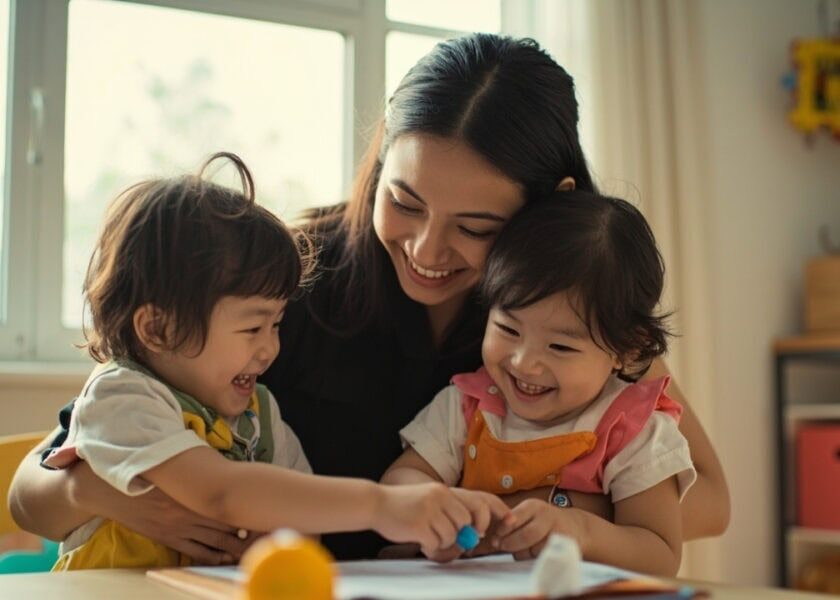
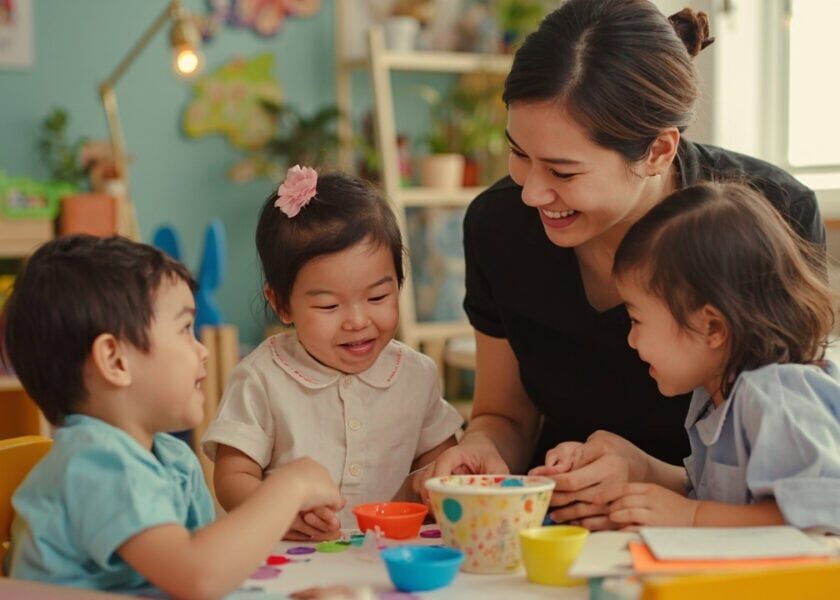
Consider what happens when two children are in childcare together. Not just in the same centre or home, but in a relationship with the same caregivers, the same daily rhythms, the same small songs and routines and discoveries.
They build what I think of as shared memory architecture—the invisible foundation of a sibling bond that will be called upon in adolescence, in adulthood, in middle age, when parents are aging and marriages are being navigated and children are being raised. That shared memory of who we were before we became who we are. That knowledge of each other’s earliest selves, held in the body as much as in the mind.
There is a particular kind of solidarity that develops between siblings who have been in care together. They have both known the experience of morning goodbye. They have both found comfort with the same familiar face when their parents were not yet home. They have both had the experience of being one among several children, learning to share attention and negotiate space and find their place in a peer group that was not chosen but was given.
When Children Are in Different Arrangements
Now consider what happens when siblings are in different arrangements—one in a centre, one with a domestic helper, one with grandparents, one with a childminder. Each child develops a different relationship with the concept of being cared for outside the home. Each has a different vocabulary for the people who looked after them.
Their childhoods, while overlapping, become subtly parallel rather than shared.
This is not necessarily harmful. Many children raised in entirely different circumstances grow to be deeply close siblings. But it requires more deliberate effort from parents to create the threads that might otherwise form naturally through shared experience. And in the busy, demanding reality of raising multiple children in Singapore, that deliberate effort is not always easy to sustain.
When Only One Child Is in Care
There is another dimension that deserves attention. When only one child is in childcare—perhaps because a second child arrived and a different arrangement was made, or because one child is older and has moved on while a younger one is still in care—the child who remains can sometimes feel a strange displacement.
They are still where their sibling used to be, but their sibling is no longer there. The shared experience has ended, and ended unevenly.
The sibling bond is more resilient than this. It is also more creative. What children need from their siblings is not identical experience—it is mutual recognition. The question is not whether your children shared exactly the same childcare arrangement. The question is whether they have enough shared context to understand each other, enough shared memory to feel like they came from the same childhood.
And this can be built in many ways: through family rituals, through regular time together, through the stories parents tell about the children’s early years, through deliberate efforts to create sibling identity even when care arrangements differ. The childcare arrangement matters, but it is not the only architecture.
What Childcare Teaches About Being With Others
There is another dimension to this that I find is often underappreciated in how we talk about childcare decisions. When children are in care, they are learning something profound: how to be part of a group of peers outside their family.
This is different from being a sibling. Sibling relationships are shaped by biology, by shared household, by the accident of birth order and the inevitability of sharing parents. Peer relationships in childcare are chosen, or at least entered into by circumstance, and they require a different set of skills: how to share attention, how to navigate conflict without a parent mediating, how to find your place in a small community, how to form attachments to people who are not your family.
These skills matter enormously for sibling relationships. Siblings who have both learned how to be part of a peer group—how to negotiate, how to accommodate, how to stand up for themselves, how to read social cues—bring those skills home to each other. They are better equipped to manage the inevitable frictions of sibling life because they have practice.
They have learned, in childcare, that relationships require effort and patience and sometimes compromise. And they have learned it together, as siblings, even if the learning happened in separate interactions with separate peers.
The sibling bond is strengthened, not weakened, when both children have rich peer experiences outside the family. What they learn about relating to others becomes part of what they bring to relating to each other.
The Caregiver as Model for Sibling Relationships
Children are watching. They are always watching, even when it seems they are not. They watch how the people who care for them speak to other children. They watch how their caregivers handle conflict, manage emotions, divide attention, respond to need. And what they watch becomes part of what they expect from all relationships.
When a caregiver consistently models warmth and fairness, when they respond to each child’s needs without obvious favouritism, when they help children navigate the inevitable competition for attention that arises in any group—children are internalising something. They are learning that relationships can be structured with care.
That attention does not have to be a zero-sum game. That it is possible to have your own needs met even when others are also present and also needing.
This is deeply relevant to siblings. The fear that many parents carry—that caring for one child well might somehow mean neglecting another—can be quietly resolved by what children observe in consistent, quality childcare. They see, with their own eyes, that a caregiver can hold multiple children’s needs at once. That one child’s turn does not mean another’s loss. That there is enough attention, enough care, enough responsiveness to go around.
And this becomes the template they carry into their sibling relationship. Not scarcity. Abundance. Not competition. Generosity.
Why Home-Based Care Offers Something Special
This is one of the gifts of home-based care, in particular—the intimacy of a smaller setting, where children can see their caregiver relate to each child individually, where the ratio allows for genuine one-to-one moments even in a group context. Where the rhythm of the day is flexible enough to accommodate the particular needs of a particular child without disrupting the whole.
Where siblings can experience being cared for together and separately, in the same place, by the same person, and understand that both are possible.
Transitions: When the Architecture Shifts
Parents often overlook transitions in the noise of childcare decision-making. The movement between care arrangements, the moments when one phase ends and another begins, the first days in a new place, the graduation from infant care to childcare, the move to a new caregiver—these are not just logistical events. They are psychological events, and they have real implications for sibling relationships.
When One Child Transitions and Another Does Not
When one child transitions and another does not, the sibling who remains can feel a complex mixture of emotions. Happiness for their brother or sister, certainly. But also something like vertigo—the world is changing, and they are still here, in the same place, watching from the window of an experience that has just shifted for someone they love.
The transition becomes, in some sense, a shared event, even for the child who did not move. The household feels different. The rhythm feels different. And the sibling who moved is now carrying an experience the other cannot access in the same way.
How Parents Can Respond
Parents who are attentive to this dynamic can use transitions as moments to strengthen rather than strain sibling bonds:
- A deliberate conversation before a transition
- An acknowledgment that change is hard, even when it is good
- A ritual that welcomes the transitioning child back into the family rhythm after their first days in a new place
- Something as simple as a small gift or a special meal to mark the occasion
These gestures communicate to both children that transitions are family events, not individual ones. That however the arrangements change, the family remains the same.
When Siblings Transition Together
When siblings are transitioning together—moving from one care arrangement to another—there is an opportunity here that should not be underestimated. Two children entering a new place, facing new faces, learning new routines, side by side.
This shared vulnerability, this mutual reliance on each other for reassurance and courage, builds a kind of sibling solidarity that becomes part of the foundation of their bond. They will remember this. They were there together when the world was new.
Practical Ways to Nurture Sibling Bonds Through Your Childcare Choices
Here are ways that parents can actively use their childcare choices—and the spaces around them—to nurture sibling bonds.
Look for Continuity
If your children can be in care together—sharing the same space, the same rhythms, the same consistent caregivers—understand what a gift you are giving them. Not just convenience, not just logistics. A shared foundation. A story they will tell each other in thirty years without quite realizing they are telling it. The child who grows up saying “remember when” and the other child knowing exactly what is being referenced.
Build Deliberate Bridges If Arrangements Differ
If your children are in different arrangements, create deliberate bridges. Family meals. Sibling rituals—a Sunday morning walk, a weekly movie night, a bedtime story that only happens when they are together. Shared experiences outside of care that can compensate for different experiences inside care.
Parents often underestimate how powerful these small, regular rituals can be. They are the mortar between the bricks of shared memory.
Help Them Compare Notes
Talk about their childcare lives to each other. Ask the child in one arrangement about their day, and then ask the child in another arrangement about theirs, and help them see the similarities. Ask questions that invite comparison—”Did anything funny happen today? What did you have for snack? Who did you play with?”—and let them discover, over time, that they are part of a shared culture of childhood even if the specifics differ.
Make Transitions Family Events
When transitions happen, mark the changes. Celebrate what is ending as well as what is beginning. Let both children feel that the family is moving through these transitions together, even if only one child is physically changing arrangements.
Trust the Bond to Do Its Work
Children are not passive recipients of whatever their childcare arrangements do to them. They are active agents in their own relationships. Siblings find ways to connect—through shared games, shared secrets, shared resistance to bedtime, shared jokes that no one else understands.
Trust that the bond is forming, even in the moments you cannot see it. Trust that the foundation you are laying through your choices, your attention, and your love is becoming something your children will carry forward into the longest relationship they will ever have.
What Quality Childminding Actually Looks Like
For families navigating childcare decisions across multiple children, the practical dimensions matter alongside the emotional ones. Here is what to look for when you are evaluating options, especially if sibling connection is part of what you are hoping to support.
Consistent Caregivers Who Build Relationships Over Time
Quality childminding is not just about supervision—it is about relationship. When the same caregiver cares for your children consistently over months and years, they become part of the architecture of your family. They learn the particular texture of each child’s needs. They become someone your children will reference in the stories they tell about their childhood. They become part of the shared memory that binds siblings together.
Small Ratios That Allow Genuine Connection
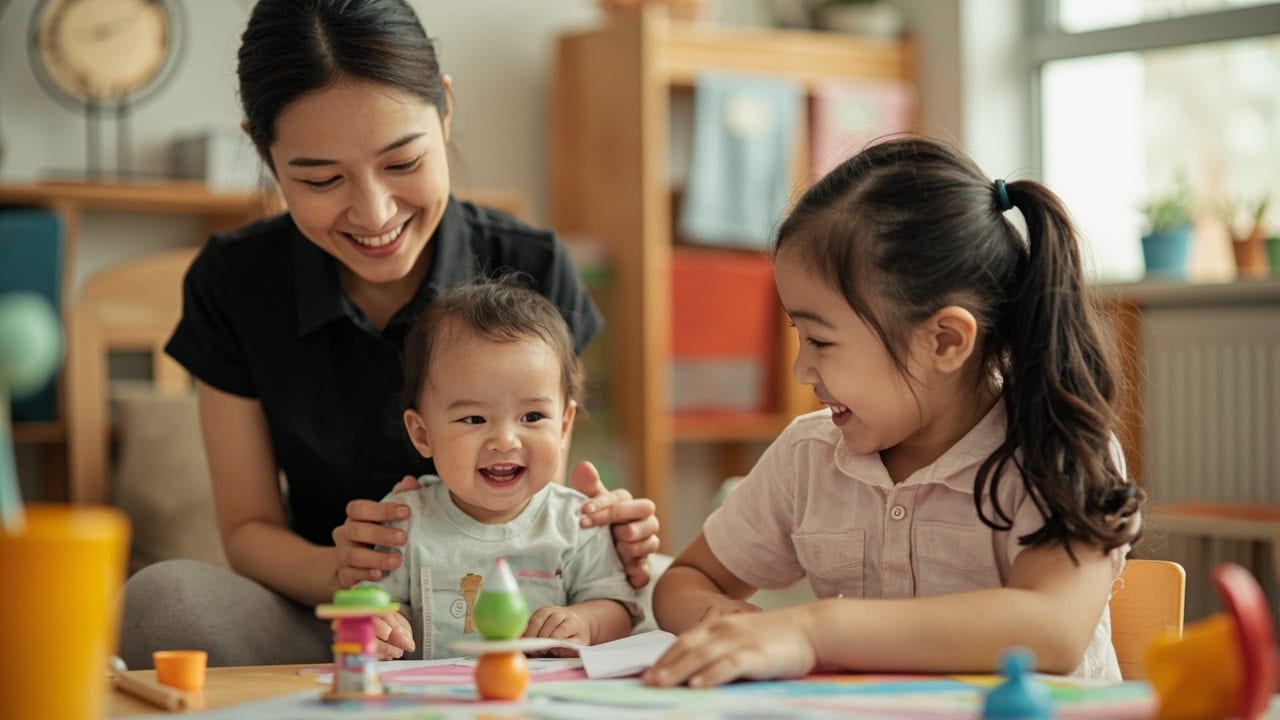
In infant care, a ratio of up to one caregiver to three infants allows for genuine attention rather than just management. Each child can be truly seen. In smaller, home-based settings, siblings can experience being cared for together and separately, in the same place, by the same person, and understand that both kinds of attention are possible and valuable.
Flexible Rhythms That Accommodate Individual Needs
Quality care adapts to the child, not the other way around. When the rhythm of the day is flexible enough to accommodate a particular child’s needs without disrupting the whole, siblings learn that their individual needs matter—and that the family system can hold them. They learn that attention is abundant, not scarce.
Transparent Communication
Parents need to know what is happening in the hours they are apart. Systems that allow trust to be maintained even when oversight is not physically present reduce parental anxiety and support the kind of confident, attentive parenting that sibling bonds need to flourish.
How EduNanny Approaches This Work
EduNanny understands this. Not just as a philosophy, but as a practice. The approach here is built around something that matters more than any individual feature or service detail: the understanding that childcare is not only about the child in front of you. It is about the family that child belongs to. The siblings they are growing up alongside. The relationship they are quietly, steadily building, whether we pay attention to it or not.
The EduNanny model, operating within the ECDA Childminding Pilot, offers pathways that make this kind of attention possible:
- Home-based care, where the ratio of caregivers to infants allows for genuine connection—up to one to three in infant care settings, a ratio that means each child can be truly seen, not just managed
- Consistent caregivers who build relationships with families over time, who learn the particular texture of each child’s needs, who become part of the architecture of the sibling bond whether they know it or not
- Transparent communication so parents know what is happening in the hours they are apart, with systems in place that allow trust to be maintained even when oversight is not physically present
For families navigating childcare decisions across multiple children—children at different stages, with different temperaments, with different needs—the practical dimensions matter. The pilot fee structures are designed to be affordable. CDA and Baby Bonus funds can be used, reducing the financial weight of decisions that carry emotional weight. Monday to Friday care blocks that align with the rhythms of working family life in Singapore.
These are not small things. They are the conditions that allow parents to make the choices they want to make, not just the choices they can afford to make.
And for families across Singapore, from HDB flats to landed homes, from first-time parents to those adding a third child to their family, the relevance is the same. The sibling bond does not care about your housing type or your income bracket or your postcode. It is forming anyway, every day, in the decisions you make about who holds your children when you cannot.
The Long View: What Your Children Will Carry Forward
There is a version of this conversation that could focus entirely on the childcare years—the anxieties, the logistics, the developmental milestones, the endless negotiations about schedules and transitions and who is picking up whom. And those things matter. They matter enormously, in the moment, in the daily texture of family life.
But I want to end by naming something that is easy to forget when you are in the thick of it. The childcare years end. The decisions you make now will become memories, and those memories will become the shared language of your children’s relationship.
The morning goodbye they both learned to navigate. The caregiver who knew them both by name. The transition they weathered together or the separate paths they took and then found their way back from. The way their childhoods intersected and diverged and intersected again.
Your children will be siblings for the rest of their lives. Not just when they are young, not just when they live under the same roof, but when they are forty and sixty and eighty. The bond you are building now, through the architecture of your choices, will be the foundation they stand on when they need each other most.
When parents are gone. When spouses are doing their best. When the world is complicated. When they need someone who knew them before they had language to describe themselves. Someone who was there. Someone who remembers.
If you are a parent in Singapore navigating childcare decisions for multiple children—if you are weighing the logistics of two or three or four children’s arrangements, if you are wondering how to support the bond between your children even as you manage the practical demands of working family life—I want you to know that you are not just making logistical decisions. You are building something that will last.
The architecture of sibling love is built over years. It is built in shared mornings and separate afternoons. In different transitions and the same family dinner. In the way parents pay attention to both children at once, making it look easy when it is actually an act of sustained will. In the way caregivers hold space for multiple children with patience and warmth. In the stories families tell about who their children were before they became who they are.
This is what EduNanny is here to support. Not just infant care, not just childminding, not just a service that fills a practical gap. But the quiet, important work of building the conditions for a lifelong bond. Of holding space for siblings to grow up together, in care, in trust, in the shared memory of being young and together and known.
The sibling bond is the longest relationship your children will ever have. And it begins, without fanfare, before you are even paying attention. In the hand pressed against the arm. In the small body curled beside a smaller one. In the wordless understanding that you are not alone. You have someone.
That is the architecture you are building. That is the architecture EduNanny is honoured to be part of.
And that is what I leave you with today: the long view, the love that lasts, and the quiet faith that the decisions you make with care will carry forward into a future you will not see but that your children will live.
Ready to explore childcare options that support your children’s bond? Speak with our team about how EduNanny’s home-based childminding approach can become part of your family’s architecture of sibling love.
Learn more about EduNanny’s approach to quality childcare or read about our story and values.