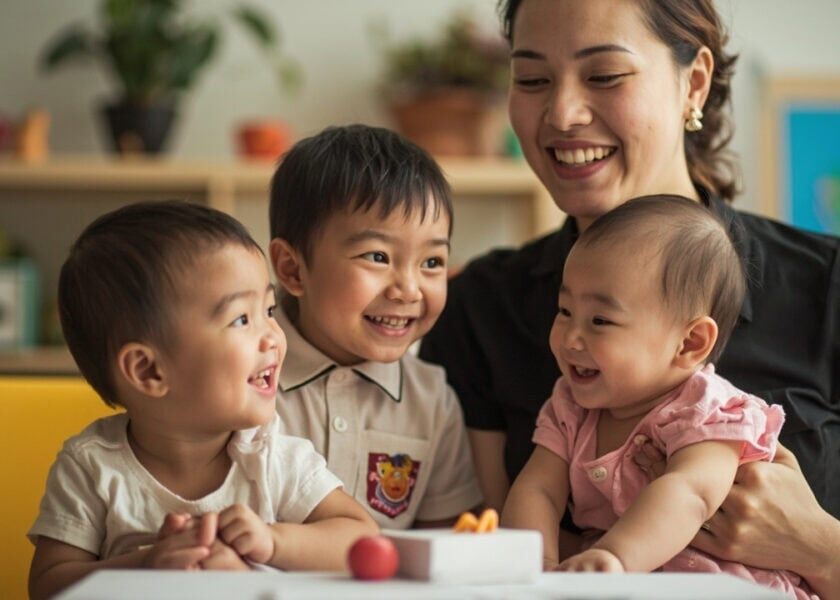
Why Consistency Transforms Your Child’s Early Years in Singapore
The Childcare Decision Every Singapore Parent Eventually Faces
There is a moment, familiar to almost every parent in Singapore, when the weight of a decision settles in — not because the options are few, but because they are many. You are sitting across from a friend at a café in Holland Village, or scrolling through your phone at eleven p.m. after the baby has finally fallen asleep, and someone asks you the question that sounds simple but feels impossible: what kind of childcare are you using?
And you realise, with a small twist of anxiety, that you do not know how to answer. Because the honest answer is not a name or a centre or a service. The honest answer is a question you have not yet resolved for yourself — what kind of childcare do I actually need, and how are these choices meaningfully different from one another?
You are not alone in this. Across Singapore, in HDB living rooms and condominiums in Districts 9 and 10, in the group chats that buzz with advice and warnings and recommendations, parents are navigating one of the most fragmented childcare landscapes in the region. They are not short on options. They are short on clarity.
This article is an attempt to offer what is genuinely missing in that conversation: not reassurance, though reassurance matters, but a map. A way of understanding the landscape that lets you see not just where you might place your child, but why each model of care is structured the way it is, what trade-offs each one carries, and what questions you should be asking before you commit to any of them.
Here is the essential picture to carry with you as you read: childcare is not a single category. It is a spectrum with meaningfully different models, and the differences matter — not just for your logistics, but for your child’s development and your family’s long-term peace of mind.
Understanding Singapore’s Childcare Landscape
Singapore’s childcare system, to a parent approaching it for the first time, can feel like a maze with too many entrances and no clear centre. There are traditional childcare centres, many of them large and institutional, with operating hours that accommodate working parents and ratios that meet regulatory minimums. There are infant care centres, a separate category with different licensing requirements and a different age band. There are babysitting services, ranging from apps that connect you with vetted freelancers to informal arrangements with someone a friend knows. There are live-in domestic workers who may or may not have training in early childhood development. There are nannies, au pairs, and the occasional grandparent — a whole ecosystem of care that has evolved organically because Singapore’s economy depends on working parents and has never fully solved the question of who cares for the children while the parents work.
What is striking is not that these options exist. Options are a sign of a functioning, diverse society. What is striking is how little guidance most parents receive in understanding what these options actually mean in practice. The differences are not trivial. They are not interchangeable. They represent fundamentally different philosophies of what childcare is and what children need.
The Three Models: Institutions, Arrangements, and Partners
A childcare centre is an institution. It has a licence, a physical space, a schedule, a curriculum, a director, and a staff structure where caregivers may rotate. Your child’s primary caregiver today may not be the same person who cared for them six months ago, and may not be the same person who cared for them yesterday. This is not a failure of quality. It is simply the nature of institutional care, where staffing changes, leave, and turnover are structural realities. The centre itself is consistent. The caregiver relationship is not.
Informal care is an arrangement. A babysitter, a neighbour, a relative who helps out — it may be warm, loving, and deeply trusted. It may also be intermittent, dependent on availability, and lacking in any formal accountability or developmental structure. There is nothing wrong with informal care in principle. Many children thrive in informal arrangements, and many families could not function without them. But informal care, by definition, does not offer the consistency, the continuity, or the professional investment that a developing child needs to form the kind of stable attachment that research consistently links to later emotional and cognitive outcomes.
A dedicated childcare partner is a different model entirely. Built around one fundamental premise: that your child deserves a consistent, invested caregiver who knows them, who understands their rhythms, their preferences, their emerging personality, and who develops that knowledge not as a job requirement but as a professional commitment to the family.
Why Singapore Families Are Rethinking Care
Singapore is a society that has always relied on informal care networks — on grandparents, on extended family, on community. Many Asian cultures have deep traditions of multi-generational caregiving, and these traditions carry genuine value. But they also carry assumptions that are increasingly difficult to sustain in the present:
- Grandparents who raised their own children decades ago may not have training in contemporary early childhood pedagogy
- They may not be physically suited for the demands of infant care
- They may not want to be — and that matters too
- The assumption that family will always be available, and that availability is the same as suitability, is one that more and more Singapore families are examining critically
At the same time, the institutional childcare model — with its long hours, its group settings, its institutional rhythms — does not fit every family’s philosophy, schedule, or preference. Many parents want their child cared for in a home environment with consistent, warm, individualised attention, but they cannot achieve this through informal arrangements because of reliability, training, or accountability concerns.
The dedicated childcare partner model emerged, in part, as a response to this genuine tension. It honours the value of relationship-based, home-based care while providing the professional structure, training, accountability, and consistency that families need.
Why Consistency Actually Matters — More Than the Brochures Suggest
When a child forms an attachment to a caregiver, that attachment is not sentimental. It is neurological. The quality of early attachments shapes the architecture of the developing brain, influencing not just emotional regulation in toddlerhood but cognitive flexibility, stress response systems, and the capacity for relationship throughout life.
But here is what the research also tells us, and what is rarely communicated to parents in practical terms: the attachment benefit requires consistency. A child does not form a secure attachment to an institution. They form it to a person. And that person must be present reliably, predictably, and over an extended period for the neurological pathways of trust and security to solidify.
When caregivers rotate in a centre setting — when a different face greets your child every Monday, or when the person who comforted them yesterday is on leave today — the child must repeatedly do the psychological work of re-engagement. They adapt, because children are resilient and adaptive. But adaptation is not the same as security. It is a survival response.
Consider what this looks like in practice. In a centre with twenty infants and a rotating team of caregivers, each caregiver may know the children in their care generally — the ones who need more sleep, the ones who are going through a fussy phase. But they may not know the specific way your child signals hunger, or that the slight change in appetite this week is because a sibling was born recently and the household is adjusting, or that the new song your child has been humming is from a video they watched yesterday with Dad.
This is not a criticism of centre caregivers, who are often dedicated and hardworking professionals. It is a structural observation. When you are responsible for many children, you know them in general. When you are responsible for three, you know them specifically.
What Good Care Looks Like Day to Day
In a dedicated partner model, the ratio of up to three infants per caregiver means that one caregiver is genuinely present to three children, not one among many in a room. The relationship is not incidental to the model. It is the model.
The caregiver knows that child’s favourite song. They know the specific way that child signals hunger or tiredness. They know when a developmental leap is beginning and can support it. This is not a sentimental version of care. It is a practical version of care that recognises that developmental support requires relationship, and relationship requires time, and time requires consistency.
The Real Cost of Childcare: Beyond the Monthly Fee
Every parent in Singapore is thinking about cost, and the conversation around childcare cost is full of half-truths and misdirection.
The direct monthly fee for a dedicated childcare partner model is often positioned as higher than a childcare centre. This is true if you look only at the headline number. What it obscures is what you are actually paying for, what you are getting, and what the hidden costs of other arrangements actually are.
What Centres Actually Cost
A traditional centre charges fees that appear more affordable on paper. But consider what is often excluded:
- Meals and snacks
- Diapers and basic supplies
- Enrolment or registration fees
- Activity charges for enrichment programmes
- Minimum commitment periods that lock you in even when circumstances change
And the reality that if your child’s primary caregiver leaves — as they frequently do in a high-turnover industry — your child must adjust to someone new, and so must you. The centre’s price is consistent. Its staff is not.
What Informal Care Actually Costs
Informal care often appears to be free, or nearly free, when the caregiver is a family member or a friend. But the costs are real even when they are not monetary:
- The unspoken debt that accumulates in family relationships
- The unreliability when someone is unavailable
- The absence of any accountability or recourse when things go wrong
- The quiet knowledge that the person caring for your child may have no formal training in early childhood development
What You Are Actually Paying For
A dedicated childcare partner model charges a fee that reflects an investment: in the caregiver’s training, in the continuity of the relationship, in the communication infrastructure that keeps parents informed, in the regulatory compliance that protects everyone.
When you pay that fee, you are not paying for a seat in a room. You are paying for a professional, consistent, invested relationship between a trained caregiver and your child.
Making Quality Care More Accessible
Singapore has developed mechanisms that make this investment more accessible than parents often realise:
- The Child Development Account, funded through the Baby Bonus scheme, can be used for approved care arrangements — not just centres
- The ECDA Childminding Pilot has created a pathway for home-based care arrangements that meet specific quality standards
- Fee structures vary, and the exact applicability depends on individual circumstances
The narrative that quality childcare is only for families with high disposable income is one that deserves to be questioned. The right model exists for more families than commonly assumed.
Communication and the Case for a Dedicated Partner Model
There is a question that sophisticated parents in Singapore are increasingly asking, and it is one that the broader childcare conversation rarely addresses: what is the role of communication in a childcare arrangement, and why does it matter more than we usually admit?
Most parents, when they evaluate a childcare option, focus on safety, cleanliness, and the general impression of the caregiver. These are reasonable starting points. But the parents who ultimately feel most confident in their arrangement — the ones who can leave for a workday without dreading the afternoon update call, who trust that if something important happens they will know about it, who feel like partners rather than customers — these parents have something else. They have a communication culture.
How Different Models Handle Communication
In a traditional centre, communication is often institutional. There are daily reports, sometimes app-based, sometimes written. There are parent-teacher meetings twice a year. There are newsletters. These mechanisms exist, and they serve a function. But they also reflect the reality that in an institutional setting, each child is one of many, and the capacity for personalised, responsive communication is structurally limited by the ratio of caregivers to children.
In an informal arrangement, communication depends entirely on the individual. There may be no systematic communication at all. Parents may not know what their child ate for lunch, or whether there was a developmental milestone reached that day, unless the caregiver happens to mention it.
In a dedicated partner model, when it is implemented thoughtfully, communication is built into the structure:
- Structured updates that parents can receive in real time
- Mechanisms for daily check-ins that go beyond perfunctory notes
- A culture where the caregiver understands they are keeping a family informed and involved
- Where transparency measures are in place, parents have a window into the daily life their child is living while they are apart
These are not features that compensate for poor care. They are features that reflect good care and make it visible.
Questions Every Parent Should Ask Before Choosing Childcare
Whether you are evaluating a centre, an informal arrangement, or a dedicated partner model, these are the questions that matter most:
On Consistency
- Who will be the primary caregiver for my child?
- How often does that person change?
- What happens when that person is on leave or leaves the organisation?
On Ratios
- How many children is each caregiver responsible for?
- Is this ratio consistent across the day, or does it change during certain periods?
On Training
- What preparation does the caregiver have for working with infants and toddlers?
- Is there ongoing professional development?
On Communication
- How will I know what happened during the day?
- What is the protocol for sharing developmental observations?
- How do I reach someone if I have a concern?
On Developmental Engagement
- What does a typical day look like for my child?
- Is the focus primarily on safety and routine, or is there active engagement with developmental milestones, play, language, and social learning?
On Philosophy
- Why does this arrangement exist?
- What does it believe about what children need?
These are not questions that childcare providers are always prepared to answer clearly. That is itself informative. The providers who can answer them specifically, who have clear structures and thoughtful responses, are the ones who have thought deeply about what they are actually offering — not just a service, but a model of care with an underlying understanding of child development.
EduNanny by BUTLER: A Model Built Around Relationship
EduNanny by BUTLER was built around a recognition that many Singapore families need something specific and have had no specific place to turn. They need a model that offers the consistency and relationship of a dedicated caregiver, the professionalism and accountability of an institution, and the home-based warmth that neither a centre nor an informal arrangement reliably provides.
They need a model that grows with the family, where the caregiver is not a rotating stranger but a known, trusted professional who understands the child’s history, the family’s rhythms, and the individual needs that no standardised curriculum can address.
What EduNanny Actually Offers
- Dedicated caregiver relationships — one consistent professional who builds knowledge of your child over time, not a rotating team
- Low caregiver ratios — designed to allow genuine attention, fundamentally different from large centre settings
- Home-based environment — your child is cared for in a home setting with individualised warmth, not a group institutional space
- Structured communication — built into the service, not an afterthought
- Monday to Friday care blocks — structured to meet the reality of working parents’ lives
- Professional accountability — training, compliance, and recourse that informal arrangements cannot provide
- ECDA Childminding Pilot participation — recognition that home-based, relationship-focused care is a legitimate pathway within Singapore’s childcare ecosystem
Addressing the Concerns Parents Actually Have
“Is dedicated care really worth the investment?”
The cost is real. So is the value. When you pay for a dedicated childcare partner, you are paying for a professional relationship that shapes your child’s early development, not just supervision. The question is not whether you can afford it — it is whether you understand what you are buying. For families who understand it, the investment often proves itself in ways that are hard to quantify: a child who is secure, a family that feels informed, a caregiver who knows your child well enough to support their development in real time.
“What if something goes wrong?”
Unlike informal arrangements with no accountability structure, professional models have protocols, compliance requirements, and channels for addressing concerns. The ECDA Childminding Pilot framework provides quality standards that protect families. This is not to say problems never arise — no childcare model is perfect — but it is to say that you have recourse and structure when they do.
“Will my child be safe?”
Safety is the baseline. Any model worth considering will meet regulatory requirements. The question beyond safety is what your child is experiencing while they are safe — whether they are thriving, developing, and forming the relationships that will support them throughout their lives.
“What if our needs change?”
One advantage of the dedicated partner model is its flexibility in structure. Unlike centre contracts that lock you in, and unlike informal arrangements that can disappear without warning, a professional model can adapt to your family’s changing needs — whether that means adjusting hours, adding care for a new sibling, or transitioning to a new phase as your child grows.
Who EduNanny Is For
It is for families who:
- Value relationship-based care and understand why it matters developmentally
- Want the warmth and individualisation of home-based care with professional accountability
- Are looking for consistency that grows with their child over years, not months
- Want to be genuine partners in their child’s daily care, not distant observers
- Understand that the early years are not a waiting period before real education begins — they are the education
The Right Care Is Out There
You have read this far because you are a parent who is thinking carefully about a decision that matters. That fact alone suggests you are already approaching this the right way.
The right approach is not to find the “best” childcare model in the abstract. It is to find the model that fits your family’s actual situation — your working hours, your budget, your values, your child’s temperament, and your own peace of mind.
Here is a simple framework to guide your thinking:
- If you need guaranteed reliability and structured hours, and your priority is regulatory compliance and familiarity — a traditional centre may be the right fit.
- If you have strong informal support networks and value flexibility above all else — informal care may serve you, though with awareness of its limitations.
- If you want home-based care with consistent relationships, professional accountability, and developmental engagement built into the model — a dedicated childcare partner model is worth serious consideration.
The people who do this work — the caregivers, the childcare partners, the professionals who show up every day to care for children who are not their own — are engaged in something that is both ordinary and profound.
It is ordinary in the sense that children need care, and someone must provide it, and it happens every day in millions of households and settings across Singapore. It is profound in the sense that the quality of that care, the consistency of those relationships, and the intentionality of that engagement shape who those children become.
Every parent who has handed their child to someone else and walked away, trusting that the person they left behind will love and protect and nurture their child as they would themselves, knows the weight of that trust. It is not a transaction. It is an act of faith, made rational by evidence, but still an act of faith.
The dedicated childcare partner model exists because some families want to honour that faith with structure. They want a model where the caregiver is not just present but invested. Where the care is not just adequate but intentional. Where the arrangement is not just a service but a relationship, and the relationship is not just a convenience but a contribution to a child’s foundational years.
If you are a parent in Singapore who has been navigating this landscape, who has felt the weight of the options and the absence of a clear map, this article is not meant to tell you what to choose. It is meant to give you the map — to show you that the landscape is understandable, that the differences are real and meaningful, and that there is a model that was built around exactly the needs you may not have known how to articulate.
Most importantly: ask the questions. Visit the spaces. Meet the caregivers. Trust your instincts. The clarity to find the right care begins with understanding what you are actually choosing between.
If EduNanny sounds like it may be the right fit for your family, we invite you to start a conversation with us. Not because we have the only answer, but because we believe every family deserves to understand all their options clearly — and to choose with confidence.
Learn more about EduNanny or get to know our approach.
#SingaporeChildcare #InfantCareSG #ChildminderSingapore #DedicatedChildcarePartner #EduNannySG