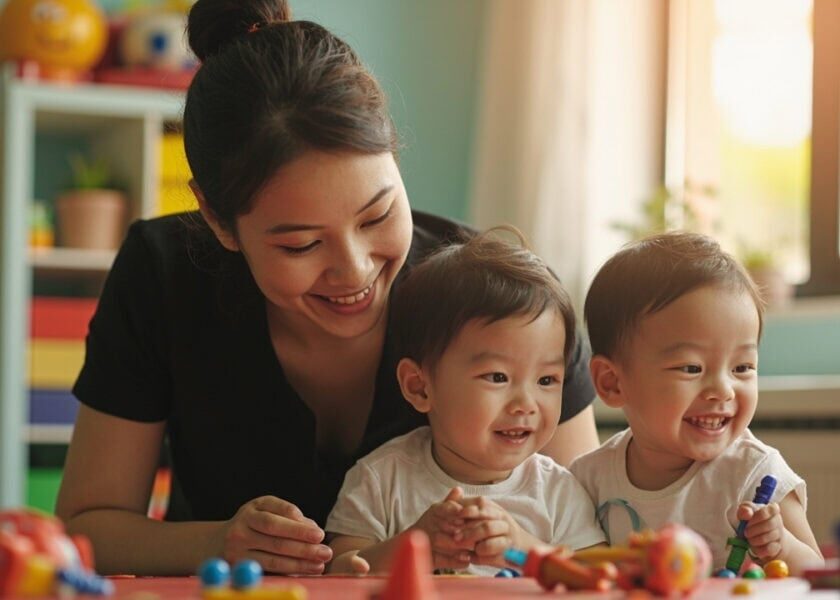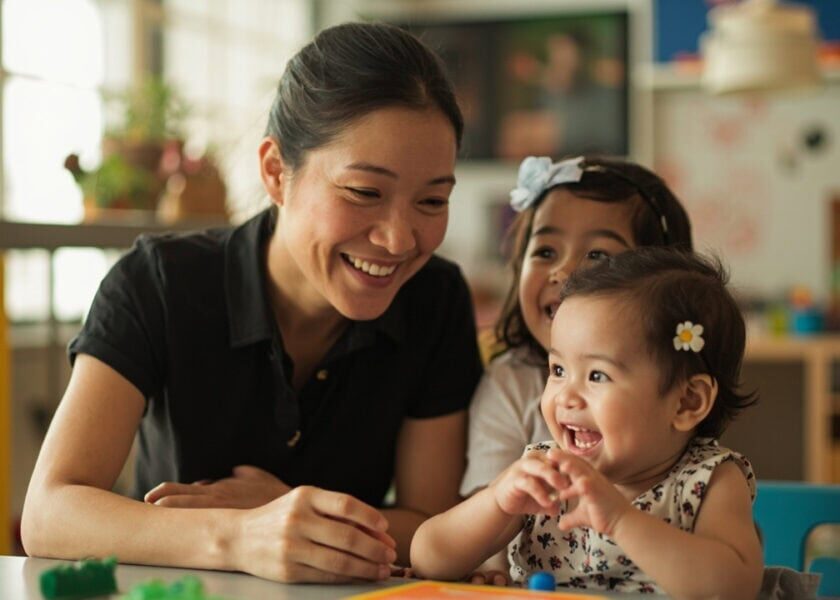
How Quality Childcare Changes the Entire Family Dynamic
The Moment Every Singapore Parent With More Than One Child Eventually Recognizes
There is a moment every Singapore parent with more than one child eventually recognizes, though no one quite puts it into words until someone else does first.
It is evening. The flat feels like itself—the kind of warmth that comes from dinners eaten at the same table, school bags hung on the same hooks, the particular way the fan oscillates over everything you own. Your older child is telling you about something that happened at recess. You are listening. You think you are listening well.
And then your younger child pulls at your sleeve, and you realize you have missed something your older child just said. Your younger child is looking at you with the specific expression that means: I needed you to hear me too.
You are not a bad parent. You are a parent who has been doing math all day—calculating, dividing, parceling out attention like a limited resource that runs out by six o’clock. There is always a remainder. There is always someone who got the shorter fraction.
This is the quiet arithmetic of the multi-child Singapore household. And it is the place where most conversations about childcare begin and end in the wrong direction.
The Gap Nobody Talks About
Most childcare conversations start with the individual child. They start with developmental milestones and learning environments and whether the caregiver will notice when your baby stacks two blocks for the first time. These are important concerns. But they are incomplete in a way that matters enormously to the parents living inside the tension.
Because the truth is: when you find the right childcare for your child, something shifts. The first few mornings are hard, then manageable, and then one day your child comes home with a drawing she made, or singing a song you have never heard, and you feel the specific relief of a burden you did not fully name until it lifted.
You feel it for your child.
But you do not always feel it for your family.
Here is the part that no one tells you to expect: the relief that arrives for one child does not automatically distribute itself across the household. You have solved one equation. The other children are still waiting in the same rooms, still vying for the same attention, still watching the parent who is now marginally less stressed but not yet the parent who has been truly freed up to be present.
This is the gap that most childcare discussions do not address. The gap between what quality care does for the enrolled child and what it has the potential to do for the entire family system.
The Sibling Effect
Let us talk about the sibling comparison dynamic, because it is one of the most quietly painful things that happens in multi-child households, and it is almost never named.
Your older child was first. Everything you learned about parenting, you learned through her. Every fever you panicked over, every milestone you celebrated, every mistake you made and corrected—all of it filtered through the singular experience of raising your first child with everything you had.
Then your second child arrived. And suddenly you were not raising a child anymore. You were managing a household. And your second child entered a world where comparisons were inevitable, where the bar for attention was set by the child who came first.
This is not something parents do deliberately. It is something the system does to everyone inside it. The older child learned to perform for the spotlight because she was the only one in it. The younger child learned to compete for it. And you, in the middle, learned to feel guilty about the mathematics of love, as though there were not enough to go around.
Quality childcare begins to rebalance this. When one child is in consistent, quality care, something changes in the house. The child who has been in care comes home with a different kind of energy—not depleted, not starved for stimulation, not desperate for attention she could not get in a busy household. She has been somewhere where her needs were met. And that means when she returns to the family, she is more able to receive rather than demand.
This is the redistribution that matters. Not just that you have more time. Not just that you are less exhausted. But that the child who has been cared for comes home in a state that actually allows her to be part of the family rather than competing with it.
And the sibling who has been watching—this is the part that breaks something open in your chest when you finally see it. The sibling who has been feeling the absence of full attention, who has been wondering whether there is enough room in this family for all of her—watches her brother or sister return from care in a way that makes room for everyone else.
The Guilt of Divided Attention
There is another dimension to this that deserves to be spoken plainly: the guilt of divided attention and what quality childcare does to it.
Singapore parents carry a particular weight around this. You are navigating the demands of work, the expectations of extended family, the competitive anxiety of a society that measures children against one another on dimensions that begin in infant care and never quite stop. And inside all of that, you are trying to be fair.
You are trying to split yourself in a way that does not split you at all. You are trying to give each child the sense that she is the most important, because that is what love requires, while knowing that the mathematics of time and attention do not permit everyone to be first.
When you place one child in quality care and begin to see the changes in your household—when your older child starts saying goodnight without checking whether you were listening earlier, when your younger child stops pulling at your sleeve because she has started trusting that you will be there—the guilt does not disappear entirely. But it transforms.
It stops being the guilt of divided attention. It starts being something closer to the recognition that you made a decision that was right for your family. That what looked like choosing one child over another was actually choosing to free yourself up to show up better for all of them.
This reframe is not small. It is the difference between carrying a burden and understanding its purpose.
How Quality Care Changes the Household
The school run is where Singapore family life becomes most visible and most fragile. You know this morning. You know it before it begins. The older child’s science test and the younger child’s favorite shoes—the ones that are in the wash—and it is raining, and the school gate opens at seven-thirty-five, and the centre is on the other side of the estate, and you are already running behind before you have left the flat.
Your older child feels your stress. Your younger child feels your stress. By the time you get everyone where they need to be, you have spent the morning managing anxiety instead of enjoying your children.
Now consider what happens when that morning changes. When the younger child is already settled into her care environment by the time the school run begins, everything shifts. Your older child gets your full attention. Your younger child arrives at her centre calm rather than frantic. And you arrive at the school gate as a parent who is actually present, who has a moment to hear what your child is saying about her science test before she walks through the doors.
This is what family rhythm feels like when it has been restored. It is not that the days become perfect. It is that they stop being relentless.
What Happens to Sibling Relationships
Children notice everything. They notice who is where, when, and why. They notice who gets picked up first and who waits longest. They notice the texture of their parents’ attention in a way that adults have mostly forgotten how to see.
When one child is in consistent, high-quality care, sibling relationships have the opportunity to develop differently. The time you spend with the child who is not in care is no longer shadowed by guilt. The time you spend together as a family has more room in it. The weekends stop being about recovery and start being about connection.
When the children are together—when the child in care comes home to a sibling who has been waiting with less desperation because the household has settled—the relationship between them changes. They play differently. They fight differently. They resolve differently. Because they are no longer competing for the same scarce resource. They are simply being siblings.
What Family-Centered Childminding Looks Like
Understanding that families are systems is one thing. Finding care that actually operates from this understanding is another.
When evaluating childminding options, Singapore parents benefit from looking beyond marketing language to the structural elements that make family-centered care possible:
- Ratios that matter: Smaller ratios mean caregivers can actually respond to individual children rather than managing groups. For infants, the difference between one-to-three and one-to-five is not just a number—it is the difference between attention and supervision.
- Consistency: Children in quality care develop attachment to their caregivers over time. Frequent caregiver changes undermine the security that makes the sibling effect possible.
- Communication without surveillance: Parents need information that builds trust, not footage that feeds anxiety. The best care arrangements create confidence through transparency and regular, meaningful updates.
- Structure that serves families: Monday to Friday care blocks that align with working family rhythms. Fee structures that do not add financial anxiety on top of everything else parents are managing.
These are not luxury features. They are the foundation on which the sibling effect becomes possible.
The EduNanny Approach
EduNanny operates within the ECDA Childminding Pilot, and this matters for reasons that go beyond regulatory credibility. The pilot framework was designed with intention. It recognizes that home-based care and community or centre-based pathways offer different things to different families, and it has built flexibility into the model to serve that reality.
The ratios—up to one to three for infants—are not arbitrary numbers. They are the product of understanding what it actually takes to meet an infant’s needs with consistency and attention. The Monday to Friday care blocks are structured around the rhythms of working families. The pilot fee structures are designed to be accessible. And the integration with CDA and Baby Bonus mechanisms means that the financial dimension of quality care does not have to be a source of anxiety.
EduNanny’s approach to communication reflects a genuine understanding of what parents need. When your child is in care, you are not able to see what is happening every moment. What you need is not surveillance—you need trust, and trust is built through information. When CCTV measures are deployed, they are deployed not as a monitoring mechanism for parents, but as a foundation for the kind of open, honest relationship that allows everyone in the care arrangement to feel secure.
Parents also need support not just during the first weeks of a new care arrangement, but in the ongoing reality of raising children. Questions come up at odd hours. Doubts surface in the middle of the night. EduNanny offers a chatbot for parents navigating questions between scheduled touchpoints—not a replacement for human guidance, but an acknowledgment that parents deserve answers when they need them.
Addressing Real Parent Concerns
“Isn’t choosing childcare for one child unfair to my other children?”
This is one of the most common and most quietly painful concerns parents carry. Quality childcare for one child does not create inequality—it redistributes the household’s emotional resources in ways that often benefit everyone. When a child in care returns home calmer, more regulated, and less demanding of scarce parental attention, there is simply more of you available for all your children. The sibling effect is not about choosing one child over another. It is about recognizing that what affects one member of the family affects the whole system.
“Will my child feel rejected by being in care?”
Children who experience quality, consistent care typically develop stronger rather than weaker attachment security. When care is warm, responsive, and reliable, children learn that they can trust adults outside the immediate family—which, paradoxically, often makes them more available for family connection, not less.
“How do I know the care is actually good?”
Look for evidence of genuine caregiver stability. Observe how your child responds over time rather than in the first week. Pay attention to how the arrangement affects your household’s overall rhythm. Quality care that serves the family system will begin, within weeks, to ease pressure on the whole household—not just the enrolled child.
Making the Decision for Your Family
There is a moment that happens in households where quality care has settled in. It does not announce itself. It does not feel dramatic when it is happening. But when you look back at it, you recognize it as a turning point.
It might be a Sunday morning. The flat is quiet in the way it gets quiet when no one has anywhere to be. Your older child is reading on the couch, and your younger child—home from care for the weekend—is playing with a toy she brought back, narrating a story to herself that you can hear from the kitchen. And you realize that you are not rushing. You are not counting minutes. You are simply there, in your home, with your children, and there is enough of you to go around.
If you are a parent in Singapore considering childminding for your infant or young child, here is what this article is ultimately pointing toward:
- Look beyond the enrolled child: Ask not just “Will my child thrive here?” but “Will this arrangement help my whole household breathe?”
- Notice the sibling effect in prospect: Consider how quality care for one child might change the energy your other children come home to.
- Pay attention to rhythm: The school run is not a small thing. The morning logistics shape the entire day’s emotional register for everyone involved.
- Trust the transformation: The guilt you carry about divided attention may not disappear entirely, but it can transform—from the weight of inadequacy into the clarity of a deliberate family choice.
What EduNanny is really offering is simpler than any of this. They are offering to see your family as a family. Not as a collection of individual children who need individual services. Not as a market segment to be targeted with the right messaging. But as a living system—messy, beautiful, complicated, full of competing needs and competing loves—where what happens to one member affects everyone else.
When you choose quality childcare for your child, you are not just choosing something for your child. You are making a decision about your family. You are saying: there is enough here. There is enough attention, enough energy, enough love to go around—but it needs to be supported by the right structures, the right people, the right environment.
That is what EduNanny is here to help you find.
Curious about how family-centered childminding might shift your household’s rhythm? Connect with EduNanny to explore what thoughtful, development-oriented care could look like for your family.
Learn more about EduNanny’s approach or visit the EduNanny homepage.