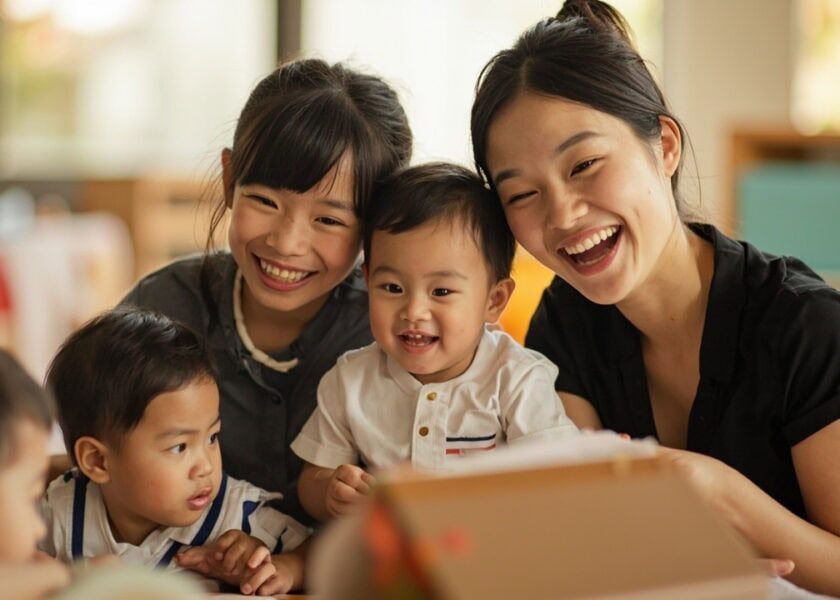
Why Choosing Quality Childcare Is the Most Generous Thing Singapore Parents Can Do
“`html
The Moment Every Singapore Parent Recognises But Few Name Aloud
It usually arrives somewhere between the second month and the second year. After the visitors have gone home. After the baby shower feels like another lifetime. After the novelty has settled into routine — and the routine has started to feel a little too heavy.
You look around your home and notice something. The marriage that used to include long Sunday mornings and unhurried dinners now runs on logistics. The grandparents who came to Singapore to help are exhausted in ways they never expected. Your older child is acting out, and you wonder if it is related to all the changes. You are performing parenthood — competently, even impressively — but somewhere beneath the surface, you are running on reserves that ran out months ago.
And here is what is most unspoken of all: you chose this. Or at least, that is what it feels like. You chose to have children, and now this is the cost. This is what family means.
But what if the cost you are paying is not parenthood itself? What if it is something narrower, something more fixable — something that has less to do with whether you love your children and everything to do with whether your family has the infrastructure to carry that love forward?
The Blind Spot in Singapore’s Parenting Conversations
This is the question that most parenting content in Singapore does not ask. The libraries of advice, the developmental frameworks, the careful guides to choosing a centre — they are all necessary, and many are excellent. But they share a common gap. They treat childcare as a service for the child. They rarely ask the larger question: what does childcare do to the family?
What Family Systems Theory Teaches Us
Family is not a collection of individuals sharing a roof. It is a system — a web of relationships where what happens to one person ripples through everyone else. When a new baby arrives, the system must reorganise itself. When that reorganisation lacks the support it needs, the strain shows up everywhere: in marital tension, in grandparent exhaustion, in older children acting out, in parents who feel like they are slowly disappearing.
In Singapore, where multigenerational living is not an anomaly but a cultural norm, these dynamics carry particular weight.
The Singapore Reality: When Grandparents Become the Default Solution
Grandparents move in or move nearby to help. They become, by default, the childcare solution. The older generation steps back into a caregiving role they thought they had retired from — not because they were asked, but because the family needed them and saying no felt impossible.
The grandparent-grandchild bond that should be built on spoiling and storytime and unconditional presence gets complicated by the weight of responsibility. The laughter gets quieter. The joy becomes work.
This is not a failure of love. It is a failure of infrastructure.
How Quality Childcare Transforms Your Whole Family
When we talk about childcare in Singapore, we tend to talk about it as though it exists in isolation. There is the child. There is the caregiver. There is the transaction.
But that framing misses something essential: childcare is not a service separate from your family life. It is infrastructure within your family life. It is the system that determines whether your marriage has room to breathe, whether your parents can be grandparents again, whether your other children can know you as their parent and not just as the tired person who is always managing schedules.
For Your Child
When an infant is placed in the care of someone trained — someone who understands attachment, who knows the difference between soothing and spoiling, who has the ratios and the environment to respond — that infant is not being neglected or displaced. That infant is entering a space designed for their flourishing.
But here is what too few people acknowledge: the infant thrives in that professional setting, and then comes home. Comes home to parents who are rested. Comes home to a household that has room for joy. Comes home to a mother or father who can be patient not because they are forcing themselves to be, but because they actually have patience left.
That is what children feel. Not the curriculum. Not the toys. They feel the quality of your presence. And your presence is only as good as the infrastructure that makes it possible.
For Your Marriage
Singapore marriages do not fail because couples stop loving each other. They fail because they run out of capacity. The logistics of modern parenthood — the childcare coordination, the eldercare responsibilities, the dual-income pressure that is often not a choice but a necessity — crowd out the very things that made them a couple in the first place.
The conversations that used to last until midnight. The weekends that were theirs. The laughter that had nothing to do with who packed which lunch and who forgot which appointment.
Couples who have found their footing in the childcare puzzle often describe the same thing: they became a team again. Not just co-managers of a household, but partners who could look at each other and remember why they chose each other. Quality childcare creates the conditions for parents to show up for each other and for their children as people who are still in love, still connected, still capable of joy.
For Your Parents
When grandparents are freed from the unexpected weight of full-time caregiving, something remarkable happens. They return to being grandparents.
Not the ones managing schedules and settling disputes and sacrificing their retirement for a role they did not choose, but the ones who spoil, who overfeed, who tell the same stories over and over because they have the time and the presence to do so.
The grandparent-grandchild bond — one of the most beautiful and fragile relationships in family life — needs that lightness to exist. It cannot grow under obligation.
For Your Other Children
Your older child was the centre of your universe before the new baby arrived. Now they watch you navigate the impossible arithmetic of attention and time. Siblings who grow up competing for a resource that always feels scarce.
When the household has the infrastructure to meet every child’s needs, siblings learn to share not out of forced sacrifice but out of genuine security. The parents — who are no longer running on empty — have the patience to hold both children, to celebrate both children, to be present for both of them in ways that create a foundation for how those siblings will relate to each other for the rest of their lives.
For You, as a Parent
Let us be honest about something that Singapore parents rarely say aloud because it feels selfish to say it: you existed before your child. You had a career, or ambitions, or friendships, or simply a version of yourself that had nothing to do with being someone’s mother or father.
And that version of you is not gone — it is just buried.
Parents who have no space for their own identities, no time for the relationships and pursuits that made them feel like a whole person, are not just tired. They are diminished. And diminished parents make for strained households, resentful partnerships, and children who grow up understanding intuitively that their parents gave up everything for them, even if no one ever said it.
What parents need is not permission to stop caring for their children. They need permission to stop disappearing.
What Quality Infant Care Actually Looks Like
Not all childcare is equal. Here is what developmental science tells us matters most:
- Ratios that matter: For infants, the caregiver-to-child ratio directly affects the quality of responsiveness a child receives. Smaller ratios mean more attention, more attunement, more of the individual care that infants require for healthy attachment.
- Attachment-informed practice: Look for caregivers who understand the difference between soothing and spoiling, who know that infants cannot be spoiled, and who respond to cues rather than schedules. Your infant is not just fed and changed — they are seen and known.
- Communication and transparency: Regular updates, photographs, the ability to check in — these are not luxuries. They are the things that allow you to be present at work, at dinner, in the moments that matter, without the background hum of anxiety about your child.
- An environment designed for development: Is the space clean, safe, stimulating without being overwhelming? Is there natural light? Age-appropriate materials? A routine that balances predictability with responsiveness?
- Trained and supported caregivers: The person caring for your infant should have genuine training in infant development, not just experience with children. Ask about qualifications, ongoing development, and the support the organisation provides to its caregivers — because supported caregivers provide better care.
What Singapore Parents Actually Wonder
“Am I being selfish for choosing childcare?”
You are not being selfish. You are being wise. Choosing quality childcare says: I believe my child deserves more than my exhaustion. I believe my marriage deserves more than my resentment. I believe my parents deserve to be grandparents again. I believe my other children deserve a parent who is present. And I believe I deserve to be a whole person who can love them all well.
That is not selfishness. That is the most generous thing you can do for your family.
“Will my child feel abandoned?”
Children feel the quality of your presence, not the quantity of your hours. When your child comes home to a parent who is actually there — engaged, patient, joyful — that is what shapes them. When you are performing parenthood from a place of depletion, that is also what they feel.
Quality professional care creates the conditions for your child to thrive developmentally and for you to show up emotionally. That is not a trade-off. That is a gift to your child.
“What about the bond with grandparents?”
Grandparents and grandchildren deserve a relationship built on spoiling, laughter, and presence — not on obligation and depletion. When professional care removes the weight of full-time caregiving from grandparents, it restores that bond to what it was meant to be.
Grandparents who grandparent by choice are present in a completely different way than grandparents who are caregivers by default. Your children will feel the difference. Your parents will feel the difference.
“How do I know if this is the right choice for my family?”
The right choice is the one that allows your family system to function. The one that gives you breathing room. The one that allows your marriage to be a partnership, your parents to be grandparents, your children to have parents who are actually there.
You do not have to have it figured out alone. Talk to families who have made this work. Visit the care arrangements available to you. Ask questions about ratios, training, communication, and how the organisation thinks about family wellbeing. The right fit exists — and it will feel like relief, not compromise.
A Note on Multigenerational Living
Singapore families navigate something that many Western parenting resources simply do not address: the complexity of multigenerational households. Grandparents who moved to Singapore to help are now exhausted. Adult children who never intended to rely on their parents for full-time care are doing exactly that. The cultural expectation that family helps family creates beautiful bonds — and sometimes creates invisible burdens.
Quality childcare does not reject multigenerational involvement. It redistributes it. Grandparents can remain deeply involved in their grandchildren’s lives without being the primary caregivers. The weekly dinners, the Sunday outings, the school pickup that leaves room for spoiling — those can remain.
What changes is the weight of daily responsibility that neither generation chose but both accepted.
This is not a Western solution imposed on a Singapore reality. It is an infrastructure solution that allows Singapore’s multigenerational family culture to function without burning anyone out.
The Choice That Strengthens Your Family
Choosing childcare is not a compromise. It is not a concession you make because you have to work, or because you cannot cope, or because you are somehow less devoted than the parent who stays home.
Choosing quality childcare — for your infant, for your toddler, for your child — is the most affirming decision you can make for your family.
When your child thrives in a place built for their development, you are not giving up the privilege of raising them. You are creating the conditions to raise them better. When you have the capacity to show up — truly show up, not just perform the role — your children receive not your constant presence but your actual presence. And that is the gift that shapes them.
When your marriage has room to breathe, you are not neglecting your children. You are showing them what a healthy partnership looks like. You are giving them a model of love that endures not through sacrifice alone but through joy.
When your parents are freed from a weight they never asked to carry, you are not diminishing their role in your family’s life. You are restoring it. You are giving them back the relationship they came to Singapore hoping to have — the one built on spoiling and laughter and presence, not on obligation and depletion.
When your siblings are raised in a household that can meet both their needs, you are not just managing a family. You are building the foundation for a lifelong relationship between two people who will know each other long after you are gone.
Begin With a Conversation
EduNanny exists because we believe that childcare is not separate from family life. It is the infrastructure that makes family life possible. We believe that every child deserves care rooted in developmental understanding, and every family deserves the infrastructure to flourish — not just survive, but flourish.
If you are wondering whether quality childcare is a gift or a surrender — I want you to know that it is a gift. To your child. To your marriage. To your parents. To yourself. To the whole, beautifully complicated, impossibly demanding, deeply rewarding ecosystem that is your family.
We are here to walk this path with you. Not as a service you hire and forget, but as partners who see the whole picture — the child in our care, and the family that loves them.
EduNanny. Because when you care for a child, you are not just caring for a child. You are caring for a family. And we know what that means.
Explore how EduNanny’s infant care and childminding services are designed for families across Singapore — and how we support not just your child, but your whole family.
“`