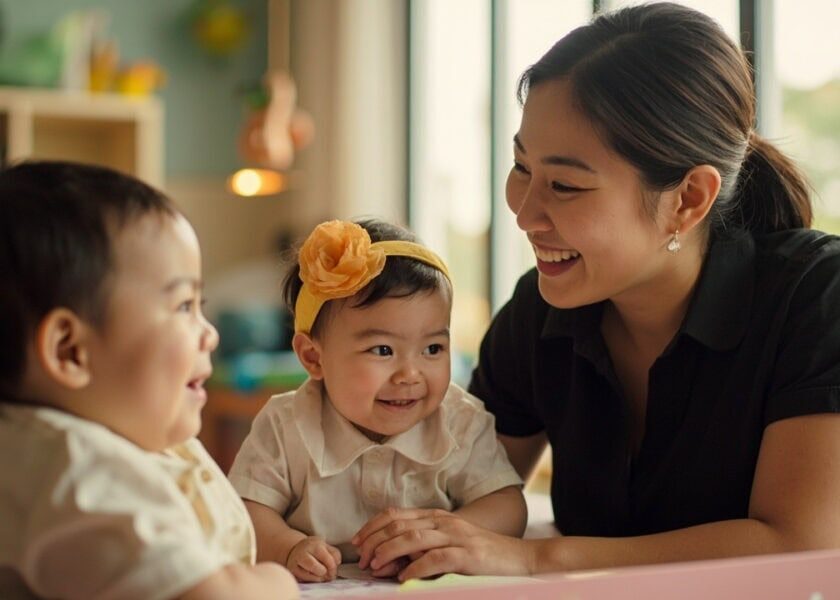
Why Children at Different Stages Thrive with Age-Appropriate Care
When “Childcare” Becomes Multiple Worlds
When you have children at different developmental stages, you quickly learn that the word “childcare” can be almost misleading. It suggests a single thing, a uniform service. But your infant is not experiencing the world the way your four-year-old is. Your toddler is not processing emotions or building skills the way your preschooler does.
Each child is at a different threshold of their own development, and what they need from the people who care for them while you are at work is genuinely, meaningfully different.
Here is what many families quietly realize: finding one arrangement that genuinely honors both of these realities is harder than it looks. A centre where your toddler is one of twenty children in a room is not the same as a place where your infant has the focused, unhurried attention they require. A programme designed for preschoolers may not have the gentle, responsive routines that your baby needs.
You are not looking for one thing. You are looking for a system that can hold different things at once.
This is the gap that EduNanny was built to address. Not as a theoretical exercise, but as a response to what families actually described needing.
What Children at Different Stages Actually Need
Understanding what your children need at each stage is the foundation for evaluating whether any care arrangement can truly serve your family. These needs are not interchangeable—they are distinct, and they matter equally.
For Your Infant
For an infant, the world is still mostly about trust. Attachment is not a buzzword; it is the architecture of everything that comes after.
Infants need caregivers who respond consistently, who hold them with attentiveness, who understand that comfort and security are not luxuries but necessities. In those early months and years, the ratio of adults to children matters enormously.
When an infant has a caregiver who can be truly present, who is not simultaneously managing three other crying babies, something foundational takes root. The infant learns that the world is reliable. That people can be counted on. That crying leads to comfort.
This is not sentiment. This is the beginning of how a human being learns to be in relationship with others.
For Your Toddler
Your toddler is discovering the pleasure of growing autonomy. They need safe spaces to explore, supervised independence to practice emerging skills, and gentle guidance as they begin to navigate early social dynamics. The world is expanding, and they need caregivers who can balance protection with the freedom to discover.
For Your Preschooler
Fast forward a few years. Your preschooler is asking why the sky is blue, negotiating over who gets the red block, noticing when someone is left out, and beginning to understand the enormous pleasure of making something, building something, solving something.
Their needs are different. Social dynamics matter. Cognitive curiosity needs fuel. Physical independence needs space to be practiced.
The preschooler is not just being cared for; they are being stretched, challenged, introduced to the joy of their own capabilities. Quality care for a preschooler looks like rich conversation, opportunities to collaborate and create, and adults who ask good questions instead of just giving answers.
What Quality Looks Like at Each Stage
| Developmental Stage | Core Needs | What Quality Care Provides |
|---|---|---|
| Infant (0–12 months) | Trust, security, consistent responsiveness | Low caregiver-to-infant ratios, unhurried routines, attachment-focused interaction |
| Toddler (1–2 years) | Safe exploration, growing autonomy | Supervised independence, support for emerging skills, gentle social guidance |
| Preschooler (3–6 years) | Cognitive engagement, collaborative play | Rich conversation, project-based learning, opportunities to lead and create |
A childcare arrangement that cannot articulate how it serves each stage differently may not be serving any of them as well as your children deserve.
The Sibling Bond: Not a Casualty, But a Strength
When siblings are enrolled at different stages at EduNanny, they are not just placed in different rooms. They are placed in environments that have been thoughtfully designed around what children actually need at each developmental threshold.
And critically, the sibling bond itself is not left to chance.
One of the beautiful things about having children in care at the same centre is that siblings get to see each other. They have shared drop-offs and pick-ups. They hear about each other’s days. They carry a sense of belonging to the same place, even as they move through spaces that are age-appropriate for each of them.
Siblings are not just people who live in the same house. They are the first community your children will ever know. They are the people who will shape each other’s understanding of fairness, of sharing, of loyalty, of what it means to have someone in your corner.
Over time, we have observed something quietly remarkable happen between siblings at different stages. The older child grows more patient, more protective, more aware of the world as a place that includes small people who need gentleness. The younger child is motivated by imitation, by watching what their sibling does, by wanting to be part of what they are part of.
These are not abstract benefits. They are observable, real, and they compound over time. When your childcare arrangement understands this dynamic, it does not just care for your children in parallel. It creates conditions where they grow together, not just alongside each other.
The Practical Reality for Multi-Child Families
Beyond the developmental needs, the logistics of multiple children are real and they are daily:
- Pickup times that need to work for a baby on one schedule and a preschooler on another
- The exhaustion of coordinating different bags, different drop-off points, different routines
- Managing multiple communication channels, apps, and reporting systems
When siblings are in different programmes at the same centre, some of this complexity eases. There is one place. There is one relationship with the team. There are shared communication channels where you can hear about both of your children’s days without juggling three different apps or three different systems.
For families navigating the demands of modern Singapore, this coherence is not a small thing. It is the difference between feeling coordinated and feeling scattered.
There is also something else worth naming. When you have children at different stages, it is easy to feel that you are doing something wrong if one arrangement serves your infant differently than it serves your preschooler. The cultural weight of wanting everything to be equal can be surprisingly heavy.
But your children are not the same. They have never been the same. They arrived with different temperaments, different needs, different rhythms. The best thing you can do for them is not to treat them identically. It is to see them clearly, individually, and to find arrangements that honor who they actually are at each stage.
What EduNanny Offers Families
EduNanny operates within the ECDA Childminding Pilot, and we mention this not as a credential alone, but because it reflects a certain philosophy.
The pilot was designed to expand the kinds of care options available to Singapore families, recognizing that the childcare landscape needed more nuance, more flexibility, more pathways. Both home-based and centre-based options exist within this framework, allowing families to choose what fits their children’s ages, their neighbourhood, their own working lives.
The pilot fee structures are designed to make quality care accessible, and families can use CDA funds and Baby Bonus where applicable, because we believe that financial considerations should not force families into arrangements that are not right for their children.
We also believe that transparency is not optional. When you entrust your children to any care arrangement, you deserve to know what is happening during the hours you are apart. Communication at EduNanny is ongoing, and where systems like CCTV are deployed, they are there to support the trust and clarity that families need. This is not about surveillance. It is about partnership. It is about ensuring that the relationship between families and caregivers is grounded in openness rather than uncertainty.
Questions Worth Asking Any Care Provider
If you are currently navigating this decision, here are some questions worth asking any care provider you are considering:
- How does your programme differ for infants, toddlers, and preschoolers? Ask for specific examples, not general statements.
- What is the caregiver-to-child ratio at each age group? For infants especially, this number matters enormously.
- How do siblings in different programmes interact? Is there intentional time or space for them to be together?
- How is communication handled when you have children at different stages? Is it consolidated or fragmented?
- How do you support the sibling bond when children are in separate age-appropriate environments?
The answers you receive will tell you whether a centre truly understands the complexity of serving multi-child families, or whether they are offering the same approach with a different age label attached.
A Final Truth
Choosing childcare for even one child is a profound decision. For families with children at multiple stages, the weight of that decision is multiplied, and the stakes feel even more personal. You are not just choosing a service. You are choosing a context in which your children will grow, sometimes for years, during the most formative window of their lives.
Your children are not the same. That is not a problem to solve. That is the beautiful truth that makes your family singular.
The right childcare does not try to flatten them into one approach. It holds them each at their own threshold, protects the bond that connects them, and walks alongside your family as your children grow into the people they are becoming.
That is the care we are building. That is the care we are inviting you into—not just today, but for every stage that comes next.
We welcome you to reach out, ask questions, and explore whether EduNanny is the right fit for your family. Every family’s situation is unique, and we would be honored to listen to yours.
Learn more about who we are or return to our homepage.