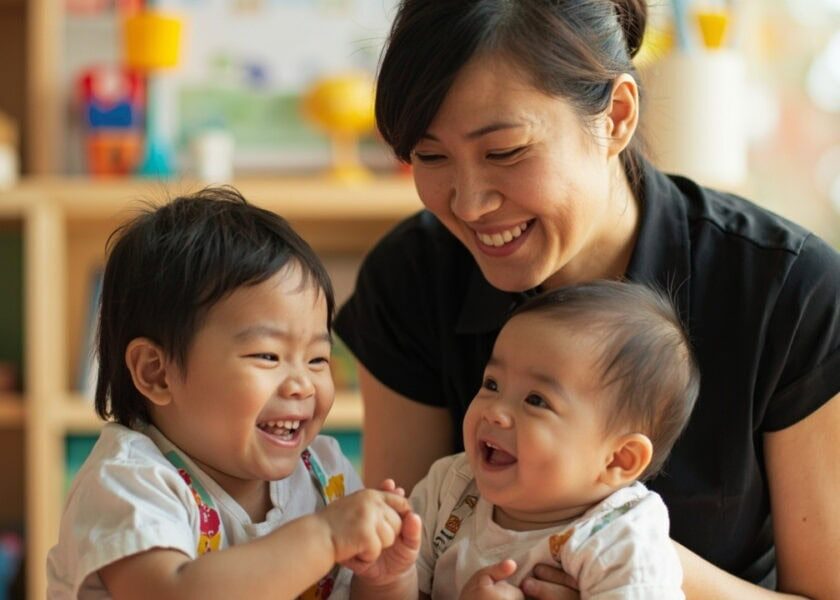
When Your Family Grows, Your Care Partnership Deepens
The Quiet Questions Every Growing Family Carries
The moment a second child enters your imagination, a whole constellation of smaller worries assembles around that central question.
Will the caregiver know this new child the way she knows the first? Will my first child feel displaced, less known, less held? Will attention become a finite resource that gets divided until neither child receives enough?
These are not dramatic fears. They are the quiet, persistent anxieties of parents who have experienced what it means to have a caregiver who truly knows their child—and who are afraid of what growth might cost them.
Here is what I want to tell you, because I have seen this fear resolved in family after family: your worry is the proof that you understand what you have found. And what you have found is worth protecting.
What Actually Happens When a Second Child Arrives
When a second child joins a quality childcare arrangement, something unexpected happens to the caregiver’s understanding. It does not diminish. It deepens.
The caregiver who has spent two years learning your first child’s rhythms, who knows exactly which song calms them before a storm, who recognizes the particular tension in their shoulders before a growth spurt—that caregiver does not start from zero with your second child. She starts from a foundation of knowing your family.
She understands how you communicate. She knows which routines bring peace and which ones unravel everyone. She has seen how siblings in your household are beginning to notice each other, and she can nurture that awareness from its earliest stirrings.
The second child does not arrive into unfamiliar territory. They arrive into a world that has been carefully prepared for them by someone who already loves the child who will become their first friend.
The Accumulated Partnership: Knowledge That Compounds
This is the great advantage of continuity that most childcare conversations miss. We talk so much about what happens in the first year, in the first months, in the first thousand days. And those conversations matter. But the families who stay, who grow with the same caregiver across years and across children, discover something that cannot be manufactured in a first enrollment: the accumulated partnership.
There is a different quality to care when the caregiver has known your family for three years. She remembers the season when your oldest was struggling with a developmental leap, and she remembers what worked. She remembers the particular challenge of your second child’s adjustment, and she remembers how gently your oldest responded to that disruption.
She holds the story of your family’s growth in a way that no intake form could capture. And when a question arises—a question about development, about behavior, about what is typical and what deserves attention—she answers not as someone meeting your child for the first time, but as someone who has watched your child grow and who knows what is consistent with their pattern.
This accumulated knowledge is not a nice-to-have. It is the thing that makes childcare genuinely supportive rather than merely custodial. It is the difference between a service and a partnership.
What Quality Sibling Care Actually Looks Like
For families navigating the practical transition of adding a second child, the details matter less than the disposition. Will there be an adjustment period? Yes. Will the older child need extra attention during the weeks when the younger one is new? Absolutely. Will there be moments of regression, of jealousy, of the complicated feelings that siblings carry?
These are features of siblinghood, not flaws in the childcare arrangement.
What matters is whether the caregiver expects these dynamics, understands them, and has the experience to hold space for the whole family while each member finds their new equilibrium.
Consider what this looks like in practice: when a second child joins, the caregiver draws on her knowledge of your first child’s temperament to anticipate how they will respond to disruption. She creates opportunities for your oldest to feel like a helper, a model, a significant person in the new baby’s life. She watches for the moments when sibling connection is emerging naturally and amplifies them.
Why Attention Divides Less Than You Fear
I want to speak directly to the fear that attention divides when a second child arrives. In quality childcare settings with appropriate ratios—and this is where the structure of care matters—the concern about divided attention reflects a misunderstanding of how sibling care actually works.
When one caregiver holds knowledge of multiple children in a family, she holds it in a way that serves each child specifically. The infant needs physical care and sensory stimulation calibrated to their developmental stage. The older child needs social interaction and cognitive challenge calibrated to theirs. These are not competing demands. They are parallel streams that an experienced caregiver learns to tend simultaneously.
In settings where caregiver-to-child ratios are maintained appropriately, siblings in quality childcare environments often develop skills that only emerge through the presence of another child. They learn to share attention, to negotiate, to see themselves reflected in another’s responses. The older child develops patience and nurturing instincts. The younger child has a built-in model of competence and language.
The sibling bond, nurtured in a safe environment by someone who understands sibling dynamics, becomes a genuine developmental asset rather than a distraction from individual care.
How EduNanny Singapore Grows With Your Family
EduNanny Singapore, operating under the ECDA Childminding Pilot, has built its model around the recognition that families grow. The home-based pathway and centre-based options both accommodate siblings, and the infant ratios ensure that the youngest members of your family receive the focused attention their development requires.
These are not abstract promises. They are structural commitments that allow families to move from one child to two, or two to three, without the anxiety of wondering whether the arrangement can hold.
What families discover, as they move through these transitions together, is that the arrangement does not merely accommodate growth. It benefits from it.
Continuity Across Children
| Stage of Family Growth | What the Caregiver Brings | What Your Child Experiences |
|---|---|---|
| First child enrollment | Foundation of knowing your family values, communication style, and routines | Individualized care calibrated to their developmental stage |
| Second child joins | Deep knowledge of sibling dynamics, accumulated understanding of developmental patterns | Care that acknowledges their place in the family story, not just their individual needs |
| Ongoing years | Memory of each child’s trajectory, ability to notice deviations early | Relationship continuity that compounds into genuine security |
When evaluating childcare options, parents often focus on what happens in the first year. The question worth asking is: what happens in the third year? What happens when your family looks different than it does today?
The families who find lasting value in their childcare arrangement are often the ones who asked that question early—and chose a partner designed to grow with them.
What Families Worried About (And Found)
Before choosing quality care for a second child, many parents have carried specific worries. Here is how the experience often resolves.
“Will my first child feel displaced?”
Quality childcare arrangements anticipate this. The caregiver who has built a bond with your first child deliberately creates moments that honor that relationship even as she welcomes a new member. Your oldest is not losing a caregiver—they are gaining a person who now loves two children in your family, and who can help them discover the particular joy of being a sibling.
“Can one caregiver really know two children well?”
The caregiver who knows your family deeply brings that understanding to every child in it. She does not divide her attention so much as expand her capacity. The infant receives developmentally appropriate stimulation. The toddler receives challenge and social interaction. These parallel needs are met not in competition but in harmony.
“What if the arrangement can’t hold when we add another child?”
The structural commitments of EduNanny Singapore—appropriate ratios, accommodation for siblings, a model built around family growth—mean this concern is addressed before it becomes a problem.
And here is what becomes clear, when you speak with families who have made this choice: they do not describe it as a business decision. They describe it as relief. The relief of not having to rebuild from scratch. The relief of being known. The relief of walking into a space where your children are greeted by someone who has watched them grow and who delights in who they are becoming.
The Invitation
If you are a parent who has chosen quality care for your first child and who wonders whether that choice can hold when your family grows, I want you to hear this clearly: the answer is yes.
The right partnership does not fragment when a second child arrives. It deepens. The caregiver who knows your first child will know your second. The environment that nurtured your oldest will nurture your youngest. And the relationship that has supported your family through the early years will continue to support you as those years accumulate into something that feels, at times, like its own kind of miracle.
The families who have lived this will tell you the same thing. They did not plan, in the beginning, to stay for years. They simply found something worth staying for. And when the time came to bring a second child into the arrangement, they discovered that what they had built was stronger than they knew.
EduNanny Singapore invites every family who walks through its doors: not to purchase a service, but to begin a partnership. Not to find a caregiver for a season, but to find a sustained partner for the journey. Not to solve a childcare challenge, but to build a relationship that makes raising children feel less like a series of problems to be managed and more like a story to be lived together.
Your family will grow. Let your childcare partnership grow with it.
Ready to explore how EduNanny Singapore can grow with your family?
Connect with us to begin a conversation about your childcare journey.
Learn more about EduNanny Singapore and our approach to thoughtful, development-oriented childminding.