What Singapore Parents Learn Watching Their Children Grow in Quality Care
The Decision That Keeps Getting Made
There is a moment—and many parents will recognize it—when you stop counting days and start watching growth. It does not announce itself. There is no newsletter that marks the occasion, no milestone card, no transition document. It happens quietly, somewhere between the second and third year of a childcare arrangement, when you realize you are no longer evaluating whether you made the right choice. You are simply watching your child become.
That moment is what this article is about.
Not the first week. Not the first goodbye. Not the first morning you handed your infant to someone new and wondered if you had done the bravest or the most reckless thing of your life. There is already enough content about that. There are checklists, reassuring language about the adjustment period, signals to watch for. What we do not have enough of is honest conversation about what happens after the adjustment ends—when childcare stops being an event and becomes a context, a daily architecture your child inhabits for years, and which quietly, steadily, compounds into the person they are becoming.
Let us begin with what most people never say aloud: the decision to place your child in care is not a single decision. It is a daily renewal of confidence, a repeated act of trust that deepens or erodes with time.
The parent who chooses childcare on a Tuesday afternoon in January is making a decision that will be tested and proven and refined across every season that follows. The toddler who emerges from eighteen months of quality care is not the same child who entered. Neither is the parent who retrieves them. And neither is the caregiver who has held, guided, observed, and responded to that small person across hundreds of mornings and afternoons.
In Singapore, where dual-income households are the norm and extended family support is not always available, this daily renewal of trust is not abstract. It is logistical, emotional, and sometimes guilt-laden. Parents here navigate infant care decisions with particular intensity because the stakes feel simultaneously personal and practical.
Here is what most content misses: the child in quality childcare is not passively receiving care. They are actively constructing their understanding of the world, one interaction at a time.
What Children Learn in the Daily Architecture of Care
Children in quality care settings are learning profound things that will not appear on any checklist:
- That adults keep their promises
- That consistency means safety
- That exploration has reward
- That distress has comfort
- That their communication matters and produces response
- Who they are in relation to others
- How to resolve conflict, ask for help, share, and wait
- How to notice another child’s sadness and respond to it
These are not skills that appear in progress reports. They do not show up on readiness worksheets. They accumulate invisibly, and then one day you realize your child is not just being cared for. They are growing.
In Singapore’s context, where academic readiness often dominates parental anxiety, these invisible learnings are easy to undervalue. But educators and child development specialists consistently point to precisely these social-emotional foundations as the predictors of later school success, relational health, and emotional resilience.
The child who knows they can ask for help, who trusts that adults will respond, who has practiced navigating conflict in a safe environment—these children are not just ready for school. They are ready for life.
What Quality Looks Like Over Time
The families who choose EduNanny tell us something consistent, something we have come to recognize as the signature of long-game care. They stop asking, “Is my child happy at childcare?” and start asking, “What is my child learning to be?”
The first question is about the moment. The second is about the trajectory. And it is the parents who begin to ask the second question—often around the twelve-month mark, sometimes the eighteen-month mark—who most clearly see the value of what quality care provides.
At Twelve Months
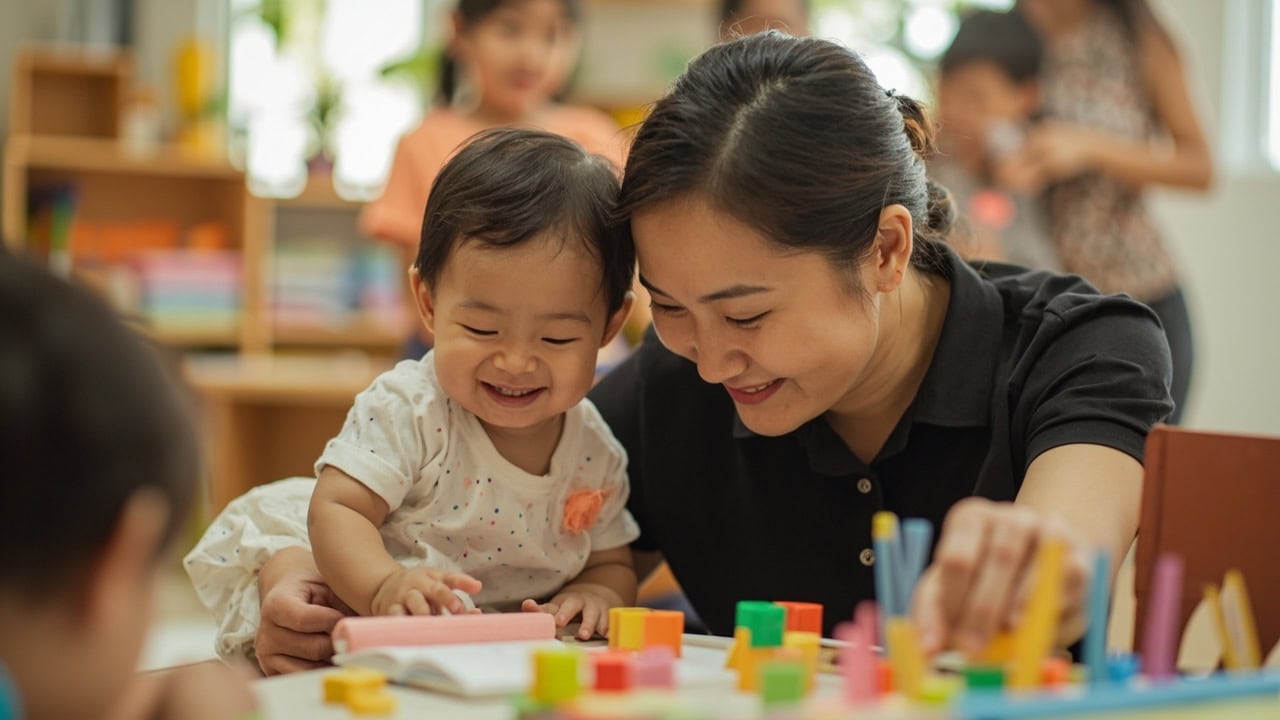
Quality looks like a child who has developed what educators sometimes call a secure base—a caregiver relationship so consistent that the child can use it as a launching point for exploration.
You can see it when your child runs to the caregiver in the morning not because they are distressed but because they are delighted. When they move confidently through the environment, testing its boundaries, returning to check in, and moving out again. When the caregiver anticipates your child’s needs not from a checklist but from months of accumulated knowledge of this particular person—their rhythms, their preferences, their emerging language.
In Singapore, where parents often return to work when infants are just three months old, this milestone carries particular weight. By the time your baby turns one, they have been in some form of childcare for nine months. They have spent more waking hours with their caregiver than with you. The question of what that relationship has built is not academic. It is the story of your child’s first year of life.
At Twenty-Four Months
You see something else. You see a child who has internalized not just the caregiver’s warmth but her expectations. A small person who has learned that there are social rules in the world, that other children have needs, that adults have rhythms and boundaries that are not negotiable but are also not random or punitive.
You see a child who has been in a miniature society for two years and has absorbed its architecture—not through explicit teaching but through daily participation in a well-designed social environment.
The child who could once be soothed by a bottle now navigates social conflicts with surprising sophistication. The child who could not speak now argues, negotiates, and requests. The child who clung now reaches out—to other children, to caregivers, to the world.
What you are witnessing is not just growth. It is the emergence of a person who has been shaped by hundreds of daily interactions that you did not orchestrate but chose.
How We Work: The ECDA Framework and What It Means for Your Child
EduNanny operates within the ECDA Childminding Pilot, and this matters not merely as a regulatory detail but as a philosophical commitment.
The pilot framework exists because Singapore recognized that families need options that respect the reality of modern life while honoring the developmental needs of infants and young children. Home-based care, community-based pathways, center-based arrangements—these are not interchangeable logistics. They represent different rhythms, different scales of relationship, different ways that a child can experience consistent, responsive care.
Within this framework, EduNanny maintains an infant ratio of up to one to three. This is not a number pulled from a best-practice manual to be filed away. It is a number that reflects a fundamental belief about what infants need: responsive attention, unhurried interaction, the experience of being truly seen by the adult who is caring for them.
When a caregiver can give that level of attention, the infant is not merely supervised. They are in relationship. And relationship, over time, is the soil in which development grows.
Singapore parents researching infant care options will encounter various ratios across different settings. What matters is not just the number on paper, but the philosophy behind it and whether the setting can actually deliver on what that ratio promises. A caregiver with three infants is not doing the same work as a caregiver with six. The quality of attention, the capacity to notice subtle developmental shifts, the responsiveness to individual rhythms—these things scale differently.
What EduNanny Singapore Does Differently
EduNanny Singapore builds its approach around three commitments: consistency, communication, and developmental intentionality.
Consistency
Our caregivers are selected and supported for the long term. We invest in relationships that are meant to last, because stability is not a nice-to-have for young children—it is the condition under which healthy development occurs. When a caregiver leaves, it is not just a staffing change. It is a small loss in the developmental architecture that has been built. We take that seriously.
In Singapore’s childcare landscape, where caregiver turnover remains a genuine concern across many settings, this question of longevity deserves serious weight. For infants and toddlers, consistency of attachment figures is foundational.
Communication
Communication with families is not a transparency measure. It is a bridge. A parent who understands what is happening in their child’s daily life can extend that understanding at home, creating continuity between care contexts that allows learning to deepen.
When families ask about open communication channels, regular updates, or ways to stay connected with their child’s day, we understand that these are not administrative conveniences. They are trust infrastructure. And trust is the currency of the long game.
Developmental Intentionality
Everything we do is oriented toward what your child needs at this moment, at this stage, for where they are going. Our caregivers are not just warm and reliable but also observant, reflective, and connected to a framework for understanding child development. Your child is not just supervised. They are known.
There is one more thing worth naming, because it is central to how we think about our role. The child is not the only one growing. The parent is too.
When you place your child in quality care and commit to that arrangement over time, you are not outsourcing parenting. You are expanding it. You are gaining a window into your child’s life that you could not have alone. You are receiving observations, developmental markers, and narrative reports that help you understand your child in ways that only sustained professional attention can provide.
The caregiver who has been with your child for eighteen months knows something about your child that you, in the intensity of daily parenting, may not yet have seen clearly. And when that knowledge is shared generously, without judgment, without hierarchy—as one adult who loves this child to another—the parent becomes more capable, not less.
Affordability and Getting Started
When we talk about affordability, we mean it with clarity about how Singapore families actually navigate the economics of childcare.
Child Development Account (CDA) funds are usable. Baby Bonus mechanisms apply. Within the pilot fee structures, we work to make quality care accessible, because we believe that developmental investment should not be rationed by income alone.
The child in a well-resourced family and the child in a family navigating careful budgeting both deserve the same quality of responsive, consistent care. EduNanny Singapore is built with this conviction at its center.
For parents who are anxious about cost—and in Singapore, where childcare fees represent a significant household expense, this anxiety is entirely legitimate—our approach is to be transparent about what you are paying for and why. You are not paying for supervision. You are paying for developmental architecture. You are paying for the kind of relationship that compounds over years, not weeks.
When you evaluate cost, we encourage you to evaluate it against the trajectory you want for your child, not just the immediate logistics of your calendar.
Questions to Ask When You Are Evaluating for the Long Game
If you are a parent in Singapore who is researching infant care options, here are questions that go beyond the first week:
- What is the caregiver’s likely tenure? Ask about turnover rates, how long the current caregiver has been in place, and what the setting does to retain quality staff.
- How does the program adapt over time? A quality program looks different for a three-month-old than for a two-year-old. Ask how the approach evolves as your child grows.
- What does communication look like at six months, not just the first week? Ask to see examples of updates or reports from children who have been in the program for an extended period.
- How does the setting handle developmental milestones? You want a partner who notices when your child is ready to move from two naps to one, when their language is accelerating, when they need more challenge or more support.
- What happens if the caregiver is absent? Ask about backup plans, consistency of secondary caregivers, and how transitions are managed.
- Can you speak with families who have been here for a year or more? The parents who are twelve months in have the perspective you need. They have seen the compounding.
The Long View
Three years from now, five years from now, when you look back at the decision you are making or have made, you will not remember the brochure you read or the tour you took.
You will remember the small moments that accumulated into a trajectory. The morning your child ran to greet someone. The evening your child told you about their friend. The afternoon you realized your child had learned something you did not teach them, and you felt a quiet gratitude for the context that made that learning possible.
You will remember that you chose to invest in a relationship, not just a service. That you trusted someone to be there for the long story, not just the first chapter. That you asked not just “Will this work in the first month?” but “Will this build something meaningful over years?”
EduNanny Singapore exists to be that context. Not just for the first chapter, but for the whole long story of your child’s early years.
We are there on the first day, and we are there on the day when your child no longer needs us. We are there for the teething nights and the developmental leaps and the birthday parties and the moments when your child says something at the dinner table that you know did not come from home but from the world they inhabit with their caregiver.
We are there because we believe that the daily architecture of early childhood is not background noise. It is the building.
That is the promise we make, and that is the promise we keep—one day, one month, one year at a time.
If you are ready to have a conversation about what quality, long-game childcare looks like for your family, we welcome that conversation. Not the sales call you have learned to expect, but a genuine dialogue about what you need, what your child needs, and whether we are the right partner for that journey.
The stakes are real, and the pressure you feel is not irrational. It is appropriate. It means you care about getting this right.
We care about that too.
EduNanny Singapore is a trusted, development-oriented childminding and childcare service for families in Singapore. Learn more about our approach or explore how we can support your family.