When Your Child Runs to Their Caregiver With Joy
The Third Relationship: What It Is and Why It Matters
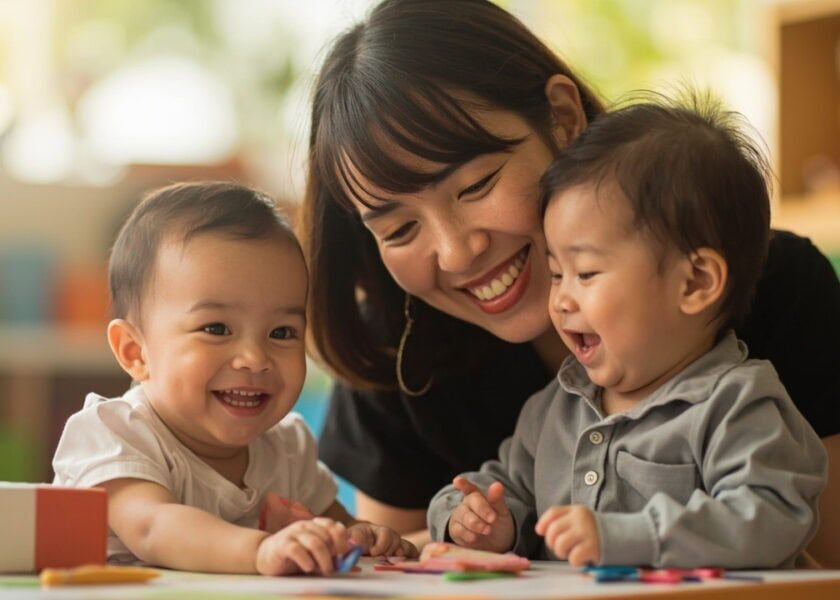
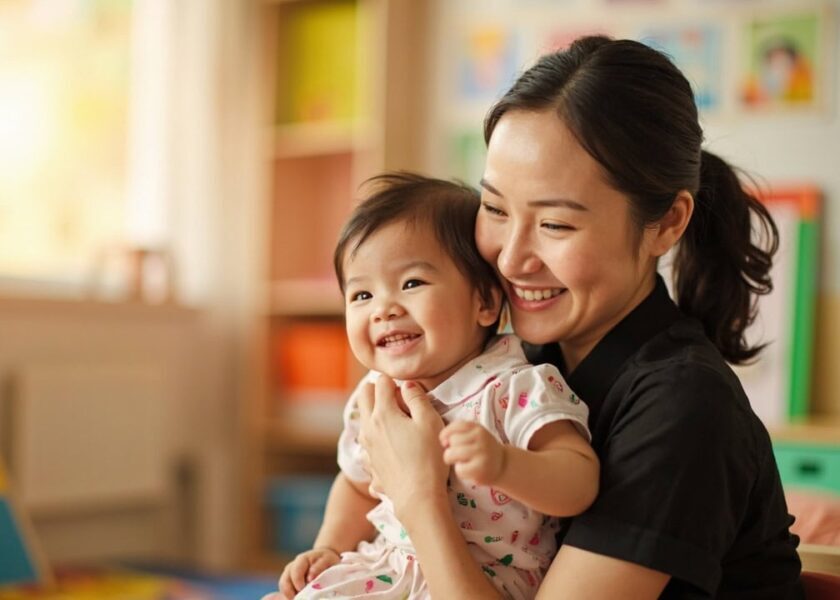
The moment your child first reaches for their caregiver with genuine delight. The moment they speak about their day and a beloved teacher or minder appears in the story naturally, warmly, as a real presence in their world.
These moments are not signs that something has gone wrong. They are signs that something is working exactly as it should.
Let us name what this is, precisely. In the first thousand days of life, and throughout early childhood, your child is building the architecture of connection. Developmental research tells us that children are wired for attachment, and that they need multiple secure relationships to thrive.
The bond you share with your child is foundational and irreplaceable. Nothing and no one will take your place. But children are not designed to have only one significant relationship. They are designed to form multiple attachments, each one contributing something distinct to their emotional and social development.
This is the third pillar I want to speak about today. The caregiver relationship. Not the temporary arrangement you may have imagined when you first enrolled your child, the functional exchange of hours for fees, but a genuine relational bond that your child experiences as real, as meaningful, as worthy of their trust and affection.
Consider what happens inside a child when this third relationship is secure and healthy. They learn that love is not a finite resource. They discover that people outside their family can be trusted, that the world contains capable and caring adults who will respond to their needs with patience and warmth.
They develop what researchers call expanded social competence: the ability to form healthy attachments with multiple figures rather than clinging to one. They have a backup system, a second harbor of safety from which to explore the world.
And they learn something precious that will serve them for life: that families are not walled gardens but living ecosystems, capable of growing to include those who genuinely care for our children.
Releasing the Guilt: What Your Child’s Heart Is Not
Now here is what I think you need to hear most clearly. When your child runs to their caregiver with joy, this is not a judgment on you. It is not evidence that you have been replaced, or that your child prefers someone else, or that you have somehow failed by being a working parent.
Your child’s heart is not a pie chart where affection for a caregiver means less for you. Your child’s heart is a garden, and the more love that grows in it, the more room there seems to be for even more love.
That bond your caregiver has nurtured with your child exists alongside your bond, not instead of it. And when that bond is healthy, it actually deepens your child’s capacity to love, including their love for you.
This is difficult to trust when you are in the midst of it. The guilt can be quiet and persistent, a whisper in the back of your mind that says you should be doing more, being more, being there. You may catch yourself feeling almost possessive of your child’s emotions, resentful even of the caregiver’s genuine connection, as though it diminishes your own.
If you have felt this, please hear me. These feelings are not signs of bad parenting. They are signs that you care deeply, that your child’s wellbeing matters enormously to you.
The goal is not to eliminate these feelings but to understand them, to find a new way to hold them that does not leave you tangled in guilt.
Reframing the Caregiver Relationship
Here is what I have learned in conversations with countless Singapore parents who have walked this path before you. The parents who navigate this transition most successfully are those who make a conscious choice to reframe the caregiver relationship from the very beginning.
They choose to see their child’s caregiver not as a temporary service provider, not as a necessary inconvenience, but as an extension of their village. A trusted ally in the enormous project of raising a child. Someone who has been invited into the family’s story, someone whose love for their child deserves gratitude rather than anxiety.
When you approach the caregiver relationship as a partnership rather than a transaction, you open the door to a kind of collaboration that serves your child far better than a distant, purely professional arrangement ever could.
You begin to see yourself not as the family who uses childcare but as the family who has built a relationship with specific caregivers, who has created continuity and consistency for their child across environments.
You start to notice the small things. The way your child’s caregiver remembers that your little one loves books about animals. Knows exactly how to calm them when they are overtired. Has developed private little rituals that your child looks forward to. And instead of feeling threatened by this knowledge, this intimacy, you begin to feel something closer to relief and gratitude.
Your child is known. Your child is deeply, individually known by someone who chooses to know them every single day.
This is an act of love. The caregiver who remembers your child’s favourite song, who notices when they are coming down with something before you do, who celebrates their small victories and holds them gently through their frustrations, is performing an act of family love. Not family replacement. Family love, extended.
Practical Ways to Strengthen This Partnership
How you engage with your child’s caregiver makes a profound difference in how this relationship develops. Here are some approaches that parents have found helpful:
- Speak about your child’s caregiver positively. Not performatively, not in a way that feels forced, but naturally. “Miss so-and-so must have worked so hard to build that garden with you today.” These small acknowledgements teach your child that you see and value this relationship, that it exists with your blessing rather than despite your presence.
- Share information generously. Tell the caregiver about changes at home, about things your child is excited about, about what they are working through emotionally. The more they know, the better they can support your child, and the more they will feel like a genuine partner rather than a separate world.
- Express appreciation directly. A thank you at pickup, a note at the holidays, a genuine acknowledgement of the work they do. People who care for children are often invisible. Your recognition matters to them, and it models for your child the importance of gratitude.
- Do not try to compete. You do not need to match your child’s caregiver in every dimension. Your role as parent is unique and irreplaceable. When you stop trying to compete, you free yourself to appreciate what the caregiver offers and to be fully present in your own role.
What Healthy Caregiver Attachment Looks Like
I want to speak directly to something you may be wondering. How do you know if the bond your child is forming with their caregiver is healthy? How do you distinguish between the developmental gift we have been describing and something that might be problematic?
Healthy caregiver attachment looks like this:
- Your child is generally happy and secure, not anxious or distressed in the care environment
- They are curious and engaged, eager to explore because they trust that their caregiver will be there when they need support
- They speak about their caregiver warmly but without obsession, as naturally as they might speak about other important people in their lives
- Over time, they show increasing independence and confidence, not increasing dependence
- When you arrive, they are delighted to see you, eager to share what they have been doing, comfortable transitioning between your care and the caregiver’s
- The caregiver does not try to compete with you or position themselves as a replacement parent
- They speak about you to your child in warm and respectful terms
- They actively support your relationship with your child, sending photos and updates that make you feel included rather than excluded, that invite you into the day’s story rather than replacing you in it
You might find yourself feeling genuinely grateful for this person, for the role they play in your child’s life. You might catch yourself saying things to your child like, “I am so glad you have Miss so-and-so who takes such good care of you,” and mean it.
This gratitude, when it comes, is itself a sign that the bond has formed healthily. It means you have begun to integrate this relationship into your family’s emotional landscape, to see it as a gift rather than a threat.
EduNanny’s Approach: Cultivating the Bond Intentionally
This is precisely where EduNanny Singapore takes a different approach than you may have encountered elsewhere. We understand that this third relationship does not happen by accident. It is not simply a by-product of proximity and time. It is cultivated, nurtured, and protected. It requires intentionality at every level of an organisation.
EduNanny, a service by BUTLER, was built on this understanding. Operating under the ECDA Childminding Pilot, we have designed our approach around the principle that continuity of caregiver relationships is not a nice-to-have but an essential feature of quality care.
When your child sees the same familiar face each morning, when they are held by someone who has watched them grow over months and years rather than weeks, when the caregiver knows your child’s rhythms and preferences and personality quirks as deeply as you do, that bond deepens in ways that simply cannot be replicated in high-turnover settings.
Your child’s security comes from knowing what comes next, who comes next, that the world is reliable and predictable and safe.
This is why our model centres on sustained partnerships with families. You will find that our caregivers are not rotating through assignments like interchangeable parts. They are building careers in this work, developing expertise over time, forming genuine attachments with the children and families they serve.
In our home-based and community-based settings, we maintain ratios that allow for true individual attention. With up to one caregiver to three infants, there is space for the kind of attunement that makes children feel truly seen. There is time to notice the small things, to respond with precision to each child’s unique needs, to build the kind of bond that gives parents real peace of mind.
We also know that trust requires transparency. Communication is woven into every aspect of our service. We keep parents informed not through sterile daily reports but through genuine, ongoing dialogue about their child’s development, discoveries, and days.
And we understand that modern parenthood includes a constant background hum of worry. In settings where we have deployed it, CCTV measures offer an additional layer of assurance because we would rather address that worry directly than pretend it does not exist.
What to Look for When Choosing Infant Care in Singapore
We know that navigating childcare is not simple, especially in Singapore’s demanding environment. The practical realities are real. The costs, the logistics, the complexity of choosing the right arrangement for your family.
As you evaluate your options, here are questions worth asking:
- Who will actually be caring for my child day to day? Will they be consistent, or will my child encounter different faces regularly?
- What is the caregiver-to-child ratio, especially for infants?
- How does this arrangement support the development of a genuine bond over time?
- What communication practices are in place to keep me informed and included?
- How does the service approach the parent-caregiver relationship? Is it transactional or partnership-oriented?
- What training and experience do the caregivers have?
EduNanny has designed our services with these realities in mind. Our pilot fee structures aim to be accessible, and families can utilise CDA funds and Baby Bonus contributions to support their arrangements. Monday to Friday care blocks provide the regularity that working families need.
Our service is designed to serve families across Singapore, recognising that excellent childcare should not be a privilege available only to those who live in certain neighbourhoods or earn certain incomes.
You Have Not Outsourced Your Parenting
If you are a parent in Singapore who has felt that complicated flutter of emotions, that strange mixture of gratitude and guilt when your child reaches for their caregiver with genuine delight, I want you to know that you are experiencing something deeply human and deeply important.
You are participating in an ancient pattern, the expansion of the village that has always been necessary for human children to thrive. Your child’s caregiver is not replacing you. Your child is not confused about who their parents are. Your child is doing exactly what human children have always done, forming multiple attachments, building a rich emotional world, preparing themselves to move through the world with confidence and love.
The question before you is not whether this third relationship will form. It will. The question is whether you will approach it with openness and intention, whether you will see it as a gift to be cultivated rather than a threat to be managed.
EduNanny Singapore stands ready to walk this path with you. Not as a faceless institution, not as a mere service provider, but as a partner in your family’s story. Our caregivers choose this work because they love children, because they understand the profound importance of the early years, because they want to contribute to raising the next generation of Singaporeans with care and intention.
When you bring your child to us, you are not dropping them off at a facility. You are inviting us into a relationship that we will tend with the same seriousness and care that you do.
The village that raised children in times past was not a single household. It was a network of trusted relationships, a community of adults who knew and loved the children in their midst. In our modern lives, that village has grown more complex, more distributed, more complicated to build. But the need remains exactly the same.
Children still thrive when they are known and loved by many. They still develop best when the adults around them collaborate rather than compete. And parents still need support, practical and emotional, to raise their children in a world that asks so much of them.
EduNanny wants to be part of your village. We want to be the trusted relationship your child looks forward to, the caregiver who knows them deeply and loves them genuinely. We want to be the partner who walks alongside you through every stage of your child’s early years, building with you a foundation of security and love that will serve your child for a lifetime.
When you see your child run to their caregiver with joy, we hope you will see what we see: not a threat to your family bond, but an extension of it. Not a sign of your absence, but a sign that your village is working as it should.
You have not outsourced your parenting. You have expanded your village. And in doing so, you have given your child the gift of knowing that love is abundant, that the world contains trustworthy people, and that they are known and cherished by more than just their immediate family.
That is everything. That is the kind of gift that shapes a human life.
We would be honoured to be part of yours.
If this article resonated with you, we would love to continue the conversation. Learn more about EduNanny Singapore’s childminding services and discover how we can walk alongside your family.