The Caregiver Who Knows Your Child Changes Everything
“`html
The Question That Matters Most
The question that sits beneath every Singapore parent’s decision about childcare is not really about curriculum or facilities or even cost. It is something older and more primal. It is this: Will the person caring for my child know who they are?
Will they know that this particular child is calmed by a specific song, not just any song? Will they notice when the brightness in their eyes dims before a fever arrives? Will they understand that this child’s silence is not contentment but warning? Will they love my child in a way that is earned, accumulated, built slowly over hundreds of hours—not assigned, not performed, but grown?
These are the questions that keep parents awake at 2 a.m., even after the paperwork is signed and the tour is done. And they are, in our experience, the right questions to ask. The only problem is that most childcare systems are not built to answer them.
What Continuity Means and Why It Matters
Developmental science has given us a word for what children need most in these early years, and that word is continuity. Not the continuity of curriculum or routine—though those matter—but the continuity of relationship.
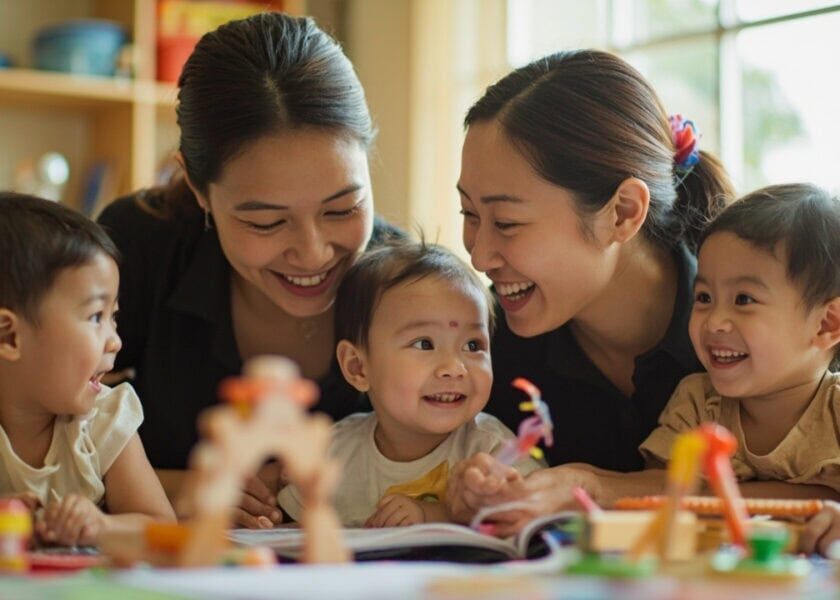
When a child has a caregiver who remains, who returns, who shows up again and again across seasons and milestones, something fundamental shifts in how they experience the world. They learn that people stay. They learn that their cues are heard and understood. They learn that they are not one among many, but singular, known, attended to.
This is not sentimental thinking. Research on attachment, on early brain development, on the architecture of emotional regulation, consistently points in the same direction: the stability of the caregiving relationship in the first years is not one factor among many. It is the foundation on which all other development rests.
A child who feels secure is a child who can explore. A child who has been truly known by a caregiver is a child who carries that knowledge into every new relationship, every new setting, every new challenge.
The Core Principles
- Relational knowing: Young children need sustained relationships with caregivers—not just competent care, but accumulated understanding built over time.
- Developmental foundation: The stability of the caregiving relationship in the first years is the platform on which all other development rests.
- Observable reality: In many childcare settings, caregiver turnover is high—meaning your child may not see the same familiar face month after month.
- What continuity provides: A caregiver who knows your child’s cues, temperament, comfort rhythms, and history; someone who reads subtle signals before they become problems.
What a Caregiver Who Knows Your Child Actually Provides
Let me be specific, because this is where the abstract becomes real. What does a caregiver who has known your child from infancy actually provide that a new caregiver cannot?
They Read the Subtle Cues
They know that your child expresses hunger not by crying but by going still. A caregiver meeting your child for the first time sees a quiet baby and assumes they are content. The caregiver who has been present for three months sees the same stillness and knows it is a question. They know how to respond because they have watched it evolve over time, matched it to other cues, tested and learned and adjusted until the knowledge became instinctive.
They Recognise Developmental Shifts
They notice when a developmental leap is beginning. Children often become more clingy, more fussy, more prone to disruption right before they make a significant advancement—learning to walk, to speak, to assert themselves. A caregiver who has been present through the weeks and months before this shift can read it, support it, reassure the parent that this is not regression but growth. A caregiver meeting your child for the first time sees a difficult day without the context to understand it.
They Know How to Comfort in the Way That Works
Not the generic way—the specific way. Perhaps it is a particular rhythm of rocking, a certain pitch of voice, a specific soft toy that smells like home. The knowledge of what calms this particular child is not information that can be written in a handover note. It is knowledge held in the body, in accumulated experience, in the trust built over time.
They Hold Your Child’s History
They know about the ear infection in April and how long it took for your child to feel safe again. They know about the new baby sister and how your child is navigating jealousy that comes and goes like weather. They know about the move, the holiday, the week when your child was sick and you were both exhausted. This history is not decorative. It is the raw material of responsive care. Without it, every day begins at zero. With it, each day builds on the last.
They Are Present, Not Performing
A caregiver who is new to your child is performing care. They are attentive because they are being observed, because they are still learning, because the relationship has not yet settled into its natural rhythm. A caregiver who has known your child for months is not performing. They are simply there, in the way that a grandparent is there, in the way that a trusted friend is there. The performance falls away. What remains is a genuine human connection, and children feel the difference.
The Reality Behind the Tour
Now think about what this means in a system where caregiver turnover is high. In many childcare settings in Singapore and around the world, the person who welcomes your infant in September may not be the person who helps them through their first fever in December. The teacher who knows that your child does not like sudden loud noises may leave before your child learns to sleep without a specific comfort.
The relationships that are just beginning to deepen are severed by schedules, by resignations, by the structural impossibility of keeping people in roles that the system does not truly value. This is not an accident. It is a consequence of how childcare has been designed.
When children are cared for in large groups, when the business model depends on staff flexibility and low overhead, when caregivers are treated as interchangeable units, continuity becomes structurally unlikely. You can tour a beautiful facility, see bright classrooms and thoughtful play spaces, and never be told that the teacher you are meeting may not be the teacher who is there in six months.
The tour cannot show you this. The brochure cannot show you this. Only time can show you this—and time is precisely what you do not have when you are making the decision.
Why This Kind of Care Is Rare
Let me say something that the industry does not say often enough: this kind of continuity is not the norm. It is not what most families experience. It is not even what most families expect, because they have been given no framework for expecting it.
When parents tour a childcare centre, they are told about ratios and curricula and accreditations. They are not told: the person who starts with your child may not be the person who finishes the year. They are not told: the 1-to-4 or 1-to-6 ratios that seem reassuring on paper often mask a reality of rotating staff, agency nurses, and caregivers who have not chosen this work and will not stay.
This is not a criticism of any individual caregiver. It is a structural observation. When childcare is designed around efficiency and scale, the human relationship becomes a casualty. And the children pay the price, not in dramatic ways, but in small accumulations—the stress of constantly adapting to new faces, the energy spent on re-establishing security that is then disrupted again, the missing of the deep knowing that would allow them to simply be themselves.
EduNanny’s Approach to Continuity
EduNanny was built with a different conviction. We believe that the relational continuity between caregiver and child is not a nice-to-have, not a feature that can be balanced against other features, but the foundational principle around which everything else must organise.
This conviction is why EduNanny participates in the ECDA Childminding Pilot, a programme that recognises home-based and community-based care as a distinct and valuable pathway—one structured to support exactly the kind of sustained relationships that children need.
Our model is different because our architecture is different. When you bring your child to EduNanny, you are not bringing them to a facility with rotating staff. You are entering into a structure designed for continuity.
- Small ratios: Our infant ratios are designed to be small—up to one caregiver to three infants—because meaningful relationships require the time and attention that small numbers make possible.
- Sustained presence: Our caregivers are not assigned to your child on a schedule. They are present across days and weeks and months, building the kind of accumulated knowledge that no orientation can transfer.
- Transparent communication: We have built our systems around transparency, because trust requires visibility. Parents in our programme have access to regular updates and meaningful reporting.
- Accessible to all: This is not a premium indulgence. The ECDA Childminding Pilot has been structured with affordability in mind. CDA and Baby Bonus funds are usable within our framework. Quality relational care should not be a luxury—every child deserves to be known.
Questions to Ask Any Childcare Provider
Before you commit to any arrangement, ask the questions that matter. Continuity is verifiable. It is something you can ask about, observe over time, and confirm through the consistency of your child’s experience.
- Will the caregiver who starts with my child be the same caregiver six months from now?
- What is your staff turnover rate? How do you support and retain your caregivers?
- What happens when a caregiver is sick or leaves?
- Can I speak to families who have been in your programme for a year or more?
- What does the caregiver know about my child’s temperament, their routines, their patterns of comfort?
When you ask these questions, the response should be specific and personal, not generic. If the answers do not add up, if you sense that the caregivers are treated as interchangeable, if the language is about slots and ratios rather than relationships, trust that instinct. You are not looking for perfection. You are looking for a system organised around the right priorities.
The Peace That Comes from Knowing
When parents find care that is built on continuity, something changes in that moment we described at the beginning—the moment of leaving, the moment of trust made visible. It does not become easy. There is no version of this that is easy. But it becomes bearable in a different way.
The parting is still hard. The love is still present. But underneath it, there is something that was not there before. There is knowledge. There is the quiet certainty that your child is not starting over. That they are in the presence of someone who knows them, who has earned their trust, who will be there when they wake from a bad dream or feel uncertain in a new situation or simply need a familiar face in a room full of new ones.
This is what continuity gives. Not just to the child, but to the parent. It gives you back a piece of yourself that you did not know you had lent out. It allows you to be present in your own life—to do your work, to be with your colleagues, to think your thoughts—because you are not consumed by worry. You know where your child is. You know who they are with. You know that they are known.
The first thousand days are not rehearsable. They do not come again. When you look back on them, you will remember many things—but I suspect that what you will remember most is not the curriculum or the facility or even the milestones. What you will remember is who was there. Who knew your child. Who loved them in the way that only sustained presence makes possible.
Begin the Conversation
We would be honoured to answer your questions and share more about howEduNanny approaches infant care and childminding in Singapore. If you would like to understand what continuity might look like for your family, we invite you to reach out.
The door is open. Your child is ready to be known.
“`