When Your Child Needs More: Choosing Professional Care With Intention
The Gift That Deserves to Be Named
Let us speak plainly about what grandparent care has meant for Singapore families, because too often the conversation about transitioning to professional care begins by tiptoeing around this truth: grandparent caregiving in Singapore is a profound act of love. It is multigenerational love made practical, daily, and intimate.
It is grandparents who delayed their own retirement plans, who moved across causeways or across the island, who set aside the quiet they had earned to re-enter the beautiful chaos of early childhood. It is love that costs nothing and means everything.
The research on multigenerational caregiving in Southeast Asia tells us something we already knew intuitively: when grandparents are involved in early childcare, children often develop secure attachment patterns, language acquisition can accelerate, and the emotional tone of the household carries a particular warmth that no other arrangement quite replicates.
In Singapore, where extended family structures remain more intact than in many Western contexts, grandparent care is not merely a practical arrangement—it is a cultural inheritance. It is the way we have always done family.
The Quiet Crossroads Many Parents Face
So when I tell you that many Singapore parents eventually find themselves at a crossroads, I need you to understand what I am not saying. I am not saying grandparent care has failed. I am not saying it was ever wrong. I am not saying that a grandmother’s love can be improved upon by a professional.
What I am saying is something far more tender, and far more true: sometimes the next right thing for your child looks different from the last right thing. And that difference is not a betrayal. It is an evolution.
There is a moment that lives quietly in the experience of many Singapore parents, and it is rarely named in the content we consume or the conversations we have. It usually arrives not as a dramatic turning point but as a small, persistent thought that surfaces during a late feeding, or while watching your child reach for your mother-in-law’s hand, or in the middle of a Tuesday when you realize that the arrangement that once felt like a gift has begun to feel like a question you do not know how to ask.
The thought sounds something like this: perhaps there is more.
And then immediately, because we are Singapore parents and we were raised to be grateful, the second thought follows: how could I want more when I have been given so much?
This is the tension that lives in the space between gratitude and growth. It is one of the most unspoken struggles in modern Singapore parenting, and it carries so much weight because it is not merely practical. It is emotional. It is about loyalty, and identity, and the stories we tell ourselves about what makes a good child, a good parent, a good family.
You feel guilty for wanting something different. You worry that choosing professional care means replacing the grandmother who has loved your child since the first hour of life. You wonder if you will be seen as ungrateful, as someone who took what was given and then decided it was not enough.
If you are carrying this weight, you need to know that you are not alone, and you need to know that the weight is not the truth.
The love a grandparent brings to a child’s life is not a finite resource that professional care depletes. Love is not a pie. Your child does not have a fixed capacity for attachment that, once filled by grandparents, cannot accommodate additional meaningful relationships. Children are not containers to be filled and then closed. They are expansive, and so is their capacity to love.
What you are feeling is not a sign that you are wrong to want professional care. It is a sign that you are paying attention. It is a sign that you are thinking deeply about your child’s future, and about your family’s evolving needs, and about the kind of parent you want to be as your child grows beyond the infant stage and into a new dimension of curiosity, social development, and independent exploration.
What Professional Care Actually Offers
Consider what professional care actually offers, not in opposition to grandparent love, but alongside it.
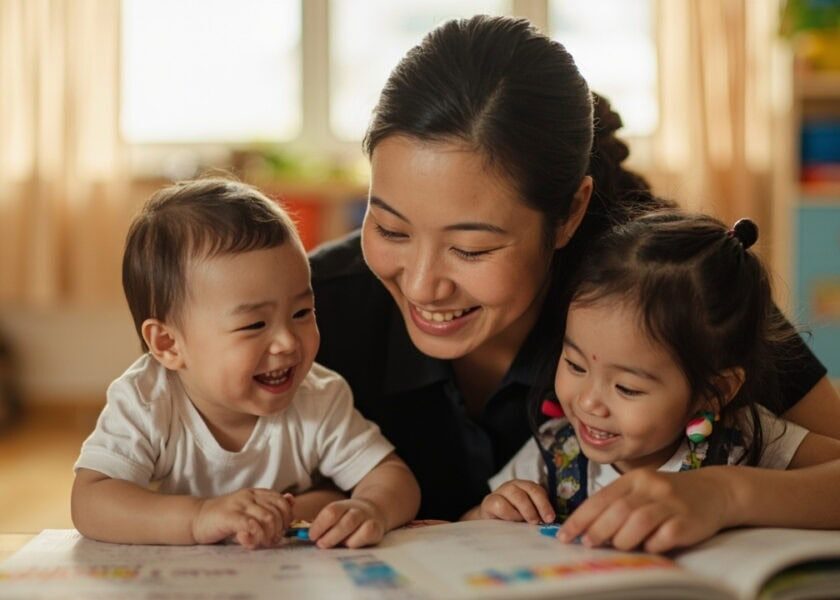
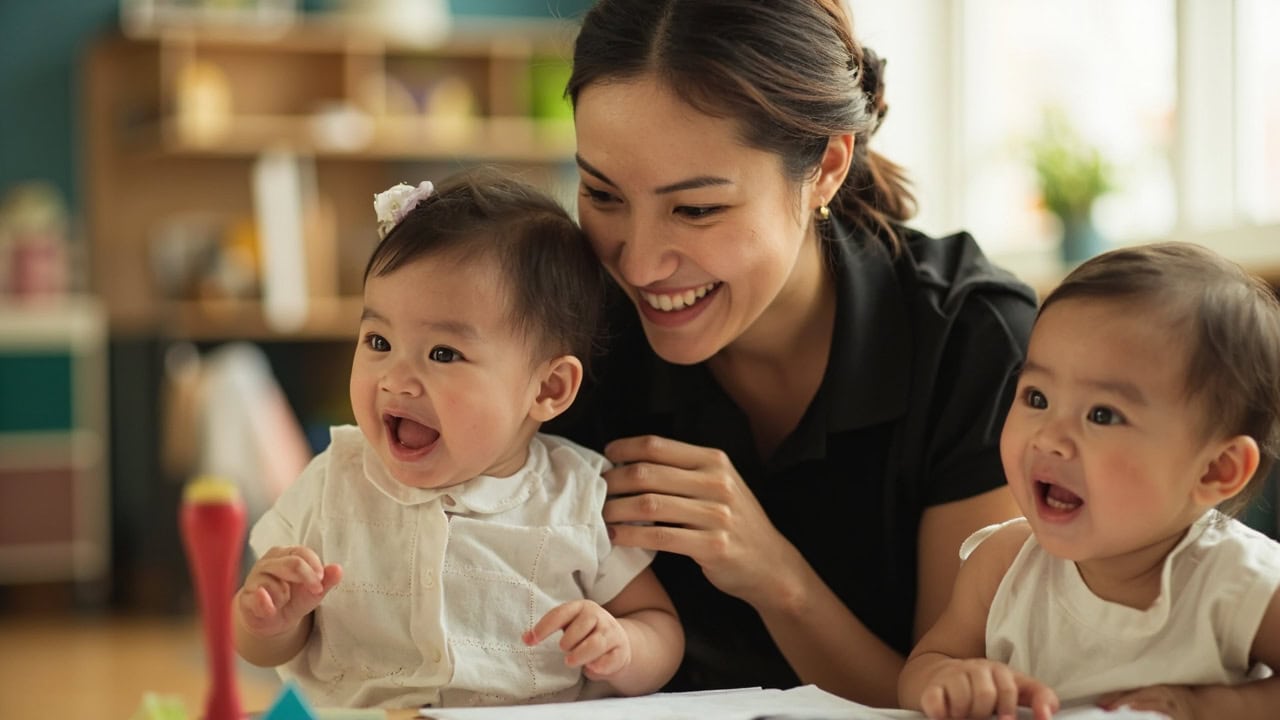
Professional caregivers are trained in developmental milestones. They understand the science of early brain development without making a child into a science experiment. They create environments designed for exploration and safety in equal measure, where a child can climb and fall and climb again, where they can learn to share and negotiate and resolve conflict with peers, where the rhythm of the day is structured not to constrain but to nurture the particular way each child moves through the world.
Beyond the practical elements, there is something else professional care can offer: a different kind of safety for a new developmental stage. A place where curiosity is encouraged, where language is modeled through consistent interaction, where children learn to navigate the social world with peers their own age. Each day brings new textures and sounds and experiences that expand your child’s understanding of what the world contains.
This is not something grandparent care failed to provide. It is something that professional care is uniquely positioned to offer at this particular developmental stage. And when you choose it, you are not saying that what came before was insufficient. You are saying that your child is ready for more—and you are providing it.
How Children and Families Adapt
How do children adapt when this change happens? With more resilience than we often give them credit for, and with more sensitivity than we sometimes prepare for.
Children are extraordinarily perceptive. They sense the emotional tone of the adults around them before they understand what they are sensing. If you approach this transition with anxiety and guilt, your child will absorb that anxiety. If you approach it with quiet confidence, with the assurance that this is a good change, that these new people are kind and safe and worthy of trust, your child will follow your emotional lead.
The adaptation is rarely as difficult as parents fear. The first days may include some resistance, some tears, some clinginess that is the natural response of any small human to any change in their care landscape. But children are wired for adaptation. It is how the species has survived.
What they need from you is not the absence of worry but the presence of calm certainty. They need you to be the rock, even when you do not feel like one.
Here is something that may not have occurred to you in the midst of your worry: professional care can actually strengthen the grandparent relationship. When a grandparent’s role shifts from primary caregiver to beloved visitor, something beautiful often happens. The hours they spend with your child become precious rather than obligatory. The pressure of daily responsibility lifts, and what remains is the pure pleasure of presence.
Grandparents become the people who take your child to the park on Saturday mornings, who bake with them on rainy afternoons, who tell stories from a generation ago and watch your child’s eyes grow wide with wonder. The bond does not weaken. It transforms into something perhaps closer to what grandparenthood was always meant to be: a source of joy, not a source of labor.
Many grandparents, when approached with honesty and respect, surprise their adult children with their understanding. They may feel a moment of hurt, a flash of wondering if they were not good enough. But when they see that this change is not about them, when they understand that their grandchildren will still need them, that the relationship will continue, that they are not being replaced but repositioned—the sting softens into something more like acceptance, and often into something like relief.
And here is another truth that is rarely spoken: many grandparents have been waiting for permission to step back. They have been loving your child with everything they have, and perhaps part of them has been longing for the chance to rest, to travel, to reclaim the years they gave to this generation’s beginning. The transition to professional care is not always experienced by grandparents as a loss. Sometimes it is received as a release.
Having the Conversation and Finding the Right Care
The conversation with your parents about this transition will be one of the most important communications you ever have with them, and it deserves to be approached with care, honesty, and deep respect. This is not a negotiation. It is a conversation between adults who love the same child and who want the best for that child, even if their visions of what that looks like have begun to diverge.
Here is what I have observed in the families who navigate this conversation most successfully:
- They lead with gratitude. They acknowledge what grandparents have given before they introduce what they are asking for.
- They speak about their own growth as parents—about the needs they see emerging in their child, about the ways they hope to continue honoring the grandparent role while making choices that feel right for their family.
- They invite grandparents into the conversation rather than presenting them with a decision that has already been made.
When you begin looking for professional care that can meet the relational standard that grandparent care has set, here is what to prioritize:
Transparency
Ask about how your child spends their day. Ask about the communication you will receive. You want regular updates, clear documentation of activities and milestones, and channels that allow you to feel connected even when you are apart. This is not about surveillance. It is about partnership.
Care Ratios
In the ECDA Childminding Pilot, the commitment to small numbers of infants per caregiver is not a bureaucratic requirement. It is a recognition that love requires time, and attention, and the capacity to truly respond to each child as an individual. When your child is in a room with fewer children rather than many, every need is met with presence rather than patience.
Warmth That Is Also Professional
You want caregivers who have been trained, yes, but who have also been chosen for their character. Who genuinely delight in the company of small children. Who find wonder in the same small moments that make you catch your breath when you watch your child sleep. Professional training is necessary, but it is not sufficient. The caregiver must love the work, not just be qualified for it.
Flexibility That Serves Your Life
Look for care structures that work with your family’s actual rhythm. Consistent, reliable care blocks mean that your family can structure its week around professional support—without losing the warmth and intentionality that makes your family who it is.
A Model That Sees You as a Parent, Not a Customer
Professional care that works best is built on collaboration. Your knowledge of your child matters. Your preferences matter. Your culture, your language, your family’s particular way of being in the world. A great caregiver does not impose a methodology. They weave your family’s values into the daily texture of care.
Common Questions Worth Considering
Even with everything I have shared, you may still have questions. That is honest, and that is okay.
Am I replacing my parents?
No. You are adding to your child’s world, not subtracting from it. The grandparent relationship does not compete with professional care—it exists alongside it, and often deepens when it is no longer carrying the weight of daily responsibility.
Will my child feel abandoned?
Children feel your emotional state before they understand it. If you approach this transition with guilt, they will absorb that guilt. If you approach it with quiet confidence, they will follow your lead. Your calm certainty is the most important thing you bring to this change.
Am I being ungrateful?
Gratitude and the desire for something different can coexist. Wanting professional care does not erase what your parents have given you. It is the natural next step of a family that is growing, evolving, and responding to changing needs.
Can professional care really match what my parents provided?
Different care offers different things. Grandparent care offers multigenerational love, cultural continuity, and a particular intimacy forged by family bonds. Professional care offers structured developmental support, peer interaction, and consistent professional practices. These are not in competition. They complement each other.
What if my parents are hurt by this decision?
Approach the conversation with honesty and respect. Lead with gratitude. Invite them into the process rather than presenting a fait accompli. Many grandparents, when they understand they are being repositioned rather than replaced, find unexpected peace with this transition.
The Next Chapter of Your Family Story
Let me tell you what I believe, because I have spent a great deal of time with Singapore families and with the question of what children truly need in their earliest years.
Children need safety. They need love. They need the unhurried attention of adults who are present to them. They need space to explore and the secure base to return to when exploration becomes overwhelming. They need consistency, and they need responsiveness. They need to know that the adults in their lives are paying attention, are keeping them safe, are celebrating their every new accomplishment as though it were the most remarkable thing anyone has ever achieved.
Grandparent care provides this. Professional care, chosen with intention and implemented with care, provides this. And here is what I want you to hear with your whole heart: providing this for your child is not a betrayal of what came before. It is an act of the same love that brought you to this crossroads in the first place.
The love that made you grateful for everything your parents have given your child is the same love that is now asking you to consider what comes next. Do not mistake this voice for ingratitude. It is the voice of a parent who is paying attention. It is the voice of a family that is growing.
This is not about replacing the photograph on your wall. It is about adding to your family story. It is about giving your child more hands to hold, more voices to learn from, more kinds of love to draw upon as they grow into the person they are becoming.
The grandmother in that photograph? She is still in that picture. She is still the first love. She is still the origin story. And one day, perhaps soon, your child will look at that photograph and understand that there was a time when grandmother was everything, and that time was beautiful, and that time was enough—and that the time that came after was also enough, and that there was enough love in all of it to fill every year of their life.
That is what you are choosing when you choose professional care with intention. You are choosing to believe that your child’s story can contain more than one kind of love. You are choosing to trust that family is not diminished by evolution, but expanded by it.
You are choosing, in the quietest and most courageous way, to love your child into the future they deserve.
And that choice, made with honesty and tenderness and the willingness to carry some weight for the sake of your child’s flourishing, is one of the most profound acts of parenting there is.
If you are exploring what thoughtful, development-focused childminding could look like for your family—care that honors what your child has already received and builds on it with intention—EduNanny by BUTLER is here to have that conversation with you.