What Quality Childcare in Singapore Actually Does for Your Child
The Foundation: Why the Early Years Shape Everything
Every child arrives in the world wired to grow. Their brains are building connections at a speed that will never be matched again. Within the first years of life, neural pathways form at a remarkable rate. This is not metaphor. This is biology. And the environment a child inhabits during these early years does not simply surround their development — it shapes it, directs it, and determines whether its potential is reached.
This is why the distinction between supervision and meaningful developmental engagement matters so much. Supervision keeps a child safe. It ensures they are fed, rested, and protected from harm. Safety is the foundation upon which everything else is built. But safety alone does not build language. Protection alone does not develop motor coordination. A child can be supervised with great care and still not be growing in the ways that matter most.
Meaningful developmental engagement is different. It is care designed with your child’s unfolding potential in mind. It is built on professional observation, on the trained ability to notice what a child is ready to learn next, and to create the precise conditions that allow that learning to occur.
For parents in Singapore, this matters because the early childhood sector here has matured significantly. There are clear standards, trained professionals, and structured frameworks that define what quality looks like. When you know what to look for, the choice becomes clearer.
What to look for in quality childminding
- Trained caregivers who understand child development, not just caregiving tasks
- Intentional environments designed to support exploration and growth
- Small caregiver-to-child ratios that allow for responsive interaction
- Professional observation that tracks each child’s developmental trajectory
- Language-rich interactions throughout the day, not just during designated activities
- Secure, warm relationships between caregivers and children
How Quality Childcare Develops Your Child: Four Domains of Growth
Understanding what quality actually does requires looking at the four key domains of development: language, cognitive, physical, and social-emotional. Each responds to intentional caregiving in measurable ways. Each builds on the others. Together, they form the foundation your child will carry forward.
Language Development: How Words Become Meaning
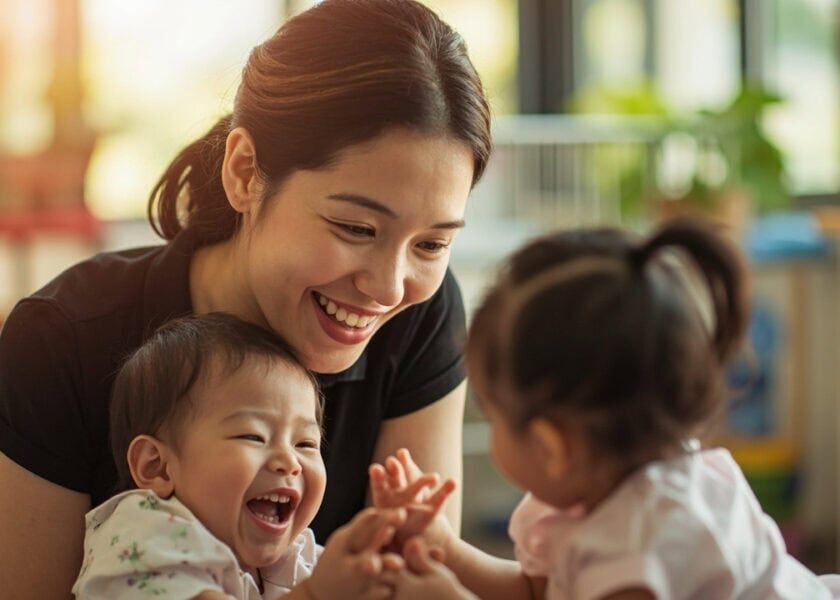
Language development in the early years is not passive. It does not happen simply because a child hears words around them. It happens when words are directed at the child with attention and response. It happens in the back-and-forth of conversation, even when that conversation is still mostly in gestures and babbles. It happens when a caregiver names what a child is looking at, mirrors their excitement, and waits for them to respond.
In quality childcare, this is not left to chance. Trained caregivers understand that every interaction is an opportunity for language development. They narrate the child’s world with intention. They expand on a child’s single word into a full sentence. They introduce vocabulary at exactly the moment when the child is curious about something that word describes.
Over months, this creates a language-rich environment — and the results are visible. Children in these settings often develop larger vocabularies earlier, stronger sentence structures, and a deeper comfort with the rhythm and music of communication.
What you might notice at home: Your eighteen-month-old points at a butterfly and says “bug.” You naturally expand that word: “Yes, that’s a butterfly. Look at its wings. They’re orange and black.” A week later, your child surprises you by saying “orange wings” when they see it again. This is language development in action, built across hundreds of such moments — many of which happened in childcare, under the care of someone trained to create them.
Cognitive Development: Building the Architecture of Thinking
Cognitive development is the architecture of thinking itself. In quality childcare, cognitive growth happens through play that is carefully scaffolded. Scaffolding is the process of supporting a child at exactly the edge of their current ability — not so easy that it bores them, not so hard that it frustrates them, but precisely calibrated to stretch them forward.
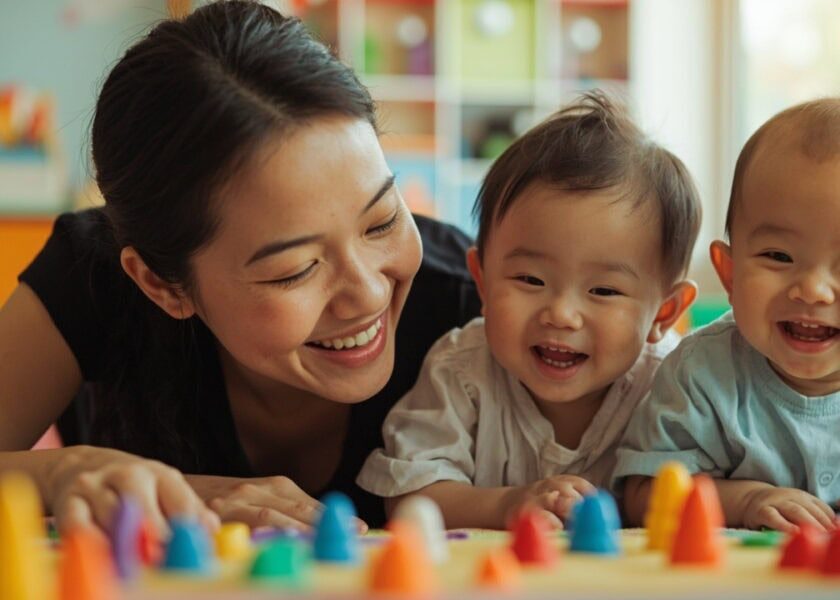
A caregiver who understands development might observe a two-year-old fascinated by how shapes fit together. Rather than simply handing them a shape-sorter and walking away, the caregiver will engage with the child, model the thinking process, ask questions that invite problem-solving, and then step back slightly to let them try.
Over time, this builds executive function — the mental skills that allow a child to focus, to remember instructions, to control impulses, and to adapt when things do not go as expected. Executive function in early childhood is one of the strongest predictors of academic success years later.
What you might notice at home: Your child attempts something new — a puzzle they have not tried before, a new way of stacking blocks, a pretend game that requires holding multiple ideas in mind. The frustration you expected does not come, or it passes quickly. Your child persists. They try a different approach. They ask for help in a specific way. These are signs of a mind that has been challenged and supported in equal measure.
Physical Development: More Than Just Movement
Physical development is often the domain parents underestimate most. Motor skills — both gross motor, which involves large movements like running and climbing, and fine motor, which involves smaller movements like picking up small objects and using crayons — develop through intentional environments and guided activity.
A child who has access to climbing structures is not just expending energy. They are developing balance, coordination, body awareness, and strength. Each attempt to climb a little higher strengthens neural connections that will later support handwriting, sports, and the physical confidence needed to navigate the world.
Fine motor development happens through activities like playdough, threading beads, tearing paper, and using child-sized scissors. These are not busy work. They are precise exercises in hand-eye coordination and finger strength.
What you might notice at home: Your child becomes more confident in their body. They climb the playground structure that previously seemed too high. They draw with a crayon using a grip that looks more controlled, more intentional. They show pride in physical achievements built not just at home, but across the hours you were apart.
Social-Emotional Development: The Foundation of Confidence
Then there is the domain that is perhaps the most important and the least visible: social-emotional development. This is where quality childcare does some of its most profound work.
Social-emotional development encompasses a child’s ability to form secure relationships, to manage their own emotions, to understand the feelings of others, and to navigate the complex social world of peers and adults. In quality childcare, this growth is supported through the experience of secure attachment.
When a caregiver is consistently warm, responsive, and reliable, a child learns something fundamental about the world: that people can be trusted, that their needs will be met, that they are worthy of attention and care. This becomes the internal working model that shapes how the child approaches all future relationships.
This is also why caregiver-to-child ratios matter so much. When a caregiver is responsible for too many children, the responsiveness that builds secure attachment becomes impossible. Attention is divided. The child’s cues are missed. In settings where ratios are thoughtfully maintained — one caregiver for every one to three infants — each child receives the attention their developing brain requires.
Within this secure base, children begin to explore. They venture away to play, knowing they can return. They learn to tolerate small frustrations because they trust their caregiver is still there. They begin to notice other children’s emotions, to share, to cooperate, to resolve conflicts with words rather than tantrums. These skills are cultivated slowly, across hundreds of daily interactions, in an environment where emotional safety has been established.
What you might notice at home: Your child is more able to soothe themselves after a fall. They show empathy when a sibling is upset. They separate from you at the childcare door with relative ease, turning toward the caregiver with a smile because that relationship has become a source of comfort, not anxiety. These are not signs that your child does not need you. They are signs that your child has learned to trust the world outside of you — which is exactly what healthy development requires.
Why Consistency Creates Transformation Over Time
The compounding nature of this growth is what many parents find most remarkable. Quality developmental engagement does not produce dramatic results in a single day. It produces subtle, almost invisible shifts that accumulate into transformation over months and years.
A child who receives consistent language stimulation does not speak in full sentences one week and fragments the next. They move gradually toward fluency, each new word building on the last. A child who develops secure attachment does not suddenly become confident overnight. They grow incrementally more secure, more curious, more resilient, until one day you realize that the child in front of you is fundamentally different from the infant you first enrolled — not because of any single moment, but because of thousands of them.
This is why school readiness, so often discussed as though it were a destination, is actually a natural outcome of quality early care. A child who has developed language skills, cognitive flexibility, physical coordination, and social-emotional confidence arrives at school already equipped with the tools they need to learn.
They can listen. They can focus. They can relate to peers. They can handle the frustration of not knowing something. They can try.
These are not skills that can be taught in a crash course before Primary One. They are the product of years of thoughtful development, built day by day, in the environments where your child spends their earliest and most formative hours.
Addressing Your Real Concerns as a Parent
Before choosing childcare, you deserve honest answers to the questions that matter most.
“Will my child feel secure with someone else?”
Quality childcare does not replace the bond between parent and child. It builds upon it. A secure child is one who has learned that their parents are reliable — and who can also learn that other trusted adults can be reliable too. The caregiver relationship in quality childcare is additive, not competitive. Your child is not choosing between you and their caregiver. They are building a broader understanding that the world contains people who can be trusted.
“How will I know what’s happening during the day?”
Transparency matters. Parents deserve to know what is happening in the spaces where they cannot be present. Communication protocols and transparency measures matter — not as surveillance, but as partnership. When parents have insight into their child’s day, they can extend the learning at home. They can celebrate what happened at childcare. They can reinforce the same values and approaches. This continuity between childcare and home is itself a form of quality.
“Is this really making a difference, or am I just hoping it is?”
This is the question at the heart of this decision. The honest answer is: you will see it. Not in dramatic revelations, but in the quiet accumulation of capability. Your child’s language will grow. Their problem-solving will sharpen. Their confidence in their body will increase. Their ability to manage emotions and connect with others will deepen. These are not promises — they are outcomes that emerge from quality. When you understand what is actually happening inside quality childcare, the hope transforms into evidence.
Practical Guidance: Choosing Infant Care in Singapore
If you are researching infant care or childminding options in Singapore, here is what to prioritize:
- Observe the caregiver-child interactions. Do the caregivers narrate, respond, and engage — or primarily manage tasks? The quality of interaction is the quality of care.
- Ask about caregiver training. Trained caregivers understand development. They do not just watch children — they observe them with professional purpose.
- Understand the ratios. Smaller groups mean more attention per child. This is not a luxury — it is a developmental necessity.
- Look for intentionality. The environment should be designed for exploration. The daily rhythm should support different kinds of learning.
- Consider practical fit. Flexibility, location, fees, and communication all matter. Quality care should fit into your family’s life, not require your life to bend around it.
When these elements align — trained caregivers, small ratios, intentional environments, and transparent communication — you have found the conditions that make quality possible.
The Quiet Truth of Quality Childcare
Let us return to where we began: that quiet question between drop-off and pick-up. What is my child actually experiencing? What are they becoming?
Now you have a clearer answer. Your child is not simply being minded. They are being observed, responded to, challenged, supported, and nurtured across every domain of their development. They are building language one interaction at a time. They are strengthening their mind through play that asks just enough of them. They are developing the confidence that comes from a body that can do more than it could yesterday. And they are learning, in the most fundamental way possible, that the world is a place where they can be safe, curious, and connected.
You cannot see all of this in the hours when you are apart. But you will see it — in the way your child speaks, the way they solve problems, the way they move through the world with growing confidence. You will see it in the way they separate from you and return to you. You will see it in the school readiness that arrives not as a milestone to be reached but as a natural unfolding of everything they have been building.
Choosing quality childcare is not a gamble. It is an investment in the most profound kind of compound interest — one that pays out not in money but in the kind of child your child is becoming.
For parents in Singapore who want both the evidence and the reassurance, who want to choose with their heads and their hearts, this is the choice that holds.
The early years are not simply a phase to be endured before “real” education begins. They are the foundation. And what is built in those foundation years compounds quietly, over time, into the kind of person your child will become.
That is the quiet truth of quality childcare. And that is why it matters so much.
For families seeking thoughtful, development-oriented childcare in Singapore, EduNanny Singapore offers a programme built on trained caregivers, intentional environments, and a commitment to meaningful engagement. Learn more about our approach to childminding or connect with our team to explore whether EduNanny is the right fit for your family.