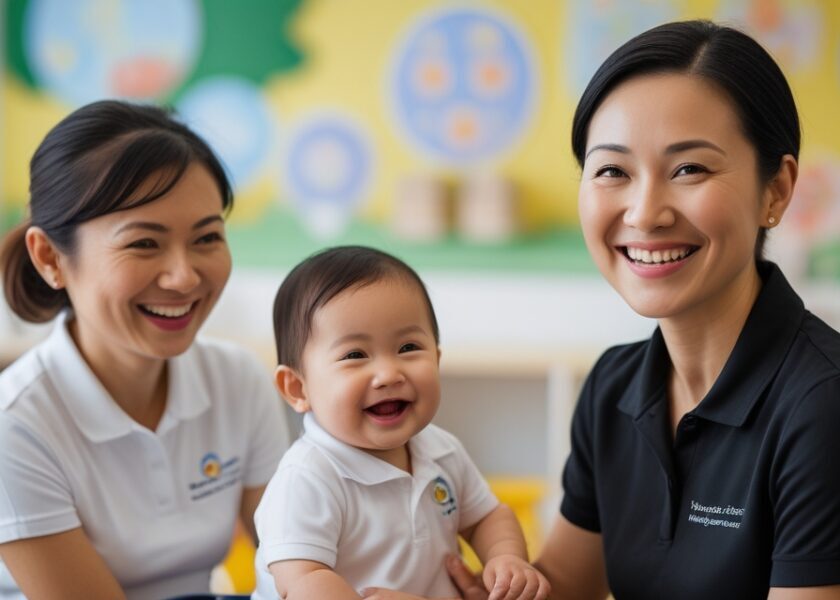
When Professional Eyes Help Singapore Parents See Their Children Clearly
The Quiet Moment That Changes Everything
There is a moment—and if you are a parent in Singapore, you may have felt it—that arrives quietly, without announcement. You pick up your child at the end of the day, and something is different.
The way they hold a crayon now. The new sound they make when they discover they can stack one block on top of another. A word, unexpected and precise, emerging from a mind that has been working while you were apart.
In that moment, you feel something shift. Not loss. Not guilt. Something closer to wonder.
You realize that while you were gone, someone was watching. Not just caring for your child, but truly observing them—noticing the way their attention moves, the moments when they reach for connection, the patterns that reveal who they are becoming.
This is the moment we want to talk about today. Not the anxiety before you make a childcare decision. Not the logistics of finding the right fit. But the quiet, profound shift that happens when parents discover they have gained something they did not expect: a developmental ally. A trained, attentive partner who watches your child with professional eyes and gives you back something invaluable—the clarity to see your own child more clearly.
But perhaps you are still carrying the worry. Perhaps you wonder if choosing professional care means something about you, about your worth as a parent, about your child’s future. We want to address that directly, because it matters, and because you deserve honesty.
You are not less of a parent for choosing professional care. You are a parent wise enough to know that development is complex, that observation is a skill, and that partnership is strength. The most intelligent parenting decisions are often the ones where we acknowledge our limits and actively seek the support our families deserve.
What Professional Caregivers Actually See
In Singapore, we plan for our children’s futures from the moment we learn they exist. We research preschools, save for enrichment, map out educational pathways with care and intention. This is not anxiety—it is love expressed through preparation.
But somewhere along the way, many of us absorb a quiet myth: that if you care deeply about your child’s development, you should be the one doing all of the watching. That noticing, observing, understanding—these are somehow things we should do alone.
This myth fails to recognize something important: love is not the same as observation. Devotion is not the same as developmental insight.
The most devoted parent, holding their child every waking moment, sees them through the lens of love—and love, beautiful as it is, can sometimes blur what needs to be seen clearly. We know our children in our hearts. But understanding them in their unfolding requires something more: trained eyes, a developmental framework, and the pattern recognition that comes from watching many children grow.
When a trained caregiver sits with your infant and watches, they are not just ensuring safety—though safety is foundational. They are watching for meaning.
Consider what happens when a twelve-month-old puts blocks in a cup. To an untrained eye, this is play. To a professional caregiver observing through a developmental framework, this is something more: the child is working through spatial concepts, testing cause and effect, building the cognitive architecture for mathematical thinking.
Professional caregivers notice:
- The way your baby’s hand opens and reaches when they are curious versus when they are seeking comfort
- The sound that precedes their first words—the experimental syllables, the intentional attempts
- The face your toddler makes when they are working through a problem, rather than simply frustrated
- When a child resists a transition not because they are being difficult, but because they need more time to regulate their nervous system
- The difference between a child who is quiet because they are shy and a child who is quiet because they are overwhelmed
These distinctions matter. When parents receive this kind of insight—when they are told not just what their child did today, but what it means—they gain something they could not give themselves alone. They gain the language to understand their child’s inner world.
The Daily Insight Advantage: What You Gain Over Time
Think about what this means over months and years of genuine partnership with a professional caregiver.
You emerge with something extraordinary: you know your child. Not in the vague, loving way we all know our children, but in the specific, textured way that comes from seeing them reflected through trained observation.
You can read your child’s cues. You understand the developmental progression—what is typical, what is emerging, what deserves attention. You are not anxiously second-guessing every milestone. You are present, informed, and confident.
This is what we mean when we talk about parent empowerment. It is not about giving parents more to do. It is about giving parents more to understand.
In the early years, this makes an enormous difference. When your two-year-old has a meltdown at the supermarket, you understand what is happening in their nervous system. When your infant resists sleep, you recognize whether they are overtired, hungry, or seeking connection. When your child achieves something new, you have the framework to celebrate it appropriately—not just as a proud parent, but as someone who understands what that achievement represents in their development.
Quality care does not replace the parent. It deepens the parent’s understanding of their own child.
The Partnership Model: What EduNanny Offers Singapore Families
EduNanny by BUTLER operates within the ECDA Childminding Pilot, offering Singapore families access to quality infant care through both home-based arrangements and community or centre-based pathways.
With ratios of up to one caregiver to three infants, every child receives the attention and observation that early development demands. The pilot fee structures are designed to be accessible, and families can utilize the Child Development Account and Baby Bonus schemes to support their choices. Care is available across Monday to Friday, in structured blocks that work with the realities of working families across Singapore.
But numbers and structures only tell part of the story. What matters is what happens inside those arrangements.
EduNanny’s approach takes the developmental partnership seriously. Communication and transparency are built into the model—parents receive updates, insights, and observations that translate professional knowledge into everyday understanding. Where deployed, measures like CCTV offer additional reassurance, not because trust is absent, but because clarity and openness serve families.
The goal is not to create dependency. The goal is to build your confidence as a parent—to give you the language and understanding you need to walk alongside your child’s development with genuine insight.
The home-based pathway offers continuity of care in familiar surroundings. The community and centre-based pathways offer structure, community, and the particular benefits of peer interaction for older infants. Families choose what fits. And what fits is always grounded in the needs of the child and the realities of the family.
What to Look For: Choosing Quality Infant Care in Singapore
For busy Singapore parents, the choice of infant care often comes wrapped in worry. Here are the questions that matter most when you are researching your options:
- How does this caregiver observe? Look for arrangements where observation is intentional, not incidental. Ask how they document and communicate developmental progress.
- What is the ratio of caregivers to infants? Fewer infants per caregiver means more individual attention and observation.
- How is information shared with parents? Quality care means you receive regular, meaningful updates—not just what your child ate and slept, but what they were curious about, what challenged them, what delighted them.
- Is there a developmental framework? Professional caregivers work from an understanding of developmental stages. They can tell you where your child is within expected ranges and what they are working toward next.
- How does this arrangement support your family? The right fit is not just about the child—it is about your family system. Consider what would give you peace and your child safety.
Quality infant care is one of those decisions that feels logistical but is actually profound. It is a statement about who you want to surround your family with. It is an act of parent intelligence.
The Choice You Are Making
We believe that every infant deserves to be seen. Not just watched, not just kept safe, but truly seen—their rhythms, their emerging gifts, their challenges, their wonder.
We believe that every parent deserves to receive that seeing as a gift, not as a threat. Because when your child’s caregiver notices something beautiful in your child’s development, you do not feel diminished. You feel grateful. You feel seen yourself—as a parent making good choices, as a family being supported.
This is what a village looks like in the modern age. Not grandparents across the hall—though that is a gift when it exists. Not a neighbor who helps out occasionally—though that kindness matters. But a professional, trained, intentional partnership that recognizes the developmental needs of infants and the emotional needs of families.
What serves our children is this: parents who are calm, informed, and present. Parents who have made thoughtful decisions and trust those decisions. Parents who have surrounded themselves with professionals who can share the weight of watching, noticing, and understanding.
The parent who chooses intentional, professional childcare is not stepping back from their role. They are stepping into a more informed, more empowered version of parenting. They are saying: “I want to understand my child. I want to be the kind of parent who sees clearly. And I am wise enough to know that seeing clearly sometimes requires partnership.”
This is what quality infant care gives your family that love alone cannot: the clarity to see, the language to understand, and the partnership to respond with confidence.
Let us return, then, to that quiet moment at pickup. The crayon held just so. The block stacked with intention. The word, unexpected and precise. In that moment, you are not watching your child alone. You are part of a conversation about who they are becoming.
EduNanny is here to build it with you. Not to replace your role as parent, but to illuminate it. Not to make decisions for you, but to give you the insight to make them well.
That is the choice you are making. That is the intelligence of choosing well.
And that is the kind of parent your child is lucky to have.
Ready to Explore Your Options?
EduNanny by BUTLER is here to answer your questions and help you find the right fit. Whether you are just beginning to explore infant care in Singapore or are ready to take the next step, we welcome the conversation.
Learn more about how the ECDA Childminding Pilot works, meet the team behind EduNanny, or reach out directly to start a personalised conversation about your family’s needs.
You can also explore the EduNanny website to learn more about our approach to developmental, relationship-based infant care across Singapore.