What Your Senses Reveal About Singapore Infant Care Quality
Reading a Childcare Space: Your Body Already Knows
When you visit a childcare centre in Singapore, you are handed tour checklists, credential reviews, and programme explanations. But here is what research and experience consistently show: quality in infant care registers in the body first, and the body is rarely wrong.
Before you ask a single question, your senses are already collecting data:
- Sight: Does the room show evidence of children’s actual inhabitation, or just careful staging for adult visitors?
- Sound: How does the acoustic environment contain children’s natural vocalisations without suppressing them?
- Touch: Were materials chosen for durability alone, or for what they feel like in a small child’s hands?
- Smell: What does the air tell you about daily attention to detail?
- Felt safety: Does your body relax or tighten, and what does that synthesis of signals mean?
Quality in infant care does not announce itself with certificates on the wall. It does not arrive in the orientation pack or the welcome brochure. It lives in the texture of things—in the weight of silence between sounds, in the particular way a room smells at ten in the morning when thirty small people have been living in it since seven.
The child’s sensory world is not a backdrop to development. It is development. The light your child wakes to. The sound they fall asleep to. The texture of the things their hands reach for. The smell of the room their body absorbs and makes part of their sense of what home feels like. These are not amenities. They are the substance of early experience.
So let us walk through a childcare visit together, sense by sense, and notice what you may have been trained to overlook.
What You See: Evidence of Real Inhabitation
The visual landscape of a childcare environment is not decoration. It is not the managed first impression designed to reassure adults. It is the world that a child who cannot yet walk, who cannot yet speak, who cannot yet tell you anything about their day, will inhabit with their whole body.
When you enter a room, do not look at the posters on the wall or the artwork at child height. Look at the ceiling. Look at where the light falls. Look at whether the room feels open or compressed, whether there are pockets of calm and corners of chaos, whether the space seems to have been arranged by people who think about children or people who think about the people who visit.
The Showroom Problem
A room that has been designed for children, but not loved by them, has a particular quality. It is clean. It is organised. It may even be beautiful. But it has the quality of a showroom.
The materials are in place. The ratios are correct. The developmental categories are properly labelled. What it lacks is evidence of inhabitation:
- No small scratches on the wooden table from children learning to grip
- No worn patches on the floor where bodies have moved and rested and risen again
- No accumulated texture of daily life
A room that is truly loved in tells you that people have been present in it. That children have touched and explored and made marks. That the space has been held around the children’s actual experience rather than curated for an adult’s assessment visit.
When you see this, you are seeing something that cannot be faked by a fresh coat of paint and a well-stocked shelf of wooden toys. You are seeing the physical environment understood as the child’s first curriculum. The room is not background. The room is message.
Ask yourself: When I look at the ceiling, where does the light fall? Is there natural light? Is the space arranged for a child’s visual comfort, or for an adult’s visual approval?
What You Hear and Smell: The Truth in Everyday Details
Listen. Not to the guide who is telling you about the curriculum, not to the director who is explaining the philosophy, but to the actual sound of the space when no one is performing for you.
The acoustic environment of a childcare room is one of the most honest indicators of what is happening inside it. A room that is comfortable for children does not sound like a room that is comfortable for adults.
Sound as a Quality Marker
Children’s natural vocalisations—their calls and exclamations and the half-sentences they speak to themselves and each other—have a particular frequency and rhythm. When a room is genuinely calibrated for children’s comfort, these sounds feel contained. Not suppressed. Not silenced. Contained. The way a good conversation is contained by a warm room.
Listen for what is happening to those sounds when you are still in the corridor, before the guide opens the door:
- Are they bouncing off hard surfaces and becoming harsh?
- Are they absorbed and softened by thoughtful acoustic design?
- Is there a constant low background hum of ventilation that masks natural sounds and forces everyone to speak louder?
The emotional climate of a room lives in its soundscape. Children who feel safe are not silent. They are vocal, curious, expressive. But the expression happens within a felt sense of containment.
Before you enter, stand in the corridor. Close your eyes. What do you hear? And what does that sound tell you about how children are allowed to be themselves in that room?
The Most Honest Sense
Smell is perhaps the most honest sense, and the most often overlooked. A childcare room cannot hide what it smells like. And what it smells like is the truth of what happens there every day.
A room that smells of stale food, of damp cloth, of the accumulated residue of meals not cleaned and spills not attended, is telling you about the quality of daily attention. It is telling you that someone is managing the visible tasks but not the invisible ones.
A room that smells clean in a particular way—not of industrial disinfectant but of warm food and natural materials and the particular scent that a space acquires when it has been lived in with care—is telling you that there are people attending to the details that do not appear on inspection checklists. That someone is thinking about what it is like to be a child whose sense of smell is acute and unfiltered.
The nose knows. In a childcare context, the nose knows things that no conversation will reveal and no credential will guarantee. When you walk into a space and it smells like the right kind of lived-in, that is data. Trust it.
What You Touch and Feel: Materials and Emotional Safety
Run your hand along a shelf. Feel the edge of a table. Pick up one of the objects a child might hold. What does the material tell you?
There is a vast difference between objects that have been chosen for durability and objects that have been chosen for the way they feel in a child’s hands. The difference is not price. It is attention. It is the question of whether someone asked, when they were selecting these things, what it would feel like to be small and to hold this, to mouth this, to explore this with the whole of your body.
The Message of Materials
When children are given materials that respect their developmental reality, the materials tell you. They have weight. They have texture. They have the quality of real things rather than plastic approximations.
A wooden bowl feels different in a child’s hands than a plastic bowl. The difference is not trivial. It is in the message the child receives about what they are allowed to hold, what the world offers them, what their sensory experience is worth.
Sensory development in the first years of life is not a bonus. It is the foundation upon which everything else is built. The child who is given rich tactile experiences—who is allowed to feel the difference between rough and smooth, cold and warm, wet and dry—is building neural pathways that will serve them in every domain of learning.
Felt Safety: The Sense With No Physical Organ
Now there is one more sense, and this is the one that has no physical organ, and yet it is perhaps the most powerful of all. It is the sense of felt safety.
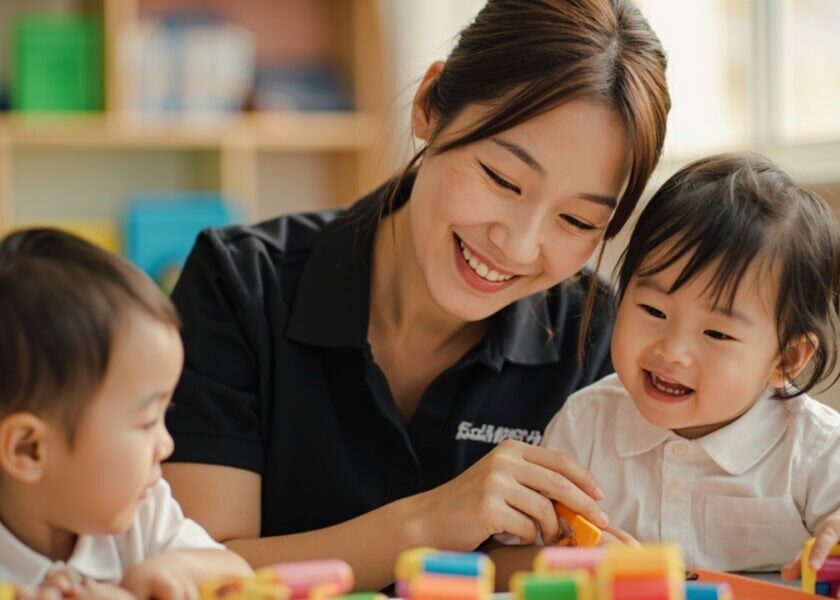
You have experienced this. You enter a space and something in your body either softens or tightens, and you cannot always name it. Perhaps it is the way a caregiver is sitting on the floor, their body oriented toward a child in a way that suggests presence rather than supervision. Perhaps it is the temperature of the room. Perhaps it is the quality of the eye contact you witness between a teacher and a child.
Felt safety is the presence of something else. It is the quality of a space that has been understood from the inside out. A space that has been designed not for the adult who will visit it once, but for the child who will inhabit it daily.
When your body relaxes in a childcare environment, it is because you are reading—below the level of conscious thought—that this space has been made for its actual inhabitants. That the people in it have been thought about. That the children have been placed at the centre of every decision, not as a slogan but as a practice.
Pick up a toy from the shelf. Feel its weight. Run your thumb along its edge. Ask yourself: If I were one year old, would this feel like something the world thought I deserved to explore?
Your Sensory Toolkit: A Practical Guide for Singapore Parents
Here is what we want you to take from this. The next time you walk into a childcare space:
- Pause at the door. Let your body arrive before your mind.
- Notice what you see. The ceiling, the light, the worn places that tell you children have been here.
- Notice what you hear. The corridor sound before you enter. The quality of containment in the room.
- Notice what you feel. When your hand touches a door handle, a shelf, a toy—what is that material telling you?
- Notice what you smell. Clean in the right way. Lived-in warmth.
- Notice your shoulders. Are they rising or dropping? That half-inch is information.
This is not a mystical gift reserved for certain parents. It is a skill, and like all skills, it improves with attention. The more you practise reading spaces with your whole body, the more accurate your reading becomes.
You are not looking for perfection. You are looking for evidence of presence. Evidence that the people in this space are paying attention to what it is like to be a child here, now, in this body, on this day.
Addressing Common Concerns
How do I know if I can trust my feelings?
Your feelings are not decoration around the real work of decision-making. They are the instruments through which you read the world your child will live in. The doubt you feel about trusting yourself is often the result of being handed checklists that bypass these instruments entirely.
Trust the half-inch your shoulders drop. Or do not trust it yet—but notice it. Start collecting data from your sensory experience, and over time you will see whether your readings align with what you later learn about the quality of care in those spaces.
What if I make the wrong choice?
The pressure of this decision can feel enormous. But remember: the child you are choosing care for cannot yet tell you what their experience of a space is. They cannot give you reviews or testimonials. They can only live in the room and let their body form impressions they will carry into their future.
What about the cost? How do I evaluate value?
Affordable infant care in Singapore is a real concern for many families. Beyond the financial architecture: value in infant care is not just what you pay per month. It is what your child is building during these foundational years. Sensory development, neural pathway formation, the felt sense of safety—these are not luxuries that can be deferred. They are the substance of early experience.
What Quality Childminding Looks Like in Singapore
Singapore parents have specific realities to navigate. Government-certified infant care centres, ECDA regulations, Child Development Co-Savings (Baby Bonus) schemes, and CDA accounts all shape the landscape of choice. But beneath the administrative framework, the same sensory questions apply.
Beyond the Regulatory Floor
ECDA licensing requirements establish minimum standards—staff qualifications, child-to-caregiver ratios, space requirements, hygiene protocols. These matter. But they describe a floor, not a ceiling. The question beyond compliance is always: what is the quality of daily attention in this space?
In infant care, the child-to-caregiver ratio is not just a number on a checklist. It is the difference between a caregiver who can truly see and a caregiver who can only supervise. When ratios are tight—fewer children per adult—caregivers can respond to individual cues, notice the texture of a child’s cry, sit on the floor with sustained attention rather than scanning supervision.
What Quality Looks Like in Practice
- A caregiver kneeling to a child’s eye level rather than bending down from standing
- Smooth transitions between activities that feel unhurried
- Children who move freely and explore without constant redirection
- Food that smells like food and is served with attention to the children’s developmental stage
- A schedule that serves children’s rhythms, not only adult convenience
- Caregivers who seem present rather than hurried, attentive rather than rushed
The ECDA Childminding Pilot
Singapore’s ECDA Childminding Pilot exists because the city-state understands, at a policy level, that the first years of life require more than institutional care. They require the kind of attention we have been describing—caregivers who are not managing children but inhabiting space with them.
Within this framework, providers like EduNanny offer pathways designed to recognise the diversity of Singapore’s families:
- Home-based care for children who thrive in smaller, more intimate environments
- Community and centre-based care for families who find community in shared spaces
- Monday to Friday care blocks that align with the rhythms of working family life
- CDA and Baby Bonus usability, so that Singapore’s practical financial architecture supports rather than complicates your choices
In programmes that maintain attentive caregiver ratios, the difference is tangible. Fewer children per adult means presence rather than oversight. It means the kind of sustained attention that the sensory framework above requires.
For families exploring these options, transparency matters. Where providers implement measures like CCTV, the question worth asking is: does this serve openness and trust, or does it serve anxiety and surveillance? The intention behind such tools shapes their effect on the relationship between caregivers and families.
Trust the Knowing: A Final Word
We are not asking you to trust us because of what we say about ourselves. We are asking you to trust what you sense. To trust that your reading of a space is valid. To trust that the half-inch your shoulders drop, or the half-inch they do not, is information.
The child you are choosing care for cannot yet tell you what their experience of a space is. They cannot give you reviews or testimonials. They can only live in the room and let their body form impressions they will carry into their future.
When you find a space where what you see and hear and touch and smell and feel all point in the same direction—you will know. And that knowing is the beginning of something good for your child, and for you, and for the family you are building together.
The next time you walk through a childcare door, pause. Let your body arrive before your mind. Notice. And trust that you already know more than you have been taught to believe.
If what you sense points toward a provider whose approach aligns with what you have been noticing, we would welcome the conversation. Not to perform for you, but to meet you where you are and answer whatever questions have arisen from your reading of the space.
Begin your search with presence, not checklists. You already have the instruments you need.
At EduNanny, we believe that choosing infant care should feel like the beginning of a trusted partnership—not a leap into the unknown. Learn more about our approach or reach out to begin a conversation.