What Your Child’s Morning Goodbye Reveals About Their Care
Why the Morning Goodbye Matters
Most parenting advice focuses on what happens when you get home. The evening wind-down. The bedtime routine. The meltdown after school pickup. These have been written about, podcasted about, and circled endlessly in parenting communities.
But the morning is different. The morning is the first daily rupture and reunion. It is the moment when your child separates from you and attaches to someone else—and that transition happens in minutes, sometimes seconds, with very little guidance about what a good one looks like or how to recognize one when you see it.
Weeks before your child was born, someone handed you a hospital bag checklist. Before the first day of school, there were orientation sessions and parent handbook tours. But before that very first morning drop-off? There was mostly silence.
Maybe a reassuring nod from the teacher. Maybe a WhatsApp group where other anxious parents compared notes. Maybe just you, standing outside, wondering if your child was crying, wondering if the person you were leaving them with knew how to hold them through it.
This silence has consequences. It leaves parents unable to assess whether their childcare arrangement is handling mornings well. It leaves them uncertain about whether their child’s morning behavior is normal adjustment or genuine distress. It leaves them carrying an emotional residue every single day that compounds quietly into exhaustion and doubt.
And it leaves caregivers—talented, trained, devoted caregivers—working in a moment of profound importance without the recognition or the support structures that would help them do it even better.
What Is Actually Happening in Your Child’s Brain
Separation anxiety is not a phase. It is a neurological response, and it is entirely rational.
When your infant or toddler experiences you leaving—even briefly, even with reassurance—their developing brain registers a threat to attachment. The amygdala fires. Cortisol rises. The nervous system goes into a kind of quiet alarm.
Not because your child does not trust that you will come back. But because their brain is not yet fully equipped to hold the certainty of your return while simultaneously feeling your absence.
This is not misbehavior. This is not a sign that your child was not properly attached to you. This is neurodevelopment doing exactly what it is supposed to do. The attachment system is healthy and active precisely because it activates under separation.
What changes over time is not the feeling itself but the child’s capacity to tolerate it, to trust the pattern, and to gradually internalize the message that you always come back and the caregiver is a safe person in your absence.
That internalization does not happen automatically. It happens through repetition, through consistency, and through the quality of the care received during those first vulnerable minutes after you leave.
Here is what most parents do not realize: your child’s morning stress response is directly influenced by the environment they are about to enter. If the morning arrival is rushed, impersonal, or handled by someone who is managing six other children at the same time, your child’s cortisol has nowhere to go. It rises. It peaks. And it shapes the first hours of their day in ways that affect their learning, their regulation, and their ability to connect.
But if the morning arrival is met with genuine presence—someone who kneels to your child’s level, acknowledges the difficulty of the goodbye, offers consistent warmth and a predictable routine—the cortisol still rises, but it falls faster. The nervous system learns a new pattern. Not that you are gone, but that being left in this place is survivable, even okay, because this person is safe.
That is the beginning of your child’s ability to be away from you and still feel secure. And it happens every single morning.
What Skilled Morning Care Looks Like
Walk into two different childcare environments on a Monday morning.
In the first, the caregiver is at the door, eyes on the phone, vaguely saying hello while managing a diaper change and a dispute over a toy truck. The parent hands over a clinging child with a rushed, “I’ll be back soon, okay?” The caregiver nods without really looking. The parent leaves feeling vaguely guilty and vaguely uneasy but tells themselves it was probably fine.
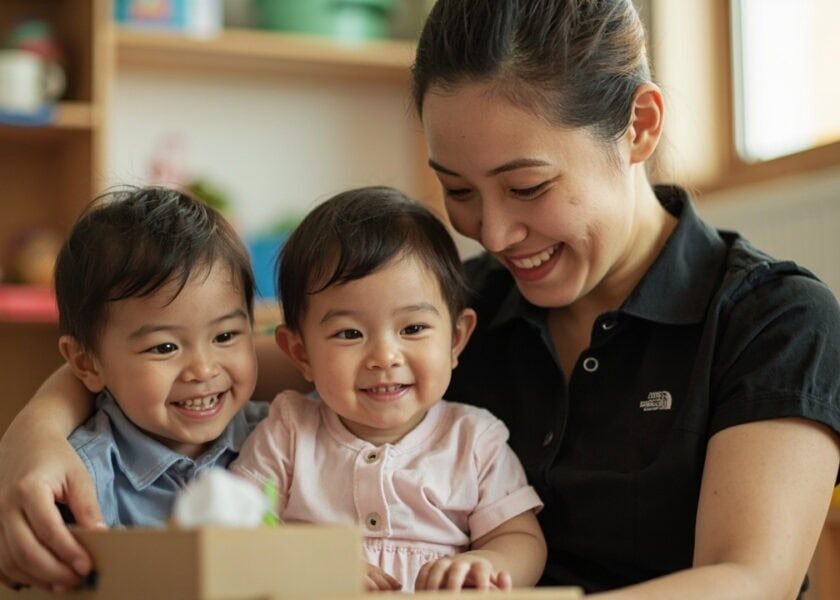
In the second, the caregiver is at the door before the parent arrives. She has already noted that this child has been coming in more easily this week but is still clingy on Mondays. She kneels down. She says good morning by name. She tells the parent, “We’ll be starting circle time in fifteen minutes, so she has a little time to settle in first.” She reaches out her arms with genuine warmth, and when the child resists, she does not pull. She waits. She acknowledges the child’s reluctance with a calm, “I know it’s hard. Mummy is going to work and you’re staying with me this morning. That’s okay. We’ll play with the blocks until circle time.”
The parent leaves. The child cries for four minutes. And then—because the caregiver stayed present, stayed warm, and did not force premature independence—the child settles.
These two scenarios happen every morning in Singapore. They look almost identical from the outside. But inside, they are doing entirely different things to your child’s nervous system, your child’s developing sense of trust, and your own ability to leave each day without feeling like you are abandoning something precious.
Skilled morning care is not about making your child stop crying immediately. It is about staying present through the crying, providing consistent sensory comfort, and following your child’s lead toward engagement rather than forcing it.
When a caregiver has time—low ratios, structured windows for settling—she can kneel down. She can wait. She can acknowledge the difficulty without rushing it. She can be the steady, warm presence that helps your child’s nervous system learn what safety feels like in your absence.
When ratios are high and routines are rigid, that kind of presence becomes nearly impossible—not because the caregiver lacks skill or devotion, but because the structure itself does not allow for it.
This is why the architecture of care matters. The philosophy behind how a service is designed determines whether the experience on the ground can actually deliver on what children and parents need.
Reading Morning Signals: A Parent’s Assessment Framework
Once you know what skilled morning care looks like, you can stop guessing and start assessing with confidence.
Watch the Arrival, Not Just the Goodbye
When you drop your child off, notice whether the caregiver meets you at the door or whether you are left waiting in a hallway. Notice whether your child’s name is used. Notice whether the caregiver’s body language is open and oriented toward your child or whether she is multitasking while you hand them over.
Notice the Settling Window
After you leave, how long does it take for your child’s distress to peak and begin to fall?
- In the first few days, fifteen minutes is reasonable
- By the second week, it should be shorter
- By the first month, it should be minutes or less, with genuine engagement replacing the crying
If your child is still in prolonged distress weeks later, that is information worth investigating with your childcare partner.
Notice the Predictability
Does the morning routine feel consistent? Same sequence of events. Same caregiver greeting. Same transition into the activity.
Children build security through predictability, and the morning is when it matters most. If your child can anticipate what happens next—good morning, hand over, wash hands, join circle time—the anxiety has less room to grow.
Notice Your Own Reaction
This one is important, and it is often overlooked. How do you feel after drop-off? Not in the abstract, but right now, this morning, after you walked away.
If you feel a gnawing uncertainty that lasts hours, if you find yourself checking the camera repeatedly, if the WhatsApp updates bring no relief—that is data. That is your nervous system telling you that the trust signal is not solid yet.
Quality morning care does not just feel different for your child. It feels different for you. It feels like a weight that has been partially lifted, like someone else genuinely holding part of the worry with you.
Questions Worth Asking
When you visit a potential childcare arrangement, ask specifically about the morning transition. Not in general terms, but with intention:
- Who receives my child during morning arrival?
- What does the settling-in period look like?
- How does the caregiver respond when a child is distressed during drop-off?
- What is the caregiver-to-infant ratio during that window?
- How do you communicate with parents after morning drop-off?
A confident, thoughtful answer to these questions tells you something important. Vague reassurances or deflection should raise questions. Do not accept that the morning goodbye will always be hard and that is just the way it is.
Trust, Guilt, and the Morning Goodbye
There is a conversation that almost no one is having out loud, and it goes something like this: the morning goodbye reflects back to you something about your own relationship with leaving your child.
Not whether you love them enough—we know you do—but whether you trust the arrangement, whether you believe your child is safe, and whether you have been given any evidence to support that belief beyond someone’s word on a brochure.
Most parents have not been given that evidence. They have been given a tour, a fee structure, a ratio number, and a promise. And then they are expected to leave their infant in that space every single morning and simply hope for the best.
You deserve more than hope. You deserve confidence, clarity, and a daily experience that proves your trust was well-placed.
A Note to the Parent Who Feels Guilty
You have been conditioned to feel guilty for leaving. Guilty for working. Guilty for needing your own life, your own career, your own hours outside the home.
And that guilt has been used—sometimes intentionally, sometimes not—to obscure a much simpler truth.
You are not abandoning your child when you leave them in the morning. You are entrusting them to a system designed to support them, and you are allowed to demand that that system actually do the thing it claims to do.
The morning goodbye is not evidence of your failure as a parent. It is evidence that you care enormously, and that you have not yet been given the support you need to feel good about what you are doing.
The difference between those two framings is not semantic. It is everything. One keeps you small, isolated, and doubt-ridden. The other opens you up to the possibility that there is a childcare arrangement out there that meets this moment with the seriousness it deserves—and that you are allowed to seek it out, evaluate it rigorously, and choose it with confidence.
Your child needs a consistent, warm caregiver who shows up for the hard moments, and a parent who is not destroyed by those same moments. Your child needs you to be okay enough—energetically, emotionally, professionally—to come back to them at the end of the day.
That means your mornings matter too.
EduNanny: Built Around the Morning Goodbye
EduNanny, by BUTLER, operates within Singapore’s ECDA Childminding Pilot—a framework designed to recognize something that has always been true: infants and young children need individual attention during moments of transition, and that attention is nearly impossible to provide when ratios are high and routines are rigid.
In our home-based and community-based pathways, we maintain up to a one-to-three infant ratio during those critical morning windows. That is not a marketing feature. That is a structural decision that makes the difference between skilled care and rushed care possible.
EduNanny caregivers are trained in exactly this—reading morning cues, managing separation responses, building attachment security through consistent daily practice. The morning goodbye becomes evidence: evidence that your child is in hands that understand what they are holding.
Within the pilot, transparency is a core principle. Where daily updates are shared, they go beyond food and sleep to include emotional notes—how your child came in, what settled them, who they played with, what they seemed proud of. This is not administrative excess. It is the daily evidence of trust being built.
For families navigating the financial realities of raising children in Singapore, our pilot fee structures are designed to be accessible. CDA and Baby Bonus funds are usable, because the first thousand days should not be a luxury accessible only to families with significant disposable income.
Monday to Friday care blocks provide the consistency that makes the morning goodbye manageable, and community-based pathways ensure that families across Singapore—not just those in certain postal districts—can access this kind of care.
Your Child Deserves a Confident Morning Goodbye
Choosing childcare is one of the most consequential decisions a family makes. And the morning drop-off is where that decision is tested, every single day.
You should not have to carry this alone. You should not have to hope. You should be able to walk away from drop-off knowing—with genuine confidence—that your child is settling into warm, trained, attentive hands.
The morning goodbye is not just a logistics problem to solve. It is a daily ritual of parting and returning that builds your child’s capacity for security, for connection, and eventually for their own independence.
Ready to explore what quality morning care looks like for your family?
Connect with EduNanny to learn more about our infant care pathways, meet our trained caregivers, and discover what a confident morning goodbye could feel like for you and your child.
Learn more about EduNanny’s ECDA Childminding Pilot or read about who we are.